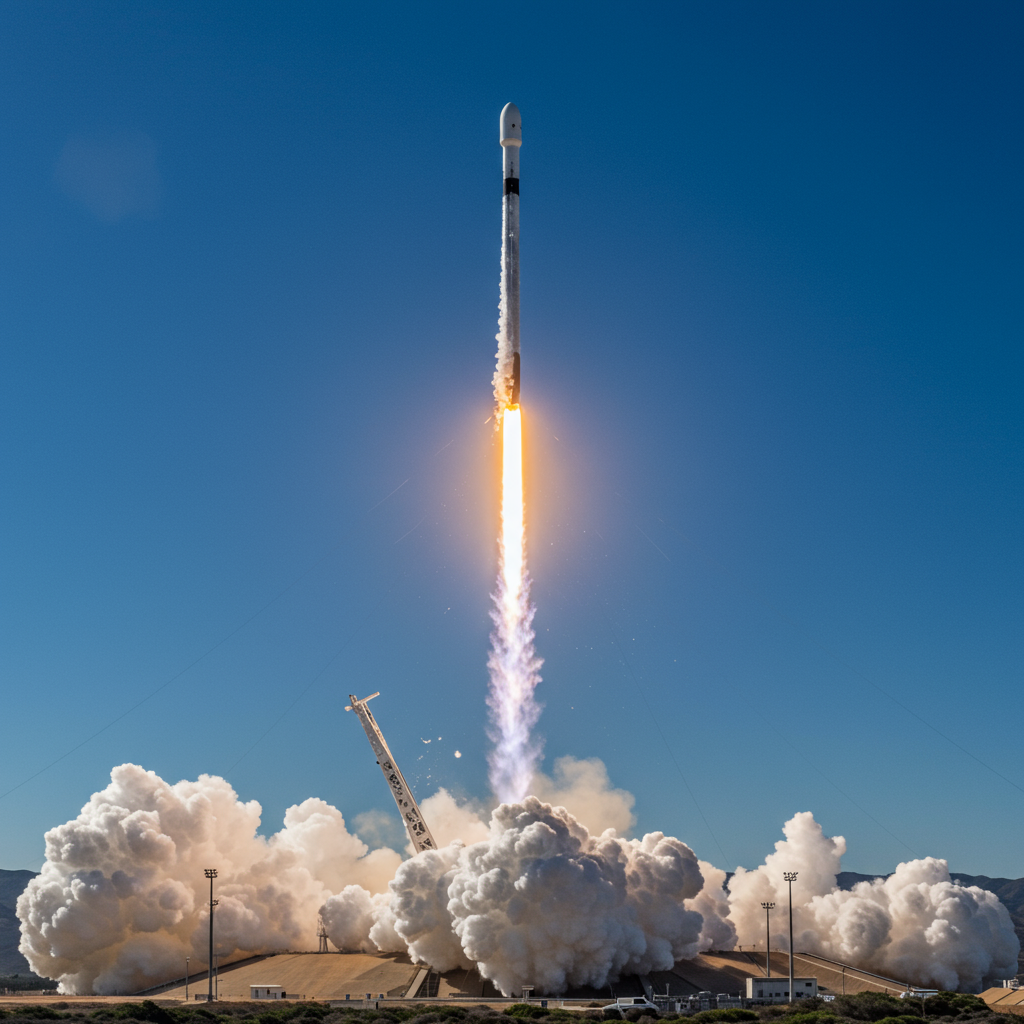
SpaceX has cemented its position as a global leader in satellite internet, achieving a monumental milestone: over 10,000 Starlink satellites now actively operating in low Earth orbit. This groundbreaking accomplishment was underscored by the Starlink Group 17-24 mission, which lifted off from Vandenberg Space Force Base in California on March 16, 2026. This launch not only expanded the already vast Starlink constellation but also celebrated the 100th anniversary of Robert Goddard’s pioneering liquid-propelled rocket flight. The relentless pace of SpaceX’s launches continues to reshape how we connect to the internet worldwide, making high-speed, low-latency access available in previously underserved regions.
A Historic Launch from California’s Coast
The Starlink Group 17-24 mission, a critical step in reaching the 10,000-satellite threshold, roared into the night sky at 10:19:09 p.m. PDT on March 16, 2026. Launching from Space Launch Complex 4 East (SLC-4E) at Vandenberg Space Force Base, the Falcon 9 rocket embarked on a southerly trajectory. This specific mission marked the 17th orbital launch from Vandenberg in 2026 alone, showcasing the operational tempo of SpaceX’s west coast facilities. The rocket carried 25 advanced Starlink V2 Mini Optimized satellites, designed to boost network capacity and performance for users globally.
The Falcon 9 first stage booster, identified as B1088, successfully completed its 14th flight during this mission. Its impressive flight history includes critical assignments for NASA (SPHEREx), two missions for the National Reconnaissance Office, and nine previous Starlink deployments. Just over eight minutes after liftoff, the booster executed a flawless return. B1088 precisely landed on the drone ship ‘Of Course I Still Love You,’ strategically positioned in the Pacific Ocean. This spectacular recovery was the 184th landing on that particular vessel and SpaceX’s 586th successful booster landing overall, further demonstrating the unmatched reusability that underpins SpaceX’s rapid launch cadence.
Starlink’s Unprecedented Global Reach and Growth
Reaching over 10,000 simultaneously active Starlink satellites in under seven years since its first deployment in May 2019 is a truly remarkable feat. This vast constellation is transforming the global internet landscape, providing vital connectivity to millions. As of February 2026, Starlink boasted over 10 million active customers across 160 countries, territories, and markets. Recent activations in places like Niue, Kuwait, and the Central African Republic highlight the network’s expanding footprint, connecting communities far beyond traditional infrastructure.
The sheer volume of SpaceX’s Starlink operations is unparalleled. In 2026, the company has maintained an astonishing average launch rate of one mission every 2.3 days. A significant portion of these launches, 26 out of 33 Falcon 9 flights this year, have been dedicated to deploying Starlink satellites. Expert orbital tracker Dr. Jonathan McDowell describes the 10,000-satellite milestone as “truly remarkable.” He emphasizes the immense technical challenge involved, noting the “tens of thousands of avoidance maneuvers a year” performed by the Starlink system to prevent collisions. This level of automated space traffic management is far beyond anything previously seen in the industry.
The Pillars of SpaceX’s Satellite Dominance
Caleb Henry, Director of Research for Quilty Space, identifies five key factors that contribute to SpaceX’s commanding lead in the satellite operator market: one financial and four technological.
- Financial Capital: SpaceX has successfully raised substantial capital, surpassing other non-government or non-internally funded constellation ventures. This financial strength provides the necessary resources for rapid development and deployment.
- Vertical Integration: The company’s unique vertical integration across launch services, satellite manufacturing, ground gateways, and user terminals is a game-changer. This end-to-end control streamlines development, reduces costs, and allows for rapid iteration.
- User Terminal Production: SpaceX’s unparalleled ability to produce user terminals at an order of magnitude higher than competitors is a critical advantage. This scale enables them to offer Starlink terminals at a remarkably low price point.
- Explosive Consumer Market: The affordable user terminals, coupled with reliable high-speed internet, have “made the consumer market explode,” according to Henry. This widespread adoption fuels further expansion and investment.
- Rapid Iteration and Learning: While not explicitly listed by Henry in the summary, SpaceX’s culture of rapid iteration and learning from every launch, including anomalies, is a significant underlying factor in their technological advancements.
Ensuring Space Safety: Lessons Learned and Future Innovations
Maintaining a constellation of over 10,000 satellites demands robust space safety protocols. SpaceX has publicly announced its own advanced Space Situational Awareness (SSA) system, dubbed ‘Stargaze.’ This innovative system utilizes star trackers on each Starlink satellite to precisely map objects in low Earth orbit. Stargaze streamlines the identification of potential collision risks and automates avoidance maneuvers, significantly enhancing space safety for all users of Earth orbit.
SpaceX’s commitment to safety was rigorously tested following an “off-nominal condition” during the Starlink 17-32 mission on February 2, 2026. While the 25 Starlink satellites were successfully deployed, an upper stage anomaly prevented the planned deorbit burn. Investigations, swiftly overseen by the Federal Aviation Administration (FAA), identified a gas bubble in the transfer tube as the cause of the failed engine ignition. Crucially, the vehicle still performed “as designed to successfully passivate the stage,” preventing it from becoming uncontrolled debris. The stage reentered Earth’s atmosphere safely hours later.
Following the anomaly, SpaceX initiated a brief stand-down, implementing technical and organizational preventative measures. Falcon 9 flights resumed just days later with the Starlink 17-33 mission on February 7, 2026, demonstrating the company’s rapid response and learning capabilities. This incident, while concerning, ultimately reinforced SpaceX’s dedication to reliability and safety. Notably, NASA confirmed that the anomaly had no impact on the safety or schedule of the Crew-12 mission, highlighting the different deorbit profiles used for crewed flights.
The Horizon: Starship and Starlink Version 3
Looking ahead, the evolution of Starlink is intrinsically linked to SpaceX’s ambitious Starship program. The company is preparing to launch significantly larger Starlink Version 3 (V3) satellites using its massive Starship rocket. While Starship V3 is still undergoing testing, Quilty Space forecasts up to eight Starship launches carrying Starlink satellites in 2026. The Starship V3 is designed to lift an unprecedented 100 metric tons to orbit. This immense capacity will unlock the full potential of the heavier V3 satellites, each engineered to offer a staggering terabit of capacity. Such advancements promise to deliver an even more robust and capable satellite internet service, pushing the boundaries of global connectivity.
SpaceX’s relentless pursuit of innovation extends beyond these major milestones. The company often conducts multiple missions simultaneously or in quick succession from different launch sites. For example, shortly after the Starlink 17-24 mission from California, another Starlink 10-46 mission was scheduled for March 17, 2026, from Cape Canaveral Space Force Station in Florida, demonstrating the staggering operational tempo and global commitment of their satellite deployment efforts.
Frequently Asked Questions
What is the significance of SpaceX reaching over 10,000 Starlink satellites?
Reaching over 10,000 active Starlink satellites in low Earth orbit marks a historic milestone for SpaceX. This immense constellation, deployed in less than seven years, signifies an unprecedented scale in commercial satellite operations. It enables Starlink to provide high-speed, low-latency internet access to millions of customers across 160+ countries, especially in remote and underserved areas. Experts like Dr. Jonathan McDowell highlight the “truly remarkable” technical challenge of managing this many satellites, including performing tens of thousands of collision avoidance maneuvers annually. This achievement solidifies Starlink’s role in transforming global connectivity.
How does SpaceX manage space debris and prevent collisions with such a large constellation?
SpaceX prioritizes space safety through several measures. They have developed an advanced Space Situational Awareness (SSA) system named ‘Stargaze,’ which uses star trackers on each satellite to map objects in low Earth orbit, enabling automated collision avoidance. Additionally, SpaceX is committed to deorbiting its upper stages whenever possible, preventing them from becoming long-term space debris. Following an upper stage anomaly in February 2026, SpaceX rapidly investigated, implemented corrective measures, and safely passivated the stage. They also develop novel methods to perform deorbit burns even on missions that traditionally lack the performance margin, demonstrating a proactive approach to space debris mitigation.
What’s next for Starlink, and how will Starship change its capabilities?
The future of Starlink is set for a massive leap with the integration of SpaceX’s Starship rocket. Starship will enable the launch of much larger and more powerful Starlink Version 3 (V3) satellites. While V3 Starship is still in testing, up to eight Starship launches carrying Starlink satellites are forecasted for 2026. The Starship V3 is designed to carry 100 metric tons to orbit, allowing for the deployment of V3 satellites, each projected to offer a groundbreaking terabit of capacity. This significant increase in capacity promises to further enhance Starlink’s internet service, pushing performance boundaries and expanding its reach even further.
The Future of Connectivity Takes Flight
The successful Starlink Group 17-24 mission from Vandenberg Space Force Base, pushing the active constellation past 10,000 satellites, represents more than just another launch; it’s a testament to SpaceX’s relentless innovation and its profound impact on global connectivity. From its rapid deployment rate to its advanced space safety protocols and ambitious plans for Starship-powered Starlink V3, SpaceX is not just launching satellites—it’s building the future of the internet, one reusable rocket flight at a time. Stay tuned as Starlink continues its journey, breaking barriers and connecting the world.