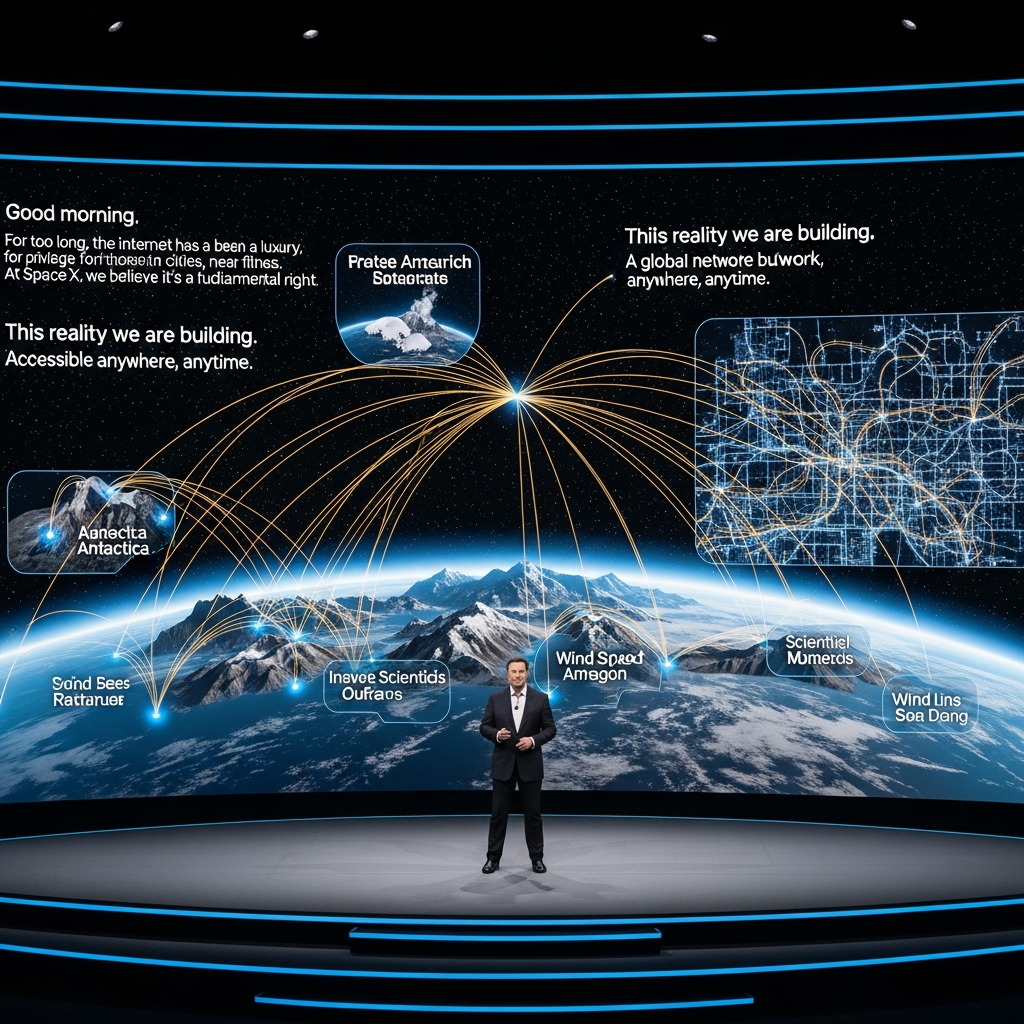
SpaceX’s Starlink project has dramatically reshaped the landscape of global internet connectivity and private spaceflight. With thousands of satellites now orbiting Earth, this ambitious initiative by Elon Musk’s company aims to deliver high-speed broadband to even the most remote corners of the planet. Recent milestones, including the launch of its 10,000th Starlink satellite, underscore an unprecedented pace of development, yet this rapid expansion also sparks critical conversations about space sustainability, astronomical research, and the inherent risks of pushing humanity’s boundaries in orbit.
The Starlink Revolution: Bridging the Digital Divide from Low-Earth Orbit
Starlink is a colossal satellite constellation operating in Low-Earth Orbit (LEO), an altitude significantly lower than traditional geostationary satellites. This proximity, typically below 1,600 kilometers, slashes signal travel time, providing a dramatically faster and more responsive internet experience. In contrast, older GEO satellites, positioned at nearly 36,000 kilometers, suffer from significant latency due to the immense signal distance. However, LEO satellites pass over any given location for only minutes, necessitating a vast network to ensure continuous service.
SpaceX formally announced the Starlink project in January 2015, following early conceptual work in the 2000s. After launching its first two test satellites in 2018 and an initial batch of 60 operational satellites in May 2019, Starlink rolled out its public beta service in November 2020. This rapid deployment reflects a core mission: to extend reliable broadband access to millions of people globally, especially those in underserved “dark zones” where traditional internet infrastructure is non-existent or unreliable. As of mid-2024, the network serves over six million users worldwide, utilizing a portable rectangular dish for connectivity.
Unprecedented Launch Cadence: A New Era of Space Access
SpaceX’s operational efficiency has set new benchmarks in the aerospace industry, largely fueled by its groundbreaking reusable rocket technology. This innovation has slashed launch costs, making the deployment of vast satellite constellations economically viable for the first time. In a significant achievement in mid-October 2025, SpaceX marked its 132nd launch of the year, setting a new annual record for the company. This mission included the deployment of its 10,000th Starlink satellite to reach orbit, a milestone celebrated during the webcast with the phrase, “From Tintin to 10,000!” The Falcon 9 rocket, departing from Vandenberg Space Force Base in California, continues to be the workhorse enabling this rapid expansion.
Currently, approximately 8,600 Starlink satellites are active, representing nearly two-thirds of all operational satellites in low Earth orbit. This exponential growth showcases SpaceX’s mastery of efficient, high-volume launches, fundamentally changing how humanity accesses and utilizes space.
Beyond Connectivity: The Broader Vision of Private Spaceflight
The ambition of SpaceX extends far beyond merely providing internet. The company has already secured regulatory approval for a total of 12,000 satellites and has filed plans for a significantly larger constellation, potentially reaching 30,000 spacecraft. This expansion hints at a future where global connectivity is ubiquitous and integrated into new services. In 2024, Starlink began testing satellites designed to offer cellular service through partnerships like the one with T-Mobile. Furthermore, SpaceX has developed a military version, Starshield, and is actively building a separate constellation of communication satellites for the U.S. government, demonstrating its diverse strategic importance.
This “space boom,” spearheaded by companies like SpaceX, heralds a new era of private spaceflight. While Starlink generates substantial revenue, the broader private sector is also pushing human space travel to new limits. The Polaris Dawn mission, launched on September 10, 2024, exemplifies this pioneering spirit. This all-civilian crew embarked on a journey to 435 miles (700 kilometers) – the highest altitude for an astronaut mission since Apollo – exposing them to substantial radiation doses. The mission notably included the first spacewalk by non-government astronauts, a perilous undertaking requiring the entire SpaceX Dragon capsule to depressurize.
The Perilous Frontier: Risks and Rewards of Space Travel
Space remains an inherently dangerous environment. History is replete with stark reminders, from the Space Shuttle Challenger (1986) and Columbia (2003) disasters, which claimed 14 lives, to a 1967 Apollo 1 launchpad fire that killed three astronauts. Even recent missions face significant challenges; two astronauts were stranded on the International Space Station longer than planned due to safety concerns with Boeing’s Starliner vehicle, citing issues like flammable tape and thruster malfunctions. The fatality rate for space travelers stands at about 3%, a figure comparable to extreme sports like solo free-climbing.
Despite these grave risks, the potential rewards are immense. Missions like Polaris Dawn conduct vital scientific research on high-radiation environments and the physiological effects of spaceflight, crucial for future deep-space exploration. Beyond scientific gains, astronauts frequently report the profound “Overview Effect” – a sense of awe and altered perspective upon viewing Earth from space. For space tourism to become truly accessible, safety standards must dramatically improve, mirroring the exponential advancements seen in aviation. Current government regulations remain light, fostering innovation but placing a heavy responsibility on private companies to prioritize safety as the industry expands.
The Dark Side of Expansion: Impact on Astronomy and Space Debris
The rapid proliferation of satellite megaconstellations, while revolutionary for connectivity, poses significant challenges for ground-based astronomy and the long-term sustainability of Earth’s orbital environment. A new international study, published in Nature, confirmed that commercially deployed satellites are as bright as the brightest stars visible to the unaided eye. This “light pollution” from reflected sunlight creates streaks across images captured by powerful observatories like the Vera C. Rubin Observatory in Chile, profoundly hindering crucial astronomical research. For instance, AST SpaceMobile’s BlueWalker 3 satellite, with its massive 693-square-foot array, was measured at a visual magnitude of 0.4 – comparable to the brightest stars.
Furthermore, the sheer number of satellites dramatically increases the risk of space collisions and the generation of orbital debris. As of June 2024, Starlink alone accounts for over 6,000 active satellites. China reported to the United Nations in 2021 that its Tianhe space station module had to perform evasive maneuvers twice to avoid Starlink satellites. Between December 2022 and May 2023, Starlink satellites executed over 25,000 collision avoidance maneuvers, a doubling from the previous six-month period.
Recognizing these challenges, operators like SpaceX are collaborating with the astronomy community to develop mitigation strategies. These include equipping satellites with anti-collision systems and designing them for natural atmospheric re-entry after a few years to reduce long-term debris. Newer generations of Starlink satellites also incorporate low-reflectivity films on solar arrays to minimize reflected light, though the scale of the challenge necessitates ongoing and urgent solutions.
The Future Trajectory: Balancing Innovation with Responsibility
The ongoing expansion of SpaceX Starlink marks a pivotal moment in human history, democratizing internet access while simultaneously propelling the private space industry forward. Yet, this progress is not without its complexities. The drive for global connectivity, scientific discovery, and human exploration must be carefully balanced with environmental stewardship of Earth’s orbit and the protection of scientific endeavors like ground-based astronomy. As reusable rockets continue to lower the cost of space access, the imperative grows for robust international collaboration on regulatory frameworks and innovative solutions to ensure a sustainable and accessible space environment for future generations.
Frequently Asked Questions
What is the primary purpose of SpaceX Starlink, and how does it work?
SpaceX Starlink’s main objective is to provide high-speed, low-latency broadband internet service globally, with a particular focus on extending connectivity to rural and underserved regions. It achieves this using a vast “megaconstellation” of thousands of small satellites operating in Low-Earth Orbit (LEO), typically below 1,600 kilometers. Unlike traditional geostationary satellites that are much farther away and cause significant signal delay, LEO satellites orbit closer to Earth, enabling faster communication. Users connect to the network via a specialized, portable dish that communicates directly with the passing satellites.
What are the main concerns surrounding the expansion of Starlink and other megaconstellations?
The rapid growth of Starlink and similar satellite megaconstellations raises two primary concerns. Firstly, their increasing brightness, caused by reflected sunlight, significantly impacts ground-based astronomy. These bright satellites can create streaks across telescope images, interfering with crucial scientific research. Secondly, the sheer number of satellites dramatically escalates the risk of space collisions and the creation of orbital debris. These fragments pose a long-term threat to active satellites and future space missions. SpaceX is working on mitigation efforts like anti-collision systems and low-reflectivity coatings, but the challenge remains substantial.
How does Starlink compare to traditional satellite internet, and who benefits most from its service?
Starlink offers significant advantages over traditional satellite internet, primarily due to its Low-Earth Orbit (LEO) design. This results in much lower latency (faster response times) and higher speeds compared to older systems using geostationary (GEO) satellites. Consequently, Starlink is better suited for activities requiring quick data transfer, such as online gaming, video conferencing, and general web browsing. The service most benefits individuals and communities in remote or rural areas where terrestrial broadband infrastructure is inadequate or nonexistent, effectively bridging the digital divide for millions of users worldwide.