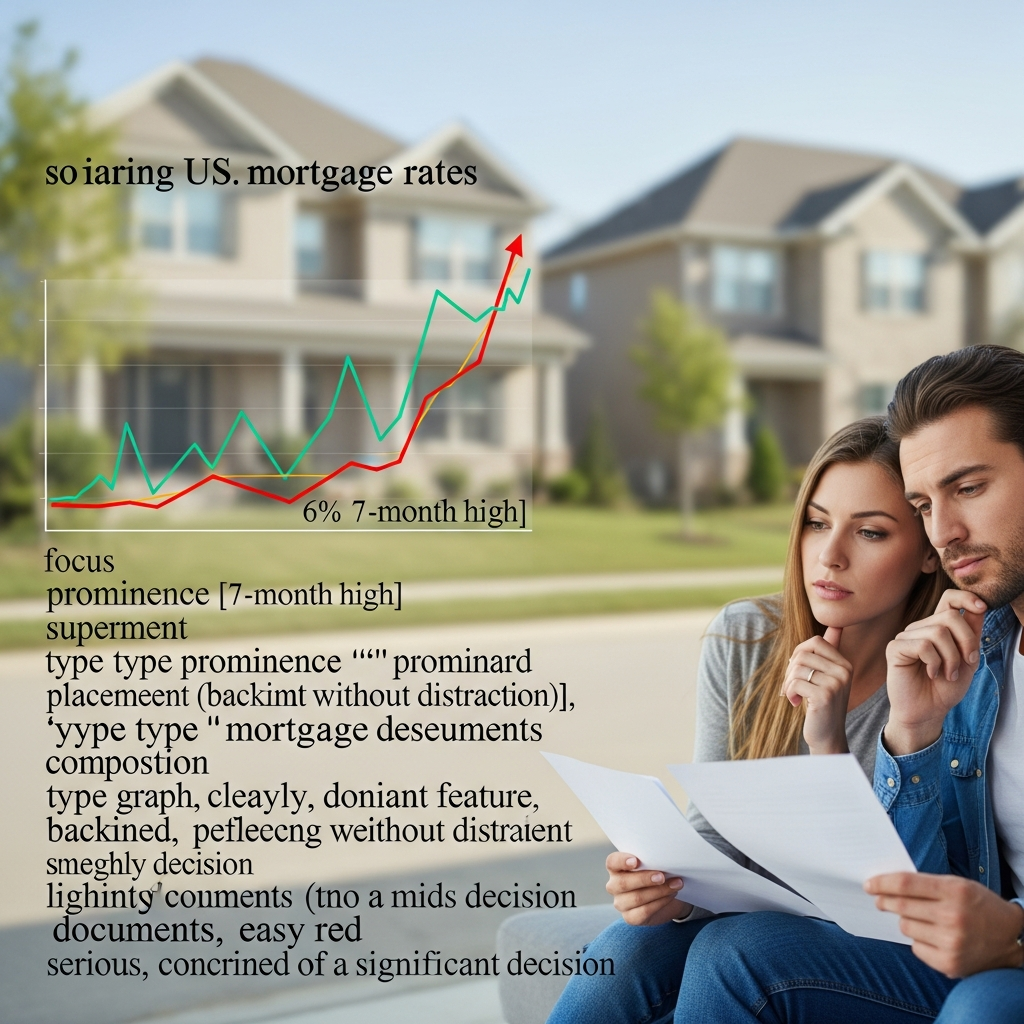
The American housing market is experiencing a significant shift as US mortgage rates recently climbed to their highest point in seven months. This latest surge, pushing the average long-term fixed rate above 6%, marks a pivotal moment for both prospective homebuyers and those considering refinancing. Understanding the intricate factors driving these rates—from global geopolitics to Federal Reserve policy—is crucial for navigating today’s dynamic real estate landscape. This comprehensive guide synthesizes expert analysis and forecasts to help you make informed decisions.
The Latest Surge in US Mortgage Rates
The average long-term US mortgage rate has recently reached 6.11% for a 30-year fixed loan, according to Freddie Mac. This represents an uptick from 6% just a week prior and significantly impacts borrowing costs across the nation. For comparison, the average rate one year ago stood at 6.65%, while it had dipped to its lowest in three and a half years just a few weeks before this recent climb. Other sources, like Optimal Blue, report the average 30-year fixed-rate conforming mortgage at 6.060% as of March 12, 2026, slightly higher than the previous week.
This upward movement brings rates back to levels not seen in roughly seven months, creating a challenging environment for many. Borrowing costs for 15-year fixed-rate mortgages, often favored by those looking to refinance, also increased to 5.5% from 5.43% last week. These fluctuations highlight the sensitive nature of the bond market and its direct influence on mortgage pricing.
Unpacking the Forces Behind the Climb
Several interconnected factors are contributing to the recent escalation in interest rates. A primary driver is the ongoing volatility in the bond market, particularly concerning the 10-year U.S. Treasury note yield. This yield, which lenders use as a benchmark for pricing home loans, climbed to 4.25% at midday Thursday, up from 4.13% a week earlier.
Geopolitical events, specifically the war with Iran, have ignited fears of higher inflation. Rising oil prices, a direct consequence of global instability, threaten to fuel inflation, which could deter the Federal Reserve from implementing anticipated rate cuts. While the Fed does not directly set mortgage rates, its decisions on the federal funds rate indirectly influence the 10-year Treasury yield, thereby impacting home loan costs. Financial market volatility from the Middle East appears to be overriding other economic indicators, such as unexpectedly weak hiring reports or stable consumer inflation snapshots, that would typically exert downward pressure on rates. Historically, the “spread” between the 10-year Treasury yield and the 30-year fixed mortgage rate has also been a key determinant, widening post-2022 due to the Fed’s quantitative tightening (QT) program.
Navigating Today’s Challenging Housing Market
The current surge in US mortgage rates compounds the difficulties in a housing market still reeling from the downturn that began in 2022. Sales of previously occupied U.S. homes have lingered near a 4-million annual pace since 2023, significantly below the historical norm. Last year saw sales plunge to a 30-year low, with activity remaining sluggish even as rates were somewhat lower earlier this year.
A significant hurdle for the market is the “lock-in effect,” where many existing homeowners are reluctant to sell. Having secured remarkably low interest rates during the pandemic era (some below 3%), they are unwilling to exchange these favorable terms for a new mortgage at significantly higher current rates. This phenomenon constrains the supply of available homes, despite a slight improvement in unsold inventory.
Home Prices and Regional Variations
National home price appreciation has substantially decelerated, with the S&P CoreLogic Case-Shiller U.S. National Home Price Index showing a modest 1.3% year-over-year gain in December 2025. Other data points to an even lower national year-over-year gain of 0.2% through January 2026. This means inflation has recently outpaced home price growth, narrowing real gains for owners.
However, the national average masks significant regional differences. While cities like New York, Chicago, Cleveland, and Milwaukee have recorded gains between 3.5-5.0%, once-booming markets such as Miami, Tampa, and Austin have seen price drops of 4.6-6.0%. This divergence underscores the importance of local dynamics in today’s market. The challenge of affordability remains acute, especially for first-time buyers whose ability to qualify for a median-priced home has plummeted.
What the Mortgage Rate Forecasts Say for the Future
For many, the critical question is where US mortgage rates are headed next. While the recent climb to seven-month highs creates immediate concern, expert forecasts provide a longer-term perspective. An AI-driven forecast, combining economic projections with advanced AI analysis, suggests that while rates have fluctuated, their long-term trajectory is heavily influenced by the 10-year U.S. Treasury note yield and the “spread” between this yield and the 30-year fixed mortgage rate.
Near-Term Outlook: Stability with Geopolitical Risks
Before the latest jump, mortgage rates had generally hovered around 6% throughout the current year, which was seen as an encouraging sign for prospective home shoppers entering the spring season. However, the recent increase to 6.11% demonstrates the market’s vulnerability to external shocks. Geopolitical tensions, like the conflict in the Middle East, can swiftly override domestic economic signals, pushing rates higher and creating uncertainty. This emphasizes that short-term rate movements can be highly unpredictable.
Long-Term Projections: Through 2030 and Beyond
Looking further ahead, experts generally agree that a return to the sub-3% mortgage rates seen in 2020-2021 is highly unlikely without another drastic, unforeseen economic event like a major recession or global pandemic. Based on a consensus forecast compiled from Deloitte, Goldman Sachs, and the Congressional Budget Office (CBO), and refined by AI, the base case scenario predicts mortgage rates to be around 6% in 2027.
However, alternative scenarios exist:
Bull Case (Soft Landing): If the Federal Reserve successfully manages inflation and achieves a soft landing, with gradual rate cuts through 2027, the 30-year fixed mortgage rate could settle near 5.00% by 2030. This scenario assumes a normalization of the MBS spread to its historical average.
Bear Case (Persistent Inflation): Should inflation remain stubbornly above 2.5% and U.S. fiscal deficits increase, the 10-year Treasury yield could stay elevated. In this scenario, mortgage rates might climb towards 7.00% by 2027 before easing slightly to 6.60% by 2030.
These projections highlight the significant margin of error in long-range forecasts, which depend heavily on economic stability, Fed policy, and geopolitical developments.
Strategies for Prospective Homebuyers and Refinancers
In a market marked by rising US mortgage rates and fluctuating conditions, strategic planning is paramount for anyone looking to buy or refinance. With a 30-year conventional mortgage rate hovering around 6.00% to 6.11%, securing a rate slightly above 6.00% is considered good, while anything below 6.00% is “really good,” according to market analysts.
Smart Shopping for Your Best Mortgage Rate
One of the most actionable steps you can take is to comparison shop. This means exploring two key areas:
Different Mortgage Types: Research various loan options such as conventional loans (best for excellent credit), FHA loans (accessible for lower credit scores due to Federal Housing Administration insurance), VA loans (no minimum down payment for military members, veterans, and spouses), and USDA loans (for low-to-moderate-income borrowers in eligible rural areas). Each offers unique benefits and qualification criteria.
Different Lenders: Freddie Mac research indicates that comparing offers from multiple lenders can save homebuyers an estimated $600 to $1,200 annually, particularly in high-interest rate environments. This is a crucial step that many overlook.
Remember, the interest rate is distinct from the Annual Percentage Rate (APR); the APR includes interest plus applicable fees, making it a more comprehensive measure of your borrowing cost.
Understanding Loan Costs and Affordability
The impact of mortgage rates on monthly payments and overall costs is substantial. For example, a $300,000 loan at 6.060% over 30 years would accrue approximately $351,687 in interest alone. Shortening the term to 15 years at 5.405% drastically reduces interest paid to around $138,507.
The National Association of Realtors (NAR)’s Housing Affordability Index also provides a stark reminder of the challenges. This index, which measures if typical household income is sufficient to qualify for a median-priced home, has plummeted for first-time buyers. Even slight decreases in mortgage rates can significantly lower the qualifying income needed, making rate movements especially critical for this group.
Political Efforts and Their Potential Impact
The issue of housing affordability has also entered the political arena. In a move to address high housing costs and limited supply, President Donald Trump signed executive orders aimed at tackling these concerns ahead of midterm elections. These orders focus on reducing federal housing regulatory burdens and incentivizing state and local governments to streamline construction processes.
The administration aims to cut “layers of unnecessary regulatory barriers, slow permitting processes, and onerous mandates,” which are blamed for inflating housing costs. Key federal agencies are directed to review and update or eliminate regulations, with White House officials citing Biden-era energy efficiency mandates as potentially adding up to $9,000 to housing construction costs. Another executive order seeks to simplify the mortgage process, directing the Consumer Financial Protection Bureau (CFPB) to modify guidelines to facilitate lending by smaller community banks and update Home Mortgage Disclosure Act requirements. The theory is that these changes could boost competition among lenders and reduce borrowing costs.
However, the political landscape reveals a tension: while there’s a desire to boost homeownership for new buyers, there’s also an aim to protect the financial interests of existing property owners. This can sometimes lead to contradictory stances on aggressively increasing housing supply, which could depress home values.
Frequently Asked Questions
Why did US mortgage rates recently climb to seven-month highs?
US mortgage rates recently climbed to seven-month highs, with the 30-year fixed rate reaching 6.11%, primarily due to heightened jitters in the bond market. Geopolitical tensions, particularly the war with Iran, have driven rising oil prices. These higher oil prices fuel inflation fears, which, in turn, lead to increased Treasury yields. Since mortgage rates typically mirror the 10-year Treasury yield, this creates upward pressure on home loan costs. This current geopolitical influence is overriding other economic signals that might otherwise lead to lower rates.
What mortgage rate should I consider “good” in today’s market, and how can I find the best one?
In March 2026, with the average 30-year conventional mortgage rate around 6.00% to 6.11%, securing a rate slightly above 6.00% is generally considered “good.” Anything below 6.00% is often described as “really good.” To find the best mortgage rate, it’s crucial to comparison shop by exploring different loan types (e.g., conventional, FHA, VA, USDA) that align with your financial profile. Additionally, obtain quotes from at least three to five different lenders, as research suggests this can save homebuyers hundreds, even thousands, annually.
What are the long-term forecasts for US mortgage rates through 2030?
Long-term forecasts, including AI-driven analyses, indicate that US mortgage rates are unlikely to return to the ultra-low 3% levels seen during the pandemic without another significant economic crisis. The base case prediction suggests mortgage rates will hover around 6% in 2027. A bull case scenario, assuming a “soft landing” and gradual Fed rate cuts, could see rates near 5.00% by 2030. Conversely, a bear case, with persistent inflation and fiscal pressures, could push rates toward 7.00% by 2027 before settling around 6.60% by 2030.
Conclusion
The recent ascent of US mortgage rates to seven-month highs underscores the complex and often unpredictable nature of the housing market. Driven by a confluence of geopolitical events, inflation concerns, and bond market dynamics, these higher borrowing costs present both challenges and opportunities. While the overall housing market faces headwinds from reduced affordability and the “lock-in effect,” proactive strategies like diligent comparison shopping and understanding the long-term forecasts are vital for navigating this environment. As the Federal Reserve’s future actions and global events continue to shape the financial landscape, staying informed and planning thoughtfully will empower you to make the most advantageous decisions for your homeownership journey.