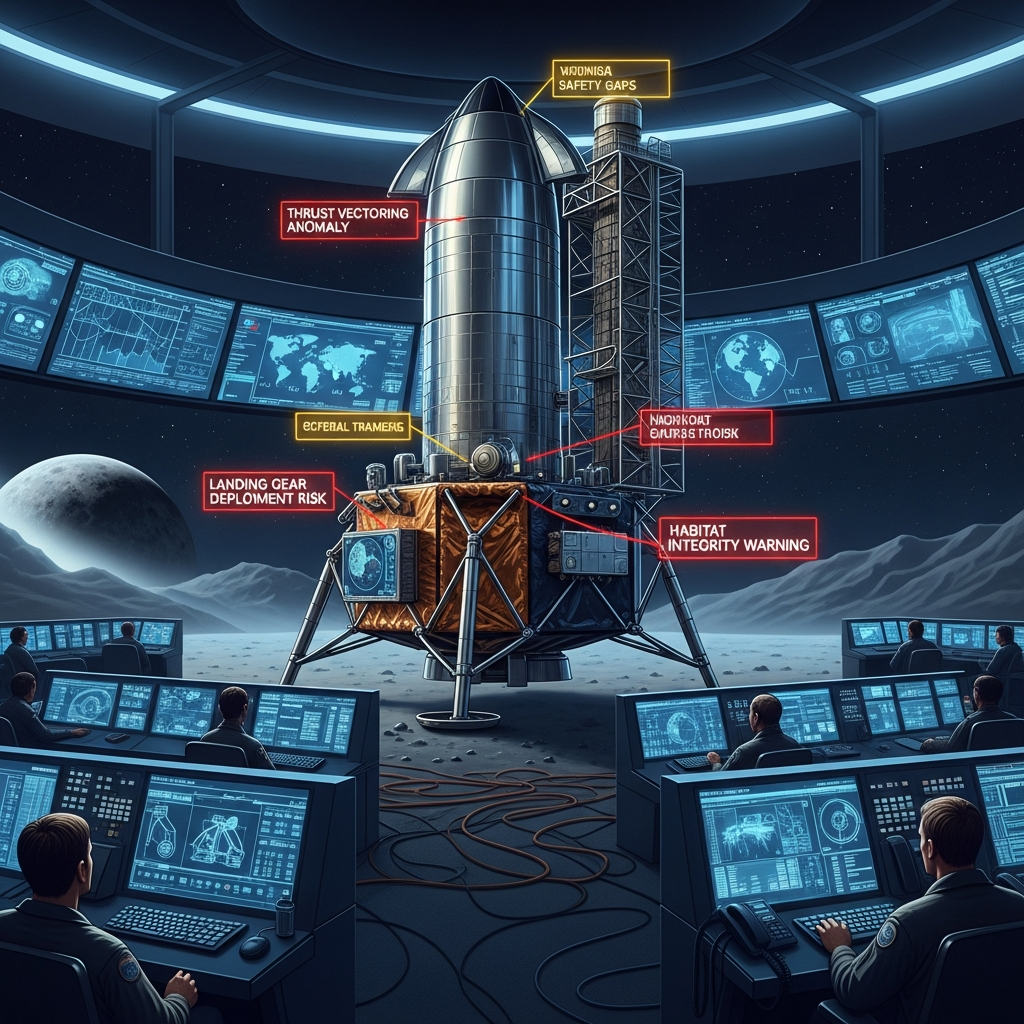
NASA’s ambitious Artemis program aims to return humans to the Moon, but a recent report from the agency’s Office of Inspector General (OIG) has revealed significant “gaps” in how NASA manages the inherent risks of upcoming lunar missions. The OIG’s assessment highlights crucial deficiencies, particularly concerning the safety protocols and testing for the advanced human landing systems (HLS) being developed by SpaceX and Blue Origin. This audit underscores that, much like the Apollo era, NASA currently lacks the ability to rescue a stranded crew in a life-threatening emergency on the lunar surface or in space, raising serious questions about astronaut survival and overall mission readiness.
Critical Flaws in Lunar Lander Risk Management Identified
The OIG report, released recently, acknowledges NASA’s efforts to mitigate hazards associated with the next-generation lunar landers. However, it strongly emphasizes that the agency’s approach still contains major shortcomings. These include insufficient planned tests for some critical lander systems and incomplete analyses of potential crew survival scenarios. Specifically, the OIG noted a lack of clear strategies for what might happen after a catastrophic, yet non-fatal, incident during a lunar mission. This comprehensive examination by the OIG comes at a pivotal time as NASA pushes forward with its complex Artemis initiative, which has already seen significant schedule adjustments.
Artemis II Mission Faces Delays and Technical Hurdles
The foundational Artemis II mission, a crewed journey around the Moon and back, continues to experience delays. Initially slated for early February, the nine-day flight, carrying four astronauts aboard the Orion capsule “Integrity,” is now targeting a launch around April 1. These postponements stem from persistent hydrogen propellant leaks and, more recently, issues with the upper stage propellant pressurization system. Resolving these technical challenges required NASA to move the Space Launch System (SLS) rocket back to its processing hangar for repairs. With these issues reportedly fixed, NASA is gearing up for a flight readiness review, aiming to roll the SLS rocket back to Kennedy Space Center’s pad 39B by March 19 or 20 for final launch preparations.
A Major Overhaul: Reshaping the Artemis Program
In a significant strategic shift, NASA announced a major overhaul of the Artemis program on February 27. The revised plan now includes an additional Artemis III mission next year. This mission will involve an Orion capsule performing critical rendezvous and checkout operations in Earth orbit with one or both of the human landing systems currently under development. Building on lessons learned, NASA now aims for two lunar-landing missions in 2028. These crewed landings will only proceed if the landers are deemed ready and will be preceded by comprehensive unpiloted test flights to ensure their operational capabilities.
OIG Report’s Context: Prior to Program Revisions
It is important to note that the OIG report was finalized before this revised mission architecture was publicly announced by NASA Administrator Jared Isaacman. Consequently, the OIG’s initial assessment predominantly focused on SpaceX’s Starship HLS, which was originally slated for the first two Artemis Moon landings. Under the updated plan, NASA intends to deploy whichever lander, SpaceX’s or Blue Origin’s, is fully ready when needed. This flexibility underscores the complexity and challenges inherent in developing these groundbreaking lunar vehicles.
SpaceX Starship HLS: Unprecedented Engineering Challenges
SpaceX’s human landing system is a modified variant of its towering Starship vehicle, typically the second stage of the massive Super Heavy-Starship rocket. To reach the Moon, this 171-foot-tall HLS requires an incredibly intricate orbital refueling process. An estimated 10 to 20 Starship tanker flights are needed to fill a propellant depot ship in low-Earth orbit. This depot will then autonomously refuel the HLS before it embarks on its journey to lunar orbit, awaiting the Orion crew.
This scale of orbital refueling has never been attempted. A significant unknown is how SpaceX plans to mitigate the constant loss of cryogenic propellants due to warming and evaporation, a phenomenon known as boil-off. Furthermore, landing the colossal Starship HLS near the Moon’s rugged South Pole presents unique hazards. The OIG highlighted that the region’s steep slopes, some reaching 20 degrees, exceed NASA’s required 8-degree tilt tolerance for landers. Given Starship’s immense height—equivalent to a 14-story building—there is a tangible risk it could tip over upon landing, a critical safety concern.
The Elevator Dilemma: A Top Risk for Starship Crews
Adding to the operational complexities, crew access for Starship HLS involves a unique external elevator. Astronauts will have to descend approximately 115 feet, roughly 10 stories, down the side of the rocket to reach the lunar surface. While seemingly a minor engineering detail compared to orbital refueling, program managers view this elevator as a significant safety risk. The OIG explicitly stated that “currently, there is no other method for the crew to enter the vehicle from the lunar surface in the event of an elevator failure.” NASA mandates “single failure tolerance” for catastrophic events, meaning a system should sustain a single failure without impacting the design goal. SpaceX is developing a robust design with redundancies, but the HLS program is actively tracking this elevator system as a top risk and working with SpaceX to develop alternate ingress/egress methods.
Blue Origin’s Blue Moon: Shared Hurdles and Unique Features
Blue Origin’s Blue Moon lander, while significantly shorter at 53 feet tall, faces similar challenges, particularly regarding orbital refueling in Earth orbit. Like Starship, it will require tanker flights to top off its propellant tanks before its journey to the Moon and again in lunar orbit before descending to the surface with astronauts. Blue Moon also confronts landing risks at the lunar South Pole, including the possibility of exceeding its tilt tolerance. Such an event could compromise critical crew functions, such as operating the hatch for entry and exit. In contrast to Starship’s elevator, Blue Moon features stairs for crew access, allowing astronauts to reach the surface from six feet below the hatch.
Understanding the Odds: Artemis vs. Apollo and Shuttle
The OIG report puts the crew loss risk for Artemis into historical perspective. The established loss-of-crew threshold for the first two Artemis moon landings is projected to be 1-in-40 for lunar operations and 1-in-30 overall, from launch to splashdown. For comparison, Apollo astronauts faced approximately 1-in-10 odds of crew loss, while Space Shuttle missions, tragically, experienced an actual 1-in-70 risk. These figures highlight the enduring dangers and the critical importance of robust safety protocols in human spaceflight.
Before any astronauts embark on crewed lunar landings, both the Starship HLS and Blue Moon landers will undergo rigorous unpiloted test flights in lunar orbit. These exhaustive tests are essential to verify their operational readiness and ensure astronaut safety. The primary landing sites near the Moon’s South Pole, chosen for their potential water ice resources, present far more severe challenges than the relatively flatter equatorial regions explored by Apollo crews, further emphasizing the need for comprehensive testing and risk mitigation strategies.
Systemic Programmatic Challenges and Costs
Beyond lander-specific risks, the OIG has consistently highlighted broader programmatic challenges within NASA’s Artemis endeavors. Earlier reports, such as one from 2020 focusing on the Space Launch System (SLS) rocket, indicated significant cost overruns and schedule delays. That report projected SLS costs to exceed $18 billion by its maiden flight, with potential to reach nearly $23 billion if Artemis II slipped to 2023. This historical context of cost and schedule pressures, often driven by technical problems, evolving requirements, and contractor performance issues, underscores the intricate and often difficult balance NASA must strike between ambitious goals and rigorous safety and budget management.
Similarly, other lunar initiatives like the Commercial Lunar Payload Services (CLPS) program, which supports Artemis, have also seen delays. For example, Astrobotic’s Griffin-1 mission, intended to deliver NASA’s VIPER rover, faced multiple postponements, eventually switching its primary payload and targeting a July 2026 launch. These examples illustrate the pervasive developmental hurdles and cost escalations common in pioneering space exploration projects, reinforcing the OIG’s critical role in scrutinizing NASA’s management practices across the board.
Frequently Asked Questions
What are the main safety concerns identified by the OIG for Artemis moon landers?
The OIG report identified several critical safety concerns for Artemis moon landers. These include significant “gaps” in NASA’s risk management approach, particularly insufficient testing of critical lander systems, and incomplete crew survival analyses for potential catastrophic but non-fatal events. A major concern highlighted is NASA’s current inability to rescue a stranded crew on the lunar surface or in space, mirroring a challenge from the Apollo era. Specific lander risks include the tipping hazard for SpaceX’s 171-foot-tall Starship HLS on steep South Pole slopes and the lack of alternative egress for its external elevator. Blue Origin’s Blue Moon also faces tilt tolerance issues affecting crew functions.
How has NASA’s Artemis program timeline and lander strategy changed recently?
NASA announced a major overhaul of the Artemis program on February 27. The updated plan now includes an additional Artemis III mission next year, where an Orion capsule will conduct rendezvous and checkout operations with a human landing system (HLS) in Earth orbit. Instead of directly moving to crewed lunar landings, NASA now aims to launch two lunar-landing missions in 2028, which will be preceded by unpiloted test flights of the landers. This revised strategy offers more flexibility, with NASA planning to use whichever HLS (SpaceX’s Starship or Blue Origin’s Blue Moon) is ready when needed.
What unique engineering challenges do SpaceX’s Starship HLS and Blue Origin’s Blue Moon face for lunar landings?
SpaceX’s Starship HLS, at 171 feet tall, faces unique challenges including the need for 10-20 Starship tanker flights for orbital refueling, a process never before attempted at this scale, and managing cryogenic propellant boil-off. Its immense height also poses a tipping risk on the lunar South Pole’s steep slopes (up to 20 degrees). A top safety risk is the 115-foot external elevator for crew access, as there’s currently no alternative ingress/egress if it fails. Blue Origin’s 53-foot Blue Moon also requires complex orbital refueling and faces tilt tolerance issues impacting critical crew functions. Both landers must navigate the rugged South Pole terrain, which is significantly more challenging than Apollo’s equatorial landing sites.
The Path Ahead: Prioritizing Safety in Lunar Exploration
The OIG’s latest assessment provides a crucial, candid look at the challenges facing NASA’s Artemis program. While the agency is making strides, these identified gaps in Artemis moon lander safety and NASA’s moon lander risk management highlight the immense complexities of returning humans to the Moon. The success of future lunar missions, and indeed the lives of astronauts, hinges on NASA’s ability to rigorously address these concerns, strengthen its testing posture, and develop comprehensive crew survival and rescue capabilities. As the program evolves, a steadfast commitment to overcoming these engineering and safety hurdles will be paramount to realizing humanity’s enduring dream of deep space exploration.