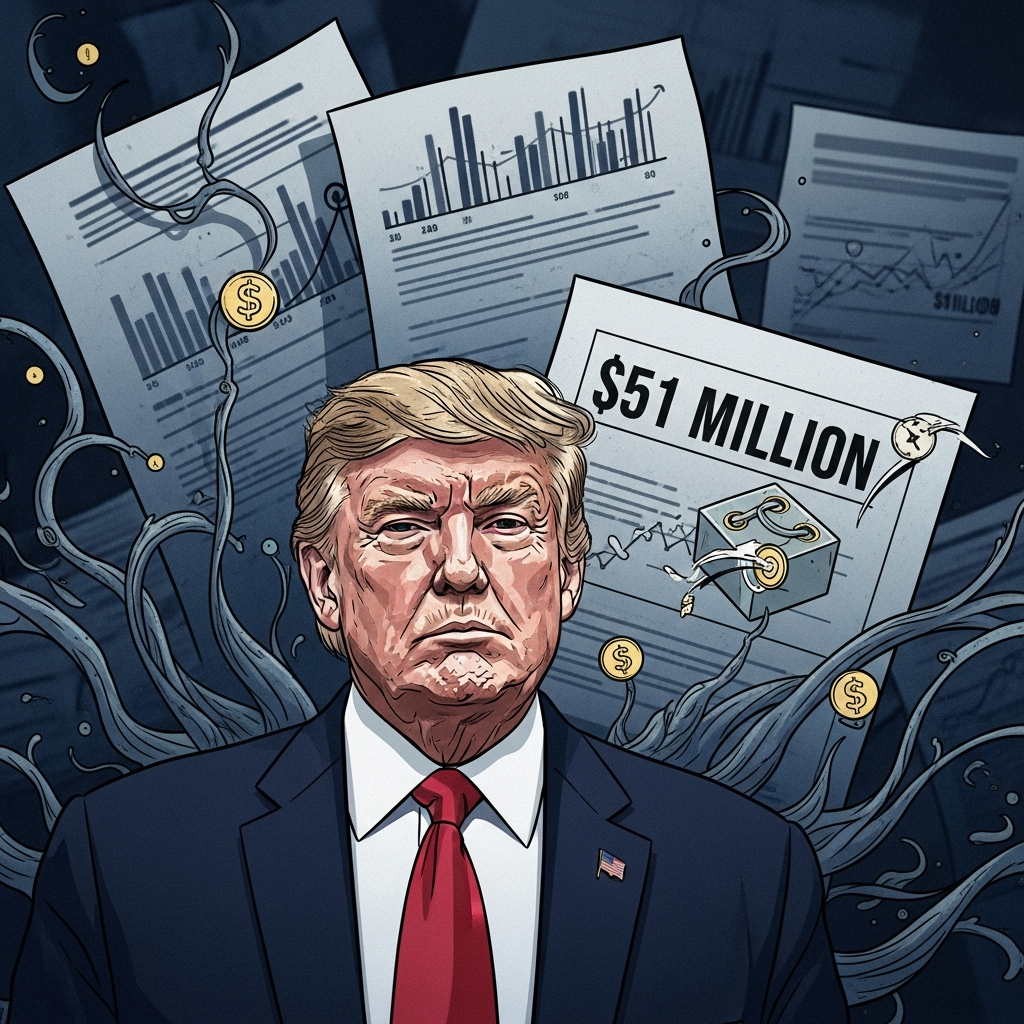
New White House disclosures have unveiled a substantial financial move by President Donald Trump. These recent filings detail an aggressive investment spree, with bond acquisitions totaling at least $51 million. This significant portfolio expansion, encompassing a diverse range of corporate and municipal debt, immediately raises fresh questions. The scrutiny is particularly sharp regarding potential conflicts of interest. This deep dive explores the specifics of these presidential investments and their broader implications for ethical governance.
Unpacking President Trump’s Multi-Million Dollar Investment Spree
Financial reports released by the US Office of Government Ethics paint a clear picture of an active investment strategy. These documents cover a series of transactions from late last year, specifically while President Trump was in office. Between November 14 and December 29, President Trump reportedly made 189 distinct purchases. These acquisitions alone totaled a minimum of $51 million.
Earlier in his term, March disclosures also pointed to significant bond acquisitions. These earlier investments amounted to at least $51 million, further expanding his portfolio. Federal reporting rules mean transaction values are often provided in broad ranges. This makes precise figures difficult to ascertain from the documents. However, the aggregate maximum value of all acquired assets through these numerous transactions could reach approximately $161 million. This reveals a continuous and substantial financial strategy pursued during his presidency.
A Diverse Portfolio: Beyond Public Debt
President Trump’s bond portfolio is remarkably diverse, spanning various sectors and governmental levels. A major portion of these recent investments targeted municipal bonds. These bonds are vital instruments for public finance, issued by numerous governmental or quasi-governmental entities. Such entities include states, counties, cities, local school districts, utilities, and hospitals. These investments help fund essential local services and often come with tax advantages, making them attractive to investors.
Beyond public debt, corporate bonds form another key segment of his holdings. President Trump acquired positions in several prominent corporations across diverse industries. These include tech giant Netflix, industrial leader Boeing, and automotive powerhouse General Motors. Other notable corporate bond investments were in Occidental Petroleum, United Rentals, and CoreWeave, a cloud computing firm. These corporate holdings touch key economic sectors, specifically energy, technology, financial services, and defense industries. The portfolio also extends to an exchange-traded fund (ETF) specifically linked to the high-yield bond market. This showcases a broad strategy across different risk and return profiles.
The Ethical Quandary: No Blind Trust in Sight
The sheer scale and nature of these presidential investments immediately sparked significant ethical debates. A central issue is President Trump’s continued operation without the use of a blind trust. A blind trust is a critical mechanism designed to prevent conflicts of interest for public officials. It involves placing personal assets under the management of an independent trustee. The trustee makes all investment decisions without the owner’s knowledge or input. This separation shields officials from any direct influence, ensuring policy decisions are based solely on the public interest.
By contrast, President Trump retains direct knowledge of his portfolio. This means he knows exactly which companies and sectors he is invested in. Critics argue this creates an inherent conflict, as his administration’s policies could directly impact his personal wealth. White House officials have offered explanations, stating that independent financial managers handle the trades. These managers purportedly use index-replicating programs to manage the portfolio. Furthermore, both earlier and subsequent filings reportedly received approval from the Office of Government Ethics. Yet, the core concern persists. A president aware of his specific holdings faces ongoing scrutiny. His personal financial interests may intersect directly with his official duties, fueling public and market unease.
Policy and Portfolio: Direct Links to Official Actions
The connection between President Trump’s investments and his policy agenda is particularly striking and has drawn close attention. Reports highlight instances where his official actions or statements align closely with his personal holdings. For example, he has actively promoted Boeing aircraft during international trips. This promotion directly benefits a company in which he holds significant bonds.
Similarly, he has lauded General Motors’ decisions to move production of certain Chevrolet models. He specifically cited their plans to return production from Mexico back to the U.S. This move supported his protectionist tariff policies while also positively impacting a company in his portfolio. Perhaps the most scrutinized situation involves Netflix, a company in which President Trump holds bonds. Netflix is currently embroiled in a contested effort linked to Warner Bros. Discovery, which has prompted an antitrust review. President Trump has publicly stated his intention to become personally involved in this antitrust review.
An intervention from the highest office could send major regulatory signals. Such signals could significantly sway market perceptions and directly affect the value of his investments. These examples underscore a unique intersection. Presidential policy and personal financial interests appear to converge, demanding close monitoring by investors and the public. This raises fundamental questions about governance integrity and the impartiality of executive decisions.
The Precedent Set: Ongoing Scrutiny and Transparency Challenges
These recent disclosures are not isolated incidents but rather fit into a broader pattern observed throughout President Trump’s public life and his tenure in office. His financial activities have consistently drawn scrutiny. Earlier filings, such as one in August, detailed 690 transactions amounting to at least $104 million. With the additional activity in November and December, the combined disclosed investment amount has risen to at least $106 million. This excludes three other sales totaling $2 million. This aggressive and continuous financial activity showcases a strategy of personal wealth building. It often appears to blend personal business with official responsibilities.
The absence of a blind trust remains a focal point of this debate. It implies he maintains direct knowledge and potential influence over assets that could be affected by his administration’s policies. For federal elected officials, financial transparency is mandatory. Such reports aim to ensure public trust and help detect potential conflicts of interest. However, the specific details within these filings continually spark ongoing ethical questions. The balance between personal finance and public duty remains a contentious area, with these disclosures continuing to fuel discussions about the boundaries of presidential conduct.
Frequently Asked Questions
What types of bonds did President Donald Trump invest in recently, according to new disclosures?
Recent financial disclosures reveal President Donald Trump diversified his portfolio significantly during his term. He invested heavily in both municipal and corporate bonds. Municipal bonds were issued by various public entities, including American cities, local school districts, utilities, and hospitals. His corporate bond acquisitions spanned major companies such as Netflix, Boeing, General Motors, Occidental Petroleum, United Rentals, and CoreWeave. Additionally, he invested in an exchange-traded fund (ETF) focused on the high-yield bond market. This broad range covers multiple economic sectors.
Why are these financial disclosures raising concerns about potential conflicts of interest for President Trump?
Concerns about potential conflicts of interest arise primarily because President Trump manages his personal wealth without placing it into a blind trust. This means he has direct knowledge of his investments. Critics argue this situation allows his policy decisions and official statements to potentially influence the value of his personal portfolio. Specific instances cited include his promotion of Boeing aircraft and his public comments regarding GM production shifts. His declared intent to intervene in a Netflix antitrust review further fuels these concerns, as presidential intervention could directly impact his holdings.
How do presidential financial disclosures inform the public and ensure ethical conduct in governance?
Presidential financial disclosures are a mandatory transparency mechanism for all federal officials, including the President. They provide the public with critical insight into an official’s personal financial activities. The primary goal is to monitor for, and prevent, potential conflicts of interest. By revealing investments, sources of income, and liabilities, these reports allow for public scrutiny, helping to ensure that officials prioritize public duty over personal gain. While they disclose transactions, the ongoing debate often centers on how these activities are managed, particularly the use of blind trusts to avoid even the appearance of impropriety.
Conclusion
President Donald Trump’s extensive bond investment spree, totaling at least $51 million and potentially far more, illuminates a complex intersection. It highlights the convergence of personal finance, presidential power, and public ethics. The detailed financial disclosures provide a rare glimpse into a president’s active wealth management strategy during his tenure. However, they simultaneously intensify scrutiny regarding potential conflicts of interest. The continued absence of a blind trust remains a central point of contention. It directly links presidential policy decisions to personal financial outcomes, drawing a spotlight onto governance integrity. As these disclosures continue, the public, financial markets, and ethics watchdogs will undoubtedly maintain a close watch. Ensuring transparency and upholding the integrity of public office remains paramount. This ongoing narrative underscores the critical importance of clear ethical boundaries in leadership and accountability.