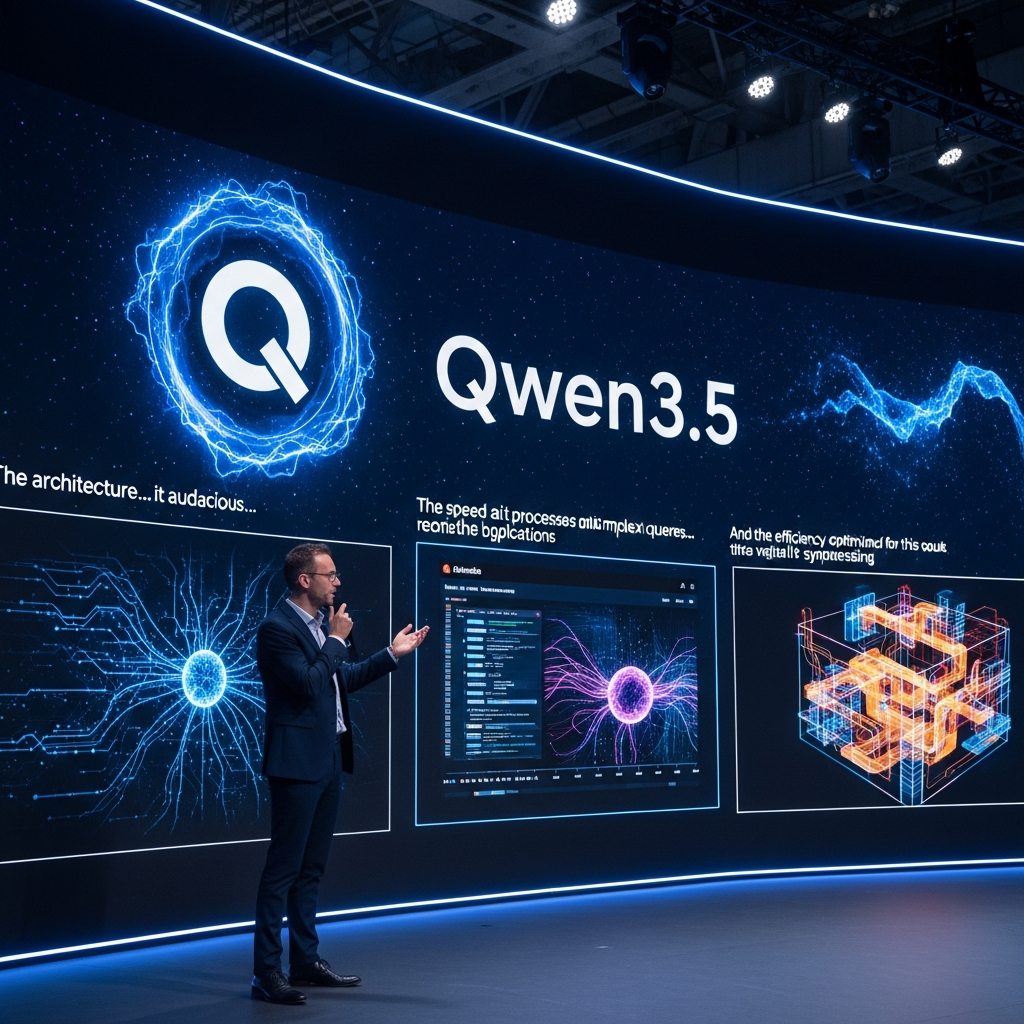
Alibaba has unveiled its groundbreaking Qwen3.5 model series, a significant leap forward in artificial intelligence that promises to democratize advanced AI capabilities. These innovative models, ranging from compact versions designed for edge devices to a formidable 400-billion-parameter flagship, redefine the balance between raw power and operational efficiency. Experts, including Elon Musk, have praised Qwen3.5 for its “impressive intelligence density,” signaling a new era where powerful AI can be deployed with unprecedented agility and affordability. This strategic release positions Alibaba at the forefront of the global AI race, making sophisticated multimodal and agentic AI more accessible than ever.
The Qwen3.5 Revolution: A New Paradigm for AI Agents
The Qwen3.5 series represents Alibaba’s commitment to open-source AI innovation, delivering robust performance with significantly fewer computational demands. This “intelligence density” means developers can achieve powerful results without the heavy infrastructure traditionally required by large language models (LLMs). At its core, Qwen3.5 is engineered for developing native multimodal agents, capable of understanding and interacting with the world through both text and vision, much like a human.
What Makes Qwen3.5 Stand Out?
At the heart of the Qwen3.5 breakthrough is a suite of architectural innovations. These models boast a unique hybrid design combining sparse Mixture-of-Experts (MoE) with Gated Delta Networks. This sophisticated architecture allows Qwen3.5 to deliver high-level intelligence while keeping active parameters—and thus, computational cost—remarkably low. Its enhanced ability to interpret user interfaces makes it an ideal foundation for next-generation agentic applications that can autonomously navigate and operate digital environments.
Unpacking the Flagship: Qwen3.5-397B-A17B Vision-Language Model
The crown jewel of the series is the Qwen3.5-397B-A17B, a Vision-Language Model (VLM) with an impressive total of 397 billion parameters. What’s truly remarkable is its sparse MoE design, which activates only 17 billion parameters during any single forward pass. This ingenious approach means the model operates with the speed and memory footprint of a much smaller system, delivering 8.6x to 19.0x increased decoding throughput compared to previous generations. This efficiency dramatically reduces the operational costs typically associated with such powerful AI.
Native Multimodality and Agentic Prowess
Qwen3.5 excels in native multimodal training through “Early Fusion.” Unlike models that layer vision capabilities later, Qwen3.5 learned from images and text concurrently using trillions of multimodal tokens. This makes it highly adept at visual reasoning, outperforming prior Qwen3-VL versions. It’s particularly suited for agentic tasks, such as generating precise HTML and CSS code from a UI screenshot or analyzing long videos with second-level accuracy. With an input context length of 256K tokens, extensible up to an astounding 1 million tokens, Qwen3.5 can process entire codebases or lengthy videos in a single prompt. This significantly reduces the need for complex Retrieval-Augmented Generation (RAG) systems.
Alibaba’s “Winning with Small Size”: The Qwen3.5 Small Model Series
Alibaba’s strategic vision extends beyond the flagship, encompassing a quartet of small-sized Qwen3.5 models: Qwen3.5-0.8B, Qwen3.5-2B, Qwen3.5-4B, and Qwen3.5-9B. These compact powerhouses are engineered to provide “more powerful intelligence with less computing power,” making advanced AI accessible for a broader range of applications. They achieve robust native multimodal capabilities, elevating both intelligence and visual understanding within their limited parameter counts.
Power in Compact Packages: Specific Use Cases and Performance
Qwen3.5-9B: This model offers comprehensive performance comparable to models with ten times its parameter count. It excels across authoritative evaluations, including Instruction Following, Doctor-level Reasoning, Mathematical Reasoning, and Complex Document Understanding. Its cost-effectiveness makes it a highly versatile general-purpose option.
Qwen3.5-4B: Striking an optimal balance between performance and resource consumption, the 4B model features exceptionally strong Agent capabilities. It’s an ideal multi-modal base for lightweight Agents, capable of autonomously operating mobile phones and computers. It even matches the performance of the much larger Qwen3-VL-30B-A3B in Visual Agent evaluations.
- Qwen3.5-0.8B/2B: These ultra-small models deliver rapid inference speeds and are designed for direct deployment on diverse terminal hardware. This includes mobile phones, tablets, smart cockpits, and wearable devices. They unlock new possibilities for edge-side AI applications like offline voice interaction and real-time perception.
- developer.nvidia.com
- eu.36kr.com
- www.indiatoday.in
- www.marktechpost.com
- news.futunn.com
Elon Musk’s notable reaction on X, describing the benchmark comparisons for the Qwen3.5 small series as “impressive intelligence density,” underscores the significance of these advancements. The series has quickly dominated global open-source model rankings, securing top positions and showcasing its immediate impact.
Under the Hood: Key Technological Breakthroughs
The remarkable performance and efficiency of Qwen3.5 are built upon four major technological innovations that challenge traditional LLM limitations:
Hybrid Attention Mechanism
This innovation allows the model to “read selectively,” dynamically focusing attention on critical information within long texts. It intelligently skims less important details, eliminating the computational waste of traditional full-scale attention calculations. This enhances both efficiency and accuracy, particularly crucial for processing extended contexts.
Extreme Sparse MoE Architecture
Moving beyond dense models, Qwen3.5’s MoE architecture activates only the most relevant “expert” sub-networks for any given input. This enables it to tap into a vast knowledge base (397 billion parameters) with minimal computational activation (17 billion parameters), resulting in dramatic reductions in inference costs and energy consumption.
Native Multi-token Prediction
Instead of generating one token at a time, Qwen3.5 learns to make joint predictions for multiple subsequent positions during training. This “multi-step planning” capability nearly doubles inference speed, providing users with near “instant response” experiences. This is particularly beneficial for high-frequency scenarios like long text generation, code completion, and multi-turn dialogues.
System-level Training Stability Optimization
To ensure the robust operation of these aggressive architectural innovations during ultra-large-scale training, Qwen3.5 integrates several stability optimizations. An attention gating mechanism, for instance, acts as an “intelligent switch” to regulate information flow. This prevents useful data from being drowned out and avoids excessive amplification of irrelevant information, thereby improving output accuracy and long-context generalization.
Empowering Developers: The Qwen3.5 Ecosystem
Alibaba’s commitment to open-source AI means Qwen3.5 isn’t just a research triumph; it’s a powerful tool for developers globally. The company has made these models widely accessible, fostering a vibrant ecosystem for innovation.
NVIDIA’s Role in Acceleration and Deployment
NVIDIA plays a pivotal role in maximizing Qwen3.5’s potential. Developers can leverage GPU-accelerated endpoints on build.nvidia.com for immediate experimentation, prompt testing, and evaluation. Programmatic access is available through an API, supporting advanced features like tool calling. For production-ready deployment, NVIDIA NIM offers optimized, containerized inference microservices. Furthermore, the NVIDIA NeMo framework provides comprehensive tools for customizing Qwen3.5, facilitating high-throughput fine-tuning of its massive architecture for specialized domain-specific requirements.
Open-Source Accessibility and Cost-Effectiveness
The Qwen3.5 models are publicly available with open weights on platforms like Hugging Face and ModelScope. They can also be integrated through Alibaba Cloud’s Model-as-a-Service platform. This widespread accessibility, coupled with an API price as low as 0.8 yuan per million tokens for Qwen3.5-Plus (reportedly 1/18th the cost of Gemini 3 Pro), underscores Alibaba’s aim to make cutting-edge AI both powerful and economical. The Qwen app and PC versions also offer immediate integration, further broadening access.
The Future of AI Agents and Edge Computing
The launch of Qwen3.5 marks a pivotal moment in AI development. By offering robust multimodal capabilities in both colossal and compact forms, Alibaba is accelerating the shift towards sophisticated AI agents that can seamlessly operate across digital interfaces. Its efficiency innovations pave the way for a “full explosion” of core AI application scenarios on edge devices, from autonomous mobile operations to real-time decision-making in smart cockpits. This series enhances the accessibility and utility of advanced AI, fostering innovation across a multitude of industries and use cases. The ongoing competition in the AI landscape, particularly between the US and China, continues to drive such remarkable advancements, ultimately benefiting developers and end-users worldwide.
Frequently Asked Questions
What makes Alibaba’s Qwen3.5 model so efficient compared to other large language models?
Alibaba’s Qwen3.5 achieves superior efficiency through its innovative sparse Mixture-of-Experts (MoE) architecture. While the flagship model has 397 billion total parameters, only about 17 billion parameters are actively engaged during inference. This dramatic reduction in activated parameters, combined with a hybrid attention mechanism and native multi-token prediction, allows Qwen3.5 to deliver high intelligence with significantly less computational power, reducing deployment memory usage by 60% and boosting throughput up to 19 times compared to previous models.
Where can developers access and deploy Alibaba’s Qwen3.5 models for their AI projects?
Developers have multiple avenues to access and deploy Qwen3.5 models. The open weights are publicly available on platforms like Hugging Face and ModelScope, allowing for local deployment. For GPU-accelerated performance and ease of use, NVIDIA offers free access to GPU-accelerated endpoints on build.nvidia.com, an API for programmatic access, and NVIDIA NIM for optimized inference microservices. Additionally, the NVIDIA NeMo framework provides tools for fine-tuning the models for specialized requirements. Qwen3.5 is also integrated into Alibaba Cloud’s Model-as-a-Service platform.
How does the Qwen3.5 small model series benefit developers creating AI applications for edge devices?
The Qwen3.5 small model series (0.8B, 2B, 4B, 9B) provides powerful multimodal intelligence in compact packages, making it ideal for edge device AI. These models offer rapid inference speeds and significantly lower computational requirements, allowing for direct deployment on mobile phones, tablets, smart cockpits, and wearable devices. This capability enables new edge AI applications such as offline voice interaction, local document parsing, and real-time perception without relying on cloud-based processing, enhancing privacy, speed, and reliability for on-device applications.
Conclusion
Alibaba’s Qwen3.5 series stands as a testament to the relentless pace of AI innovation. By deftly blending immense capability with unparalleled efficiency, these models are not just pushing technical boundaries but also expanding the horizons of what’s possible in real-world AI applications. From advanced multimodal agents that understand user interfaces to lightweight models powering next-generation edge devices, Qwen3.5 offers a versatile and cost-effective toolkit for developers worldwide. As the AI landscape continues to evolve, Alibaba’s commitment to open-source and “intelligence density” is poised to drive the adoption of truly intelligent systems across every facet of technology.