Imagine a clock that ticks endlessly without any power source, its internal gears in perpetual, self-driven motion. This captivating concept, once confined to the realm of science fiction, is now a reality. Physicists at the University of Colorado Boulder have unveiled a groundbreaking “time crystal,” a novel phase of matter that can be observed directly. This isn’t a prop for a time machine, but it represents a profound leap in our understanding of quantum phenomena, paving the way for revolutionary technological applications.
This discovery, published in “Nature Materials” by lead author Hanqing Zhao and Professor Ivan Smalyukh, marks a significant milestone. It’s the first time a time crystal has been created that is visible to the human eye, and even more remarkably, directly under a microscope. This breakthrough could transform fields from advanced computing to security, offering a tangible glimpse into the mysterious world of quantum mechanics.
What Exactly is a Time Crystal?
The idea of a time crystal might sound like something from a classic sci-fi movie, exploring distant galaxies or dystopian futures. Films like Arrival or Minority Report often delve into complex temporal concepts. However, the reality of a time crystal is rooted deeply in physics, not fantasy. It’s a curious phase of matter where its constituent particles, like atoms or molecules, exist in constant, repeating motion, even in their lowest energy state. Think of it as matter organized in time, rather than just in space.
Traditional crystals, such as diamonds or table salt, are “space crystals.” Their atoms arrange themselves in fixed, repeating patterns across space. Nobel laureate Frank Wilczek first proposed the theoretical concept of a time crystal in 2012. He wondered if matter could similarly organize itself in a repeating pattern, but across time. Instead of a static lattice, the particles would cycle through a set of movements indefinitely, a never-ending loop.
Wilczek’s initial theoretical model for a time crystal proved impossible to create in its ideal lowest energy state. Yet, scientists have made significant strides since. In 2021, for example, physicists utilized Google’s Sycamore quantum computer to generate a network of atoms. When nudged with a laser, these atoms exhibited repeating fluctuations, offering an early glimpse into this unique state of matter.
CU Boulder’s Visible Breakthrough
The team at CU Boulder, led by Hanqing Zhao and Ivan Smalyukh, pushed these boundaries further. They set out to create a time crystal using liquid crystals, the same versatile materials found in your smartphone display. Their innovative approach allowed them to create a time crystal that is not only stable but also uniquely visible.
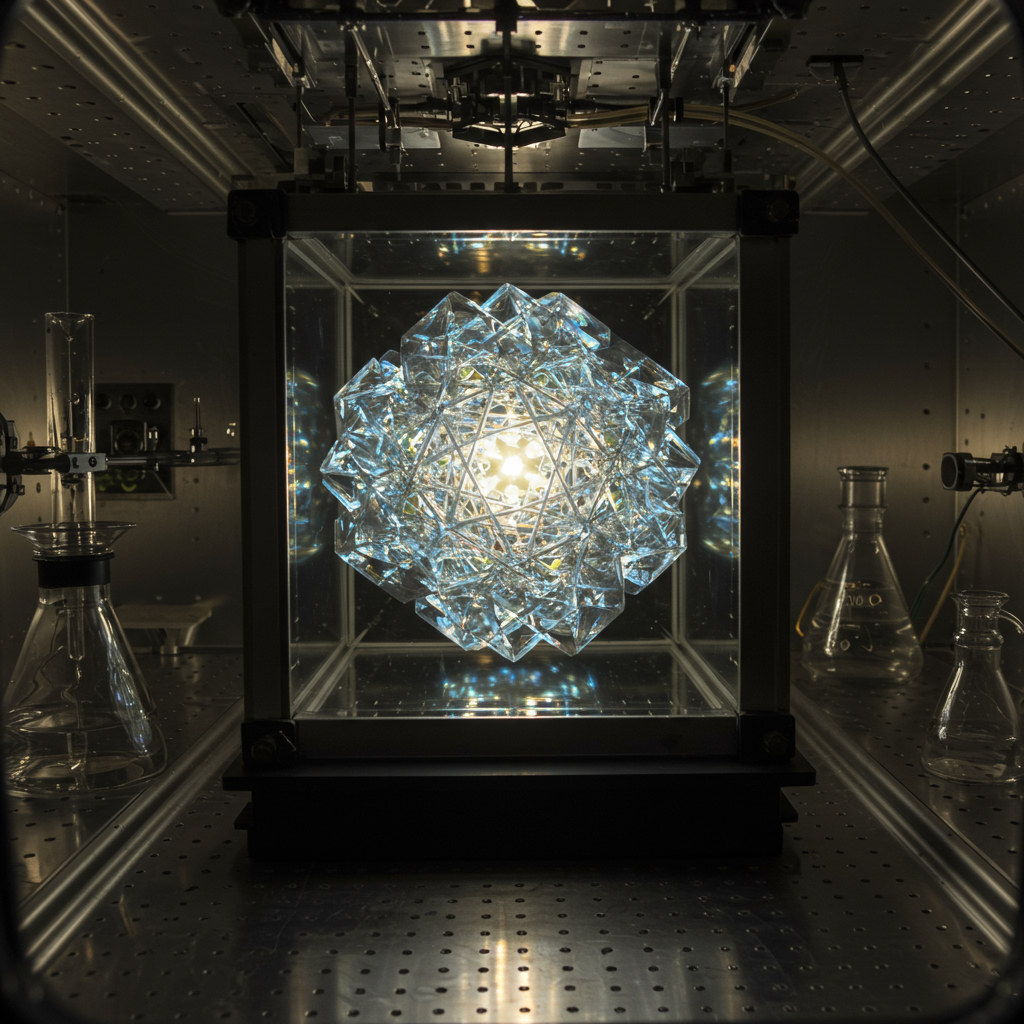
Their method involved designing glass cells filled with a solution of liquid crystals. These rod-shaped molecules behave with properties of both liquids and solids. When a specific type of light shines on these cells, the magic happens. Dye molecules coated on the glass change their orientation. This action gently “squeezes” the liquid crystals. This compression leads to the rapid formation of thousands of tiny structural “kinks” within the liquid crystal matrix.
Professor Smalyukh explains that these kinks don’t just sit there. They begin to move and interact in a complex, repetitive dance. Visualize a meticulously choreographed ballroom, where dancers break apart, spin, and re-form, continuously repeating their intricate patterns. Under a microscope, these dynamic liquid crystal samples display mesmerizing, “psychedelic tiger stripes” that maintain their motion for hours. This spontaneous emergence of order from seemingly nothing, simply by shining a light, is truly remarkable.
Unprecedented Stability and Control
A key aspect of this new time crystal is its extraordinary stability. The researchers found these dynamic patterns to be “unusually hard to break.” They could even alter the temperature of their samples without disrupting the mesmerizing movement of the liquid crystals. This resilience is crucial for any potential real-world applications.
This ability to visually observe and study time crystals offers unprecedented opportunities. Previous versions were far more abstract and difficult to directly interact with. The visible nature of this new time crystal opens a direct window into its complex inner workings, allowing scientists to better understand and, eventually, control its unique properties.
From Quantum Labs to Practical Applications
While a time crystal won’t power a fictional time machine, its potential real-world applications are significant and diverse. The visible, stable patterns offer several intriguing possibilities:
Anti-Counterfeiting Measures: Imagine currency or valuable documents embedded with “time watermarks.” Shining a specific light on these materials would reveal a unique, dynamic pattern, instantly verifying authenticity and making counterfeiting exceptionally difficult. This provides a sophisticated layer of security.
Advanced Data Storage: By stacking multiple time crystals, researchers can create even more intricate and complex patterns. These could function as “time barcodes,” potentially allowing for the storage of vast amounts of digital data in novel, highly dense formats. This could revolutionize information technology, especially in an era demanding ever-increasing storage capacity.
- New Sensors and Devices: The precise, controllable motion of these liquid crystal systems could lead to new types of sensors or actuators, operating on principles vastly different from current technologies. Their unique response to light and inherent stability make them ideal candidates for next-generation devices.
- www.colorado.edu
- www.colorado.edu
- www.newscientist.com
- www.colorado.edu
- www.timeout.com
Professor Smalyukh emphasizes the broad, unexplored potential, stating, “We don’t want to put a limit on the applications right now. I think there are opportunities to push this technology in all sorts of directions.”
Beyond Time Crystals: CU Boulder’s Broader Research Horizons
This breakthrough in quantum matter highlights CU Boulder’s commitment to pushing the boundaries of scientific understanding. The university is a hub for diverse, cutting-edge research that spans fundamental physics to practical, real-world solutions.
For instance, the challenges of quantum computing are a major area of exploration. While the field promises revolutionary advancements in drug development, material science, and even climate change mitigation, significant engineering hurdles remain. Researchers are actively grappling with the “existential question” of precisely what these powerful machines will be useful for, even as the technology progresses. This visible time crystal is a tangible step in understanding quantum phenomena that could contribute to this broader quantum revolution.
Moreover, CU Boulder is at the forefront of combining quantum physics with AI to tackle critical engineering problems. Associate Professor Sanghamitra Neogi and her team, for example, developed AtomThermCAD software. This tool uses AI-accelerated quantum physics calculations to predict heat generation in nanoscale microchips, a crucial challenge in the semiconductor industry. Such innovations save years of development time and enhance chip performance, much like how time crystals explore novel material properties.
The university also dedicates research to enhancing human-robot interaction. Morteza Lahijanian and his team are developing algorithms that enable robots to make safer decisions when working alongside humans. This approach draws on game theory, prioritizing human safety and minimizing “robot regret” to foster a collaborative, rather than adversarial, environment. These diverse research initiatives underscore CU Boulder’s role in shaping future technologies across multiple domains.
Frequently Asked Questions
What makes the CU Boulder time crystal unique compared to previous versions?
The CU Boulder time crystal is unique because it’s the first one that humans can actually see, even under a microscope or, in special conditions, with the naked eye. This contrasts with earlier iterations, such as those created using quantum computers, which were far more abstract. This visibility allows for direct observation and easier study of its stable, repeating motion, which is created using ordinary liquid crystals under specific light conditions.
How do liquid crystals contribute to creating a visible time crystal?
Liquid crystals are rod-shaped molecules, similar to those in phone displays, that exhibit properties of both liquids and solids. In the CU Boulder experiment, dye molecules coated on glass cells squeeze these liquid crystals when illuminated by a specific type of light. This compression causes thousands of “kinks” to form within the liquid crystal structure. These kinks then interact in complex, repeating patterns, creating the stable, observable motion characteristic of a time crystal.
What are the potential practical applications of this new time crystal?
The new visible time crystal holds promise for several technological applications. Researchers suggest its use in anti-counterfeiting measures, where “time watermarks” could verify authenticity through dynamic, light-activated patterns on currency or documents. It could also revolutionize data storage by enabling the creation of complex “time barcodes” for storing vast amounts of digital information. Beyond these, it may lead to new types of sensors and advanced materials.
The Future of Quantum Materials
The creation of a visible time crystal by CU Boulder physicists represents more than just a scientific curiosity. It’s a tangible step forward in our quest to understand and harness the bizarre rules of quantum matter. As researchers continue to explore its properties and refine its creation, the potential for entirely new technologies remains vast and exciting. This breakthrough reminds us that the boundaries of what is possible are constantly being redrawn, often by looking at familiar materials in fundamentally new ways. The future of quantum innovation looks brighter than ever.