swiss neutrality rules will remain in their current, flexible form following a decisive nationwide referendum on Sunday, as voters rejected a high-stakes proposal to codify a more rigid and isolationist interpretation of the nation’s long-standing principle.
Key Takeaways
- Decisive Rejection: Approximately 70% of Swiss voters and all cantons cast “no” votes against the “Safeguarding Swiss Neutrality” initiative.
- Sanctions Preserved: The rejection ensures the Swiss government retains the authority to impose unilateral economic sanctions, such as those currently applied to Russia, without requiring UN Security Council approval.
- Military Flexibility: switzerland will not be barred from participating in or cooperating with international defense alliances like NATO, provided it is not under direct attack.
- Political Divide: The initiative was championed by the right-wing Swiss People’s Party (SVP) but faced strong opposition from the Swiss government and major political parties.
- Upcoming Votes: The outcome sets the stage for another critical referendum in November regarding Swiss arms export regulations.
- The Military Restriction: The initiative sought to bar Switzerland from joining or cooperating with any military or defense alliances unless the nation itself was the target of an attack. This would have fundamentally changed the nature of Swiss defense policy, moving away from the concept of a country that maintains a strong military to participate in international peacekeeping and collective security efforts.
- The Economic Restriction: This was perhaps the most controversial aspect. By requiring UN Security Council approval for all sanctions, the initiative would have handed de facto control over Swiss economic foreign policy to the permanent members of the Security Council—including Russia. This would have prevented Switzerland from using its economic weight as a tool of diplomacy and international law.
- 1815: Swiss neutrality was formally recognized on the international stage following the conclusion of the Napoleonic Wars at the Congress of Vienna. This established Switzerland as a buffer state in Europe.
- Post-WWII: Switzerland maintained its neutrality through the mid-20th century, navigating the complexities of the Cold War by maintaining strong economic ties with both sides while avoiding military entanglements.
- 2022: The landscape shifted significantly following the Russian invasion of Ukraine. The Swiss government’s decision to adopt EU sanctions against Moscow marked a pivotal moment, sparking the very debate that led to this referendum.
- For Voters and Citizens: The result preserves the current geopolitical status quo. You can expect Switzerland to continue its role as an active, albeit neutral, participant in international diplomacy and to maintain its alignment with Western economic standards.
- For the Defense Industry: The rejection of the military restrictions means that Swiss defense companies will not face immediate constitutional barriers to international cooperation, though they remain subject to existing export laws.
- For International Partners (EU/NATO): The outcome provides continuity. Partners can expect Switzerland to remain a predictable actor that can respond to global crises and sanctions through established diplomatic and economic channels.
- For Investors: The stability of Switzerland’s foreign policy regime reduces the risk of sudden, isolationist shifts that could impact trade relations and international financial standing.
- www.theglobeandmail.com
- www.politico.eu
What Happened: The Referendum Results
On Sunday, September 28, 2026, the Swiss electorate participated in a nationwide referendum that sought to fundamentally alter the constitutional interpretation of the country’s neutrality. According to projections from the Swiss polling institute GFS Bern, roughly 7 out of 10 participants voted against the “Safeguarding Swiss Neutrality” initiative. Early official results indicated a “no” vote of approximately 68%, with a participation rate of 46%, though the Federal Statistical Office later confirmed that the final rejection reached approximately 70%.
The proposal, which was introduced by the right-wing Pro Switzerland organization and heavily supported by the Swiss People’s Party (SVP), aimed to amend the Swiss constitution to mandate a stricter adherence to neutrality. Had the initiative passed, Switzerland would have been constitutionally prohibited from joining military or defense alliances—unless the country itself was under direct attack—and would have been barred from implementing economic sanctions against hostile states unless those sanctions were explicitly authorized by the United Nations Security Council.
The rejection was widespread across the country, with every single canton in Switzerland casting a “no” vote, signaling a broad national consensus against the proposed isolationist shift.
Why It Matters: The Geopolitical Stakes
The outcome of this vote has profound implications for Switzerland’s role on the global stage, particularly concerning its relationship with the European Union (EU) and its response to the conflict in Ukraine.
For several years, Switzerland has largely mirrored the EU’s sanctions regime against Moscow. In mid-August 2026, the Swiss government expanded its sanctions list following the EU’s 20th sanctions package. Under the proposed “hardened” rules, such unilateral actions would have been impossible. Because Russia holds veto power on the UN Security Council, any attempt to sanction Moscow through the UN would have been blocked. Therefore, a “yes” vote would have effectively stripped the Swiss government of its ability to act in concert with its Western neighbors in response to international aggression.
Furthermore, the rejection preserves Switzerland’s ability to engage in security cooperation. While Switzerland is not a member of NATO, it maintains various levels of cooperation to bolster continental security. The initiative would have severely curtailed this agency, potentially leaving the country more isolated during times of international crisis.
Deep-Dive: The Mechanics of the Proposed Change
To understand why the initiative caused such intense debate, it is necessary to examine the specific legal mechanisms it sought to implement. The proponents argued that the current “case-by-case” application of neutrality was eroding the country’s traditional identity. However, opponents argued that the proposal would have replaced “armed neutrality” with a form of “passive isolationism.”
Comparison of Neutrality Frameworks
| Feature | Proposed “Hardened” Neutrality | Current Swiss Policy |
|---|---|---|
| Economic Sanctions | Only if approved by UN Security Council | Can be imposed unilaterally (e.g., on Russia) |
| Military/Defense Alliances | Prohibited unless under direct attack | Participation/cooperation allowed (e.g., NATO) |
| Sanction Implementation | Strict, case-by-case via UN | Flexible, mirroring EU packages |
| International Cooperation | Highly restricted/isolationist | Active engagement with Western partners |
The Two Pillars of the Initiative
Stakeholder Analysis and Reactions
The referendum highlighted a deep ideological rift within the Swiss political landscape, pitting the traditionalist, sovereignty-focused right wing against the government-aligned mainstream.
The Proponents: SVP and Pro Switzerland
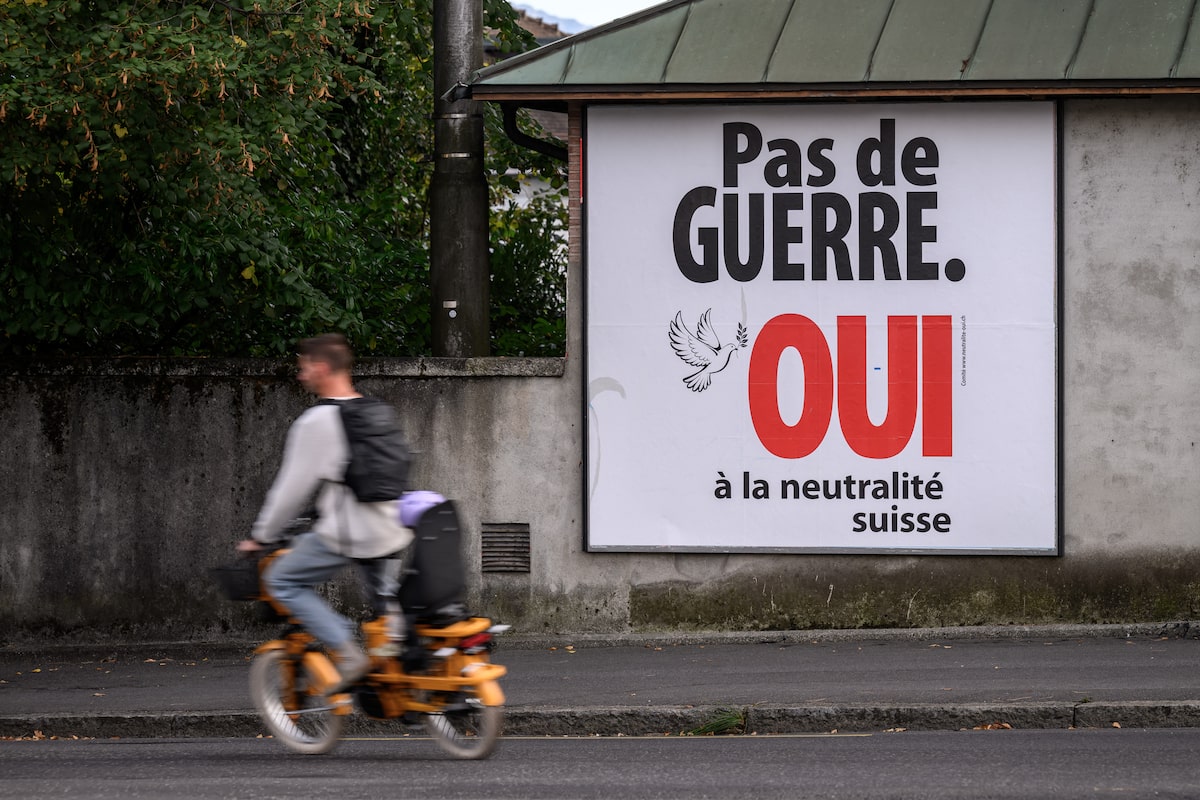
The Swiss People’s Party (SVP) led the campaign, utilizing slogans such as “No war, yes to neutrality” and imagery of white peace doves. They contended that Switzerland’s neutrality has already been compromised by the government’s decision to impose sanctions on Russia following the 2022 invasion of Ukraine.
Lukas Reimann, an SVP lawmaker, expressed dissatisfaction with the outcome but acknowledged the significance of the debate. “I’m of course not pleased with the result,” Reimann stated, adding that “it is absolutely clear that neutrality belongs to Switzerland and is part of Switzerland’s identity.”
Reimann also issued a warning to the government, suggesting that the party would remain vigilant and “become active again” if the state continues to stray from what they define as traditional neutrality by adopting even tougher sanctions.
The Opponents: Government and Mainstream Parties
The Swiss government, the Parliament, and a broad coalition of parties—including the Green Party, the Social Democrats (SP), the Centre Party, and the FDP—all advised voters to reject the proposal. They argued that the initiative would lead to international isolation and an inability to uphold international law.
Ignazio Cassis, the Federal Councillor leading the foreign affairs department, emphasized the stability of the current system. Following the vote, Cassis remarked, “This result is not a vote against neutrality. Switzerland was neutral yesterday, it is neutral today, and it will remain neutral in the future.”
Sibel Arslan, a lawmaker for the Green Party, characterized the vote as a rejection of the SVP’s vision for the country. “Voters understood what the SVP wanted: it wanted Switzerland to isolate itself internationally and shirk its responsibilities when international law is being trampled on,” Arslan said.
Academic Perspective
Before the vote, Fabio Wasserfallen, a professor of European politics at the University of Bern, noted that while Swiss voters hold neutrality in high regard, they tend to support the government’s modern implementation of it. He suggested that the electorate distinguishes between “isolationist neutrality” and the “active neutrality” currently practiced by Bern.
Historical Context: The Evolution of Swiss Neutrality
To understand the weight of this referendum, one must look back to the origins of Swiss neutrality. While the concept has evolved, its roots are deeply embedded in the nation’s history.

What It Means for You
Depending on your role in society, the outcome of this referendum carries different practical implications:
Counterpoints and Open Questions
Despite the decisive victory for the status quo, the referendum has not silenced the critics of the current policy.
The Sovereignty Argument: Proponents of the initiative argue that the current “flexible” neutrality is actually a surrender of Swiss sovereignty to the European Union. They contend that by mirroring EU sanctions, Switzerland is no longer an independent actor but a satellite of Brussels. This remains a potent political argument that will likely continue to resonate within the SVP and other right-wing circles.
The “Erosion” Debate: There is an ongoing question of whether neutrality can truly be maintained while participating in economic warfare. Critics of the government argue that sanctions are a form of non-military aggression that fundamentally contradicts the spirit of neutrality.
Unresolved Tension: Can Switzerland truly be seen as neutral by the global community if it is economically integrated into the Western sanctions regime? This is a question that remains at the heart of Swiss political discourse and is unlikely to be settled by a single vote.
What Happens Next
The rejection of the “Safeguarding Swiss Neutrality” initiative does not mean the debate over Switzerland’s international posture is over. In fact, the political calendar suggests that the tension between traditional neutrality and modern security requirements will intensify.
The November Referendum: Swiss voters will face another significant question later this year. In November 2026, a referendum will be held to determine whether Switzerland’s current arms export rules are fit for purpose. The proposal will ask if the country should be permitted to export weapons to a defined group of 25 mostly Western countries, even if those countries are involved in an ongoing conflict.
If the November proposal is approved, it would represent a significant tightening of Swiss ties with Western defense partners and could provide a substantial boost to the country’s domestic defense industry. This upcoming vote will serve as a secondary test of whether the Swiss public prefers a more integrated security role or a more strictly isolationist one.
Frequently Asked Questions
What is Swiss neutrality?
Swiss neutrality is a principle of foreign policy that has been part of the country’s identity since 1815. It means that Switzerland does not participate in armed conflicts between other states and does not join military alliances. However, modern Swiss neutrality is “flexible,” meaning the government can still take diplomatic and economic actions, such as imposing sanctions, to uphold international law.
Why did Russia support the neutrality initiative?
Russia’s interest in the initiative was primarily driven by the desire to limit the ability of Western-aligned nations to impose economic sanctions. Since Russia holds a veto on the UN Security Council, a law requiring UN approval for all sanctions would have effectively prevented Switzerland from acting against Moscow, as any such UN-led sanctions would be blocked by the Russian veto.
Does this vote change Switzerland’s relationship with NATO?
No. The rejection of the initiative means that the current status quo remains. Switzerland can continue its existing cooperation with NATO and other international security organizations. The initiative would have prohibited such cooperation unless Switzerland was under direct attack, but that restriction was rejected by the voters.
How does the upcoming November vote differ from this one?
The current vote was about the definition of neutrality (specifically regarding sanctions and alliances). The upcoming vote in November is more specific: it concerns arms export rules. It asks whether Switzerland should be allowed to export weapons to a specific group of 25 Western nations, even during active conflicts, which would potentially strengthen the Swiss defense industry and its ties to Western security structures.
Closing
By rejecting the proposal to “harden” its neutrality, Swiss voters have opted for continuity over a radical shift toward isolationism. The result ensures that the Swiss government maintains the agency to navigate a complex geopolitical landscape, allowing for the continued use of economic sanctions and international security cooperation
References
Featured image: Image via The Globe and Mail