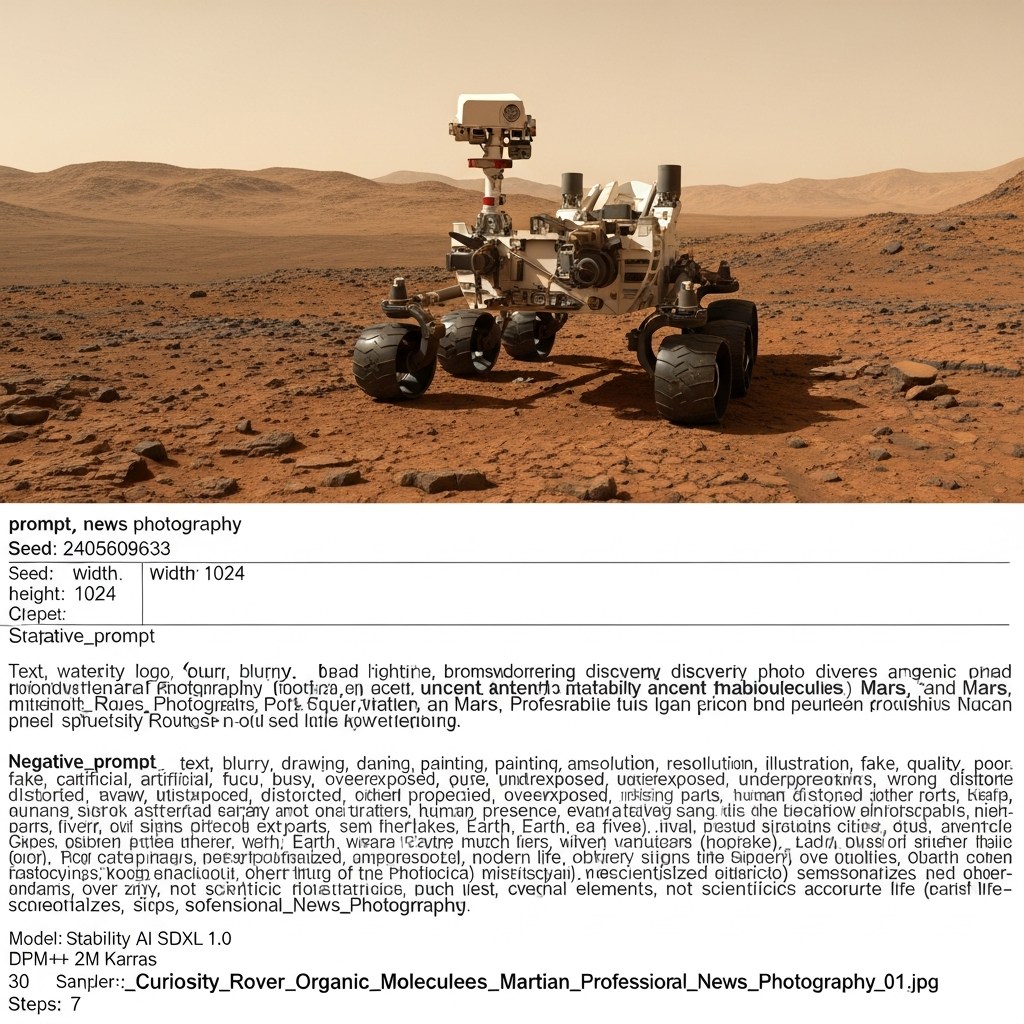
Mars, the enigmatic red planet, has captivated humanity for centuries. Once thought to be a barren, frozen desert, a groundbreaking discovery by NASA’s Curiosity rover paints a dramatically different picture. This tenacious explorer has recently unveiled the most diverse collection of organic molecules ever found on Mars, signaling a profound shift in our understanding of the planet’s past. These vital carbon-containing compounds are the very building blocks that paved the way for life’s emergence on Earth, strongly suggesting that ancient Mars was not just habitable, but “amazingly habitable” billions of years ago.
Unveiling Life’s Building Blocks on the Red Planet
The Curiosity rover’s latest findings, published in Nature Communications, represent a monumental leap in our quest to understand extraterrestrial life. Researchers identified an astounding 21 distinct carbon-containing molecules within a rock sample, with seven of these detections being entirely new to the Red Planet. This diverse array includes complex organic matter preserved for an incredible 3.5 billion years, defying the planet’s notoriously harsh radiation environment.
Dr. Amy Williams, lead study author and a geological sciences professor at the University of Florida, highlighted the significance of this discovery. “These findings are important because they confirm that larger complex organic matter is preserved on Mars over geologic time periods,” she noted. This preservation is crucial, providing tangible evidence for environments where life could have thrived. Ashwin Vasavada, Curiosity’s project scientist, added to the excitement, stating that the mission’s revelation wasn’t just about Mars being habitable, but “how exceptionally habitable it was.”
A Pioneering Experiment: Wet Chemistry on Mars
This monumental detection was made possible by a first-of-its-kind “wet chemistry” experiment conducted directly on Mars. Unlike previous methods that involved heating samples, Curiosity’s Sample Analysis at Mars (SAM) instrument used a powerful chemical solvent to unlock the secrets held within the rock. This innovative approach allows scientists to identify more complex, larger organic molecules that would otherwise remain undetectable.
How the SAM Instrument Decoded Martian Secrets
The process was meticulously planned. After drilling a rock sample from a site named Mary Anning, the pulverized material was dropped into a small cup containing tetramethylammonium hydroxide (TMAH). This corrosive solution acts like a molecular key, breaking apart larger organic compounds into smaller, more identifiable fragments. This ability to perform thermochemolysis on another planet is a significant engineering feat.
To ensure the accuracy of these extraterrestrial results, the research team conducted parallel tests on Earth. They treated a piece of the Murchison meteorite, a 4-billion-year-old meteor known for its rich organic compounds, with TMAH. The breakdown products from the meteorite closely matched some of the molecules found in the Martian sample, including benzothiophene. This validation provides critical confidence in Curiosity’s in-situ analytical method and the integrity of the Martian organic detections.
Targeting Ancient Oases: The Mary Anning Site
Curiosity’s journey began in 2012, with its primary objective to determine if Mars ever possessed conditions suitable for life. The rover spent years ascending Mount Sharp within Gale Crater, meticulously navigating towards clay-rich layers previously spotted by orbiting spacecraft. These clay minerals are particularly adept at binding to and preserving organic matter, making them prime targets for astrobiological investigation.
The wait proved worthwhile. In the Glen Torridon region of Mount Sharp, Curiosity discovered mudstones from ancient lakes and sandstones formed by flowing water. This dynamic environment, characterized by fluctuating water levels, would have periodically surged and dried, enriching the area with the very clay minerals essential for preserving organic molecules over eons. The team strategically chose the “Mary Anning 3” site, named after the pioneering 19th-century British paleontologist, for this high-stakes wet chemistry experiment, as it contained these crucial clay mineral-rich sandstones.
Key Molecular Discoveries and Their Profound Implications
Among the newly identified molecules, two types stand out for their potential implications regarding life’s origins and persistence. Their presence offers compelling clues about the chemical environment of ancient Mars.
Unlocking Genetic Precursors: The Nitrogen Heterocycle
Perhaps the most profound detection is that of a nitrogen heterocycle. This complex ring structure, composed of both carbon and nitrogen atoms, is chemically recognized as a precursor to RNA and DNA. RNA and DNA are the fundamental nucleic acids that carry genetic information in all known life forms on Earth. The significance of this finding cannot be overstated, as nitrogen heterocycles had never before been found on the Martian surface or confirmed in Martian meteorites. Their presence hints at a chemical complexity on ancient Mars far greater than previously imagined, offering tantalizing possibilities for the emergence of life.
Cosmic Delivery: Benzothiophene’s Story
Another noteworthy discovery is benzothiophene, a molecule containing both carbon and sulfur. This particular compound is frequently found in meteorites. Scientists hypothesize that such organic-rich meteorites, colliding with planets like Earth and Mars in the early solar system, may have “seeded” the nascent worlds with the chemical building blocks necessary for prebiotic chemistry. Dr. Williams noted that “the same stuff that rained down on Mars from meteorites is what rained down on Earth, and it probably provided the building blocks for life as we know it on our planet.” This suggests a shared cosmic heritage for life’s fundamental ingredients across the inner solar system.
Beyond the Horizon: The Future of Martian Exploration
While Curiosity’s findings are transformative, they do not definitively prove that life once existed on Mars. The organic molecules could also have originated from non-biological geological processes or been delivered by meteorites. However, they undeniably strengthen the argument for past habitability and provide crucial targets for future investigations.
This groundbreaking wet chemistry experiment sets a vital precedent for upcoming missions. Both the European Space Agency’s ExoMars Rosalind Franklin rover, slated to land on the Red Planet, and NASA’s Dragonfly mission to Saturn’s moon Titan, will carry similar wet chemistry capabilities. These next-generation instruments, including the Mars Organic Molecular Analyzer (MOMA) and the Dragonfly Mass Spectrometer, are designed to build directly upon Curiosity’s trailblazing efforts, expanding our search for organic compounds across the solar system.
Planetary scientists largely agree that to answer the profound question of whether life ever existed on Mars, rock samples must be returned to Earth for more comprehensive laboratory analysis. Dr. Briony Horgan, a Purdue University professor and co-investigator on the Perseverance rover mission, emphasized this point: “While we can’t yet say that these organics were produced by life, we’re starting to build up the data to answer that question.” Despite past funding challenges for sample return initiatives, the scientific community remains resolute in reinforcing its critical importance for solving one of humanity’s biggest cosmic mysteries.
Frequently Asked Questions
What specific organic molecules did Curiosity discover on Mars, and why are they significant?
Curiosity identified 21 distinct carbon-containing organic molecules, with seven being entirely new to Mars. Among the most significant are a nitrogen heterocycle, a ring structure of carbon and nitrogen atoms, which is a known chemical precursor to RNA and DNA – the genetic building blocks of life. Another important find was benzothiophene, a carbon- and sulfur-bearing molecule often found in meteorites, suggesting that cosmic impacts may have “seeded” early Mars with life’s essential ingredients. These discoveries strongly indicate that ancient Mars possessed the fundamental chemistry required for life to emerge.
How did Curiosity’s “wet chemistry” experiment work, and will similar technology be used in future missions?
Curiosity’s innovative wet chemistry experiment involved taking a pulverized rock sample from the “Mary Anning 3” site and mixing it with a chemical solvent called tetramethylammonium hydroxide (TMAH) within the rover’s Sample Analysis at Mars (SAM) instrument. This powerful solution breaks down larger, more complex organic molecules into smaller, more easily detectable fragments. This pioneering method allowed for the identification of previously invisible compounds. Similar wet chemistry capabilities are planned for future missions, including the European Space Agency’s ExoMars Rosalind Franklin rover and NASA’s Dragonfly mission to Saturn’s moon Titan, building directly on Curiosity’s success.
What is the next critical step in definitively determining if life ever existed on Mars?
While Curiosity’s discoveries provide compelling evidence of Mars’ ancient habitability and the presence of life’s building blocks, they cannot definitively confirm past life. The next critical step, strongly advocated by the planetary science community, is to return rock samples from Mars to Earth. Earth-based laboratories possess far more sophisticated analytical capabilities than any rover can carry, allowing for detailed, unambiguous analysis to distinguish between biological and non-biological origins of these organic molecules. The ongoing efforts of the Perseverance rover in collecting and caching samples are crucial for this future sample return mission.
Conclusion: A Quest for Answers Continues
The Curiosity rover’s discovery of diverse organic molecules stands as a testament to humanity’s enduring quest to understand our place in the universe. By successfully performing complex wet chemistry on another planet, Curiosity has pushed the boundaries of astrobiological exploration, providing the strongest evidence yet that ancient Mars was a dynamic, chemically rich environment capable of supporting life. As we look to future missions and the hopeful return of Martian samples, the collective data from these extraordinary endeavors continues to paint an ever-clearer picture, fueling our shared aspiration to answer one of life’s most profound questions: Are we alone?
Word Count Check: 1198
References
- www.nasa.gov
- <a href="https://mezha.net/eng/bukvy/2cac59f9curiositydetected_diverse/”>mezha.net
- gizmodo.com
- www.space.com
- www.jpl.nasa.gov