Key takeaways
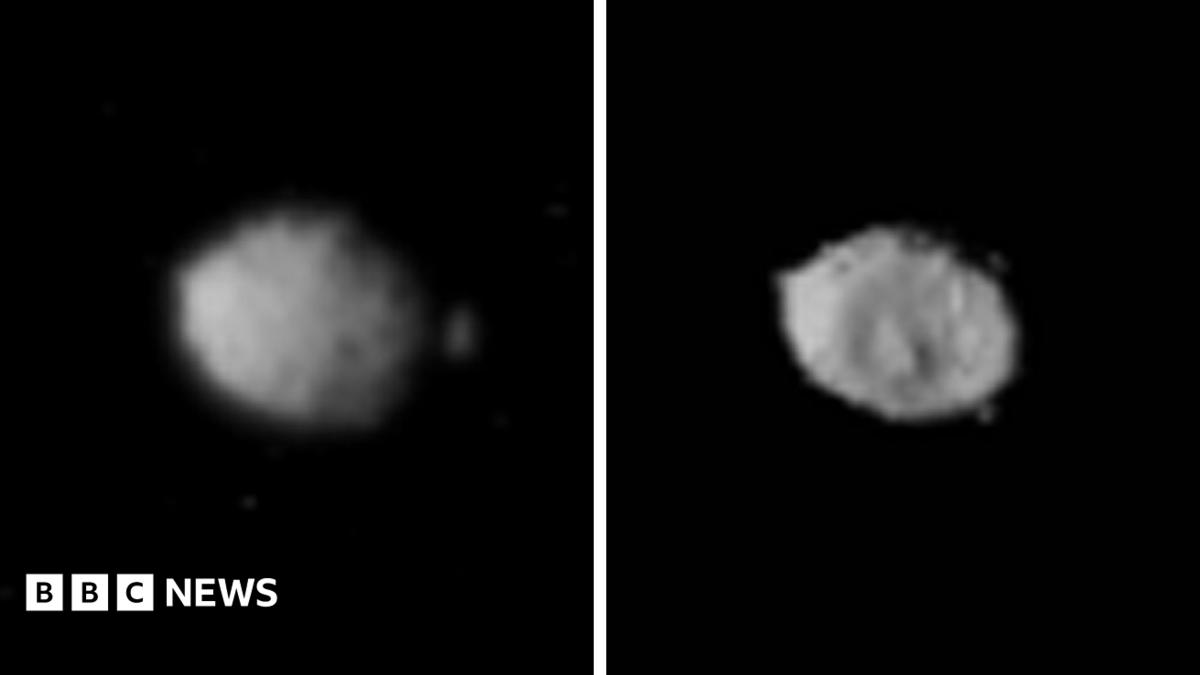
- The European Space Agency’s first close-up images from Hera, released on November 25, 2026, show a stadium-sized crater on Dimorphos, the asteroid NASA hit in 2022.
- Dimorphos is now tumbling chaotically, and hundreds of boulders drift around it and its larger companion, Didymos.
- Scientists do not yet know whether DART threw out all of these boulders, or why the asteroid survived the impact intact.
- Hera will spend about six months moving closer and releasing two CubeSats, with measuring Dimorphos’s mass a central goal.
The Hera spacecraft has returned its first close-up images of Dimorphos, and they show a crater roughly the size of a sports stadium carved into the asteroid by NASA’s DART probe, according to The European Space Agency (ESA). ESA released the pictures on Wednesday, November 25, 2026, about four years after DART deliberately crashed into the small moonlet to test whether a spacecraft could nudge an asteroid off its path.
The images also show a system that is messier than many researchers expected. Dimorphos is tumbling in its orbit around the larger asteroid Didymos, and hundreds of boulders are drifting around both bodies. Neither asteroid threatens Earth, which is why they were chosen for the experiment.
A crater almost as wide as the asteroid itself
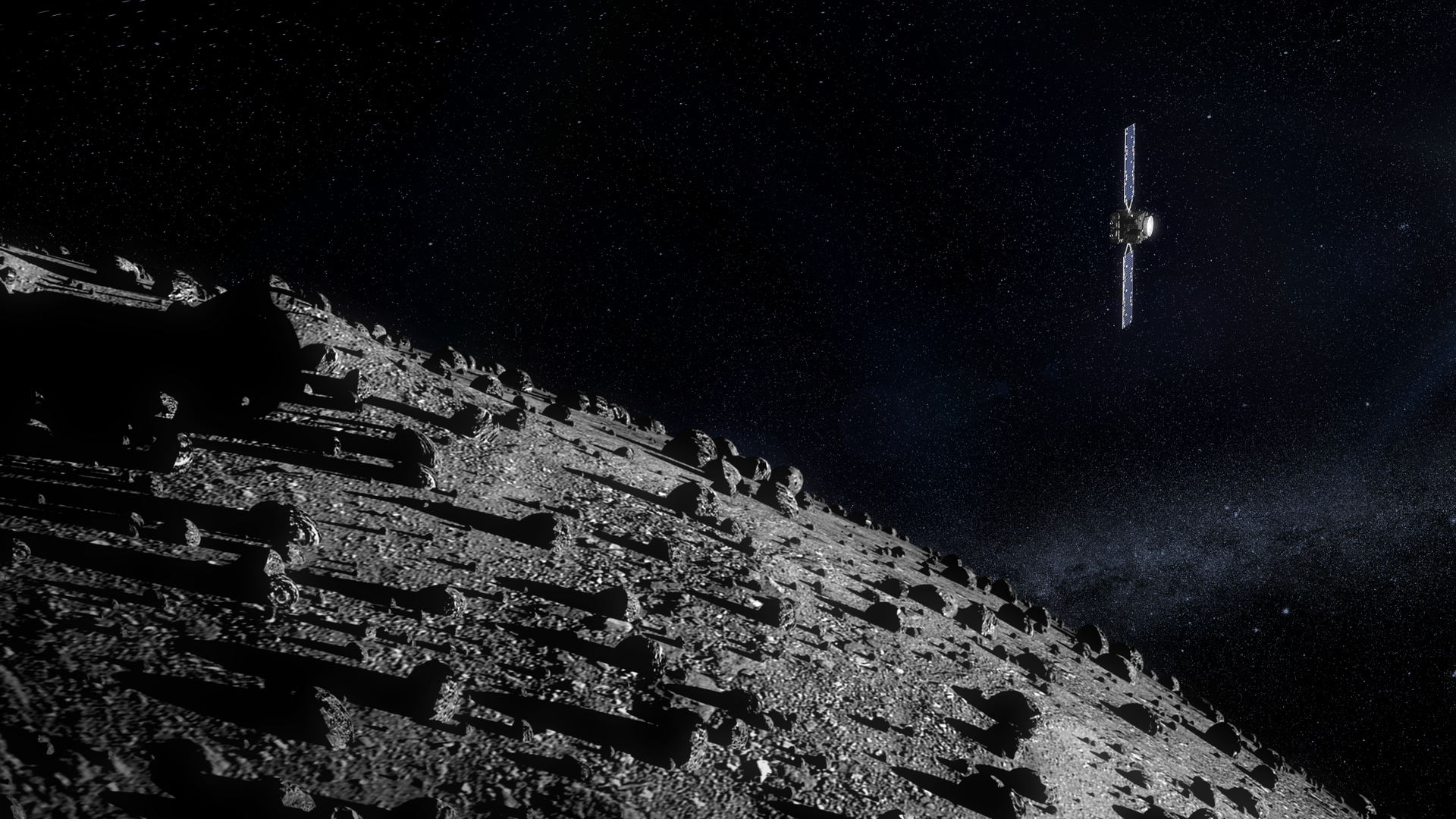
Dimorphos is about 151 metres (roughly 500 feet) across, according to ESA. DART, a car-sized spacecraft, struck it on September 26, 2022. Hera’s first views show that the impact did far more than leave a dent.
Patrick Michel, Hera’s principal investigator at the Côte d’Azur Observatory in Nice, France, said in ESA’s announcement that the face struck by DART “has been flattened into an impact crater the size of a sports stadium, which extends across the asteroid’s entire width.”
Sabina Raducan, a planetary scientist on the Hera science team, told the BBC: “The crater is almost as large as the body itself, which is really, really spectacular.” She added that it was hard to describe the excitement of finally seeing what happened and, as “a crater person,” she found it “beautiful.”
Michel told Ars Technica that researchers had expected one of two outcomes: either DART made a crater, or it reshaped the asteroid. “In fact, we did both because the crater is so large that the shape has changed,” he said. He described the result as a transition “between just cratering and global transformation,” and said scientists are “still not sure how this can happen.”
Euronews reported that the new images have a resolution of 2.7 metres per pixel and include a before-and-after comparison built from DART’s own final pictures. It also reported a thermal image from the Japanese TIRI instrument on Hera, credited to ESA and the Japanese space agency JAXA, that shows much hotter areas facing the Sun.
Michel told Euronews that the crater is huge, yet “it didn’t destroy the object, and there are things in the middle of it that we still don’t understand.” Why Dimorphos stayed in one piece is one of the main open questions. Euronews reported that scientists are wary of drawing quick conclusions, because bodies like this can behave so unlike everyday experience.
Dimorphos is tumbling instead of keeping one face to Didymos
The second major finding concerns motion. Before DART, Dimorphos behaved in an orderly way. Raducan told the BBC that it was “more like our own Moon,” always showing the same face to Didymos.
That is no longer true. “Now it’s very, very chaotic – it’s tumbling,” Raducan said. “Imagine a barrel that you throw down the stairs, and the barrel is rolling and it’s moving, and basically that’s what Dimorphos does right now around Didymos.”
Michael Kueppers, ESA’s Hera mission scientist, put it more briefly. “As Hera returned more images, it became clear that the DART impact has left Dimorphos tumbling wildly in its orbit,” he said, according to Ars Technica.
Michel gave Euronews more detail. Dimorphos, he said, does not rotate around a single axis. Sometimes the crater on the side facing the direction of rotation is visible, and sometimes it shifts to the other side. “So there has also been a significant destabilisation of its rotation,” he said. Euronews likened the moonlet to a boxer after a powerful punch.
Didymos, by contrast, appears unchanged in this respect. Ars Technica reported that Hera found the larger asteroid spinning on its axis just as DART had observed on its final approach in 2022.
The long-term behaviour of Dimorphos is unknown. Euronews reported that this uncertainty is one reason mission leaders want to bring Hera back to the system later, to check whether the orbit and rotation have changed over the years.
Hundreds of boulders turn the system into a crowded neighbourhood
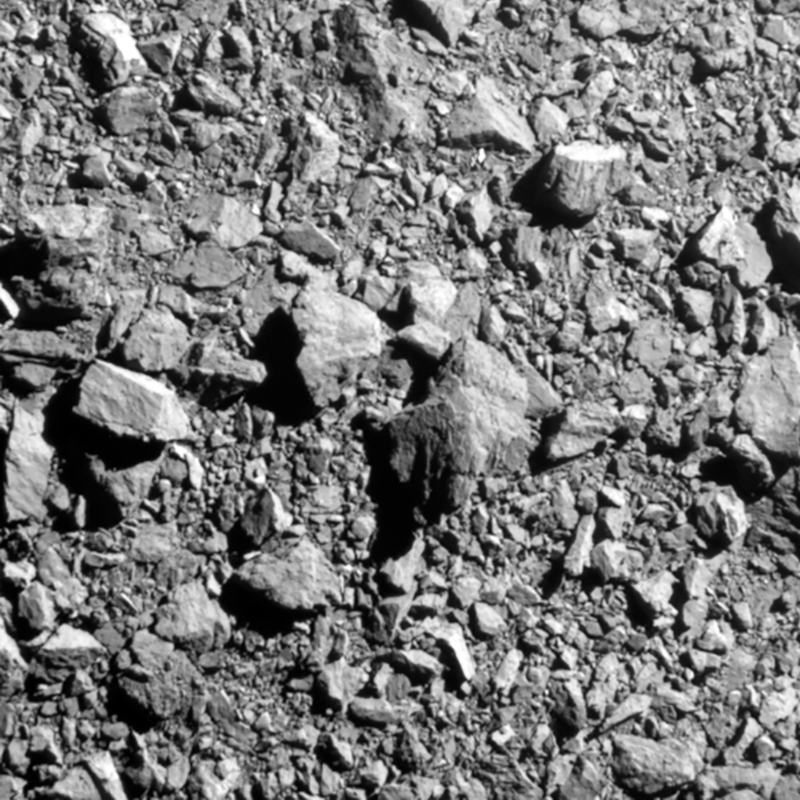
The third surprise is the debris. Hera’s early reconnaissance found hundreds of boulders moving around Didymos and Dimorphos. ESA released a composite of 11 long-exposure images from Hera’s Hyperscout-H instrument, taken on November 6 from about 29.9 kilometres (18.6 miles) away. Ground teams digitally removed the two bright asteroids, leaving dot trails that each represent a rock in motion.
A debris cloud was not itself a surprise. The Hubble Space Telescope photographed material streaming behind the pair soon after the 2022 impact, and the BBC reported that the impact produced a trail about 10,000 kilometres (6,200 miles) long. What astonished scientists, according to Ars Technica, was the size of the swarm.
“As we approached Didymos and Dimorphos, we quickly realized the asteroids were not alone,” said Naomi Murdoch, a planetary scientist at the Institut Supérieur de l’Aéronautique et de l’Espace in Toulouse, France. “In fact, they had a lot of company.” She added: “Hera came to visit two asteroids, and we found hundreds of companions.”
How big are the boulders?
The outlets describe the rocks somewhat differently, probably because they refer to different objects and different imaging distances:
- Ars Technica quoted Murdoch as saying the fragments range from the size of a football to that of a washing machine.
- Euronews reported lumps of debris up to a metre in size floating around the asteroid.
- The BBC reported boulders from tens of centimetres to metre-size rocks in the surrounding swarm.
- The BBC also reported that the smallest details visible in the Didymos images are about 3 metres across, so boulders seen on Didymos’s surface are at least that large, and some are up to 10 metres.
- Murdoch told the BBC that Hera can already see “boulders the size of cars and buses sitting on a world with almost no gravity.”
The drifting boulders, the surface boulders and the debris that DART might have thrown off are not necessarily the same population, and scientists have not said they are.
Did DART throw them all out?
The obvious explanation is that the impact flung the rocks off Dimorphos. Researchers are cautious. Ars Technica reported that scientists said they need more information before saying so with confidence. The debris might instead be a relic of how Dimorphos formed in the distant past.
A further clue complicates the picture. According to a summary of ESA’s announcement, boulder fields elsewhere on Dimorphos look much as they did in DART’s 2022 images, with no evidence of major surface change in those regions. A huge crater on one face and apparently little disturbance elsewhere is the combination that struck scientists, rather than the crater alone.
Murdoch said the team needs to characterise the boulders “to understand if they’re linked to DART, if they’re linked to another process, and what the consequences might be for other asteroid systems in the Solar System.” Hera is the first mission to study an asteroid that has its own moon over a sustained period.
An earlier Hera image, released on November 5 and reported by Popular Science, showed Didymos from about 37 miles (60 kilometres) away. It showed the opposite side from the one DART’s camera saw before impact, and Michel said it felt like “looking at a whole new world.” Popular Science reported that astronomers are curious how much of Didymos’s surface comes from debris thrown off by DART, given that only about half a mile separates the two bodies. That remains an open research question.
Why a quarter-mile-per-hour flyby still needs care
The boulder field complicates an already delicate operation. Hera’s current trajectory takes it around the asteroids at a relative speed of about a quarter of a mile per hour, or roughly 12 centimetres per second, Ars Technica reported. At that pace there is no danger of a sudden hypervelocity collision with a boulder.
The low speeds follow from the weak gravity. Murdoch told the BBC that gravity at Didymos’s surface is about 40,000 times weaker than on Earth. In that setting, everything moves slowly, including the hazards.
Weak gravity also makes outcomes hard to predict. Ars Technica noted that NASA’s OSIRIS-REx spacecraft kicked up an estimated six tons of rock and dust when it gently touched the asteroid Bennu to collect a sample in 2020. “Each time we interact with them, whether to take a sample or to make an impact, the response of the surface was not the one we predicted, simply because our intuition relies on what we experience every day on Earth,” Michel said.
Hera mission manager Ian Carnelli told Euronews: “It’s complete chaos… It’s completely different from what our brain would tell us rationally that these rocks should look like and behave.”
The CubeSat teams are worried and excited
The two small satellites Hera carries are most exposed to the debris. Both are shoebox-sized CubeSats, and both are scheduled to be released in January 2027.
Milani will study asteroid materials and the dust around the system. Its project manager, Margherita Cardi, said that images she saw “didn’t reassure me.” She described “a mix of excitement and panic” to Ars Technica and, in the Euronews account, called it “a nightmare.”
Juventas will probe the interior of an asteroid with radar and measure Dimorphos’s feeble gravity field before attempting a landing. Claudia Balossi, its spacecraft systems engineer, said its planned path runs close to the boulders. “We are right in the middle of it,” she said, adding that the smallest rocks are probably about as big as the CubeSat. If a boulder lands on it, she joked, the team would “activate our gravimeter right away.”
Michel told Euronews the next six months will bring “risky operations almost every month,” calling it “a bit like an Indiana Jones adventure, full of suspense.”
What the crater can and cannot say about asteroid deflection
DART’s headline result has not changed. It struck Dimorphos at roughly 6.14 kilometres per second, which Ars Technica gave as more than 13,700 mph and the BBC rounded to about 14,000 mph. The impact released about 10 billion joules of energy, according to Ars Technica. It shortened Dimorphos’s orbit around Didymos from 11 hours 55 minutes by about 33 minutes. Ars Technica said that was 25 times the most conservative expectation. Earth-based telescopes measured that change.
What Earth-based telescopes could not show was the asteroid’s mass, internal structure or what the impact did to its surface. That is Hera’s job. Michel said in an ESA statement that the mission is carrying out “a thorough investigation ever of a deflected asteroid” to give “a complete and unbiased picture of humankind’s first planetary defense test.”
The mass measurement is central. The BBC reported that it would show how effective DART’s push was. Simon Green, a planetary scientist on Hera’s science team, said it would help predict a future deflection: “We [could] measure its properties and say: ‘Well, we need this mass of spacecraft, travelling at this speed, this early, in order to deflect it enough so that it misses the Earth’.”
A stadium-sized crater is not, on its own, a manual for stopping a dangerous asteroid. One summary of ESA’s announcement made that point directly: further measurements are what should improve predictions. Ars Technica reported that asteroids vary in density and makeup, so knowing Dimorphos’s physical properties will anchor computer models used to test how to deflect different types.
Michel was optimistic about the payoff. “Once we understand, we have a breakthrough, which really solves planetary defense,” he told Ars Technica.
The threat the experiment is meant to prepare for
Carolyn Ernst of the Johns Hopkins Applied Physics Laboratory, who has worked on both DART and Hera, told the BBC the motivation is plain: “We all know what happened to the dinosaurs, right? And we don’t want that to happen to us.”
She offered reassurance as well. “The good news for us is that there are far fewer potential threats out there in the Solar System than there were millions of years ago. But there are objects out there.” The biggest asteroids, she said, have been spotted and none is heading for Earth. The uncertainty lies in a middle size range. “The smallest stuff isn’t too much of a threat because our atmosphere protects us,” she said, but in the middle range “we don’t know where all of them are.”
The BBC noted that asteroids of about Dimorphos’s size could wipe out a city, while those more than a kilometre across could cause global devastation. It also reported that NASA’s NEO Surveyor, a space telescope designed to track potentially hazardous asteroids, is due to launch in 2027.
Carnelli told Euronews he was proud that “space agencies, but also politicians and taxpayers, are taking a natural hazard very seriously.” He said he had fought for funding for Hera for a decade or more.
The schedule: closer passes, CubeSats and a possible extension
Hera launched on a SpaceX Falcon 9 from Cape Canaveral Space Force Station in Florida on October 7, 2024, and spent about two years travelling to the system, which currently sits about 193.5 million kilometres (120 million miles) from Earth. On the way it photographed Mars’s moon Deimos and caught Dimorphos casting a shadow on Didymos.
According to the available accounts, the plan runs as follows:
| When | What |
|---|---|
| November 25, 2026 | ESA releases first close-up views; Hera observes from roughly 25–30 km |
| December 2026 (planned) | Hera approaches to about 13 km |
| January 2027 (planned) | Hera deploys the Milani and Juventas CubeSats |
| Over about six months | Closer observations of both asteroids, including mass and structure |
The December approach and January deployment are planned, not guaranteed, given the debris. Ars Technica said the boulders are an added risk for the CubeSat deployment.
A proposed second chapter
Carnelli told Euronews that Hera still has plenty of propellant, which is why an extended mission is being considered. His idea is for Hera to leave in September, spend two years travelling around the solar system, make flybys of two more asteroids and then return to Didymos. Euronews reported that he is preparing to request funding, so the plan is a proposal and not an approved mission.
A return would let the team check whether the orbit and rotation have changed and whether surface features have shifted or eroded since the impact.
Other asteroid missions are also planned. The BBC reported that two spacecraft are due to visit Apophis, an asteroid about 450 metres long that will pass about 32,000 kilometres above Earth on April 13, 2029. One is NASA’s Osiris-Apex, and the other is Ramses, a joint ESA and JAXA mission. Apophis was discovered in 2004 and was once thought possibly dangerous. Scientists now say it will not hit Earth for at least the next 100 years.
Raducan summed up the state of knowledge in a line Ars Technica quoted: “We knew right away that the impact was successful, that DART made a really, really large mess. However, we didn’t really know what kind of mess.” Hera is now filling in that picture.
Frequently asked questions
What did the Hera spacecraft find at Dimorphos?
Hera’s first images show a stadium-sized crater that spans the width of Dimorphos. They also show that the moonlet is tumbling chaotically and that hundreds of boulders drift around it and Didymos. ESA released the images on November 25, 2026.
Is Dimorphos a danger to Earth?
No. Neither Dimorphos nor Didymos threatens Earth, and that is why they were chosen for NASA’s DART test. The experiment was a trial of a planetary-defence technique, not a response to an emergency.
Do scientists know where the boulders came from?
Not yet. The impact may have thrown them off Dimorphos, but they could also be leftovers from how the moonlet formed. Scientists say they need more data before settling the question.
What will Hera do next?
Hera will spend about six months moving closer to both asteroids and sending back higher-resolution images. It is scheduled to deploy two CubeSats, Milani and Juventas, in January 2027. A key goal is measuring Dimorphos’s mass to judge how effective DART’s push was.
References
- Watch live: Europe unveils 1st close-up views of asteroid Dimorphos after NASA — space.com
- ESA has released the first images of a deliberately dented asteroid — euronews.com
- Hera finds NASA’s asteroid crash test left a stadium-sized crater · Digg — digg.com
- Hera mission images from asteroid crash show stadium-sized crater — bbc.co.uk
- Hera spacecraft photographs asteroid from 37 miles away — popsci.com
- European spacecraft finds chaotic scene after asteroid deflection experiment — arstechnica.com
Featured image: (Image credit: ESA-Science Office) — via Space