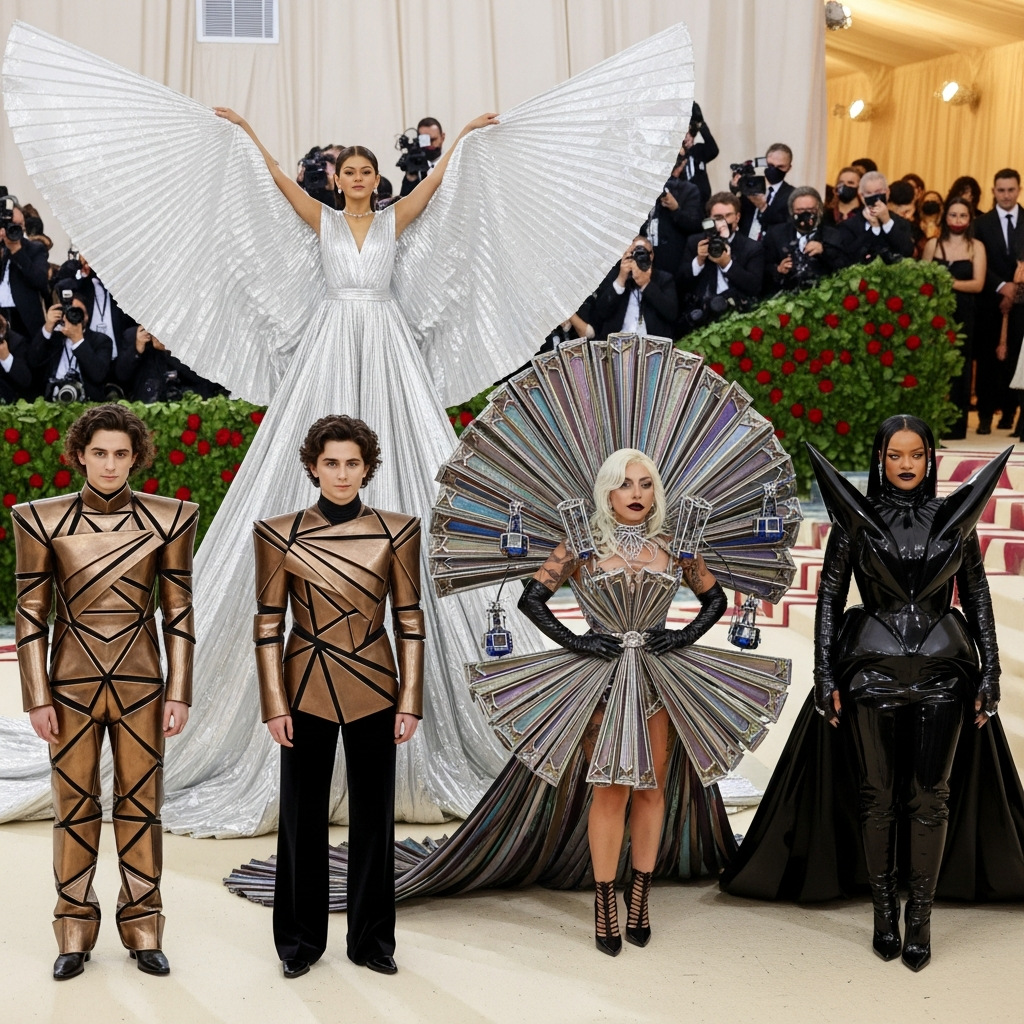
The Met Gala 2026, held on May 4th at the Metropolitan Museum of Art in New York City, redefined the intersection of fashion and fine art. This year’s highly anticipated event, a cornerstone fundraiser for the Met’s esteemed Costume Institute, challenged celebrities to embody a theme that promised boundless creativity: “Costume Art,” with an accompanying dress code of “Fashion is Art.” From avant-garde interpretations to breathtaking sculptural designs, the red carpet transformed into a living gallery, showcasing unparalleled glamour and artistic expression.
Fashion enthusiasts worldwide eagerly watched as global superstars, industry icons, and emerging talents delivered unforgettable statements. The gala, orchestrated by a powerful lineup of co-chairs, celebrated fashion as an inextricable part of artistic and cultural narratives, spanning eras from prehistory to the present.
The Grand Theme: “Costume Art” Unpacked
At its core, the Met Gala 2026 theme, “Costume Art,” served as a profound exploration of the relationship between garments and the human body within the broader context of Western art. The Metropolitan Museum of Art’s spring exhibition, from which the theme was drawn, curated a dialogue between The Costume Institute’s holdings and diverse art objects across the Met’s vast collection. Max Hollein, CEO and director of The Met, articulated that the exhibit aimed to elevate “universal and timeless themes” while introducing “new ideas and ways of seeing.”
Andrew Bolton, the Costume Institute’s curator in charge, provided further insight. He described the exhibition’s organization around “thematic body types,” including sections like “the Naked Body,” “the Classical Body,” “the Pregnant Body,” and “the Aging Body.” This expansive approach highlighted the “inextricable relationship between clothing and the body,” demonstrating how artistic representations are shaped by fashion, and conversely, how fashion is shaped by the bodies it adorns. The dress code, “Fashion is Art,” invited attendees to celebrate this rich interplay, encouraging personal and imaginative interpretations of the dressed body’s central role throughout art history.
Star-Studded Leadership: Guiding Fashion’s Biggest Night
The Met Gala 2026 was steered by an exceptionally powerful group of co-chairs, bringing together titans from music, film, sports, and fashion. Superstar Beyoncé made a highly anticipated return as a co-chair for the first time in a decade, joining acclaimed actress Nicole Kidman, tennis legend Venus Williams, and the event’s enduring visionary, Anna Wintour. This quartet set the tone for a night of innovation and impact.
Further bolstering the event’s leadership were honorary co-chairs Jeff Bezos and Lauren Sánchez Bezos, recognized for their significant sponsorship of both the gala and the exhibition. The host committee featured a diverse array of influential figures, including Saint Laurent creative director Anthony Vaccarello and actress Zoë Kravitz, alongside musicians Sabrina Carpenter, Doja Cat, LISA, Sam Smith, and Yseult; dancer Misty Copeland; and actors Teyana Taylor, Elizabeth Debicki, Gwendoline Christie, and Lena Dunham.
Not without its moments of political commentary, the gala saw some notable absences. New York City Mayor Zohran Mamdani and his wife, Rama Duwaji, chose not to attend, citing their focus on city affordability issues. The selection of Jeff Bezos as an honorary co-chair also sparked controversy, drawing criticism from an “anti-billionaire group.” Such discussions underscored the gala’s position not just as a fashion event, but as a cultural barometer often reflecting broader societal conversations.
Red Carpet Extravaganza: Decoding “Fashion is Art”
The red carpet of the Met Gala 2026 was a spectacle of sartorial daring, with celebrities embracing the “Fashion is Art” dress code in profoundly imaginative ways. Designers and their muses collaborated to translate classical art, sculpture, historical narratives, and abstract concepts into wearable masterpieces. Dramatic reveals, sculptural silhouettes, and intricate detailing became recurring themes, showcasing the limitless possibilities when fashion truly becomes art.
Iconic Arrivals & Artful Interpretations
Global icon Beyoncé arrived to roaring cheers with Jay-Z and their daughter Blue Ivy, marking Blue Ivy’s Met Gala debut at 14. Beyoncé herself captivated in a skeleton-inspired look, complete with a dramatic feather train, blending two popular stylistic choices of the evening. Fashionably late, as is tradition, Rihanna and A$AP Rocky closed out the red carpet. Rihanna, a perennial favorite, stunned in a glittering Maison Margiela creation, while A$AP Rocky opted for an elegant Chanel ensemble.
Kim Kardashian, attending her 13th Met Gala, fully embodied the theme with a structured orange outfit featuring a fiberglass top and accessorized with striking blonde hair. Model Irina Shayk pushed boundaries with an Alexander Wang design made entirely of watches, rings, and necklaces, eschewing traditional fabrics for a sculptural jewelry-based look. Olympic gold medalist Eileen Gu‘s Iris van Herpen bubble dress perfectly articulated her vision of “art in motion,” blending surrealism, sports, fashion, and femininity.
Many stars drew direct inspiration from art history:
Heidi Klum transformed into a hyper-realistic marble statue, channeling Raffaelle Monti’s 1860s “Veiled Lady.”
Broadway producer Jordan Roth wore a simple velvet dress, but it was a faceless statuette by Robert Wun emerging from his back, inspired by Jean-Léon Gérôme’s “Pygmalion and Galatea,” that truly captivated.
Lena Dunham‘s bold red Valentino gown, adorned with crows’ feathers and sequins, referenced Italian painter Artemisia Gentileschi’s “Judith Slaying Holofernes.”
Anne Hathaway’s black and white Michael Kors gown, hand-painted by Peter McGough, evoked ancient Greek pottery.
Lauren Sánchez Bezos graced the carpet in a navy satin mermaid gown by Schiaparelli, a direct homage to John Singer Sargent’s “Madame X.”
K-Pop star EJAE showcased Korean culture with a sculptural Swarovski gown, incorporating traditional binyeos (hairpins) and linking her look to the Venus sculpture.
Tennis legend Venus Williams wore a sparkling Swarovski gown inspired by Robert Pruitt’s “Venus Williams, Double Portrait,” weaving in themes of legacy and progress.
Singer Charli XCX‘s Saint Laurent gown featured a delicate handblown glass Iris flower, a direct tribute to Yves Saint Laurent’s 1988 couture show inspired by Van Gogh’s “Irises.”
Other notable looks included Janelle Monáe‘s breathtaking, sculpture-esque Christian Siriano design featuring robotic butterflies and cords, blurring the lines between nature and technology. Sam Smith delivered dramatic flair in a gem-encrusted Christian Cowan gown, topped with a towering feather fascinator. Kylie Jenner’s custom Schiaparelli dress played with illusion, featuring a nude corset with faux nipples, complemented by bleached eyebrows. K-Pop artist Lisa‘s glimmering Robert Wun gown was elevated by 3D-printed mannequin arms, modeled after her own and posed in Thai dancing positions, creating a truly unique spectacle. Katy Perry opted for a futuristic, all-white Stella McCartney gown with cigarette-like burns, a mirrored mask, and a silver grill, also presenting cryptic tarot cards on the red carpet.
The absence of Zendaya, a Met Gala fixture known for her on-theme looks (like Joan of Arc in 2018 or her double appearance as co-chair in 2024), was noted, though her stylist Law Roach attended. Meanwhile, a new wave of stars made their debuts, including “Heated Rivalry” actors Connor Storrie and Hudson Williams, singer Tate McRae, actress Sarah Pidgeon, and singer Sombr, each making their mark on fashion’s biggest night. Even athletes like Cincinnati Bengals quarterback Joe Burrow demonstrated their sartorial prowess, while Olympic stars Alysa Liu, Eileen Gu, and Lindsey Vonn added athletic grace to the artistic evening.
Menswear, often conservative, saw a vibrant shift towards artistic interpretation. Many male celebrities, including John Batiste (inspired by Barkley L. Hendrick), Russell Westbrook (cobalt blue denim jacket), Danny Ramirez (long tan suit jacket), and Ben Platt (eclectic Tanner Fletcher), embraced the theme with bold choices that strayed far from the traditional black tuxedo. Colman Domingo, a consistent menswear standout, impressed with a vibrant Valentino look influenced by Jean-Michel Basquiat.
Beyond the Red Carpet: Inside the Met Gala Experience
Once the dazzling red carpet concluded, the exclusive Met Gala experience continued inside the Metropolitan Museum of Art. After posing for photographs, guests enjoyed a lavish, catered dinner crafted by Olivier Cheng Catering and Events, typically featuring delicacies like a burrata appetizer, rack of lamb, and an array of exquisite desserts, as reported by Vogue.
Throughout the evening, performers took to the stage at the iconic Temple of Dendur. In past years, legends like Ariana Grande, Madonna, Rihanna, and Lady Gaga have entertained guests with unforgettable musical sets. Attendees also had the privilege of an exclusive preview of the “Costume Art” exhibition before its public debut on May 10th. However, glimpses inside the event itself remain rare due to the gala’s strict no-phone and no-social-media policy, a rule famously (and occasionally) bent by Kylie Jenner with a quick bathroom mirror selfie. This exclusivity adds to the mystique and allure of the Met Gala.
The Met Gala’s Enduring Legacy: Fundraising and Fashion History
Beyond the glamour, the primary purpose of the Met Gala is its role as the premier fundraiser for the Metropolitan Museum of Art’s Costume Institute. This annual event is crucial for supporting the Institute’s exhibitions, acquisitions, and operations. The previous year, the gala set a record, raising an astounding $31 million, underscoring its significant financial impact on the arts.
Anna Wintour, now Chief Content Officer for Condé Nast and Global Editorial Director of Vogue, remains the central figure, meticulously curating the guest list and ensuring each attendee aligns with the event’s prestige. With individual tickets priced at $100,000 per seat, or $350,000 for a table of ten, the Met Gala maintains its status as one of the most exclusive and coveted invitations in the world. For those unable to attend, Vogue’s sixth annual livestream, co-hosted by Ashley Graham, Cara Delevingne, La La Anthony, and Emma Chamberlain, provided a crucial window into the red-carpet arrivals, cementing the event’s global reach and cultural significance.
The Met Gala 2026 continued its tradition of setting new benchmarks in fashion as art. Recalling themes from recent years, such as 2025’s “Superfine: Tailoring Black Style,” 2024’s “Sleeping Beauties: Reawakening Fashion,” and 2023’s “Karl Lagerfeld: A Line of Beauty,” each gala adds a unique chapter to fashion history. The “Costume Art” theme pushed boundaries, inviting a deeply personal and artistic response from every attendee, solidifying the Met Gala’s place as an unparalleled celebration of creativity, culture, and philanthropy.
Frequently Asked Questions
What was the central concept behind the Met Gala 2026 theme “Costume Art”?
The “Costume Art” theme for the Met Gala 2026 was a comprehensive exploration of the relationship between clothing and the human body within Western art history, spanning from prehistoric times to the present. The Metropolitan Museum of Art’s accompanying exhibition organized displays around “thematic body types” (e.g., the Naked Body, the Classical Body, the Aging Body) to demonstrate the ubiquity and endurance of the dressed body across diverse cultures and artistic representations. It aimed to highlight the “inextricable relationship between clothing and the body,” showing how both influence and are shaped by the other.
Which high-profile individuals co-chaired the 2026 Met Gala alongside Anna Wintour?
The 2026 Met Gala featured a distinguished lineup of celebrity co-chairs. Joining Anna Wintour, the long-standing orchestrator of the event, were global music icon Beyoncé, acclaimed actress Nicole Kidman, and tennis superstar Venus Williams. Additionally, Amazon founder Jeff Bezos and Lauren Sánchez Bezos served as honorary co-chairs, recognizing their significant sponsorship of both the gala and its accompanying exhibition.
How did celebrities interpret the “Fashion is Art” dress code at the 2026 Met Gala?
Celebrities embraced the “Fashion is Art” dress code with diverse and often highly conceptual interpretations. Many drew direct inspiration from classical paintings and sculptures, with notable examples including Heidi Klum as a marble “Veiled Lady” and Jordan Roth’s tribute to “Pygmalion and Galatea.” Others explored abstract artistic concepts like movement, surrealism, or body modification, such as Eileen Gu’s bubble dress and Irina Shayk’s jewelry-only ensemble. Personal narratives and cultural representation, as seen in Maluma’s Colombian-inspired suit and EJAE’s Korean binyeo accessories, also played a key role, showcasing fashion as a canvas for profound storytelling and artistic expression.