North Korea Unleashes Ballistic Missiles, Escalating Regional Tensions
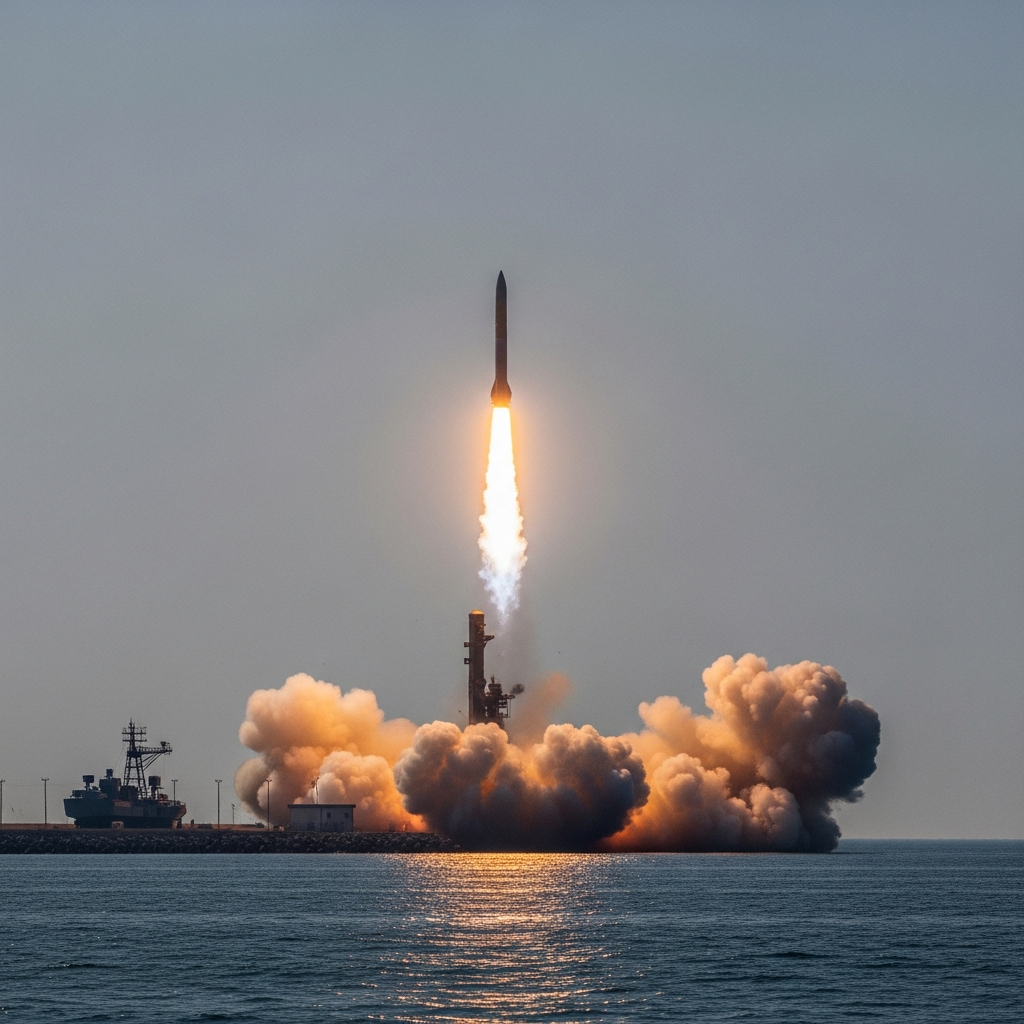
On a recent Sunday, North Korea fired multiple short-range ballistic missiles into its eastern waters. This significant North Korea missile launch immediately triggered alarms across the region. The event came just days after the International Atomic Energy Agency (IAEA) issued a stern warning. The agency highlighted “very serious” advancements in North Korea’s nuclear weapons program. These launches underscore Pyongyang’s unwavering commitment to expanding its military might. They also pose a direct challenge to international peace and security.
South Korea, the United States, and Japan swiftly condemned the actions. South Korea’s Joint Chiefs of Staff confirmed the launches. They originated from North Korea’s Sinpo area. The missiles each flew approximately 140 kilometers (87 miles). They traveled towards the country’s eastern maritime zone. South Korea has affirmed its robust readiness against any provocations. It is closely exchanging intelligence with its allies.
A Deliberate Test: New Warheads and Operational Readiness
This wasn’t just another routine test. North Korea’s state media, KCNA, later revealed the specific objectives. The launches aimed to verify the “characteristics and power of cluster bomb warhead and fragmentation mine warhead.” These warheads are designed for the Hwasongpho-11 Ra surface-to-surface tactical ballistic missile. Leader Kim Jong Un personally oversaw the test. His daughter, Ju-ae, was also reportedly present. This presence signals the profound importance Pyongyang places on these developments.
According to KCNA, five projectiles were launched. They hit an island target roughly 136 kilometers (85 miles) away. The agency boasted that the missiles impacted a vast area. It claimed 12.5 to 13 hectares (or 31 to 32 acres in another report) were struck with “very high density.” Kim Jong Un expressed “great satisfaction” with the results. He stated these cluster bomb warheads would “boost the high-density striking capability.” They enhance the precision striking capability for specific target areas. This development, he noted, was the productive outcome of a five-year dedicated effort.
Strategic Reach and Rejection of Diplomacy
The implications of these cluster bomb warheads are profound. Analysts like Hong Min from the Korea Institute for National Unification noted the missiles’ range. It places South Korea’s capital, Seoul, and key U.S. military installations within striking distance. This system appears designed to bridge the gap. It fills the space between multiple rocket launchers and short-range ballistic missiles. Yang Moo-jin, a professor at the University of North Korean Studies, pointed out another critical detail. Frontline corps commanders observed this test. This suggests the system is nearing “operational deployment.” It implies a direct launch capability from forward positions. These positions could target South Korea and U.S. bases. Approximately 28,000 American troops are stationed in South Korea.
South Korea considers these repeated ballistic missile tests as clear provocations. Seoul has consistently urged Pyongyang to halt such actions. It calls for engagement in peace efforts. However, North Korea’s latest tests are seen as a stark rejection of these overtures. This stance persists despite South Korea’s recent expressions of regret. These concerned civilian drone incursions earlier in the year. Pyongyang initially seemed to welcome the sentiment. Yet, it quickly reverted to labeling the South its “most hostile” enemy state. Neither North nor South Korea are signatories to the 2008 Oslo Convention. This international treaty bans cluster bombs.
The Shadow of Submarine-Launched Missiles
A crucial element under investigation is the launch platform. South Korea’s military is analyzing whether the missiles came from a submarine, a land-based launcher, or both. The launch site, Sinpo, is particularly significant. It’s an eastern coastal city. Sinpo hosts a major shipyard used for building submarines. If a submarine launch (SLBM) is confirmed, it would mark North Korea’s first in four years.
Such a development is profoundly worrying for regional security. SLBMs are incredibly difficult for rivals to detect in advance. This stealth capability enhances a nation’s second-strike potential. It complicates defense strategies for adversaries. Adding to these concerns, North Korea unveiled a nuclear-powered submarine under construction last year. This ongoing naval modernization, potentially aided by Russia, strengthens their underwater capabilities.
Kim Jong Un’s Unwavering Nuclear Ambition
Sunday’s launches are part of a growing pattern. They represent the latest in North Korea’s intensified weapons tests this year. Just the previous week, Kim Jong Un reportedly supervised missile tests from a destroyer. In an earlier week, North Korea conducted three days of testing activities. These examined ballistic missiles armed with cluster-bomb warheads. They also tested other new weapons systems. Last month, Pyongyang announced testing an upgraded solid-fuel engine. This engine is for missiles capable of reaching the U.S. mainland.
Kim Jong Un has relentlessly focused on enlarging his nuclear and missile arsenals. This strategy intensified after the collapse of his high-stakes nuclear diplomacy with former U.S. President Donald Trump in 2019. While Trump has expressed a desire for renewed dialogue, Kim maintains a precondition. He insists Washington must drop demands for North Korea’s nuclear disarmament.
Nuclear Program Accelerates Amid Geopolitical Shifts
The international community’s concerns about North Korea’s nuclear program are mounting. IAEA Director General Rafael Grossi recently provided a sobering assessment. He confirmed a “rapid increase” in activities at North Korean nuclear manufacturing facilities. Grossi stated these activities point to a “very serious increase” in its nuclear weapons production capabilities. Many outside observers echo this view. They note North Korea’s efforts to expand its main Yongbyon nuclear complex. They also cite the construction of additional uranium-enrichment sites. Last September, South Korea’s then-Unification Minister confirmed four such facilities were operating daily.
The timing of these launches carries significant diplomatic weight. They occurred just hours before South Korean President Lee Jae Myung departed. He left for official visits to India and Vietnam. Some observers believe North Korea’s recent testing activities are strategic. They are likely meant to increase Pyongyang’s leverage. This applies to future dealings with the U.S. A rescheduled Trump-Xi Jinping summit in Beijing in May could provide a diplomatic opening. North Korea aims to position itself advantageously.
Furthermore, North Korea’s military modernization appears to be accelerating. A South Korean lawmaker, citing satellite imagery, revealed this. Pyongyang is reportedly receiving military technology assistance from Russia. This exchange occurs as North Korea provides ground troops and artillery shells. These resources support Russia’s invasion of Ukraine. This “quid pro quo” arrangement complicates the regional security landscape. It further entrenches North Korea’s defiant stance against international sanctions.
International Condemnation and Future Outlook
The U.S. Indo-Pacific Command reaffirmed its unwavering commitment. It pledged to defend the U.S. homeland and its allies in the region. Japan’s Defense Ministry lodged a strong protest with Pyongyang. Tokyo asserts these launches threaten regional and international peace. They also violate numerous U.N. Security Council resolutions. These resolutions strictly ban all ballistic missile activities by North Korea. Despite these sanctions, Pyongyang consistently disregards international prohibitions.
Frequently Asked Questions
What specific type of missile and warhead did North Korea test recently?
North Korea recently tested the Hwasongpho-11 Ra surface-to-surface tactical ballistic missile. The test focused on verifying the characteristics and power of new cluster bomb and fragmentation mine warheads. These sophisticated warheads are designed to enhance the missile’s ability to strike a target area with very high density and precision, according to North Korean state media.
Why is a potential submarine launch from Sinpo a significant concern for regional security?
A submarine-launched ballistic missile (SLBM) test from Sinpo, a major submarine construction site, is a serious concern because underwater launches are notoriously difficult for adversaries to detect in advance. This stealth capability grants North Korea a more robust second-strike option, making pre-emptive defense more challenging for South Korea, Japan, and the United States, thereby heightening regional security instability.
How do North Korea’s recent missile tests connect to broader diplomatic efforts or lack thereof?
North Korea’s recent missile launches are widely interpreted as a rejection of diplomatic overtures, particularly from South Korea. While former U.S. President Donald Trump has expressed interest in resuming dialogue, Kim Jong Un insists on denuclearization demands being dropped as a precondition. These tests are likely aimed at increasing Pyongyang’s leverage ahead of potential future negotiations, such as a possible Trump-Xi Jinping summit, and to solidify its position as a nuclear-armed state.
Conclusion: A Persistent Challenge to Global Stability
North Korea’s latest ballistic missile launches are a stark reminder of its escalating military ambitions. The development of advanced cluster munitions and the potential for submarine-launched capabilities present a grave threat. These actions destabilize regional security and defy international norms. The international community, led by South Korea, the U.S., and Japan, remains vigilant. Efforts to counter these provocations and pursue denuclearization continue. However, Pyongyang’s increasing defiance, coupled with external military assistance, signals a complex and challenging path forward for global stability. The world watches closely as North Korea continues its aggressive pursuit of enhanced military power.