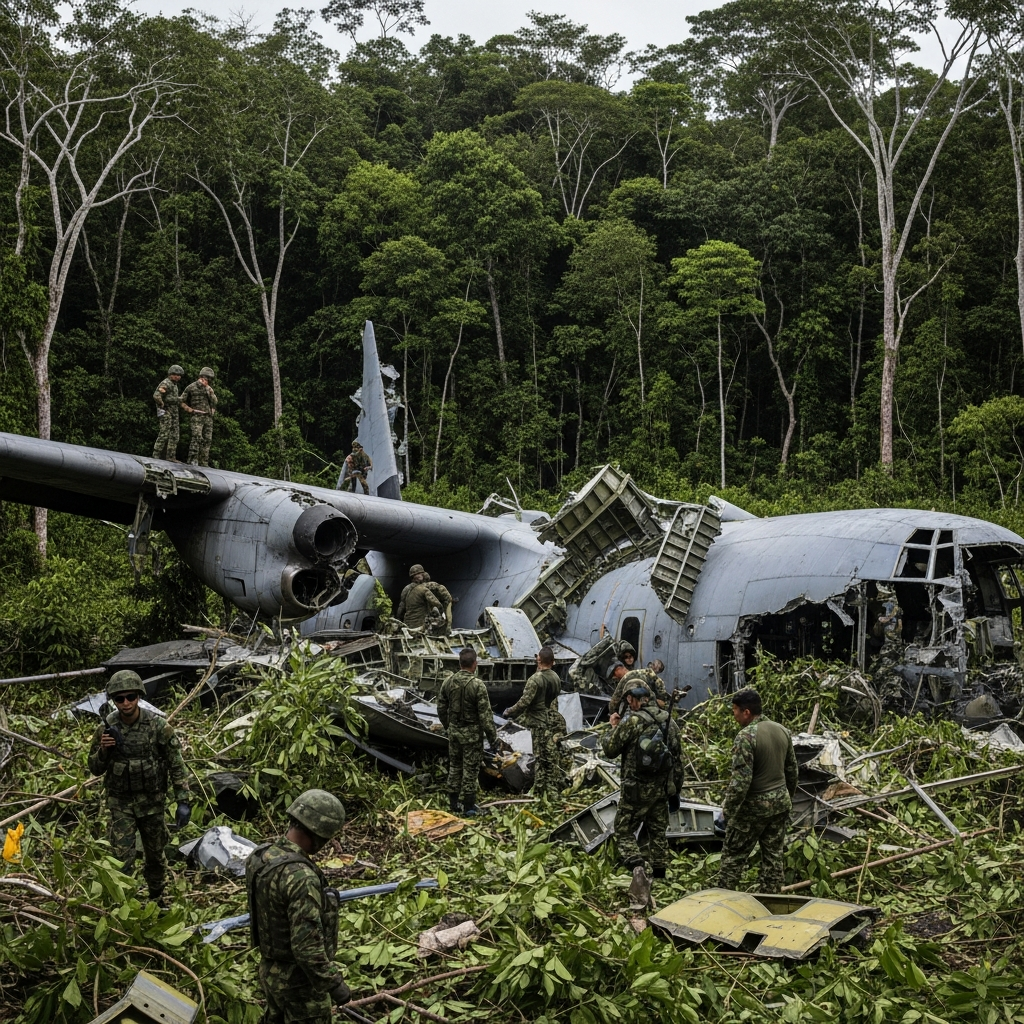
On March 23, 2026, a tragic Colombia military plane crash claimed at least 66 lives, sending shockwaves across the nation. A Lockheed Martin C-130 Hercules transport aircraft, carrying 128 individuals, went down shortly after takeoff from Puerto Leguízamo, a remote town in the Amazonian province of Putumayo. This devastating incident, which also left dozens injured and four military personnel missing, marks one of the deadliest aviation accidents in Colombia’s recent history. Authorities have swiftly initiated an investigation, emphasizing that initial evidence points to an accident rather than an external attack, despite the region’s known presence of illegal armed groups.
The Tragic Incident Unfolds in Putumayo
The ill-fated military transport plane departed from Puerto Leguízamo, situated near Colombia’s borders with Ecuador and Peru, with its primary mission to carry troops to another city within Putumayo. Just moments into its flight, the aircraft experienced a critical problem, descending rapidly approximately two kilometers (1.2 miles) from the airport. Eyewitnesses and local media captured images of a significant black cloud of smoke rising from the crash site, which scattered burning wreckage across a field surrounded by dense foliage. Defense Minister Pedro Sánchez confirmed the situation, describing the event as “profoundly painful for the country.”
The impact of the crash was compounded by the detonation of ammunition on board the aircraft. This secondary event caused the plane to erupt further in flames and emit thick black smoke, hindering initial rescue efforts. The remote nature of Puerto Leguízamo, while challenging, saw an immediate, heart-wrenching response from the local community.
Immediate Aftermath and Heroic Civilian Aid
In the chaotic moments following the crash, local residents demonstrated remarkable courage and solidarity. Images and videos shared online showed civilians actively assisting in the rescue efforts. Many rushed to the scene on motorcycles, transporting injured soldiers from the wreckage to the town’s two small clinics. Others bravely attempted to extinguish the raging fires that had engulfed the plane’s remains.
Deputy Mayor Carlos Claros commended the people of Puerto Leguízamo for their invaluable assistance. He noted that the victims’ bodies were taken to the town’s morgue, while the injured received critical initial treatment before being airlifted to larger cities for specialized medical care. This immediate, grassroots response underscored the deep impact of the tragedy on the close-knit community.
Emergency Response and Casualties Confirmed
Following the crash, a massive emergency response was quickly mobilized. General Hugo Alejandro López Barreto, head of Colombia’s armed forces, confirmed the grim toll of at least 66 fatalities. The casualties included 58 soldiers, six air force personnel, and two police officers. Four military personnel remained unaccounted for, sparking ongoing search operations.
Out of the 128 individuals on board – comprising 115 Army personnel, 11 crew members, and two National Police officers – 57 were successfully evacuated from the crash site. Air Force Commander Carlos Fernando Silva swiftly dispatched two planes, equipped with a total of 74 beds, to evacuate the wounded. These aircraft transported injured personnel to major hospitals in the capital, Bogota, and other regions, ensuring they received advanced medical attention. Ambulances also played a crucial role in transferring injured passengers to Bogota’s Central Military Hospital.
Investigation Underway: Focus on Mechanical Failure
The Colombian authorities have launched a comprehensive investigation into the exact cause of the Colombia military plane crash. General Hugo Alejandro López Barreto and Defense Minister Pedro Sánchez were quick to address initial concerns regarding potential foul play. Both officials explicitly stated that there were no indications of an “attack by illegal actors” or “illegal armed group.” This clarification was significant given the region’s history of rebel group activity.
Colombian Air Force Commander Carlos Fernando Silva reiterated that details of the crash were still emerging. He confirmed only that the plane “had a problem and went down.” Erich Saumeth, a Colombian aviation expert and military analyst, provided critical insights into the aircraft itself. The Hercules C-130 involved in the incident had been donated by the United States to Colombia in 2020. Importantly, it underwent a thorough overhaul in 2023, which included engine inspections and the replacement of key components.
Saumeth expressed skepticism that the crash stemmed from a lack of good parts. He emphasized the crucial need for investigations to determine why the Hercules’ four turboprop engines failed so rapidly after takeoff, leading to its quick descent. Lockheed Martin, the manufacturer of the C-130, has also pledged its full commitment to assisting Colombia with the ongoing inquiry.
Political Commentary and Military Modernization Debate
The tragic Colombia military plane crash quickly became a flashpoint for political discussion. President Gustavo Petro leveraged the accident to highlight his long-standing campaign for the modernization of the country’s military aircraft and equipment. On X (formerly Twitter), Petro labeled the crash a “horrendous accident that should not have happened.” He attributed delays in his modernization plans to “bureaucratic difficulties,” asserting, “I will allow no further delays, the lives of our young people are at stake.” The President suggested that any civilian or military administrative officials found to be impeding these efforts should be held accountable and potentially removed.
However, President Petro’s statements also drew criticism. Opponents argued that budget cuts under his administration had led to a reduction in flight hours for military aircraft. This, they suggested, could result in less experienced crews, potentially compromising operational safety. The incident thus reignited a broader debate about military funding, readiness, and the bureaucratic hurdles facing essential equipment upgrades.
The C-130 Hercules in Context
The Lockheed Martin C-130 Hercules, first launched in the 1950s, has been a workhorse for air forces globally, including Colombia’s, which acquired its first models in the late 1960s. These robust transport planes are vital for moving troops and supplies, especially in rugged terrain like Colombia’s Amazonian region, which is crucial for its ongoing internal conflict. Colombia has reportedly modernized some of its older C-130s with newer models transferred from the United States. This incident, while tragic, is not isolated, as just last month, another C-130 belonging to the Bolivian air force crashed in El Alto, killing over 20 people and injuring 30, underscoring the inherent risks associated with military aviation.
Frequently Asked Questions
What caused the Colombia military plane crash on March 23, 2026?
The exact cause of the Colombia military plane crash is still under investigation. Authorities, including General Hugo Alejandro López Barreto and Defense Minister Pedro Sánchez, have stated there is no evidence to suggest an attack by illegal armed groups. Initial reports indicate the C-130 Hercules experienced a “problem” shortly after takeoff, leading to its rapid descent. Aviation experts are focusing on why the aircraft’s four engines may have failed so quickly, especially given that the plane underwent a comprehensive overhaul in 2023.
How many people were on board the crashed military plane, and what were the casualties?
The military transport plane had 128 individuals on board. This included 115 Army personnel, 11 crew members, and two National Police officers. The crash resulted in at least 66 confirmed fatalities, comprising 58 soldiers, six air force personnel, and two police officers. Additionally, dozens of people were injured, and four military personnel were reported missing following the incident. Fifty-seven people were successfully evacuated from the crash site.
What has been the political reaction and impact on military modernization efforts in Colombia?
The crash prompted strong reactions from Colombian President Gustavo Petro, who linked the tragedy to “bureaucratic difficulties” hindering his long-standing efforts to modernize the military’s equipment and aircraft. He vowed to remove officials if they obstructed these crucial upgrades. Conversely, critics of the Petro administration argued that budget cuts had reduced military aircraft flight hours, potentially leading to less experienced crews. The incident has thus intensified the national debate surrounding military funding, operational readiness, and the urgency of equipment modernization.
A Nation Mourns and Seeks Answers
The Colombia military plane crash in Puerto Leguízamo represents a profound loss for the nation’s armed forces and its people. As rescue efforts transition to recovery and the meticulous investigation continues, Colombia grapples with the immense human cost of this tragedy. The emphasis remains on understanding the precise sequence of events that led to the C-130 Hercules’ fatal descent, ensuring accountability, and implementing measures to prevent similar disasters in the future. Defense Minister Sánchez encapsulated the national sentiment, expressing hope that prayers could help relieve some of the pain inflicted by this deeply sad event for the country.