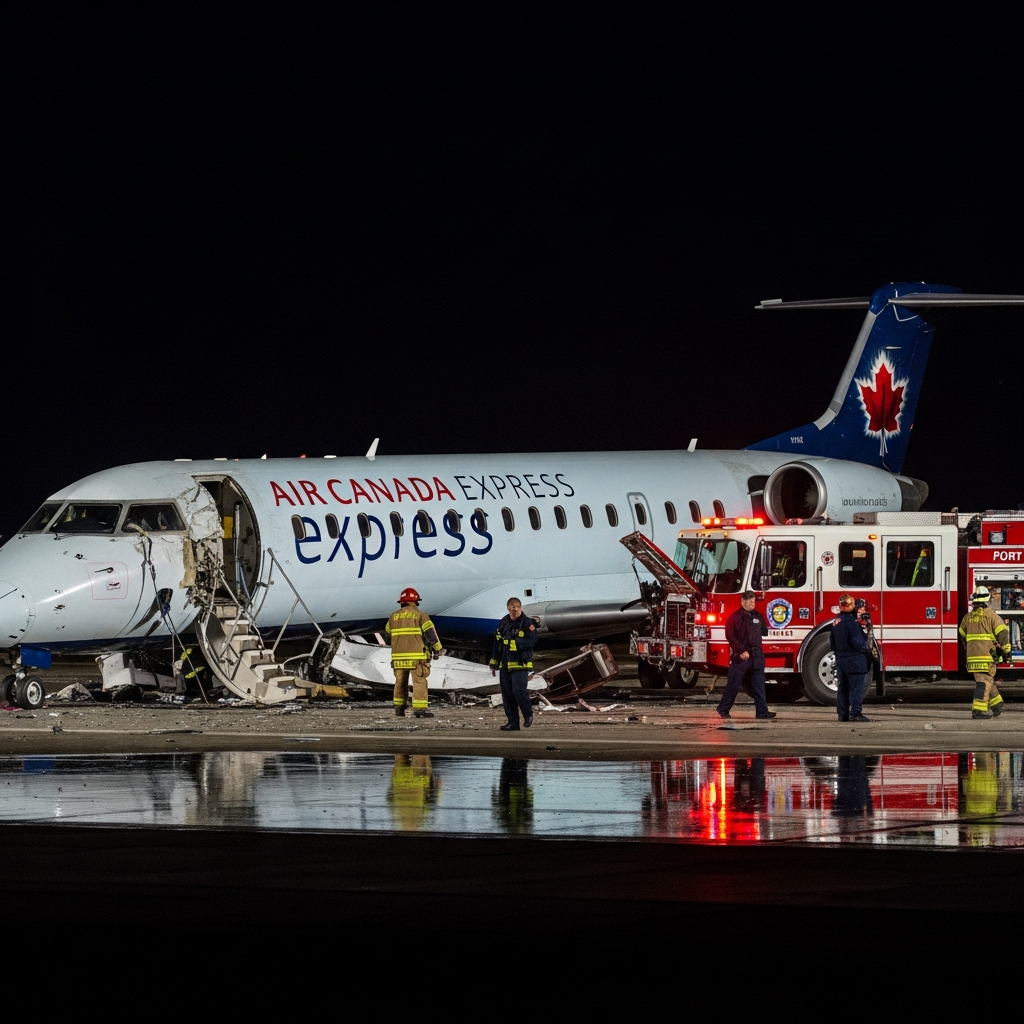
The late hours of Sunday night, March 23, 2026, cast a somber shadow over New York City’s LaGuardia Airport. A routine landing turned into an unimaginable catastrophe when an Air Canada Express regional jet, Flight 8646, collided with a Port Authority fire truck directly on Runway 4. This devastating LaGuardia airport collision claimed the lives of both pilots and left dozens of passengers and crew members injured, marking LaGuardia’s first fatal crash in over three decades. The incident plunged one of the nation’s busiest airports into chaos, triggering an immediate and extensive investigation into the causes of this profound aviation tragedy.
The runway accident, which occurred around 11:45 p.m. ET, sent shockwaves through the aviation community and raised urgent questions about airport safety protocols and air traffic control procedures. As authorities work to piece together the events of that fateful night, the industry grapples with the human cost and potential systemic implications of such a rare and severe ground collision.
The Catastrophic Night at LaGuardia: An Overview
Air Canada Express Flight 8646, operated by Jazz Aviation, was completing its journey from Montreal-Trudeau International Airport (YUL) with four crew members and 72 passengers aboard. The flight had been cleared to land on Runway 4 at LaGuardia, an arrival that should have been routine. However, the unexpected presence of a Port Authority Aircraft Rescue and Firefighting (ARFF) vehicle on the runway transformed a standard procedure into a deadly impact.
Preliminary data from FlightRadar24 revealed the CRJ-900 jet was traveling between 93 and 105 mph when it struck the fire truck. The force of the impact was immense, crushing the nose section of the aircraft. Emergency responders quickly flooded the scene, confronting a chaotic environment as passengers attempted to evacuate onto the aircraft’s wing amidst the confusion.
A Detailed Timeline Unfolds: The Moments Before Impact
Investigators are meticulously reconstructing the precise sequence of events leading up to the LaGuardia airport collision. Air traffic control (ATC) audio recordings and video footage have become critical pieces of evidence.
Just moments before the collision, the ARFF vehicle was responding to a separate incident. United Flight 2384 had aborted its takeoff earlier that night due to a warning light and reported an odor in the cabin, prompting a request for firefighters.
11:17 p.m. ET: United 2384 cleared for takeoff.
11:18 p.m. ET: United 2384 aborts takeoff.
11:20 p.m. ET: United 2384 reports an odor and requests firefighters, returning to the gate.
11:31 p.m. ET: United 2384 declares an emergency due to the odor.
Approximately 11:35 p.m. ET: Air Canada Flight 8646 is cleared to land on Runway 4.
11:36 p.m. ET: The fire truck requests and receives permission from the LaGuardia Tower to cross Runway 4 at taxiway Delta.
11:37 p.m. ET: Approximately 10 seconds later, the air traffic controller issues urgent, repeated commands: “Stop, stop, stop truck one, stop. Stop, stop…. Stop truck one, stop.”
11:37 p.m. ET: The Air Canada plane touches down.
Approximately 11:38 p.m. ET: The devastating collision occurs.
11:38 p.m. ET: The controller issues the first “go around” command, directing other incoming planes to abort landings.
The air traffic controller, visibly distraught in recordings, later acknowledged, “I messed up,” to a pilot on a ground frequency. This audio is a key focus for investigators examining potential air traffic control error as a contributing factor. Adding to the hazardous conditions, there was mist and fog at LaGuardia during the incident, which could have affected visibility.
Chaos and Courage on Board the Aircraft
Inside Air Canada Flight 8646, the landing felt “hard” before a “very loud boom” jolted passengers from their seats. Witnesses described immediate chaos and screaming. Passengers, including Jack Cabot and Rebecca Liquori, recounted striking their heads and seeing others bleeding. Without clear direction from the crew, many passengers made the independent decision to open emergency exits and evacuate onto the wing of the tilting aircraft.
Video footage captured by passengers vividly depicted the desperate moments, with individuals navigating the wing as debris hung from the plane’s front. The scene underscored the sheer terror and the instinctive human desire for survival in the face of sudden disaster. The quick, albeit unguided, evacuation likely prevented further injuries or fatalities.
Human Cost: Lives Lost, Dozens Injured
The most tragic outcome of the LaGuardia incident was the loss of life. Both the pilot and copilot of Air Canada Flight 8646 were killed. Identified as Antoine Forest and his copilot, these “young men at the start of their careers,” as described by FAA Administrator Bryan Bedford, dedicated their lives to aviation. The Air Line Pilots Association (ALPA) expressed profound sorrow, emphasizing the pilots’ commitment to safe transport.
Beyond the fatalities, the collision resulted in a significant number of injuries. Over 43 individuals were hospitalized, with many since released, though some sustained serious injuries. Port Authority Executive Director Kathryn Garcia confirmed that two Port Authority firefighters in the truck, Sgt. Michael Orsillo and Officer Adrian Baez, also suffered injuries, though not life-threatening. They were hospitalized, with one kept overnight for observation.
Remarkably, one flight attendant, Solange Tremblay, survived being ejected from the aircraft while still strapped to her seat. Her daughter confirmed she suffered multiple fractures and required surgery for a broken leg, calling her survival “a miracle.”
The Investigation Begins: Piecing Together the Puzzle
A comprehensive investigation into the LaGuardia airport collision is now underway, led by the National Transportation Safety Board (NTSB) with crucial assistance from Canadian authorities due to the aircraft’s Canadian carrier. NTSB Chair Jennifer Homendy confirmed the retrieval of both the cockpit voice recorder (CVR) and flight data recorder (FDR) from the plane. The CVR was found undamaged, promising vital audio insights into the cockpit’s final moments. Both recorders are being analyzed at NTSB labs in Washington, D.C.
A primary focus of the NTSB’s inquiry is the role of air traffic control. Specifically, investigators aim to determine the number of controllers on duty at the time and the procedures followed. Transportation Secretary Sean Duffy, in a news briefing, noted that while LaGuardia Airport is “well-staffed,” it still faces “shortages” of air traffic controllers—a statement highlighting potential staffing complexities. The intersection of ATC commands, the fire truck’s movement, and the landing aircraft’s trajectory will be meticulously scrutinized.
The accident site on Runway 4 remains closed for several days following the incident. This closure is essential for NTSB investigators to thoroughly document and collect the extensive debris, which is considered vital evidence. Additionally, surveillance video has been collected to aid the reconstruction of events. This intricate process of determining the root cause of an aircraft accident can often take a year or longer, frequently revealing multiple contributing factors.
Broader Implications for Aviation Safety
The LaGuardia airport collision occurs amidst heightened scrutiny of the aviation industry, following several high-profile aviation incidents. While there’s no direct evidence linking this collision to broader issues like the Department of Homeland Security funding shutdown (which has impacted TSA staffing but not air traffic controllers, who are still paid), the incident inevitably reignites discussions about runway safety and overall operational resilience. The FAA and NTSB are committed to using lessons learned from this tragedy to enhance safety measures and prevent future occurrences.
LaGuardia Airport: Disruption and Recovery
The immediate aftermath of the collision saw LaGuardia Airport operations grind to a halt. The airport was entirely shut down before partially reopening Monday afternoon with a single operational runway. This caused widespread disruption, leading to hundreds of flight cancellations and significant delays. Runway 4, the site of the collision, is expected to remain closed for investigative purposes until Friday morning, March 28, 2026. Airlines waived rebooking fees as stranded passengers faced overnight waits and uncertain travel plans, highlighting the ripple effect of such a significant event on a major transit hub that serves over 32 million passengers annually.
Frequently Asked Questions
What caused the deadly LaGuardia Airport collision between the plane and fire truck?
The exact cause of the LaGuardia Airport collision is under extensive investigation by the National Transportation Safety Board (NTSB). Preliminary findings indicate that an Air Canada Express jet, cleared to land, struck a Port Authority fire truck that had initially received permission to cross the runway but was then urgently told to stop by air traffic control. Investigators are examining air traffic control communications, staffing levels, visibility conditions (including mist and fog), and potential procedural lapses to determine the precise sequence of events and contributing factors.
How many casualties resulted from the LaGuardia runway accident?
The tragic LaGuardia runway accident resulted in two fatalities: the pilot and copilot of Air Canada Express Flight 8646. Additionally, over 43 passengers and crew members sustained injuries, with some requiring hospitalization. Two Port Authority firefighters in the truck involved in the collision also suffered non-life-threatening injuries. While many of the injured have since been released, the incident left a significant human toll.
What measures are being taken to investigate and prevent future LaGuardia incidents?
The NTSB is leading a comprehensive investigation into the LaGuardia incident, with support from the FAA and Canadian authorities. Key steps include retrieving and analyzing the cockpit voice recorder (CVR) and flight data recorder (FDR), meticulously documenting the crash site on Runway 4, collecting surveillance video, and scrutinizing air traffic control audio and procedures. The goal is to identify all contributing factors to this specific airport collision and implement recommendations to enhance runway safety and operational protocols, minimizing the risk of similar occurrences in the future.
Conclusion: Lessons from a Runway Tragedy
The deadly LaGuardia airport collision serves as a stark reminder of the complexities and inherent risks within the highly intricate world of aviation. The tragic loss of two pilots and the injuries sustained by many underscore the critical importance of every safety protocol, communication, and human decision. As the NTSB’s comprehensive investigation progresses, the findings will be crucial not only for understanding this specific event but also for shaping future safety enhancements across the global aviation industry. The commitment to continuous improvement in air traffic control error prevention, runway safety protocols, and emergency response remains paramount to ensuring the safest possible skies and airport operations for all.