The International Space Station (ISS) recently buzzed with activity as NASA astronauts Jessica Meir and Chris Williams ventured into the vacuum of space for a critical ISS spacewalk. This extravehicular activity (EVA), which took place on March 18, 2026, was essential for upgrading the orbiting laboratory’s power system, laying the groundwork for advanced solar arrays. The mission, however, carried a dramatic backstory, having been significantly delayed by an unprecedented medical evacuation.
This pivotal spacewalk not only marked a major step in the station’s ongoing maintenance but also served as a testament to the resilience and adaptability of human spaceflight operations. It underscored the relentless pursuit of scientific advancement and orbital infrastructure improvements, even in the face of unexpected challenges.
The Mission: Powering the Future of the ISS
NASA astronauts Jessica Meir, undertaking her fourth spacewalk, and Chris Williams, on his inaugural EVA, successfully completed a 7-hour, 2-minute spacewalk on March 18, 2026. This monumental effort represented the first U.S. spacewalk in nearly a year and kicked off Expedition 74’s external operations. Their primary objective: to prepare the International Space Station for a vital power upgrade.
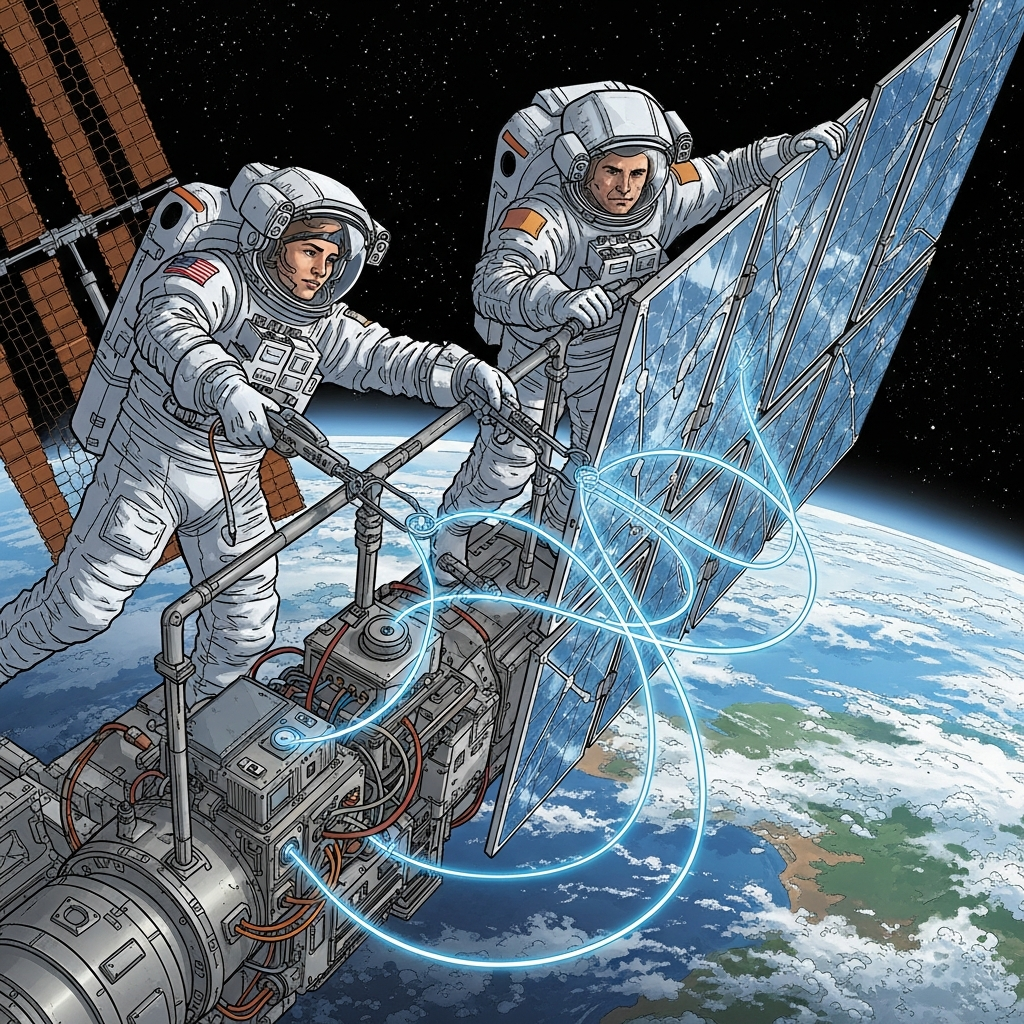
Venturing out from the Quest airlock, the duo diligently worked on the port side of the ISS’s backbone truss. Their main task involved assembling and attaching a robust bracket structure, a modification kit explicitly designed to support an iROSA (International Space Station Roll-Out Solar Array). While the iROSA panel itself will be installed during a subsequent spacewalk, this preparatory work is absolutely crucial. Once installed, this will be the seventh of eight planned rollout arrays, a significant enhancement project that began in 2021.
Why iROSA Technology is a Game-Changer
The new iROSA panels represent a leap forward in space-based power generation. Unlike the station’s original, bulkier solar wings, these innovative arrays are smaller, more efficient, and don’t rely on complex motors for deployment. Instead, the potential energy stored within their rolled-up carbon composite booms allows them to unfurl to an impressive 63-foot (19-meter) length in about six minutes. This elegant design simplifies installation and offers superior performance.
The need for these advanced arrays is pressing. The ISS’s original solar arrays have gracefully exceeded their 15-year service life and are showing signs of degradation. Once all eight iROSAs are fully operational, they are projected to boost the station’s electricity supply by a remarkable 20% to 30%. This surge in power is indispensable. It will support expanded commercial activities aboard the station, facilitate its future transition to commercially operated space platforms, and further enable critical scientific research. The proven iROSA technology has already demonstrated its versatility, having been successfully used for deep-space missions, including the Double Asteroid Redirection Test (DART) in 2022.
Beyond the Main Objective: Detailed Spacewalk Tasks
During their time outside the orbital outpost, Meir and Williams meticulously handled several other important tasks. Chris Williams meticulously documented the gears of the port-side Solar Array Rotating Joint (SARJ), a mechanism vital for allowing the solar wings to precisely track the sun. Simultaneously, Jessica Meir installed an electrical jumper, specifically designed to enable robotic servicing of components for the 2A power channel. Due to the demanding schedule, a few non-critical tasks, such as swabbing for microorganisms and installing a lens cover on a Canadarm2 camera, were prudently deferred to a later EVA. This strategic prioritization ensures the most vital upgrades are completed efficiently.
An Unprecedented Delay: The Human Element in Space
The successful completion of this spacewalk on March 18, 2026, came after a significant and unusual delay. The EVA was originally slated for January 8, 2026, with a different crew: NASA astronauts Mike Fincke and Zena Cardman. However, those plans were abruptly halted due to an urgent “medical concern with a crew member.”
This health issue escalated rapidly, leading to the first-ever medical evacuation in the long and distinguished history of the International Space Station. The entire four-person Crew-11 contingent had to depart from the ISS on January 15, 2026, approximately a month earlier than scheduled. More than a month after their return to Earth, it was confirmed that Mike Fincke was the astronaut who experienced the undisclosed health issue. While neither Fincke nor NASA has released specific details about the concern, both parties have reassuringly stressed that the astronaut is doing well.
This extraordinary event highlighted the inherent risks and complexities of human spaceflight, where the well-being of crew members takes absolute precedence. The delayed NASA spacewalk and the subsequent rescheduling of another similar EVA underscore the meticulous planning and flexibility required for sustained operations in low Earth orbit.
Astronauts’ Reflections: A Legacy of Exploration
The recent spacewalk held deep personal significance for both astronauts. For Chris Williams, it was a momentous first step outside humanity’s orbital home, marking the culmination of years of rigorous training. For Jessica Meir, it was her fourth foray into the void, bringing her cumulative time working in the vacuum of space to an impressive 28 hours and 46 minutes. Meir is also notably remembered for her participation in the world’s first all-female spacewalk in 2019.
Reflecting on the mission, Meir shared her profound experience. She highlighted the historical context, noting that March 18 marked the 61st anniversary of Alexei Leonov’s pioneering first spacewalk, a truly iconic moment in human history. Meir eloquently conveyed the “enormity of venturing outside the hatch” and described her fourth spacewalk as particularly special because she shared the experience with a first-timer, seeing it as “passing the torch to the next generation of explorers.” Drawing inspiration from Leonov’s perspective of feeling like a “grain of sand in the universe,” Meir concluded, “The view is always better when you are sharing it with a friend,” beautifully emphasizing the profound and shared nature of their challenging yet inspiring endeavor.
The International Space Station: A Quarter-Century of Discovery
The International Space Station, celebrating over 25 years of continuous human presence, remains a beacon of international collaboration and scientific discovery. Orbiting Earth at approximately 260 miles high, this colossal structure serves as a crucial testbed for scientific research in microgravity, pushing the boundaries of human knowledge in countless fields.
The ISS is a truly global effort, operated through a partnership of leading space agencies, including NASA, Roscosmos, the European Space Agency (ESA), the Japan Aerospace Exploration Agency (JAXA), and the Canadian Space Agency (CSA). Since its inception, it has hosted over 280 spacefarers from 26 countries, including 170 from the United States alone. Physically, the station is an astonishing 356 feet long – surpassing the size of a six-bedroom house. It boasts six sleeping quarters, two bathrooms, a gym, a 360-degree view bay window, and enough docking ports to accommodate up to eight spacecraft simultaneously. This orbital marvel continues to facilitate groundbreaking science and prepare humanity for future deep-space missions to the Moon and Mars.
The Vital Role of Spacewalks (EVAs)
In the intricate world of space operations, a spacewalk is officially termed Extravehicular Activity (EVA). This term encompasses any task an astronaut performs outside of a space station or spacecraft. Such activities are fundamental for the assembly, maintenance, and upgrade of orbital infrastructure. Spacewalks are inherently challenging, requiring astronauts to don specialized suits and endure direct exposure to the extreme vacuum and radiation of outer space. Without these critical EVAs, the longevity and functional capabilities of the ISS, and indeed any complex orbital habitat, would be severely limited.
Looking Ahead: Continued Upgrades and Future Missions
The successful spacewalk on March 18, 2026, marks just one step in the ongoing effort to enhance the ISS. Another spacewalk with similar objectives, focusing on further iROSA installations, is slated for the near future. This subsequent EVA was also a direct consequence of the Crew-11 medical evacuation, having originally been planned for January 15, 2026. NASA officials will announce the astronauts involved and the specific target date for this second spacewalk after today’s successful completion.
These continuous upgrades are vital for maintaining the ISS as a cutting-edge research platform and a cornerstone for future human exploration. They align with NASA’s broader vision, which includes the ambitious Artemis program aiming to return humans to the Moon and eventually journey to Mars. Lessons learned from ISS operations, including the need for robust power systems and adaptable mission planning, directly inform these future endeavors. The agency is prioritizing astronaut safety and a sustainable cadence for lunar missions, as evidenced by recent revisions to the Artemis III schedule. The future of space exploration is bright, driven by both technological innovation and the unwavering human spirit of discovery.
Frequently Asked Questions
What was the main purpose of the recent ISS spacewalk by Jessica Meir and Chris Williams?
The primary objective of the March 18, 2026, spacewalk by NASA astronauts Jessica Meir and Chris Williams was to prepare the International Space Station (ISS) for a crucial power upgrade. Specifically, they installed a modification kit and bracket structure to support the future installation of an iROSA (International Space Station Roll-Out Solar Array). This work is part of an ongoing project to replace the station’s aging solar arrays, aiming to boost its electricity supply by 20% to 30%, which is vital for expanded commercial activities and continued scientific research.
Why was the ISS spacewalk delayed from its original schedule?
The spacewalk, originally planned for January 8, 2026, was delayed due to an unprecedented medical evacuation from the International Space Station. A then-unnamed member of SpaceX’s Crew-11 experienced a medical issue, leading to the entire crew’s early departure on January 15, 2026. This marked the first medical evacuation in ISS history. It was later revealed that astronaut Mike Fincke was the crew member affected, though details of his condition were not disclosed, with assurances that he is doing well.
How do the new iROSA solar arrays enhance the International Space Station’s capabilities?
The new iROSA (International Space Station Roll-Out Solar Array) panels significantly enhance the ISS’s capabilities by providing a substantial upgrade to its power generation system. These advanced arrays are more efficient and compact than the original solar wings, deploying using stored potential energy rather than motors. Once all iROSAs are installed, they are projected to increase the station’s electricity supply by 20% to 30%. This boosted power is crucial for supporting future commercial activities, facilitating the transition to commercially operated space stations, and enabling more extensive scientific research in microgravity.