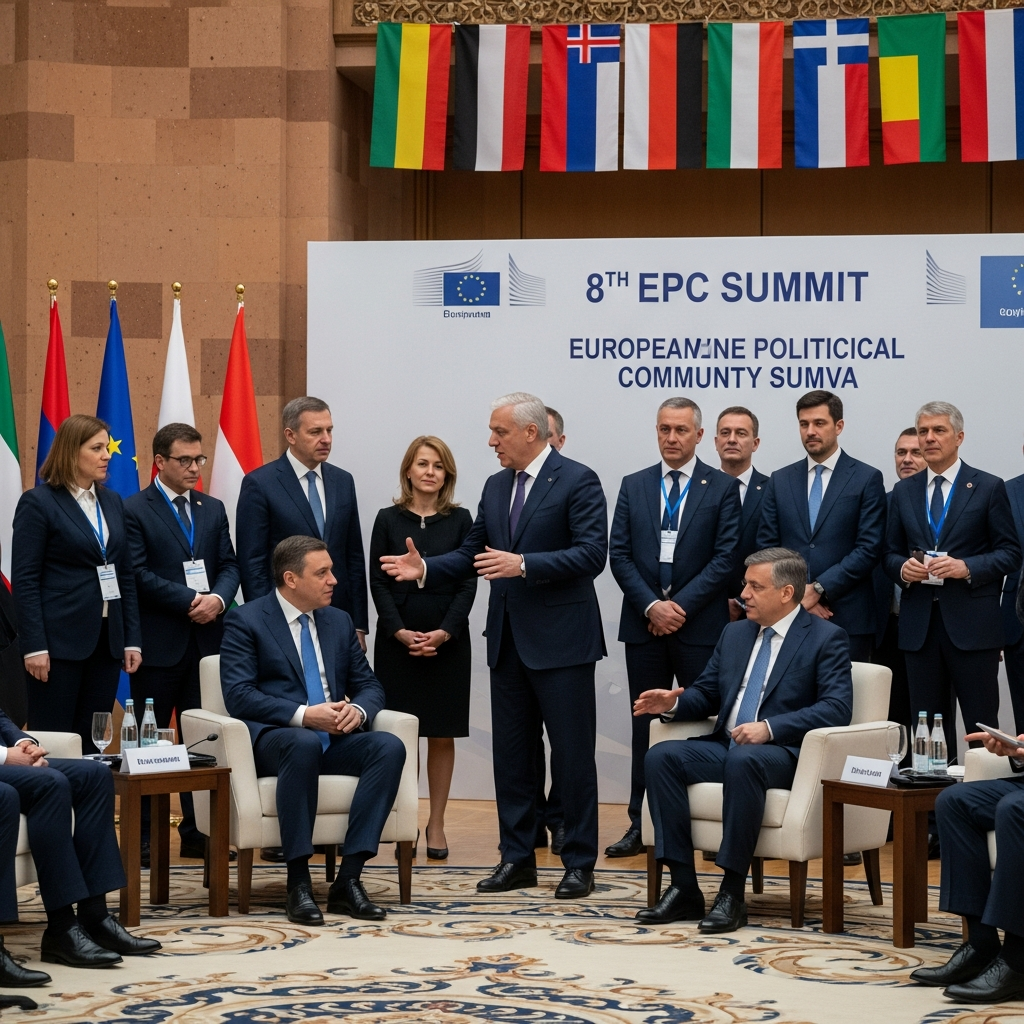
World leaders have converged in Yerevan, Armenia, for the 8th European Political Community (EPC) summit, a pivotal gathering set to redefine European cooperation amidst profound geopolitical shifts. This landmark meeting positions Armenia at the heart of European political discourse, signaling its growing ambition for closer ties with the European Union. Leaders from nearly 50 countries are engaging in face-to-face discussions on critical issues, from regional stability to global governance, under the theme ‘Building the Future: Unity and Stability in Europe’. The summit highlights the evolving landscape of European politics and Armenia’s strategic pivot.
A Historic Gathering in the South Caucasus
The vibrant capital of Yerevan is playing host to the largest assembly of European leaders ever seen in the South Caucasus. This significant event, the 8th European Political Community summit, underscores the region’s increasing relevance in broader European strategic conversations. Leaders began arriving on Sunday, May 3rd, 2026, ahead of the main discussions scheduled for Monday, May 4th. The sheer scale of participation, involving heads of state and government from across the continent, emphasizes the EPC’s growing role as a crucial forum.
Leaders Converge: A Snapshot of Power
The roster of attendees at the European Political Community summit reads like a who’s who of global diplomacy. Among the prominent figures welcomed in Yerevan were Ukrainian President Volodymyr Zelenskyy, French President Emmanuel Macron, British Prime Minister Sir Keir Starmer, and Polish Prime Minister Donald Tusk. The summit is co-chaired by European Council President António Costa and Armenian Prime Minister Nikol Pashinyan, highlighting a shared commitment to the agenda. European Commission President Ursula von der Leyen and European Parliament President Roberta Metsola are also present, demonstrating comprehensive EU representation.
Notably, Canadian Prime Minister Mark Carney is attending as a guest, marking the very first time a non-European country has formally participated in the EPC meeting. President Costa emphasized the deepening bond, stating, “Europe and Canada are more than just like-minded partners – together we are building a global alliance to defend peace, shared prosperity and multilateralism.” This signals a broadening perspective on European strategic alliances, particularly as traditional relationships with the United States evolve.
The EPC’s Mission: Unity in a Changing World
The European Political Community (EPC) was established in 2022, following Russia’s full-scale invasion of Ukraine. It serves as an essential intergovernmental forum for political and strategic discussions about the future of Europe. Its inaugural meeting took place in Prague in October 2022. Conceived by Brussels as a tool to counter Russia, the EPC aims to foster coordination on crucial issues. Josep Borrell, then EU High Representative, articulated its objective: “send a signal to Russia of a new world order without it.”
Today, the EPC comprises 47 participating states, collectively representing a formidable demographic and economic force. These nations are home to 689.5 million people, making up 8.7 percent of the global population. They also contribute approximately 23.5 percent of the world’s Gross Domestic Product (GDP). This vast reach positions the EPC as a significant platform for addressing shared challenges and promoting stability across the continent. Discussions at the Yerevan EPC summit are centered on safeguarding peace, prosperity, and multilateralism in an era of profound geopolitical transformation.
Armenia’s Strategic Pivot Towards Europe
Armenia’s role as the host nation for this significant European Political Community summit is no accident. It clearly underscores the former Soviet nation’s determined ambition for closer European ties. Yerevan’s strategic decision to welcome such a high-profile gathering represents a deliberate effort to gradually distance itself from Russia and integrate more deeply into the European sphere. This move follows a historic peace agreement between Armenia and Azerbaijan, as both countries are now visibly embarking on a more pro-European course.
Beyond the Summit: Yerevan’s EU Ambitions
In conjunction with the EPC summit, Yerevan is concurrently hosting the first-ever EU-Armenia summit. This dual event provides a powerful platform for Armenia to articulate its readiness for closer integration. Olesya Vartanyan, an expert security analyst on the South Caucasus, views the EU summit as Armenia’s declaration: “we are here and we are ready.” It’s a clear message to Brussels that Armenia is serious about strengthening its European connections.
Under the leadership of Prime Minister Nikol Pashinyan, Armenia has formally adopted a strategy of “diversification.” This approach sees the landlocked country actively pursuing ties with both Russia and the West. Political scientist Alexander Iskandaryan clarified this dynamic, stating, “In reality it’s a process where Armenia tries to establish relationships with the European Union.” The country of three million people, strategically located between Europe and Asia, has been steadily solidifying these relationships.
Diversification and Geopolitical Balancing Act
Armenia’s commitment to European integration is evident in concrete actions. In 2017, the country signed a comprehensive partnership agreement with the European Union, deepening cooperation in critical areas like trade. More recently, last year, Armenia formally adopted a law declaring its intention to apply for full EU membership. During her visit to Armenia in March, EU Enlargement Commissioner Marta Kos emphasized this burgeoning relationship, declaring that “Armenia and the EU have never been closer.”
This strategic shift isn’t without its complexities. While seeking closer Western ties, Armenia must navigate its historical relationships, particularly with Russia. The presence of such a prominent European forum in Yerevan, however, unequivocally signals Armenia’s determined trajectory. It indicates a clear intent to reshape its foreign policy orientation and secure its future within a broader European framework, balancing existing alliances with new opportunities. Russia, through its Foreign Minister Sergei Lavrov, acknowledged Armenia’s hosting intentions earlier, expressing hope it would be “understood and accepted with respect,” referencing Russia’s own respect for CIS and CSTO allies.
Key Discussions and Unfolding Dynamics
The 8th European Political Community summit in Yerevan serves as a vital arena for high-level political dialogue. Leaders are focusing on critical regional and global issues, fostering cooperation, and collectively addressing shared challenges across the European continent. The discussions aim to enhance coordination and collaboration in crucial areas such as security, stability, and economic cooperation.
Addressing Global Tensions and Regional Stability
The agenda for the Yerevan EPC summit is packed with pressing geopolitical concerns. Discussions include ongoing US-Iran tensions and the broader landscape of geopolitical transformation. Ukrainian President Volodymyr Zelenskyy is expected to hold several sideline meetings, underscoring the ongoing focus on the conflict in Ukraine and its wider implications for European security. The participation of Canadian Prime Minister Mark Carney also highlights evolving international alliances. Carney, at the World Economic Forum, spoke of a “rupture” in the US-led system of global governance, emphasizing the need for middle powers to chart new paths and defend key international values. This sentiment reflects the shifting relationship between Europe, Canada, and the United States, particularly under the Trump administration.
While the summit emphasizes unity, notable absences also shape its dynamics. German Chancellor Friedrich Merz will not be attending due to other work commitments, a detail communicated by a government spokesperson. Furthermore, there were no confirmed reports of representatives from Azerbaijan or Turkey arriving for the event, countries with significant geopolitical relevance to the South Caucasus region and the broader European context. This highlights the complex, multi-layered nature of diplomacy in the region.
The EPC’s Growing Influence: Numbers and Reach
The European Political Community’s rapid growth since its inception in 2022 demonstrates its increasing influence as a key platform for European dialogue. Its collective strength, encompassing 47 states and a substantial portion of the global population and GDP, enables it to tackle complex issues with a unified voice. From its first meeting in Prague, the EPC has solidified its role as an essential forum for addressing the future of Europe, both within and beyond the traditional EU framework. This summit in Yerevan further cements its importance, bringing together diverse European nations to deliberate on shared challenges and forge common pathways forward. The collective engagement in Armenia underscores a concerted effort to fortify European stability and influence on the global stage.
Frequently Asked Questions
What is the primary purpose of the 8th European Political Community (EPC) summit in Armenia?
The main purpose of the 8th European Political Community summit in Yerevan, Armenia, is to facilitate high-level political dialogue among nearly 50 European leaders. Established in 2022 after Russia’s invasion of Ukraine, the EPC serves as an intergovernmental forum for strategic discussions on Europe’s future. The summit aims to enhance coordination, discuss critical geopolitical issues like US-Iran tensions, and address shared challenges, promoting unity and stability across the continent. It provides a platform for leaders to engage face-to-face and collectively shape European policy.
Why is Armenia hosting the EPC summit and what does it signal for its future?
Armenia’s decision to host the 8th EPC summit, alongside the first-ever EU-Armenia summit, is a clear strategic move to deepen its ties with Europe. It signals Yerevan’s intention to gradually distance itself from Russia and integrate further into the European sphere. This proactive step aligns with Prime Minister Nikol Pashinyan’s “diversification” strategy, which aims to cultivate relationships with both the West and Russia. Hosting this event unequivocally demonstrates Armenia’s commitment to a pro-European course and its readiness to actively participate in European political discourse.
Which notable leaders attended the Yerevan EPC summit, including non-European participants?
The Yerevan EPC summit attracted a significant roster of international leaders. Key attendees included Ukrainian President Volodymyr Zelenskyy, French President Emmanuel Macron, British Prime Minister Sir Keir Starmer, and Polish Prime Minister Donald Tusk. European Council President António Costa and Armenian Prime Minister Nikol Pashinyan co-chaired the event. A unique aspect was the participation of Canadian Prime Minister Mark Carney, marking the first time a non-European country joined the EPC meeting, highlighting broader alliances. Leaders from nearly 50 countries, including all 27 EU members, converged for the discussions.
Conclusion
The 8th European Political Community summit in Yerevan represents a crucial moment for European unity and Armenia’s strategic trajectory. By hosting this significant gathering, Armenia has firmly placed itself on the European political map, signaling its earnest desire for closer integration with the European Union. The summit’s discussions, ranging from global tensions to regional stability, underscore the EPC’s vital role as a platform for dialogue in a rapidly changing world. The diverse assembly of leaders, including unprecedented non-European participation, reinforces the evolving nature of international alliances. As Europe navigates complex geopolitical landscapes, the outcomes and commitments forged in Yerevan will undoubtedly help shape the continent’s future, promoting cooperation, stability, and a stronger collective voice.