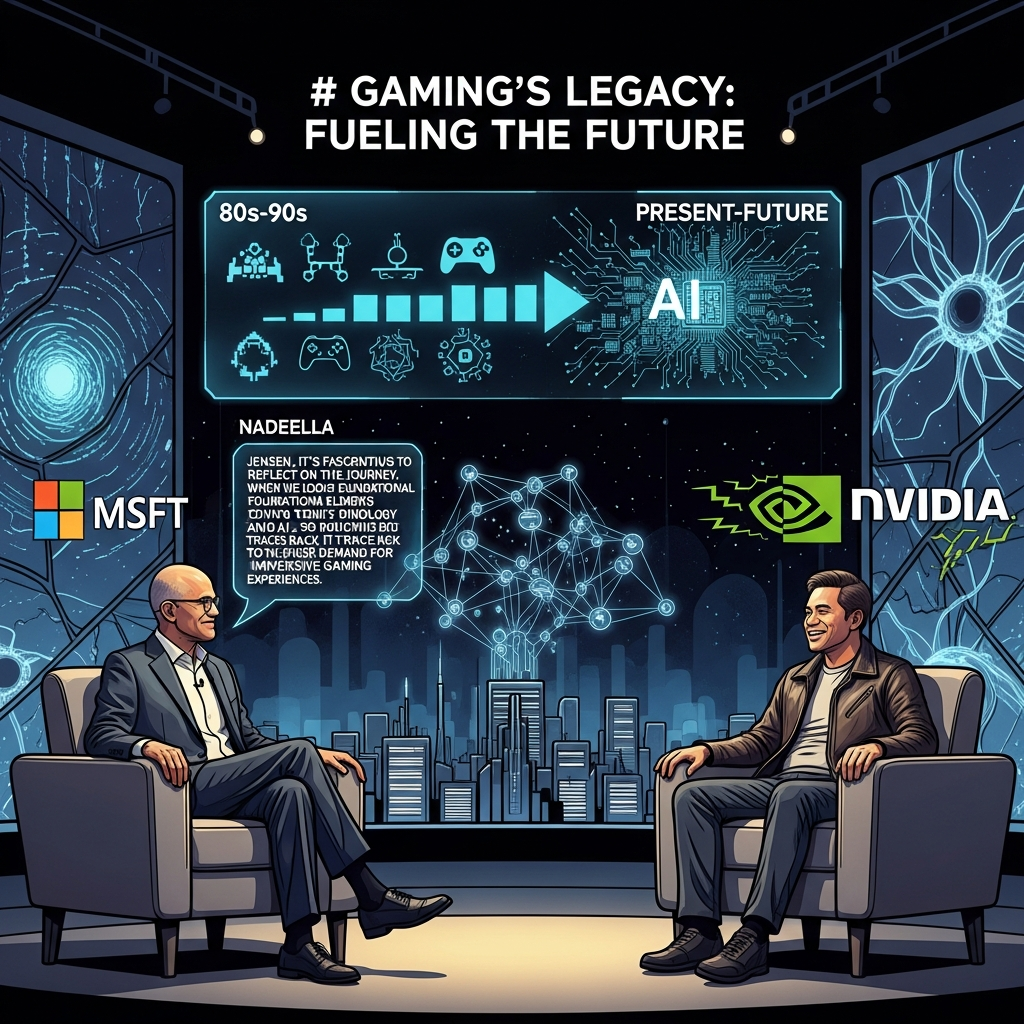
Microsoft CEO Satya Nadella recently offered a playful yet profound insight into the tech industry’s origins, joking with NVIDIA CEO Jensen Huang that neither of their companies would exist without gaming. This lighthearted remark unpacks a serious truth: gaming, often seen purely as entertainment, served as a foundational catalyst for the advancements in graphics processing and computing that define today’s AI-driven world. Nadella’s comments reinforce Microsoft’s unwavering commitment to gaming as a core identity, signaling a future where interactive entertainment continues to drive groundbreaking innovation across cloud, Windows, and cutting-edge GPU server technologies.
The Gaming Roots of Tech Giants
The anecdote surfaced during a recent Q&A session where Nadella addressed the future of the Xbox brand, a topic of intense discussion following executive changes. Rather than shying away, Nadella, sporting an Xbox-branded hoodie, used the opportunity to declare gaming as intrinsically linked to Microsoft’s identity. He emphatically stated that gaming is one of Microsoft’s indispensable “core identities,” alongside its roles as a platform company, a developer company, and a knowledge worker company. For Nadella, these foundational elements are non-negotiable for Microsoft’s continued existence and prosperity.
His joke to Jensen Huang highlights this deep-seated connection: “If it wasn’t for gaming, [NVIDIA] wouldn’t exist.” This bold statement isn’t merely hyperbole; it points to a historical truth. Gaming, with its insatiable demand for realistic graphics and immersive experiences, pushed the boundaries of hardware and software development like no other sector.
DirectX: Microsoft’s Innovation Engine
A cornerstone of this gaming-driven evolution, according to Nadella, is Microsoft’s development of DirectX. Launched in 1995 during the Windows 95 era, DirectX revolutionized how software, especially games, interacted with PC hardware. Before DirectX, developers faced the arduous task of writing code for myriad hardware configurations. This API (Application Programming Interface) created a standardized layer, enabling games to run across countless Windows PCs with diverse components, including GPUs, CPUs, and sound cards.
The impact of DirectX was immediate and far-reaching. It not only simplified game development but also became the bedrock for the original Xbox console, which was internally known as the “DirectX Box.” This crucial software layer continues to be essential today, used by GPU manufacturers like NVIDIA, AMD, and Intel to design new graphics card drivers and hardware features.
NVIDIA’s Rise: From Gaming Graphics to AI Dominance
NVIDIA’s journey mirrors Nadella’s assertion perfectly. The company’s breakthrough came with the creation of the GeForce 256 in 1999. Marketed as the world’s first true “GPU,” this chip was a game-changer. It fundamentally shifted the geometry processing, traditionally handled by the CPU, onto the graphics chip itself, dramatically improving 3D performance in games. This innovation gave rise to the modern GPU, a piece of technology now considered one of the most sought-after in the market, driving everything from entertainment to scientific research.
Without the relentless demands of gamers and the foundational software like DirectX, the accelerated development of graphics processing units might never have reached the monumental scale we see today. The “trickle from that excellence,” as Nadella describes it, has directly benefited other critical technology sectors.
Gaming’s Far-Reaching Impact on Modern Tech
The innovations born from gaming have rippled across the entire tech landscape. Beyond just better games, these investments fueled advancements in:
Cloud Computing: GPU-intensive server farms, initially optimized for rendering and data processing for games, now power sophisticated cloud services.
Windows Ecosystem: DirectX’s evolution brought stability and enhanced graphical capabilities to the entire Windows platform.
- GPU-Based Servers: The architecture refined for gaming performance became the blueprint for high-performance computing essential for scientific simulations, data analytics, and critically, artificial intelligence.
- www.windowscentral.com
- www.tomshardware.com
- mashable.com
- timesofindia.indiatimes.com
- www.businessinsider.com
Nadella points out that these advancements weren’t merely happy accidents. They were direct outcomes of strategic investments in gaming. The underlying technologies developed for immersive gaming experiences now form the backbone of the AI revolution.
Xbox’s Strategic Future: “Long on Gaming”
Addressing concerns about Xbox’s future, Nadella unequivocally stated, “For me, we’re long on gaming. We’ll continue to invest, and we’ll always do so.” This commitment underlines gaming as a central, evolving, and non-negotiable part of Microsoft’s strategic direction. The company sees gaming as the largest entertainment category, constantly exploring how to expand its reach beyond traditional AAA console titles. This doesn’t mean abandoning core experiences but rather extending gaming’s influence into new areas.
The discussions were intended to reassure the Xbox team and fans, acknowledging past missteps and emphasizing that gaming represents a deeper strategic imperative for Microsoft. A false claim circulating about new Xbox CEO Asha Sharma receiving a “blank check” was directly refuted by Microsoft’s communications chief, Frank Shaw, clarifying that while commitment is strong, it’s part of a measured, strategic investment.
From Gaming to the AI Gold Rush
NVIDIA, forged in the fires of gaming, now leads the charge in the AI era. Jensen Huang frequently emphasizes the monumental scale of current AI infrastructure. He calls the ongoing wave of data center projects “the largest infrastructure build-out in human history.” When questioned about an “AI bubble” at the World Economic Forum, Huang suggested that the perception stems from the sheer scale of these necessary foundational investments.
This massive investment, however, comes with its own challenges. The rapid pace of AI hardware innovation, exemplified by NVIDIA’s Blackwell GPU surpassing its Hopper predecessor, creates a significant issue of asset depreciation for major cloud providers and tech giants. Companies like Amazon are already adjusting depreciation schedules for their servers and networking equipment, expecting a substantial hit to operating income. This highlights the double-edged sword of rapid technological advancement: immense power but also rapid obsolescence.
Satya Nadella himself is deeply invested in AI, demonstrated by his personal development of an AI cricket analysis app. Microsoft has pledged a massive $17.5 billion investment in AI and cloud computing in India over the next four years, underscoring its strategic focus on global AI expansion. Nadella has noted that for the AI economy “not to be a bubble,” its benefits must “diffuse… and happen fast” into non-tech sectors and be “much more evenly spread.” This vision connects directly to the widespread applicability of the GPU technology that gaming once pioneered.
Frequently Asked Questions
How did gaming directly influence the development of modern GPUs and AI?
Gaming played a critical and foundational role in the evolution of modern GPUs and, by extension, AI. The relentless demand from gamers for more realistic graphics and faster performance pushed companies like NVIDIA to innovate tirelessly. This led to breakthroughs like the GeForce 256, which shifted complex 3D processing from the CPU to a dedicated graphics chip – the first true GPU. Microsoft’s DirectX API further standardized how games interacted with this hardware, accelerating development. The high-performance, parallel processing capabilities developed for gaming GPUs proved to be perfectly suited for the computational demands of AI, acting as the primary engine for machine learning and deep learning algorithms today.
What is Microsoft’s long-term strategy for gaming, particularly with Xbox’s future?
Microsoft CEO Satya Nadella has stated that Microsoft is “long on gaming” and will continue to invest significantly in the sector. Gaming is considered a “core identity” for the company, driving innovation across various tech fronts, not just entertainment. While specific details evolve, the overarching strategy involves expanding gaming’s reach beyond traditional AAA console titles, exploring new formats and platforms, and leveraging gaming’s technological advancements to benefit other areas like cloud computing and Windows. This commitment aims to reassure fans and internal teams about Xbox’s central role in Microsoft’s future.
Why are tech leaders like Jensen Huang and Satya Nadella heavily investing in AI infrastructure despite ‘bubble’ concerns?
Tech leaders like Jensen Huang and Satya Nadella are making massive investments in AI infrastructure because they view it as a necessary and foundational “build-out” for the future, not an irrational “bubble.” Huang has called it “the largest infrastructure build-out in human history,” arguing that the perceived “bubble” is simply the scale of investment required to construct the underlying layers of AI. Nadella adds that for this not to be a bubble, AI benefits must “diffuse… and happen fast” into non-tech sectors. These investments are strategic bets on AI’s transformative potential across industries, relying on the GPU technology initially perfected for gaming to power this new era.
Conclusion
Satya Nadella’s insightful joke about gaming being indispensable to Microsoft and NVIDIA’s existence is far more than just industry banter. It serves as a powerful reminder of how a single market’s relentless pursuit of innovation can become the unexpected catalyst for a global technological revolution. From the standardized brilliance of DirectX to the groundbreaking parallel processing of the first GPUs, gaming created the fertile ground from which modern cloud computing, advanced Windows capabilities, and the entire AI infrastructure have flourished. As Microsoft doubles down on its “long on gaming” strategy and NVIDIA continues to build the AI backbone, it’s clear that the legacy of pixels and play will continue to shape the very fabric of our digital future. The story of gaming is, in essence, the story of how cutting-edge technology becomes reality.