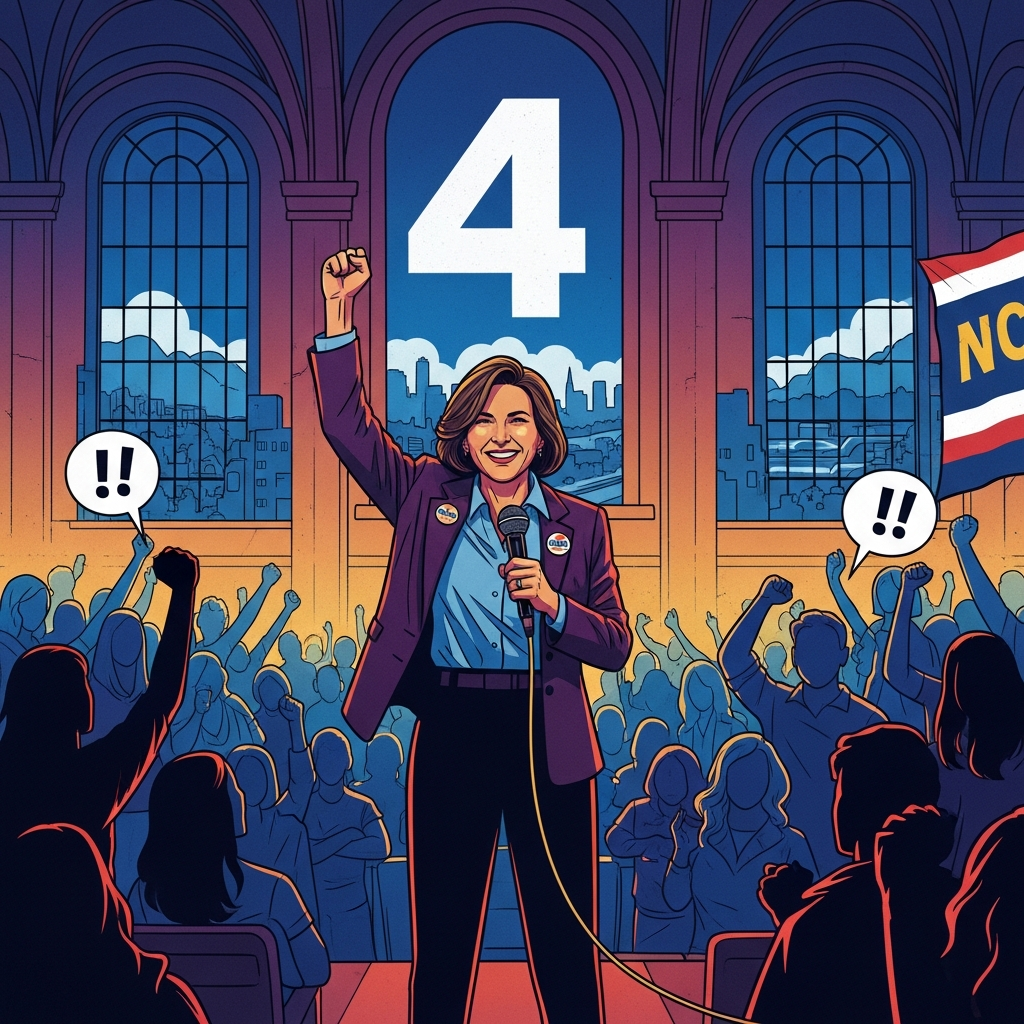
In a closely watched contest that has sent ripples through the Democratic Party, Representative Valerie Foushee secured a hard-fought victory in North Carolina’s deep-blue 4th congressional district primary. This win, confirmed just hours after polls closed on Tuesday, March 3rd, 2026, represents a significant hurdle for a burgeoning movement explicitly targeting candidates perceived as too closely aligned with the American Israel Public Affairs Committee (AIPAC). The race underscored mounting internal tensions within the Democratic Party, touching on everything from campaign finance transparency to the future of U.S. foreign policy in the Middle East.
North Carolina’s Pivotal Democratic Primary Unpacks Intra-Party Divides
The Democratic primary in North Carolina’s 4th congressional district became a critical test of progressive power versus incumbent experience. Representative Foushee narrowly defeated Durham County Commissioner Nida Allam, a prominent progressive backed by Senator Bernie Sanders and recognized as the first Muslim woman to hold political office in the state. Allam, initially hinting at a recount following the razor-thin margin, conceded the race Wednesday evening, March 4th. This outcome wasn’t merely a local affair; it reflected a national struggle playing out across Democratic primaries, fueled by intense debates over generational change, the influence of money in politics, and particularly, the U.S.-Israel relationship.
The contest was notably expensive, with outside spending exceeding $4.2 million, making it one of the most costly in state history. A significant portion of this expenditure came from a new coalition of groups explicitly launched to counter AIPAC’s influence. These groups directed nearly $1 million in attack ads against Foushee, criticizing her past ties to the pro-Israel lobbying powerhouse, which she has since disavowed. However, Foushee was not without her own formidable allies, as the Anthropic-aligned Jobs and Democracy PAC and a mysterious super PAC known as Article One also flooded the airwaves with ads supporting her candidacy.
The High Stakes: AIPAC’s Influence and Progressive Pushback
AIPAC, a powerful advocacy group committed to U.S. support for Israel, has become a lightning rod within the Democratic Party. Its affiliated super PAC, the United Democracy Project (UDP), has escalated its direct campaign spending dramatically since the 2022 midterms, investing hundreds of millions in primaries. Their strategy often involves supporting candidates and attacking opponents without explicitly mentioning Israel in their ads. For instance, in a recent New Jersey special election, UDP spent nearly $2 million against former Congressman Tom Malinowski, attacking him from a progressive angle over a 2019 vote on ICE funding, rather than his “pro-Israel” stance. Malinowski, who lost to progressive Analilia Mejia, criticized this “massive flood of dark money” and “dishonest ads.”
This pattern of indirect messaging was likely at play in the NC-04 race. The external spending against Foushee sought to highlight her past associations, leveraging the growing skepticism within the Democratic base towards unconditional support for Israel, especially amidst the ongoing conflict in Gaza. Progressive candidates like Nida Allam are riding this wave, running on platforms that openly challenge the Democratic establishment’s foreign policy and call for a shift in U.S. policy regarding Israel. Allam, whose campaign emphasized the need for a “proudly uncompromised pro-peace leader,” also focused on local issues, like opposing an AI data center, alongside her broader anti-war stance.
A Shifting Political Landscape: Democratic Divisions Over Israel
The outcome in North Carolina highlights a crucial test of AIPAC’s continued power amidst a changing political climate. Polling data indicates a significant shift in Democratic voter sentiment. A recent New York Times poll revealed that 73% of all Democrats and 74% of Kamala Harris’s 2024 voters oppose sending “additional economic and military support to Israel.” Similarly, a Washington Post poll showed 63% of Jewish Democrats disapprove of Israel’s military actions in Gaza. This growing opposition has empowered progressive challengers and groups like Justice Democrats, who view AIPAC’s brand as increasingly “toxic” among the party’s grassroots.
While AIPAC’s spokesperson, Patrick Dorton, maintains confidence in the group’s mission to ensure a “strong bipartisan pro-Israel majority,” the New Jersey primary result against Malinowski was seen by many critics as a significant misstep. Malinowski himself has pledged not to support AIPAC-backed candidates in the future, citing their demand for “absolute fealty.” The “uncommitted movement” in the 2024 presidential Democratic primary also signaled a clear disconnect between party leadership and a significant portion of voters on this issue.
The Broader Implications for the Democratic Party
Valerie Foushee’s victory, while a win for the incumbent and a setback for the anti-AIPAC group Leaders We Deserve (founded by David Hogg), does not diminish the larger struggle within the Democratic Party. Progressive candidates across the country, including Palestinian American journalist Kat Abughazaleh in Illinois, are explicitly denouncing AIPAC and refusing its financial support, framing their campaigns around these issues. They believe the party’s base is increasingly opposed to the war, making ads funded by pro-Israel groups potentially alienating.
The challenge posed by candidates like Nida Allam and Kat Abughazaleh signals a deeper desire among many Democrats for authenticity and a re-evaluation of the party’s foreign policy stances. Despite lacking the immense financial resources of pro-Israel PACs, progressives are finding an effective narrative. The ability of candidates to openly question no-strings-attached war funding for Israel and reject AIPAC support is now seen as a powerful argument in a primary, a stark departure from previous cycles. This indicates that while AIPAC continues to spend heavily, the political ground it operates on within the Democratic Party is becoming increasingly volatile.
Frequently Asked Questions
How did the NC-04 primary reflect broader Democratic Party tensions?
The North Carolina 4th Congressional District primary highlighted significant internal divisions within the Democratic Party. It showcased a clash between established incumbents and progressive challengers, particularly regarding U.S. foreign policy toward Israel and the influence of “dark money” in elections. The race pitted Rep. Valerie Foushee, who had past ties to AIPAC, against Nida Allam, a Bernie Sanders-backed progressive. This mirrors national debates over generational change, the role of super PACs, and the growing skepticism among the Democratic base toward unconditional support for Israel, especially in light of the Gaza conflict.
Which groups supported or opposed Valerie Foushee in her primary race?
Representative Valerie Foushee faced significant opposition from a new anti-AIPAC group, which spent nearly $1 million in attack ads against her. This group was part of a broader movement, including Leaders We Deserve, aimed at challenging Democrats perceived as too aligned with the American Israel Public Affairs Committee (AIPAC). However, Foushee received substantial support from her own allies, including the Anthropic-aligned Jobs and Democracy PAC and a super PAC known as Article One. These groups countered the negative ads, contributing to the high-spending nature of the primary.
What impact might the NC-04 result have on the anti-AIPAC movement’s future strategy?
While Valerie Foushee’s victory represents a setback for the anti-AIPAC movement in this particular race, it does not necessarily signal the end of their efforts. The outcome demonstrates that challenging incumbents with significant financial backing remains difficult. However, the movement is fueled by a broader shift in Democratic voter sentiment, with polls showing increasing opposition to unconditional aid to Israel. Progressive groups and candidates will likely continue to campaign against AIPAC’s influence, using this race as a learning experience and refining their strategies to leverage grassroots support and the changing political landscape in future primary challenges.
The NC-04 primary serves as a potent reminder that the Democratic Party is grappling with profound internal conflicts. While Representative Foushee’s victory secures her seat for now, the issues that animated this race—the role of money in politics, the U.S.-Israel relationship, and the battle between progressive ideals and established power—are far from resolved. As the 2026 election cycle progresses, these tensions are expected to intensify, shaping the future direction of the party and its foreign policy agenda.