Recent military actions by the United States in Iran have ignited a fervent debate across the nation, revealing a deeply divided American public. A rapid-response poll, conducted by The Washington Post and SSRS, unveiled a complex landscape of public sentiment, with more Americans opposing the strikes than supporting them. This comprehensive survey, which reached over 1,000 U.S. adults via text message, offers a critical snapshot of opinion following President Donald Trump’s order for airstrikes and amidst reports of American casualties. The findings underscore significant partisan splits, generational differences, and widespread uncertainty regarding the administration’s strategic objectives, pointing to a populace grappling with the implications of escalating geopolitical tensions.
A Nation Divided: Snapshot of Public Opinion on Iran Strikes
The immediate aftermath of U.S. military action in Iran saw a sharp divergence in American attitudes. This crucial poll, conducted on March 1, 2026, aimed to quickly gauge national feelings about the strikes ordered by President Trump. The survey’s timing was particularly poignant, coinciding with reports that three American soldiers were killed and five others seriously wounded, adding a somber backdrop to the public’s reflections.
Initial Reaction: Opposition Outweighs Support
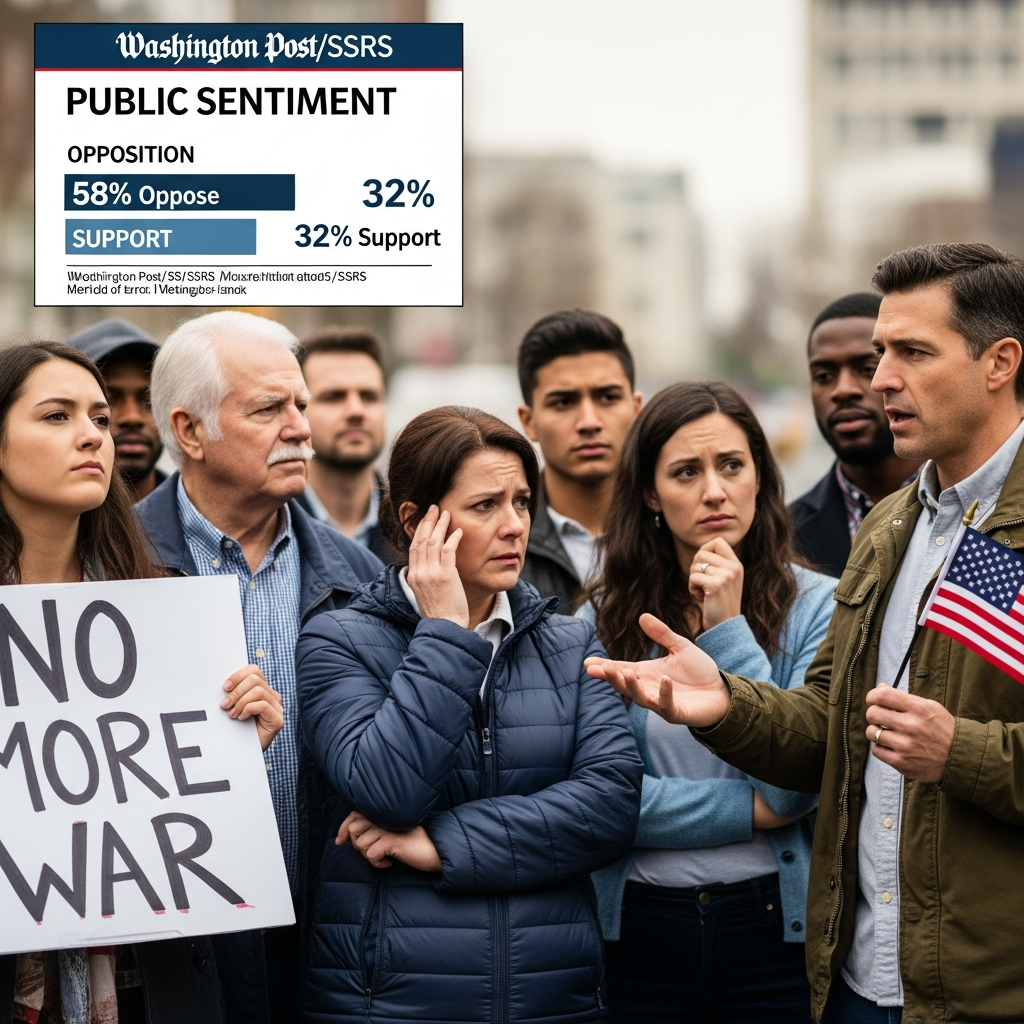
When asked directly about supporting or opposing President Trump’s order for airstrikes, Americans leaned heavily towards opposition. A significant 52 percent of respondents opposed the strikes, compared to 39 percent who expressed support. A further 9 percent remained unsure. Notably, those opposing the strikes felt more strongly about their stance; approximately four out of ten respondents strongly opposed the actions, while just over two out of ten strongly supported them. This suggests a more passionate disapproval from a substantial segment of the population.
The Partisan Divide: Echoes of Political Identity
Political affiliation proved to be the strongest predictor of opinion, illustrating the deep partisan chasm defining contemporary American discourse. Republicans largely rallied behind the President’s decision, with 81 percent expressing support. Conversely, Democrats overwhelmingly opposed the strikes, with 87 percent registering their disapproval. Political independents, often a swing demographic, also largely opposed the actions by a nearly 2-to-1 margin (59 percent opposition to 28 percent support), driving the overall unpopularity of the strikes. These numbers highlight a predictable, yet stark, ideological alignment mirroring broader political trends.
Beyond Party Lines: Gender and Age Dynamics
Beyond partisan leanings, demographics like gender and age also presented distinct patterns of opinion. Women demonstrated significantly stronger opposition to the strikes, opposing them by a 26-point margin (58 percent to 32 percent), while men were more evenly split. Age also played a crucial role: a majority of adults younger than 40 expressed opposition to the strikes. In contrast, most individuals between 50 and 64 years old supported the military action. Those aged 65 or older were found to be more divided in their views. These findings underscore a complex interplay of personal values and political identity shaping responses to foreign policy.
Future Actions and Unclear Objectives
The poll also delved into public sentiment regarding the continuation of military operations, revealing a public hesitant to escalate. A notable lack of clarity concerning the administration’s core goals further exacerbated public unease.
Should Strikes Continue? A Reluctance to Escalate
Despite initial support figures, when asked whether the U.S. should continue military strikes against Iran or stop them, nearly twice as many Americans advocated for cessation. A significant 47 percent said the U.S. should stop strikes, compared to only 25 percent who believed they should continue. A substantial 28 percent remained unsure, indicating widespread ambivalence or a desire for more information. Even among Republicans, support for continuing strikes dropped significantly from initial support, with a narrower 54 percent majority favoring continued action. Independents showed even greater reluctance, with only 16 percent supporting continued strikes. This suggests a public wary of prolonged engagement, even if initial retaliation was seen as justifiable by some.
Decoding Administration Goals: Widespread Uncertainty
A critical finding highlighted a substantial communication gap: a resounding two-thirds of Americans believed the Trump administration had not clearly explained the goals of its military action. This figure closely matched findings from prior polls, indicating a persistent issue with public clarity. When asked to articulate the administration’s main objective, perceptions varied wildly. Responses ranged from “showing power” or “taking control” (14%) and “changing the Iranian regime” (12%), to “helping Iranians/stabilizing the region” (12%) or “stopping the nuclear program” (9%). Other respondents speculated on “money/oil” (9%) or even a desire to “distract from other issues” (8%). A significant 13 percent simply stated they were “unsure of goals.” This multitude of interpretations, coupled with the overall lack of clear explanation, suggests that public support might have been fractured by an absence of a unified, compelling rationale.
Post-Khamenei Impact: Goals Perceived as Unmet
The poll also explored public perception following the death of Iranian leader Ayatollah Ali Khamenei. When asked if the Trump administration had achieved its goals with Khamenei’s death, a strong majority of nearly 7 out of 10 Americans (69 percent) believed the goals had not been achieved. Only 31 percent thought they had. Even among Republicans, less than half (48 percent) believed the goals were met, indicating that while they might support the president’s actions, a significant portion remained skeptical about the ultimate strategic success.
Deeper Concerns: War, Security, and Regional Impact
Beyond the immediate actions, Americans harbored serious anxieties about the broader ramifications of the conflict, particularly regarding the potential for escalation and its long-term effects.
The Shadow of War: Escalating Anxiety
The specter of a full-scale war loomed large in the minds of many Americans. Three-quarters of respondents expressed concern about the possibility of the U.S. getting involved in a full-scale war with Iran. A substantial 40 percent were “very concerned,” and an additional 34 percent were “somewhat concerned.” These levels of worry were comparable to earlier polls after other U.S. military actions in the region, underscoring persistent public anxiety about prolonged conflict. While Democrats and Independents showed higher levels of concern (93% and 80% respectively), even half of Republicans (51%) admitted to being at least somewhat concerned, indicating a shared apprehension across the political spectrum.
Long-Term Security & Humanitarian Outcomes
Looking ahead, Americans were almost evenly split on whether U.S. military actions would contribute to the long-term security of the United States, with 49 percent believing they would and 51 percent believing they would not. This division contrasted sharply with early optimism seen during the initial phases of the Iraq and Afghanistan wars, suggesting a more jaded perspective on military interventions. When considering the potential impact on the Iranian people, views remained highly fractured: 34 percent believed they would benefit, 30 percent thought they would be harmed, and a notable 36 percent were unsure. This ambiguity reflects the complexity of foreign interventions and the difficulty in predicting humanitarian outcomes.
Behind the Numbers: The Poll’s Methodology
The Washington Post and SSRS conducted this vital public opinion poll on March 1, 2026. A total of 1,003 U.S. adults were surveyed through a text message-based flash poll. Participants were drawn from the SSRS Opinion Panel, a nationally representative panel recruited through rigorous random sampling of U.S. households. To ensure accuracy and representativeness, the sample data was meticulously weighted to align with U.S. population demographics, partisanship, and 2024 vote choice. The overall results carry a margin of sampling error of plus or minus 3.4 percentage points, providing a reliable snapshot of national sentiment. Open-ended responses from participants were initially coded using AI software from BTInsights, then thoroughly reviewed and refined by a Post polling team to ensure precise categorization. This robust methodology underpins the trustworthiness and insights gleaned from the survey.
Frequently Asked Questions
What were the key findings of the 2026 Washington Post/SSRS poll on U.S. strikes in Iran?
The poll revealed that more Americans opposed the U.S. airstrikes in Iran (52%) than supported them (39%). There was a strong partisan divide, with 81% of Republicans supporting the strikes versus 87% of Democrats opposing. The survey also found widespread uncertainty regarding the Trump administration’s goals for military action, with two-thirds of Americans feeling the objectives were not clearly explained. Furthermore, a significant 75% of Americans expressed concern about the possibility of a full-scale war with Iran.
How was the public opinion poll on U.S. airstrikes in Iran conducted?
The Washington Post, in collaboration with SSRS, conducted a text message-based flash poll on March 1, 2026. The survey reached a random national sample of 1,003 U.S. adults drawn from the SSRS Opinion Panel, which is recruited through random sampling of U.S. households. The collected data was weighted to accurately reflect U.S. population demographics, political affiliations, and 2024 vote choices, ensuring the results were nationally representative with a margin of sampling error of plus or minus 3.4 percentage points.
How did partisan affiliation and demographics influence support for U.S. military action in Iran?
Partisan affiliation was the strongest indicator, with 81% of Republicans supporting the strikes while 87% of Democrats opposed them. Independents largely opposed the actions by a 2-to-1 margin (59% opposed). Demographically, women showed significantly stronger opposition than men, by a 26-point margin. Adults under 40 mostly opposed the strikes, while those aged 50-64 largely supported them. People 65 or older were more divided, illustrating diverse responses based on political identity and age.
Conclusion: A Nation Grappling with Geopolitical Choices
The Washington Post/SSRS poll painted a compelling picture of a nation deeply conflicted over its role in escalating tensions with Iran. The findings underscore a prevalent sentiment of opposition to the initial strikes and an even greater reluctance to continue military action. This public unease is compounded by significant uncertainty about the administration’s stated goals, contributing to a fractured understanding of the conflict’s purpose and potential outcomes. As foreign policy decisions continue to unfold, understanding these complex and often contradictory public opinions is paramount for policymakers. The deep partisan divides, generational shifts, and overarching anxieties about war reflect a dynamic American public grappling with the moral, strategic, and human costs of geopolitical engagement.