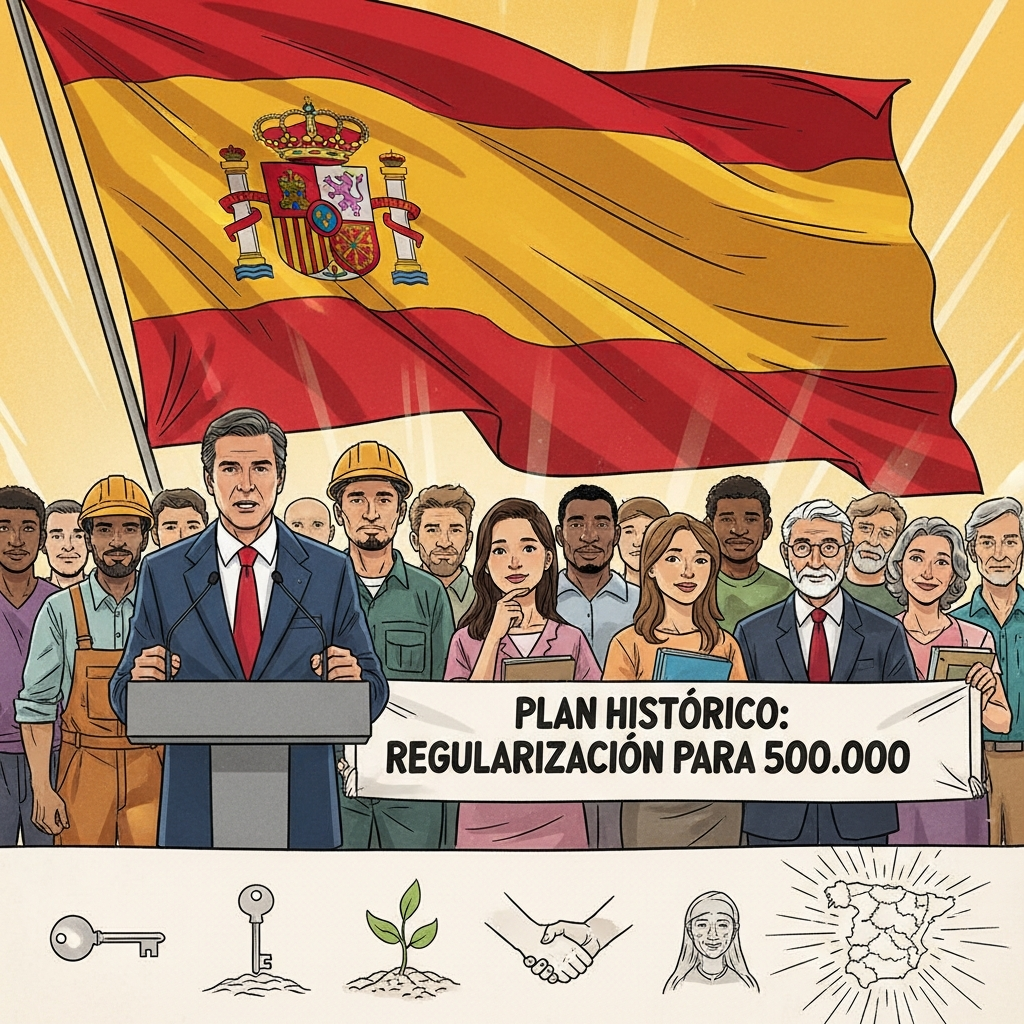
Spain has launched a groundbreaking plan to grant legal status to an estimated 500,000 undocumented migrants, signaling a pivotal shift in European immigration policy. This unprecedented initiative, driven by Prime Minister Pedro Sánchez’s socialist government, aims to formally integrate a significant portion of Spain’s undocumented population into the workforce and society. The move is championed as both an act of social justice and a crucial economic necessity for a nation grappling with an aging population and labor shortages.
This comprehensive legalization scheme offers a one-year, renewable residence permit to eligible applicants. It represents Spain’s first large-scale regularization effort in two decades, positioning the country as an outlier amidst a broader European trend of tightening immigration controls. The government views migrants not merely as a humanitarian concern but as a vital engine for economic stability and growth.
Spain’s Bold Step Towards Workforce Integration
Prime Minister Pedro Sánchez articulated the government’s decision as “an act of justice” acknowledging that nearly half a million individuals “already form part of our everyday lives.” He stressed the demographic and economic imperative, stating these migrants are essential to sustain Spain’s economy and public services. Spain, like many developed nations, faces challenges from an aging population, which could otherwise endanger its pension system and welfare state. Sánchez also drew historical parallels, reminding Spaniards of their own past migrations in search of better opportunities.
The government’s plan reinforces a migration model founded on human rights, integration, and coexistence. Migration Minister Elma Saiz highlighted the “positive impact” of the initiative, granting beneficiaries the opportunity to work across “any sector, in any part of the country.” This approach, she argued, is compatible with both economic growth and social cohesion.
Economic Imperative: Fueling Spain’s Growth
Official data strongly supports the economic rationale behind Spain’s migrant legalization. Over the past six years, migration has accounted for a remarkable 80% of Spain’s dynamic economic growth. Recent figures reveal that 52,500 of the 76,200 individuals boosting employment in a recent quarter were foreign nationals, contributing to Spain achieving its lowest jobless figure since 2008. The nation has been outperforming other major EU economies, with anticipated growth and falling unemployment rates.
A 2024 central bank report underscored the long-term necessity, indicating that Spain will require approximately 25 million migrants over the next three decades to maintain its economy and social security system. Foreign workers currently comprise 14.1% of Spain’s 22 million registered workers and have driven half of the country’s economic growth since 2022. They are vital to key sectors such as elderly care, hospitality, and agriculture, with over 250,000 foreigners formally registered in agriculture alone. Farmers’ associations like ASAJA and the main business employers’ association, CEOE, have expressed support for “orderly” immigration.
Eligibility and Application Details for the Scheme
To qualify for this significant opportunity, applicants must meet specific criteria. Foreign nationals must demonstrate they have resided in Spain for at least five months prior to December 31, 2025. Additionally, they must possess a clean criminal record. The regularization will also extend to children of eligible applicants already living in Spain.
The application window is set to open in April and will remain accessible until the end of June. Successful applicants will initially receive a one-year residence permit, which can subsequently be extended, providing a much-needed pathway to stability and formal employment. For many, like Ricardo, a Bolivian graphic designer who struggled with stable employment, this scheme promises “access to work and to a better quality of life,” while also benefiting the Spanish state through increased tax revenue.
Political Landscape and Divergent Views
The plan has ignited a fervent political debate within Spain. The conservative opposition People’s Party (PP) has strongly condemned the initiative, vowing to block the legislation. PP leader Alberto Núñez Feijóo labeled the plan “ludicrous,” claiming it would “overwhelm our public services” and reward “illegality.” The PP argues it will act as a “pull factor,” encouraging more undocumented individuals to enter Spain, and has even suggested that closer to one million migrants could apply, far exceeding the government’s 500,000 estimate.
The far-right Vox party, led by Santiago Abascal, went further, asserting that the initiative “attacks our identity” and announced its intention to appeal the decision before the Supreme Court. They warn of millions more being attracted, exacerbating pressures on healthcare, housing, and security. However, the government dismisses these “pull” effect concerns, citing a clear timeframe for the regularization process.
In stark contrast, the Catholic Church has publicly expressed its support for the government’s legislation, hailing it as “an act of social justice and recognition.” The measure also saw agreement with the far-left Podemos party, which has long campaigned for migrant regularization under the slogan “regularization is rights.” Former Podemos minister Irene Montero stated that “providing rights is the answer to racism.”
Historical Precedent and European Context
Granting amnesties to migrants is not unprecedented in Spain. Both Socialist and PP governments have implemented similar schemes in the past. Between 1986 and 2005, governments from both political spectrums legalized the status of approximately half a million migrants. The most recent significant instance was in 2005, when a Socialist administration granted residency to 577,000 people. The PP itself regularized over half a million migrants between 2000 and 2001.
This historical context provides a backdrop for the current initiative, highlighting that such measures, while contentious, are not entirely new to Spanish policy. However, the present plan stands in stark contrast to the prevailing trend across much of Europe. Governments in France, Germany, and Italy, often influenced by rising far-right parties, are generally tightening immigration rules. Spain, a primary entry point for irregular migrants, particularly via the Canary Islands, is forging its own path.
The European Commission has reacted cautiously, emphasizing the need to prevent migrants from using the Spanish policy to reside unlawfully in other EU member states. They clarified that an EU residence permit is “not a blank cheque” for unrestricted movement within the Schengen area. This international scrutiny underscores the significance of Spain’s independent approach to immigration reform.
Impact on Migrants and Society
For many undocumented migrants, this legalization plan offers a lifeline. Individuals like Diana from Peru have highlighted the severe challenges of their current situation: exploitation by employers, low pay, restricted access to banking and housing, and immense stress. The amnesty promises comprehensive assistance, benefiting individuals by providing legal work, social security contributions, and improved quality of life. Immigration lawyers affirm that the measure will profoundly change many lives.
Beyond individual benefits, proponents argue the scheme will bolster the Spanish government through increased tax revenue, investment, and business creation. The Funcas think-tank estimates around 840,000 undocumented migrants currently reside in Spain, predominantly from Latin American countries like Colombia, Peru, and Honduras. The mass regularization could bring a substantial portion of this informal economy into the formal sector, contributing to a more robust and transparent financial system.
Frequently Asked Questions
What is Spain’s new plan to grant legal status to undocumented migrants?
Spain’s government has approved a significant plan to grant legal status to approximately 500,000 undocumented migrants, offering them a one-year, renewable residence permit. This initiative aims to formally integrate these individuals into the Spanish workforce and society. Prime Minister Pedro Sánchez’s government frames it as both an act of justice and an economic necessity, particularly given Spain’s aging population and labor market demands. The move contrasts with tighter immigration controls seen in many other European nations.
Who is eligible for Spain’s migrant legalization scheme and when can they apply?
To be eligible for Spain’s legalization scheme, applicants must prove they have resided in Spain for at least five months prior to December 31, 2025, and must possess a clean criminal record. The scheme will also extend to children of eligible applicants already living in the country. The application period for this initiative is set to run from April until the end of June, providing a specific timeframe for individuals to formalize their status.
How does Spain’s mass migrant legalization plan impact its economy and European policy?
Spain’s legalization plan is projected to have a significant positive economic impact, with migrants contributing substantially to GDP growth and the social security system. Official data indicates migrants account for 80% of Spain’s recent economic growth and are crucial for sectors like agriculture, hospitality, and elderly care. This strategy positions Spain as an outlier in Europe, where many countries are tightening immigration policies. While the plan addresses Spain’s demographic and labor needs, it faces scrutiny from the European Commission regarding potential implications for free movement within the EU.