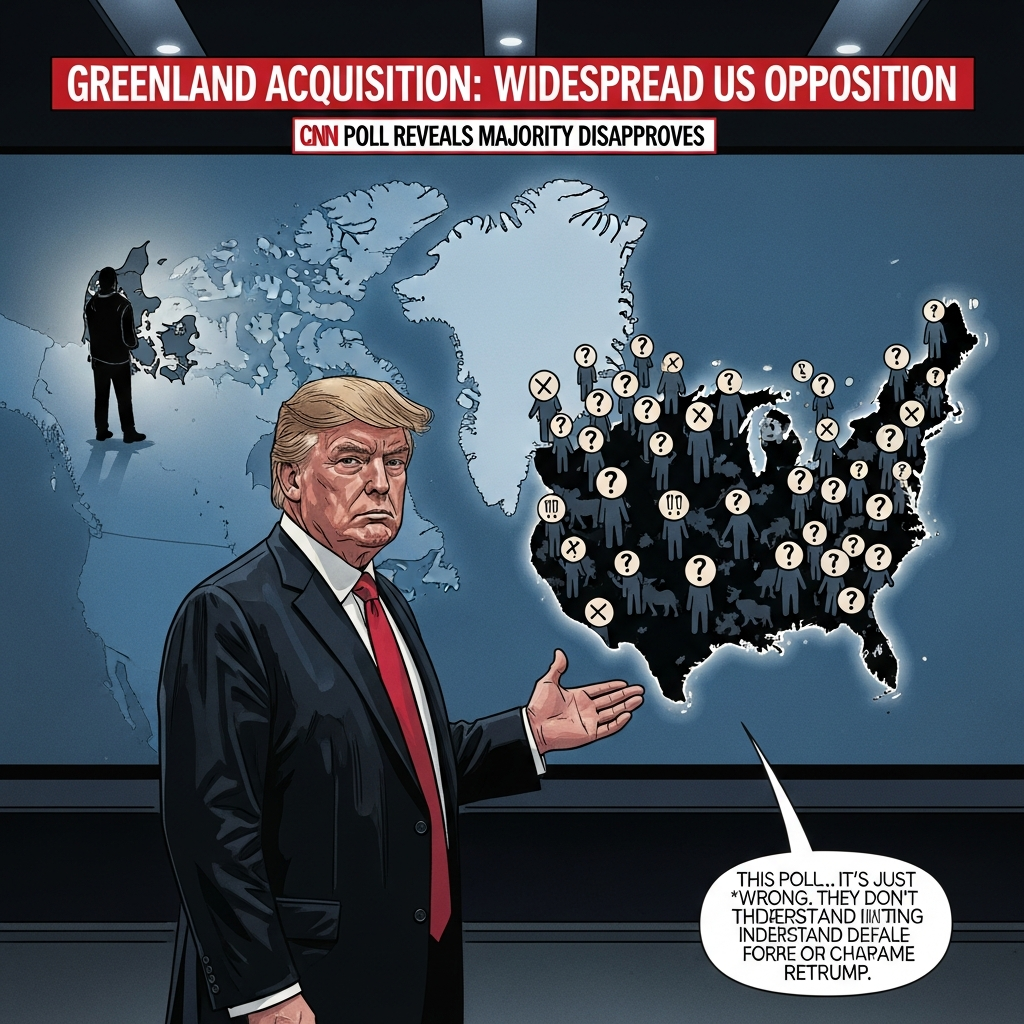
A new CNN poll conducted by SSRS reveals widespread opposition among Americans to President Donald Trump’s push for the United States to acquire Greenland, an autonomous Danish territory. The groundbreaking survey, released on January 15, 2026, highlights significant public skepticism towards US expansionist foreign policy and growing concern about the nation’s global standing. These findings arrive amidst heightened diplomatic tensions and a robust debate over America’s role on the world stage, especially after recent military actions.
Public Opinion Slams US Greenland Takeover Bid
The prospect of the United States attempting to take control of Greenland faces strong disapproval from the American public. A resounding 75% of Americans oppose the move, with a notable 52% stating they “strongly oppose” it. Only a quarter (25%) of respondents favor the idea, and a mere 7% strongly support it. This overwhelming sentiment underscores a clear public rejection of territorial expansion in the Arctic region.
The opposition exhibits a stark partisan divide. Democrats and Democratic-leaning independents are nearly unanimous in their stance, with 94% opposing the acquisition, and 80% expressing strong opposition. Even among Republicans and Republican-leaning independents, support is evenly split, with 50% in favor and 50% against. Independents, those not aligned with either major party, also largely reject the notion, with approximately eight in ten expressing disagreement.
President Trump has consistently advocated for US ownership of Greenland, citing national security as a primary concern. On his social media platform Truth Social, he declared that “anything less” than US control of Greenland is “unacceptable.” His reasoning includes the strategic presence of Russian and Chinese vessels in the Arctic and the potential for Greenland to enhance NATO’s effectiveness. He also views the island as vital for a US ballistic missile warning system, referring to it as the “Golden Dome.”
Danish and Greenlandic officials have, however, vehemently rejected any talk of a US takeover, firmly asserting Greenland’s inherent sovereignty. Following a January 14 meeting at the White House between Danish officials, US Vice President JD Vance, and Secretary of State Marco Rubio, Danish Foreign Minister Lars Løkke Rasmussen explicitly stated, “It’s clear that the president has this wish of conquering over Greenland. We made it very, very clear that this is not in the interest of the kingdom.” Greenland Prime Minister Jens-Frederik Nielsen and Danish Prime Minister Mette Frederiksen also issued a joint statement affirming, “Greenland belongs to the Greenlanders and the U.S. shall not take over Greenland.” This firm stance is mirrored by the vast majority of Greenlanders themselves, who oppose becoming part of the U.S.
International support for Greenland’s self-determination is robust. Several key NATO members, including France, Germany, Italy, Poland, Spain, and the United Kingdom, jointly defended the country’s right to decide its own future. Furthermore, Colorado Congressman Jason Crow has introduced a bipartisan bill aimed at preventing the US from invading NATO member states, specifically mentioning Greenland, highlighting domestic political opposition to such a move.
Why the Overwhelming Opposition?
The strong public and international opposition to a US takeover of Greenland stems from multiple factors. At its core, the principle of national sovereignty is paramount. Greenland is a self-governing territory of Denmark, and any attempt by an external power to acquire it without consent is widely seen as a violation of international law and norms. Such an action could severely damage diplomatic relations and destabilize alliances like NATO, which relies on mutual respect and shared values.
Expert analysis suggests that a forced acquisition would place the US on “the wrong side of international law and international public opinion,” potentially portraying the nation as an aggressor and undermining its global credibility. This could provide a significant advantage to US adversaries, who might exploit such actions to paint America in a negative light. While Greenland does possess significant deposits of critical minerals, President Trump has publicly denied that mineral wealth is his motivation, emphasizing national security. Nevertheless, the broad public sentiment leans against any form of forced expansionism.
Beyond Greenland: Public Skepticism on US Expansionism
The CNN poll’s findings extend beyond Greenland, revealing a broader public skepticism toward President Trump’s expansionist foreign policy agenda. Americans generally show little appetite for policies that seek to expand US power over other countries, especially through military means. This widespread concern suggests a fundamental disconnect between the administration’s assertive approach and public sentiment.
Nearly six in ten Americans (59%) are concerned that President Trump has “gone too far” in attempting to expand America’s power globally. Only about a third believe his efforts in this regard have been “about right.” This concern is amplified when considering military action; a majority (55%) feel that the President has already exceeded acceptable limits in using the US military to achieve his foreign policy objectives. This suggests a public wary of aggressive international postures and prolonged military engagements.
Furthermore, a growing share of Americans believes that President Trump’s foreign policy decisions during his current term have actively damaged the nation’s standing in the world. The poll found that 57% now hold this view, an increase from 53% just last summer. This reflects a deep-seated apprehension that the administration’s actions are detrimental to America’s international reputation and influence. These findings are contextualized by President Trump’s rhetoric surrounding other nations, including his praise for the military capture of Venezuela’s Nicolás Maduro and his threats against Iran’s leadership amidst street protests.
Divided Views on Venezuela Military Intervention
Public opinion on the US military action in Venezuela is more divided than on Greenland, yet still leans towards opposition. The poll indicates that 52% of Americans oppose the initial decision to take military action in Venezuela, while 48% favor it. This narrow margin reflects the complex and contentious nature of the intervention. A significant concern among respondents is the long-term stability of the Venezuelan government post-intervention and the potential for a prolonged deployment of US troops.
After Maduro’s removal, opposition intensifies regarding US efforts to control Venezuela’s government, with 58% of Americans against such actions. Strong opposition (31%) significantly outweighs strong support (13%) on this specific question. Most Americans also expressed a lack of confidence that US action would lead to a stable government in Venezuela within a year, with approximately two-thirds deeming a long-term deployment of US troops as “at least somewhat likely.”
Partisan divides are prominent in views on Venezuela. A robust 80% of Democrats and Democratic-leaning independents oppose the initial military action, sharply contrasting with 80% of Republicans and Republican-leaning independents who support it. However, Democrats show even stronger opposition to US efforts to control Venezuela’s government after Maduro’s removal, a sentiment less strongly echoed by Republicans. This highlights a consistent pattern of partisan disagreement on foreign policy interventions.
Perceived Motives: Oil, Power, Not People
The survey also delved into Americans’ perceptions of the primary motivations behind US action in Venezuela. A majority of respondents believe that access to Venezuelan oil and a demonstration of America’s military power were major factors driving the decision. These perceived economic and strategic interests largely overshadow other stated justifications.
In contrast, fewer Americans saw bringing Maduro to stand trial in the US or reducing drug trafficking to the US as primary reasons for intervention. Notably, only 26% considered improving the lives of the Venezuelan people to be a major factor in the US decision to act. This suggests a cynical view among the public regarding the humanitarian claims often associated with foreign interventions, believing that self-interest predominantly guides policy.
Understanding the Poll: Methodology and Context
The CNN poll, a crucial barometer of American public sentiment, was conducted by SSRS online and by phone from January 9-12, 2026. It surveyed a random national sample of 1,209 adults. For the full sample, the results carry a margin of sampling error of plus or minus 3.1 percentage points. This rigorous methodology ensures a statistically reliable snapshot of public opinion at a pivotal moment in US foreign policy. The findings provide valuable insight into how Americans perceive their nation’s role in global affairs and the strategic decisions made by its leadership.
Frequently Asked Questions
What is the American public’s stance on the US acquiring Greenland?
A significant majority of Americans, 75%, oppose the United States attempting to take control of Greenland. This opposition is largely driven by Democrats and Democratic-leaning independents (94% opposed, 80% strongly), while Republicans and Republican-leaning independents are evenly split (50% for, 50% against). Independents also largely reject the idea, with about eight in ten expressing opposition, indicating a broad public disapproval for the proposed territorial expansion.
Why does President Trump advocate for the US to take control of Greenland?
President Donald Trump primarily cites national security concerns as his rationale for desiring US ownership of Greenland. He has stated that the island’s acquisition would make NATO “far more formidable and effective,” given its strategic location in the Arctic where Russian and Chinese presence is increasing. Trump also views Greenland as vital for a US ballistic missile warning system, referring to it as the “Golden Dome,” despite denying interest in its rich mineral deposits.
What are the geopolitical consequences of a US attempt to take over Greenland?
A US attempt to take over Greenland without the consent of Denmark and Greenland would have severe geopolitical consequences. Experts warn it could signify “the end of the NATO alliance,” as it would involve one member invading or annexing the territory of another. Such an action would place the US on “the wrong side of international law and international public opinion,” potentially harming America’s global standing and credibility, and could be exploited by adversaries.
The latest CNN poll offers a critical glimpse into the American public’s nuanced, and often skeptical, view of current US foreign policy. From the overwhelming rejection of a US Greenland takeover to the divided but concerned stance on Venezuela, the findings reveal a populace wary of expansionism and the aggressive use of military power. These sentiments present significant headwinds for President Trump’s agenda, suggesting a public desire for a foreign policy that prioritizes diplomacy, international law, and global standing over territorial or military expansion. Understanding these public perceptions is crucial for shaping future policy and navigating complex global challenges.