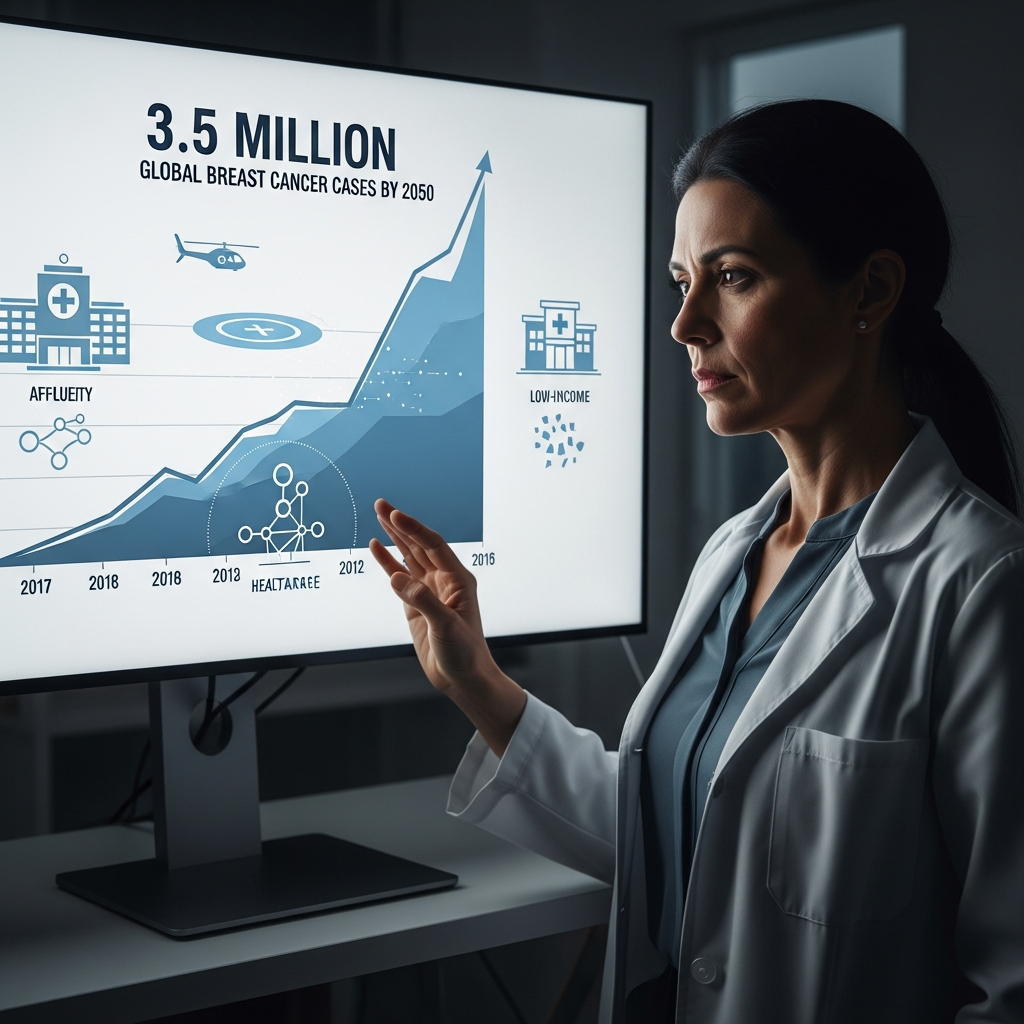
The world faces a looming breast cancer crisis. New research paints a stark picture: global annual cases are projected to surge by over 50%, reaching a staggering 3.5 million by 2050. This surge highlights a deepening global divide in who lives and who dies from the most common cancer among women worldwide. While affluent nations have seen progress, low-income countries grapple with escalating deaths, threatening to reverse decades of advancements in women’s health. Understanding this complex challenge is crucial for global health and individual well-being.
The Alarming Projections: A Looming Global Health Challenge
Breast cancer remains the most diagnosed cancer among women globally, exacting a profound toll on lives and communities. In 2023 alone, approximately 2.3 million women received a breast cancer diagnosis, leading to 764,000 deaths. This amounted to a staggering loss of roughly 24 million healthy life years. Projections, stemming from an extensive study published in The Lancet Oncology and corroborated by The Lancet, forecast a grim future. By 2050, annual new cases could top 3.5 million, with deaths soaring to nearly 1.4 million. This represents a steep 44% increase in yearly deaths if current trends continue unchecked.
This escalating burden is not evenly distributed. Experts caution that many countries are ill-prepared for this growing caseload. Health systems, particularly in lower-income nations, face overwhelming pressure. The forecast underscores an urgent need for improved prevention, screening, and treatment systems worldwide.
Understanding the Drivers Behind the Surge
Several factors contribute to the projected increase in breast cancer incidence. Demographic shifts play a significant role. Population growth and aging populations, especially in low and lower-middle-income countries (LLMICs), account for a substantial portion of the absolute rise in the global burden. Societal changes, such as women having children later, having fewer children, and experiencing longer lifetime exposure to estrogen (due to earlier menarche and later menopause), also contribute. Rising rates of obesity, diabetes, and elevated blood glucose are also identified as significant risk factors. Improved awareness and diagnostic capabilities, while positive, also contribute to the observed rise in reported cases.
A Deepening Divide: Unequal Battles and Outcomes
The most critical insight from recent studies is the stark global disparity in breast cancer outcomes. High-income countries (HICs) have made significant strides. Decades of investment in screening, early detection, and advanced treatments have driven a nearly 30% decline in cancer mortality between 1990 and 2023. Countries like Ireland, Monaco, Andorra, France, and Germany, while exhibiting high incidence rates, have largely stable rates and improving survival due to robust healthcare systems.
In stark contrast, the trend moves in the opposite direction for low-income countries (LICs). Over the same period, deaths from breast cancer have nearly doubled. The diagnosis rate in these nations rose by an alarming 147% since 1990. Women in LLMICs, who account for only 27% of new global cases, bear over 45% of all breast cancer-related ill health and early deaths. This profound inequality highlights a “hidden burden,” where lower reported incidence in low-Sociodemographic Index (SDI) regions often reflects underdiagnosis and limited healthcare access rather than actual lower disease rates.
Regional Hotspots of Concern
Specific regions face exceptionally dire situations. In sub-Saharan Africa, which includes some of the highest mortality rates worldwide, these rates are now more than double the global average. Approximately 35 deaths occur for every 100,000 people each year after adjusting for age. India has witnessed a fivefold increase in its breast cancer burden since 1990, driven by changing lifestyles, urbanization, delayed childbirth, and a pervasive lack of early detection. The Middle East and North Africa (MENA) region is also undergoing rapid epidemiological and social transitions, with some countries reporting the greatest increases in cases. This region registered 128,000 cases and 41,100 deaths in 2023 alone. As Dr. Kamal Menghrajani, an oncologist, asserts, “People’s outcomes from cancer depend on what country they live in. And that shouldn’t be the case.”
Beyond Screening: The Infrastructure Gap
The growing divergence between rising diagnosis rates and actual survival reflects a fundamental mismatch. The infrastructure needed to treat breast cancer is severely lacking in many regions. Cancer awareness and screening alone are insufficient. As Dr. Menghrajani explains, “We need to have strong infrastructure in place to be able to treat people who have cancer and support them all the way through so that they can be cured.”
Effective breast cancer treatment requires a carefully coordinated system: surgery, radiation therapy, and chemotherapy or targeted treatments. While these are generally available and covered by insurance in countries like the United States, the situation in much of sub-Saharan Africa is dramatically different. As of 2020, only about half of African countries had any external beam radiotherapy service – the most common form of radiation therapy – and none could meet their populations’ needs. Where radiation is unavailable, mastectomy often becomes the default, yet without crucial postoperative care and systemic therapy, even surgery offers limited effectiveness. The cost of advanced treatments further compounds the problem. A standard course of targeted therapy combined with chemotherapy can cost the equivalent of a decade’s average income in some lower-income countries.
Driving Factors: Why Rates Are Rising
Beyond the infrastructural divide, lifestyle and demographic changes are significant contributors to the rising breast cancer burden. A crucial finding from the Lancet Oncology study highlights that 28% of the breast cancer burden in 2023 is linked to six modifiable lifestyle factors. High red meat intake emerged as the most significant contributor, accounting for nearly 11% of healthy life years lost. Other major contributors include tobacco use, hyperglycemia, and high body mass index. High alcohol consumption and physical inactivity also contribute. While public health campaigns have achieved some success in reducing alcohol and tobacco-related breast cancer burdens, more intensive intervention efforts are needed for other risk factors.
The study in Nature also notes a concerning 29% increase in breast cancer incidence among younger, premenopausal women in recent decades, suggesting evolving risk factor profiles. These women often face unique challenges, including dual pressures of caregiving and professional obligations, which can intensify stress and delay medical visits.
A Call to Action: The WHO’s Pillars for Progress
Addressing this growing global crisis demands a concerted, multifaceted approach. Dr. Lisa Force, senior study author, stresses that it requires “both political will and investment in strategies that really target the entire cancer care continuum.” Services must be accessible and affordable, integrated with broader efforts to combat noncommunicable diseases.
The World Health Organization’s (WHO) Global Breast Cancer Initiative recommends three essential pillars to reduce cancer mortality:
Early Identification: Ensuring cancers are found promptly.
Timely Diagnosis: Guaranteeing quick and accurate diagnosis once symptoms appear.
Comprehensive Management: Ensuring patients access a full range of treatments and support.
Without a meaningful global approach, many countries will fall short of the WHO’s target of achieving a 2.5% annual reduction in age-standardized mortality rates worldwide by 2040.
Disparities Within Nations: The Unseen Struggle
Even within high-income countries with world-class treatment infrastructure, disparities persist. In the United States, Black women face a breast cancer death rate 40% higher than that of White women. Dr. Menghrajani emphasizes, “Even here in our own country, we have a lot of work to do to try to make sure that we have equitable care for cancer, no matter somebody’s socioeconomic, racial or other background.” Dr. Force adds that reasons are complex, mirroring patterns seen across countries: potentially more delayed diagnoses, treatment access gaps, and biases in patient care. “If you’re diagnosed later with breast cancer, the outcomes are generally poor,” she notes.
Empowering Yourself: Practical Steps to Reduce Risk
While the primary call to action targets global health systems, individuals can take significant steps to reduce their breast cancer risk. It’s important to remember that lifestyle changes cannot fully eliminate risk, as the majority of breast cancer causes are not attributable to lifestyle. However, adopting a healthy lifestyle can prevent more than a quarter of healthy years lost to illness.
Here are key actionable steps:
Limit Red Meat Consumption: Identified as the most significant dietary contributor.
Quit Tobacco Use: A major modifiable risk factor.
Manage Blood Sugar: High hyperglycemia is a notable contributor.
Maintain a Healthy Weight: High body mass index increases risk.
Curtail Alcohol Use: Even moderate consumption is linked to increased risk.
- Stay Physically Active: Regular activity promotes overall health and reduces risk.
- www.indiatoday.in
- bioengineer.org
- www.thenationalnews.com
- www.independent.ie
- www.nature.com
The Power of Early Detection: Screening and Awareness
Early detection remains a cornerstone of successful breast cancer treatment. The US Preventive Services Task Force recommends women get a mammogram every other year starting at age 40 and continuing through age 74. If you have concerns, a family history, or other higher-risk factors like obesity, speak with a primary care provider.
While self-exams were once widely recommended, they are no longer part of standard guidelines. This is because many women find changes related to their menstrual cycle that are not concerning, leading to unnecessary anxiety. However, women should know their bodies. Pay close attention to any new lump or mass, as well as subtler changes to the skin on the breast, the nipple, or the overall shape. Any unexplained difference warrants a conversation with a medical provider. For most women in high-income settings, breast cancer is diagnosed on mammography, making consistent screening the most impactful individual action for early detection.
Frequently Asked Questions
Why are global breast cancer cases projected to rise so sharply by 2050?
The sharp projected rise in global breast cancer cases to over 3.5 million annually by 2050 is driven by several interconnected factors. Demographic shifts, including population growth and aging, are primary contributors, particularly in low and lower-middle-income countries. Additionally, changing lifestyles such as increased rates of obesity, diabetes, and reduced physical activity play a significant role. Societal trends like women having children later in life and experiencing longer lifetime estrogen exposure also contribute to increased risk. While improved screening and awareness detect more cases, these underlying demographic and lifestyle changes are accelerating the global burden.
How do healthcare disparities affect breast cancer outcomes in low-income countries?
Healthcare disparities profoundly impact breast cancer outcomes in low-income countries, leading to significantly higher mortality rates despite lower reported incidence. These nations often lack the essential infrastructure needed for effective diagnosis and treatment. This includes critical shortages of radiotherapy machines, limited access to crucial chemotherapy drugs, and inadequate pathology services. The high cost of advanced treatments further exacerbates the problem, making life-saving care inaccessible for many. Consequently, women in these regions are often diagnosed at later stages, receive suboptimal or no treatment, and experience nearly double the mortality rates compared to high-income nations.
What are the most effective individual actions to reduce breast cancer risk and ensure early detection?
Individuals can take several practical steps to reduce their breast cancer risk and improve early detection. Lifestyle adjustments include limiting red meat consumption, quitting tobacco, managing blood sugar, maintaining a healthy weight, curtailing alcohol intake, and staying physically active. While these actions cannot eliminate risk, they significantly lower it. For early detection, consistent screening is paramount. The US Preventive Services Task Force recommends mammograms every other year for women aged 40-74. Additionally, women should be familiar with their bodies and promptly report any new or unusual breast changes to a healthcare provider.
Conclusion
The projected surge in breast cancer cases by 2050 presents an undeniable global health crisis. The deepening divide in cancer mortality between high-income and low-income nations demands urgent attention and concerted action. From strengthening healthcare infrastructures and ensuring equitable access to affordable treatments to empowering individuals with knowledge about modifiable risk factors and the importance of early detection, a comprehensive strategy is essential. This is not merely a medical challenge but a call for global health equity. By fostering political will, investing wisely, and prioritizing every woman’s right to quality care, we can mitigate this looming crisis and save millions of lives worldwide.