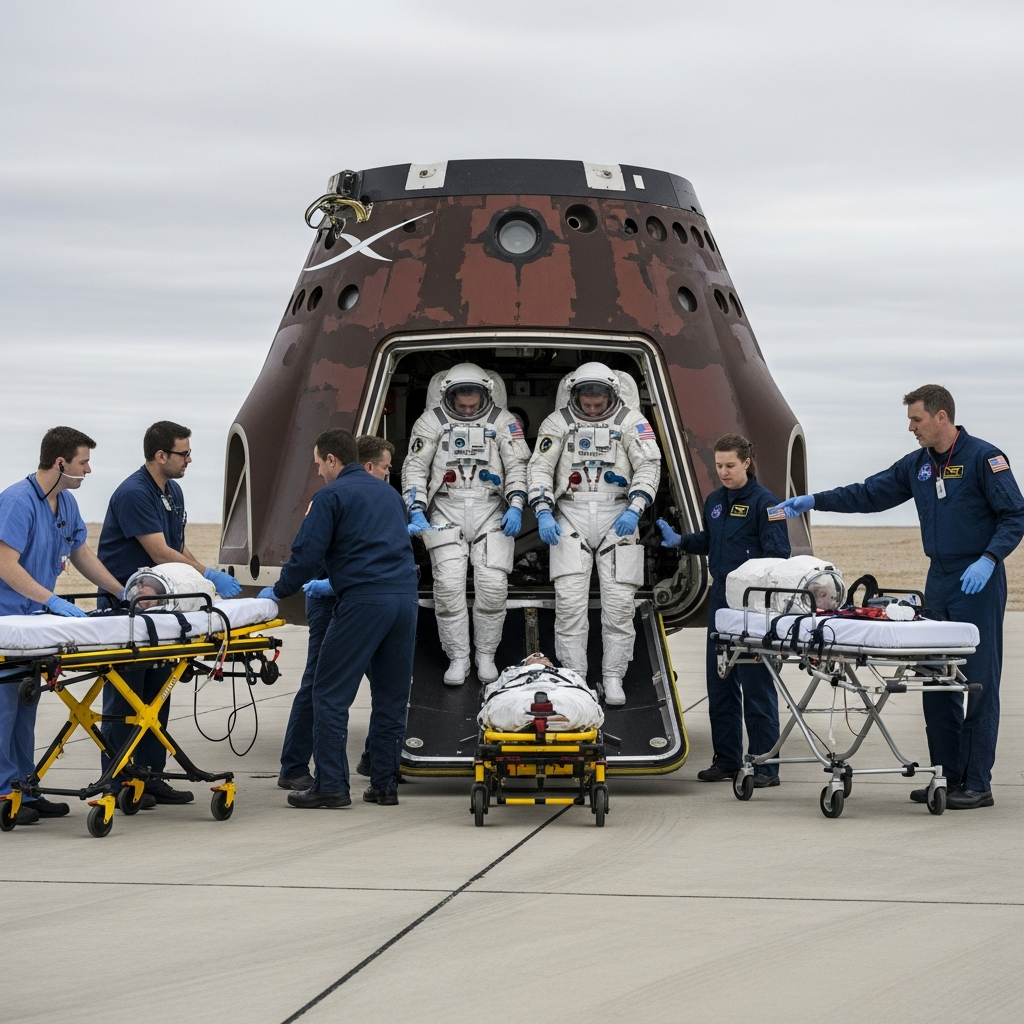
In an unprecedented event in human spaceflight history, four International Space Station (ISS) astronauts have made an urgent early return to Earth. Their mission aboard the SpaceX Dragon capsule, Endeavour, was cut short due to a serious, undisclosed medical condition affecting one of the crew members. This landmark “controlled medical evacuation” underscores NASA’s unwavering commitment to astronaut health and safety, prioritizing on-the-ground medical evaluation over continued orbital operations. The early return concluded with a successful splashdown off the California coast.
First-Ever Medical Evacuation from the ISS Signals New Era of Spaceflight Challenges
The decision to bring the Crew-11 mission home roughly a month ahead of schedule marks a significant moment. Never before in the ISS’s 25-year operational history has a mission been shortened due to a medical issue in orbit. NASA announced the early departure on January 8, stating that the move was an “abundance of caution” and in “the best interest of our astronauts.” While the agency cited privacy concerns for not disclosing specifics of the astronaut’s condition, officials confirmed it was not related to space station operations. Instead, it was linked to the prolonged effects of microgravity on the human body, a known challenge of long-duration space missions. The affected astronaut remained in stable condition throughout the journey.
Crew-11’s Unexpected Journey Home
The four international astronauts aboard the SpaceX Dragon Endeavour commenced their 10.5-hour descent from orbit at 22:30 GMT on a Wednesday. Their target was a splashdown in the Pacific Ocean off the coast of California on Thursday morning. The crew included:
Zena Cardman (NASA, Commander)
Mike Fincke (NASA, Pilot and former Expedition 74 leader)
Kimiya Yui (Japan Aerospace Exploration Agency – JAXA)
Oleg Platonov (Roscosmos, Russia)
This diverse group had spent 167 days aboard the orbital outpost. They conducted critical science experiments as part of SpaceX’s 11th crewed mission and NASA’s Expedition 74, which began on December 8. Their original mission was slated to conclude in late February.
The departure itself was a meticulous process. NASA livestreamed the Endeavour closing its hatch, undocking from the space station, and slowly drifting away. This all happened more than 400 kilometers (248 miles) above Australia. Images shared by the ISS on social media showed the astronauts in their distinctive black-and-white Dragon pressure suits. They were meticulously checking systems, preparing for the challenging re-entry.
Prioritizing Astronaut Health: NASA’s Firm Stance
NASA’s Chief Health and Medical Officer, James Polk, emphasized the agency’s core principle. “Always we err on the side of the astronaut’s health and welfare,” Polk stated. “In this particular case, we are doing the same.” This sentiment was echoed by Crew-11 pilot Mike Fincke, a retired U.S. Air Force colonel. He publicly supported the early return via an Instagram post. “This was a deliberate decision to allow the right medical evaluations to happen on the ground,” Fincke wrote. “There, the full range of diagnostic capability exists. It’s the right call, even if it’s a bit bittersweet.”
Former Canadian Space Agency astronaut Chris Hadfield further underscored NASA’s commitment. He noted that despite the “multiple domino impacts on operations,” this decision was undeniably the correct one. The incident highlights the complex physiological challenges of human spaceflight. Issues like spinal lengthening, fluid shifts, and bone density loss are common. Ongoing research into space medicine remains crucial for future long-duration missions to the Moon and Mars.
A Swift and Coordinated Return
The Crew Dragon Endeavour successfully undocked from the ISS at 5:20 p.m. EST (2220 GMT) on January 14. After several departure burns, it exited the station’s safety zones. It then spent approximately 10.5 to 11 hours orbiting Earth before the critical re-entry phase. On January 15, the Dragon performed a 13.5-minute deorbit engine burn at 2:51 a.m. EST (0751 GMT). This targeted a precise splashdown zone.
During reentry, the spacecraft experienced a seven-minute communication blackout. This is a normal occurrence due to plasma buildup around the capsule. Ground crews quickly re-established contact. The spacecraft successfully deployed its parachutes minutes before its 3:41 a.m. EST (0841 GMT) splashdown. The landing occurred in the Pacific Ocean near San Diego. Both NASA and SpaceX had monitored weather conditions closely. They anticipated “pristine” weather for the recovery operations, which took place in darkness. SpaceX recovery teams were ready to collect the capsule and extract the crew within about an hour. Residents along the California coast may even have experienced a sonic boom as the spacecraft reentered Earth’s atmosphere.
Implications for ISS Operations and Future Missions
The early departure of Crew-11 left the ISS with a reduced “skeleton crew.” Russian cosmonauts Sergey Kud-Sverchov and Sergei Mikaev, along with NASA astronaut Chris Williams, remained aboard. Williams is now the sole NASA astronaut overseeing U.S. science experiments and operations for several weeks. This period will last until the next crew arrives.
Prior to undocking, a symbolic “change of command” ceremony took place. Crew-11 pilot Mike Fincke, who had been leading Expedition 74, formally handed control of the station to Russian cosmonaut Sergey Kud-Sverchov. Fincke expressed confidence in the remaining crew’s extensive knowledge and capabilities.
NASA and SpaceX are now evaluating options to expedite the launch of the next mission, Crew-12. This mission is currently scheduled for no earlier than February 15. Despite these adjustments, NASA Administrator Jared Isaacman confirmed that the Crew-11 evacuation would not affect the agency’s Artemis 2 moon mission, which remains on track for an early February launch. Isaacman expressed profound confidence in NASA’s ability to manage such developments. He stated, “We train for this. We drill for it over and over again… for situations exactly like this.”
Astronaut Sentiments and Public Engagement
Japanese astronaut Kimiya Yui shared heartfelt photo and video farewells to space. His social media posts captured breathtaking views of Mount Fuji, the Andromeda Galaxy, auroras, and Earth’s nightscape. He expressed deep gratitude for his time on the ISS, describing it as “the most shining moments in my life.” Such personal reflections highlight the profound experience of space travel, even amidst unexpected challenges.
This incident, while serious, reinforces NASA’s stringent safety protocols. It also demonstrates the agency’s adaptability in managing complex human missions. The ability to swiftly and safely return a crew due to a medical issue sets a new precedent. It offers valuable lessons for the future of long-duration exploration. As humanity looks towards deeper space, understanding and mitigating health risks in microgravity becomes paramount.
Frequently Asked Questions
What caused the early return of astronauts from the ISS?
The early return of the four Crew-11 astronauts from the International Space Station (ISS) was prompted by an undisclosed “serious medical condition” affecting one of the crew members. NASA emphasized that the issue was not related to space station operations and that the astronaut was in stable condition. While specific details were withheld for privacy, the medical concern was reportedly linked to the prolonged effects of microgravity on the human body, a known challenge of extended spaceflight. This marked the first time in the ISS’s 25-year history that a mission was cut short due to an in-orbit medical issue.
Where did the SpaceX Dragon Endeavour splashdown after its early return?
The SpaceX Dragon Endeavour, carrying the four Crew-11 astronauts, successfully splashed down in the Pacific Ocean off the coast of California. The precise location was near San Diego, in the early hours of Thursday, January 15, at approximately 3:41 a.m. EST (0841 GMT). SpaceX recovery teams were on standby to quickly retrieve the capsule and its crew. Residents along the California coast were advised that they might hear a sonic boom as the spacecraft re-entered Earth’s atmosphere during its final approach.
How does this early ISS evacuation impact future space missions and astronaut health protocols?
This unprecedented early medical evacuation from the ISS has several implications for future space missions. It reinforces NASA’s commitment to prioritizing astronaut health and safety, even if it means disrupting mission schedules. The incident highlights the ongoing need for robust medical research into the long-term effects of microgravity on the human body. While the ISS now operates with a smaller crew until Crew-12 arrives, NASA has confirmed that the broader Artemis 2 moon mission remains unaffected. The swift and successful execution of this “controlled medical evacuation” provides invaluable data and procedural lessons that will inform and strengthen health protocols and contingency planning for all future human spaceflight endeavors, including missions to the Moon and Mars.
Conclusion: A Testament to Spaceflight Resilience
The early return of the Crew-11 astronauts represents a pivotal moment for NASA and its international partners. It demonstrates the sophisticated capabilities of commercial spaceflight providers like SpaceX. More importantly, it highlights the unwavering commitment to astronaut well-being above all else. This event provides invaluable insights into managing unforeseen medical challenges in the unique environment of space. As we continue to push the boundaries of human exploration, the lessons learned from this mission will undoubtedly contribute to safer and more successful journeys to distant worlds. The resilience of the crew, the dedication of ground teams, and the strength of international collaboration remain at the heart of humanity’s journey among the stars.