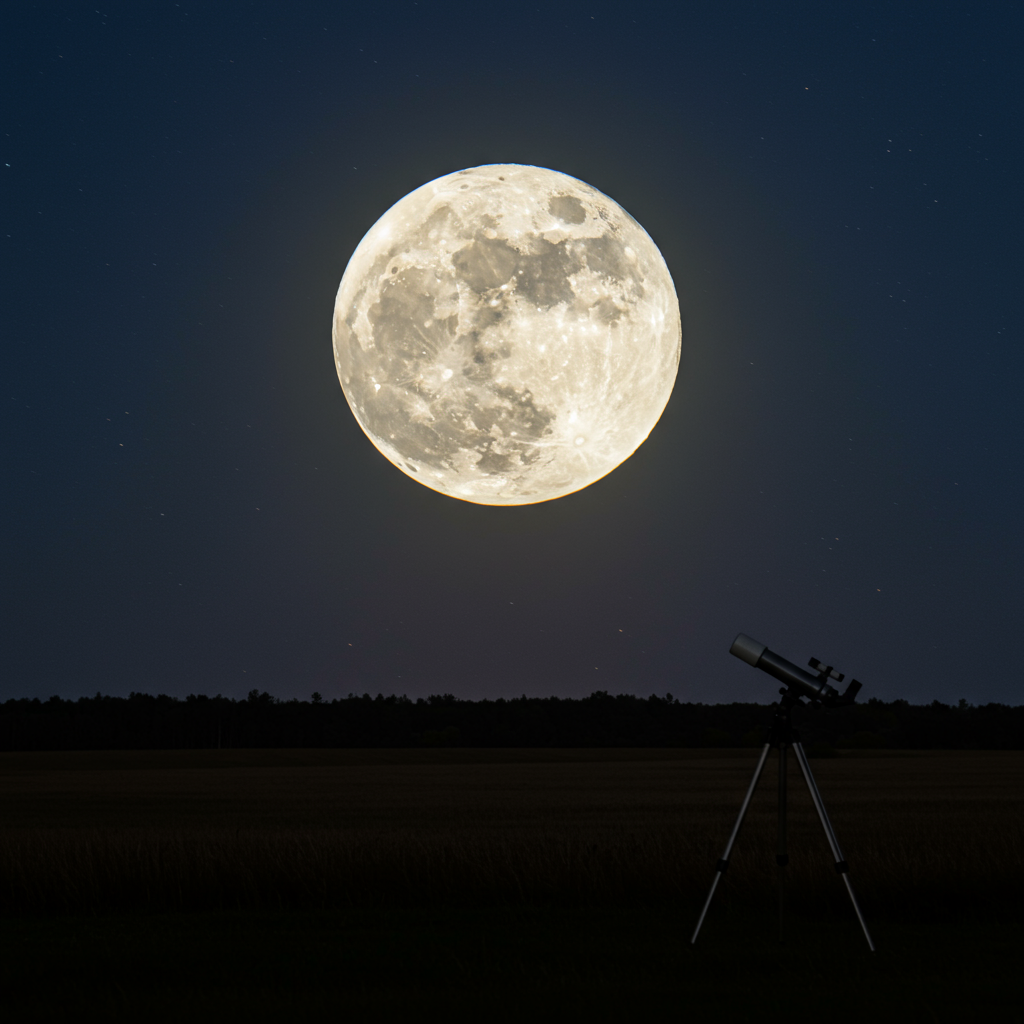
Get ready for a celestial spectacle! The July full moon, famously known as the “thunder Moon” or “Buck Moon,” is set to grace the night sky this week, reaching its peak illumination on Thursday, July 10, 2025. This event marks the first full moon of the astronomical summer, holding deep connections to seasonal cycles, ancient traditions, and providing a stunning view for stargazers. Whether you’re an experienced astronomer or a casual observer, this guide helps you understand and appreciate July’s radiant full moon.
What is the Thunder Moon?
The Thunder Moon is simply the traditional name given to the full moon that occurs in July. Full moons happen when the Earth is positioned almost directly between the sun and the moon. From our perspective on Earth, this alignment causes the entire face of the moon visible to us to be fully illuminated by sunlight. It’s a regular phase of the lunar cycle, happening approximately every 29.5 days.
July’s full moon typically arrives during a period of active summer weather. While not scientifically extraordinary, its consistent appearance is a significant marker in the natural calendar for many cultures around the world. Its timing often coincides with peak seasonal events on Earth, giving rise to its various evocative names.
Why is July’s Full Moon Called the Thunder Moon?
The name “Thunder Moon” originates from ancient Native American, European, and colonial traditions, particularly in the Northern Hemisphere. July is historically a time when summer thunderstorms are frequent and powerful across regions like North America. Early communities observed this natural correlation. They named the full moon after the prominent meteorological event occurring around that time. This practice of naming full moons based on seasonal phenomena was a vital way for these cultures to mark time, track agricultural cycles, and align with natural rhythms.
Other Names for the July Full Moon
The Thunder Moon goes by several other notable names, reflecting diverse cultural observations:
Buck Moon: This is another common name, linked to the annual growth cycle of male deer (bucks). By July, buck antlers are in a period of rapid growth and are typically covered in a soft, velvety layer before hardening later in the year. The Farmer’s Almanac frequently uses this name.
Salmon Moon: For some Native American communities, like those in Alaska, this moon’s appearance coincides with the crucial salmon run, a vital time for fishing and sustenance.
Hay Moon: In parts of Europe, the July full moon aligns with the peak season for harvesting hay, leading to this practical, agriculture-focused name.
Feather Molting Moon: The Woodland Cree observed birds molting their feathers around this time.
Raspberry Moon: The Ojibwe name links the moon to the ripening of raspberries.
These varied names underscore how different cultures used the lunar cycle to understand and interact with their environment, connecting celestial events to earthly activities and natural changes.
When and How to See the Thunder Moon
The July Thunder Moon will reach its peak illumination at 4:37 p.m. Eastern Daylight Time (2037 UTC) on Thursday, July 10, 2025. However, you don’t need to be watching at that exact moment! The moon will appear full for about three consecutive nights around this date, making it easily visible for multiple evenings.
For the most dramatic view, try to watch the moonrise shortly after sunset. In the Northern Hemisphere during summer, the full moon rises in the southeastern sky and sets in the southwest. It follows a lower path across the sky compared to winter full moons. For example, in New York City on July 10, moonrise is around 8:54 p.m. EDT, shortly after sunset. Find a location with a clear, unobstructed view of the southeastern horizon, such as a park or elevated area. Arriving 15-30 minutes before the scheduled moonrise allows you to experience the moment it appears above the horizon.
When the moon is low on the horizon, it can often appear larger and more golden than when it’s high in the sky. This effect is known as the “moon illusion.” While a precise scientific explanation is debated, it’s a stunning visual phenomenon worth experiencing. No special equipment is needed to enjoy the full moon. However, binoculars or a small telescope can enhance the view, revealing fascinating details on the lunar surface like craters and maria (dark plains). For photographers, including foreground elements like trees or buildings can create striking images of the rising full moon.
Cultural and Scientific Significance
Beyond its spectacular appearance and practical naming conventions, the Thunder Moon holds diverse cultural and scientific interest. In ancient times, observing the moon and linking it to earthly events was an early form of science and timekeeping. The association with thunder wasn’t just poetic; it also served as a marker for the peak of thunderstorm season, helping communities prepare for potential hazards.
Culturally, the Thunder Moon is steeped in symbolism. Some traditions view the accompanying thunderstorms as a form of purification or a release of energy, clearing the way for new growth. Astrologically, full moons are often seen as times of culmination, heightened emotions, and bringing things to light. The Thunder Moon, with its “electric energy,” is sometimes associated with internal “storms” leading to breakthroughs or transformations.
Scientifically, the full moon phase is when the moon’s gravitational pull combines with the sun’s to create stronger “spring tides,” resulting in higher high tides and lower low tides. The moon’s brightness can also influence nocturnal animal behavior, navigation patterns, and potentially human sleep cycles.
Could this year’s Thunder Moon be a Supermoon? A supermoon occurs when the full moon coincides closely with perigee, the point in its orbit where it is closest to Earth. If this alignment happens, the moon can appear up to 14% larger and 30% brighter than an average full moon. The timing of perigee relative to the July 10th full moon will determine if it qualifies as a supermoon.
Other Celestial Events in July 2025
July offers several other exciting opportunities for stargazing beyond the Thunder Moon:
Planetary Visibility: You might spot several planets. Mercury is difficult to see from mid-northern latitudes after sunset early in the month. Venus is a brilliant morning star visible in the east before dawn. Mars is low in the western sky after dusk, its visibility window shortening daily. Jupiter becomes visible low in the east before sunrise later in the month. Saturn rises around midnight early in July and is visible in the southeast before dawn. Uranus and Neptune require binoculars or telescopes and are also visible in the pre-dawn or late-evening sky.
Meteor Showers: The Southern Delta-Aquariids meteor shower peaks around July 29th. This shower can produce 15-20 meteors per hour in dark skies and is favorably moonless this year.
Constellations: Look for prominent constellations. From mid-northern latitudes, the Summer Triangle (Vega, Deneb, Altair) is high in the east. Scorpius, with its bright star Antares, is visible in the south. The Big Dipper and Polaris are visible in the north.
- Lunar Features: Even before the full moon, the First Quarter moon on July 2nd offers great views of lunar terrain along the terminator (the line between light and shadow). Look for the temporary Lunar X and Lunar V optical effects near the terminator around July 2nd, or the Golden Handle effect (illuminated Montes Jura) around July 5th.
- www.al.com
- www.silive.com
- vocal.media
- www.space.com
- www.space.com
The dark, moonless nights in the second half of July, after the full moon has waned, are excellent for observing fainter deep-sky objects like galaxies and nebulae.
Frequently Asked Questions
What is the Thunder Moon and when can I see it in July 2025?
The Thunder Moon is the traditional name for the July full moon. It reaches its peak illumination on Thursday, July 10, 2025, at 4:37 p.m. EDT (2037 UTC). While this is the exact moment of peak fullness, the moon will appear completely full to the eye for approximately three nights surrounding this date, making it visible from about Wednesday evening through Saturday morning.
How can I best view the Thunder Moon and what other celestial events are happening in July?
To best view the Thunder Moon, find a location with a clear view of the southeastern horizon and watch the moonrise shortly after sunset (around 8:54 p.m. EDT in NYC on July 10, but timing varies by location). The moon will appear full for several nights. July also features visible planets like Venus (morning) and Saturn (late evening/pre-dawn), the Southern Delta-Aquariids meteor shower peaking around July 29th, and prominent summer constellations like the Summer Triangle and Scorpius.
Why is the July full moon called the Thunder Moon and does it have any special significance?
It’s called the Thunder Moon because its timing in July often coincides with the peak season for summer thunderstorms in many parts of the Northern Hemisphere, a naming tradition from ancient cultures. It’s also known as the Buck Moon due to male deer growing their antlers at this time. Culturally, it can signify culmination, release of energy, or a marker for seasonal changes and activities like harvests or salmon runs, although scientifically it’s a regular full moon phase with standard gravitational effects on tides.
The presence of the Thunder Moon in the summer sky is a powerful reminder of the deep, ancient connections between Earth and the wider cosmos. Take some time this week to step outside, observe its radiance, and appreciate the blend of natural spectacle, cultural history, and scientific wonder it represents.
Word Count Check: 1070