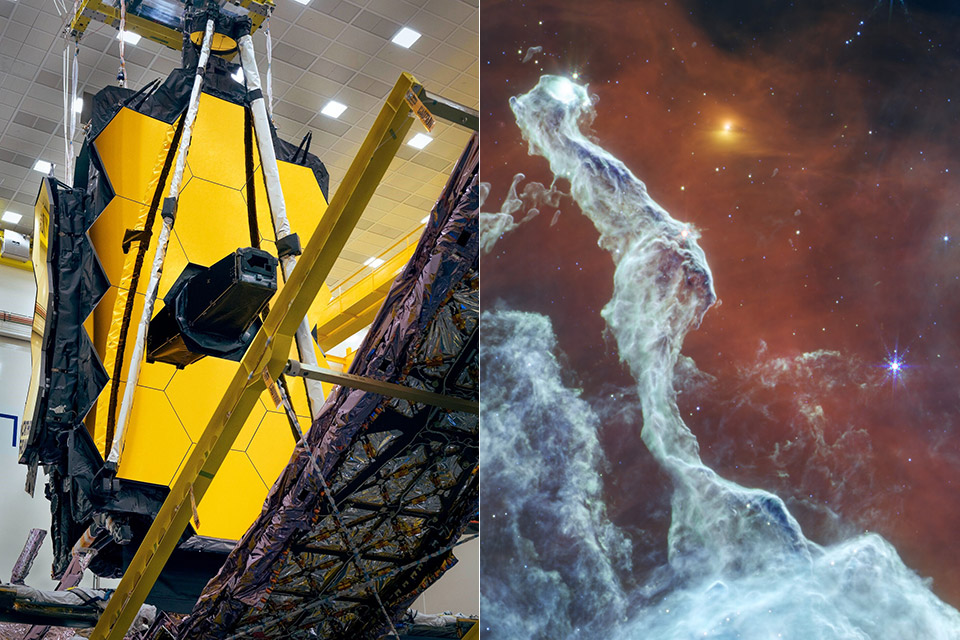
The cat’s Head nebula has been revealed in a series of new, multi-wavelength images that provide a detailed look at the complex processes of stellar birth within the Carina Nebula. Captured by both the James Webb space Telescope (JWST) and the Hubble Space Telescope, these observations offer a dual perspective on a region of space that is approximately 7,500 light-years from Earth.
Key Takeaways
- Multi-Wavelength Insight: By combining Hubble’s visible light data with JWST’s infrared capabilities, astronomers can see both the outer edges and the hidden interiors of the nebula.
- Stellar Birth Revealed: The images highlight a bright glow near the nebula’s “head,” which experts suggest is a newly forming star embedded in dust.
- Dynamic Structures: The “cat” shape is a temporary feature caused by the intense ultraviolet radiation and stellar winds from massive nearby stars.
- Advanced Instrumentation: The use of JWST’s NIRCam and MIRI instruments allowed for the detection of carbon-based molecules and warm dust that were previously obscured.
- Location: This compact stellar formation is situated within the much larger and more expansive Carina Nebula.
- For Students and Educators: These images provide a tangible, visual way to understand complex concepts like the electromagnetic spectrum, stellar winds, and the lifecycle of stars. They serve as a primary example of how technology expands the boundaries of human knowledge.
- For the Scientific Community: The ability to map carbon-based molecules in star-forming regions provides critical data for understanding the chemical building blocks that eventually form planetary systems.
- For the General Public: The thematic timing of these releases—coinciding with Halloween—demonstrates how space agencies use striking, relatable imagery to foster public engagement and interest in STEM (Science, Technology, Engineering, and Mathematics) fields.
- Spectroscopic Analysis: Using JWST to break down the light from the “eye” of the cat to confirm if it is indeed a nascent star.
- Chemical Mapping: Further investigating the distribution of carbon-based molecules to see how they correlate with the density of the dust pillars.
- Comparative Studies: Comparing the erosion rates in the Cat’s Head Nebula with other star-forming regions to create a more universal model of nebular decay.
- gnyouth.net
- www.space.com
What Happened
On October 31, 2026, new astronomical findings regarding the Cat’s Head Nebula were highlighted, showcasing the power of modern space observatories. The data presented, which includes a mix of visible and infrared views, stems from a period of intense observation by the James Webb Space Telescope that began on May 27, 2026, when the observatory returned to the Carina Nebula region.
According to a report by GN Youth News, the images provide a multi-layered view of the nebula. While the Hubble Space Telescope has previously documented the region in visible light, the arrival of the JWST data allows for a much deeper penetration into the dense clouds of gas and dust. The nebula, which earned its name due to its silhouette resembling a cat sitting with its back turned, is being studied to understand how massive stars influence their surroundings.
Why It Matters
The ability to observe the same celestial object through different wavelengths is a cornerstone of modern astrophysics. The Cat’s Head Nebula serves as a perfect case study for why this multi-wavelength approach is essential for understanding the lifecycle of stars.
Visible light, such as that captured by Hubble, is easily blocked by cosmic dust. In the visible spectrum, the nebula appears as an opaque, dark brown mass. However, infrared light—the kind used by the JWST—can pass through these dust clouds, acting like a thermal imaging camera that reveals the “skeleton” and the internal activity of the nebula. This allows scientists to locate nascent stars that would otherwise remain invisible to traditional telescopes.
Furthermore, these observations help refine our models of stellar evolution. By studying how radiation and winds from massive stars carve out shapes like the “cat’s head,” researchers can better predict how star-forming regions in our galaxy, and even in other galaxies, change over millions of years.
The Physics of Cosmic Erosion
The distinctive shape of the Cat’s Head Nebula is not a permanent fixture of the cosmos but rather a result of ongoing environmental erosion. This process is driven by two primary forces: intense ultraviolet (UV) radiation and powerful stellar winds.
As massive stars within the Carina Nebula evolve, they emit high-energy radiation and streams of charged particles. This radiation hits the surrounding clouds of gas and dust, a process known as photoevaporation. The lighter, less dense materials are stripped away and pushed outward, while the denser pockets of gas and dust resist this erosion. Over eons, these resistant pockets have been sculpted into the long, irregular pillar that forms the “body” of the cat, complete with a head and a downward-pointing tail.
Because this process is continuous, the nebula is in a constant state of flux. Astronomer notes indicate that as the stars within the formation continue to grow and evolve, the physical structure of the pillar will eventually disperse. The “cat” shape we see today is a fleeting moment in a much larger cosmic timeline.
Technical Comparison: Hubble vs. James Webb
To understand the scientific value of these new images, it is necessary to compare the specific data provided by the different instruments used to observe the region.
| Observational Method | Primary Instrument | Wavelength Type | Visual Characteristics | Scientific Focus |
|---|---|---|---|---|
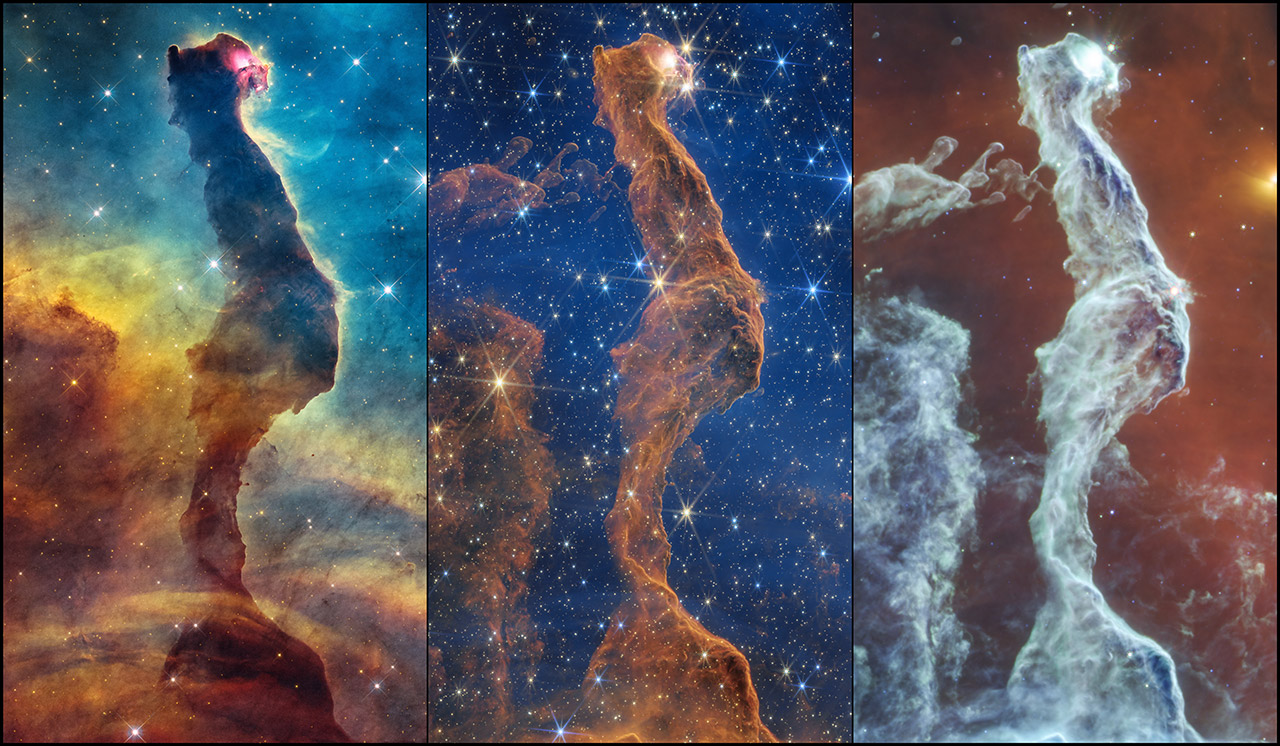
| Visible Light | Hubble Space Telescope | Visible Spectrum | Opaque, dark brown mass with a luminous yellow rim | Ionized gas (oxygen, hydrogen, sulfur) and scattered starlight |
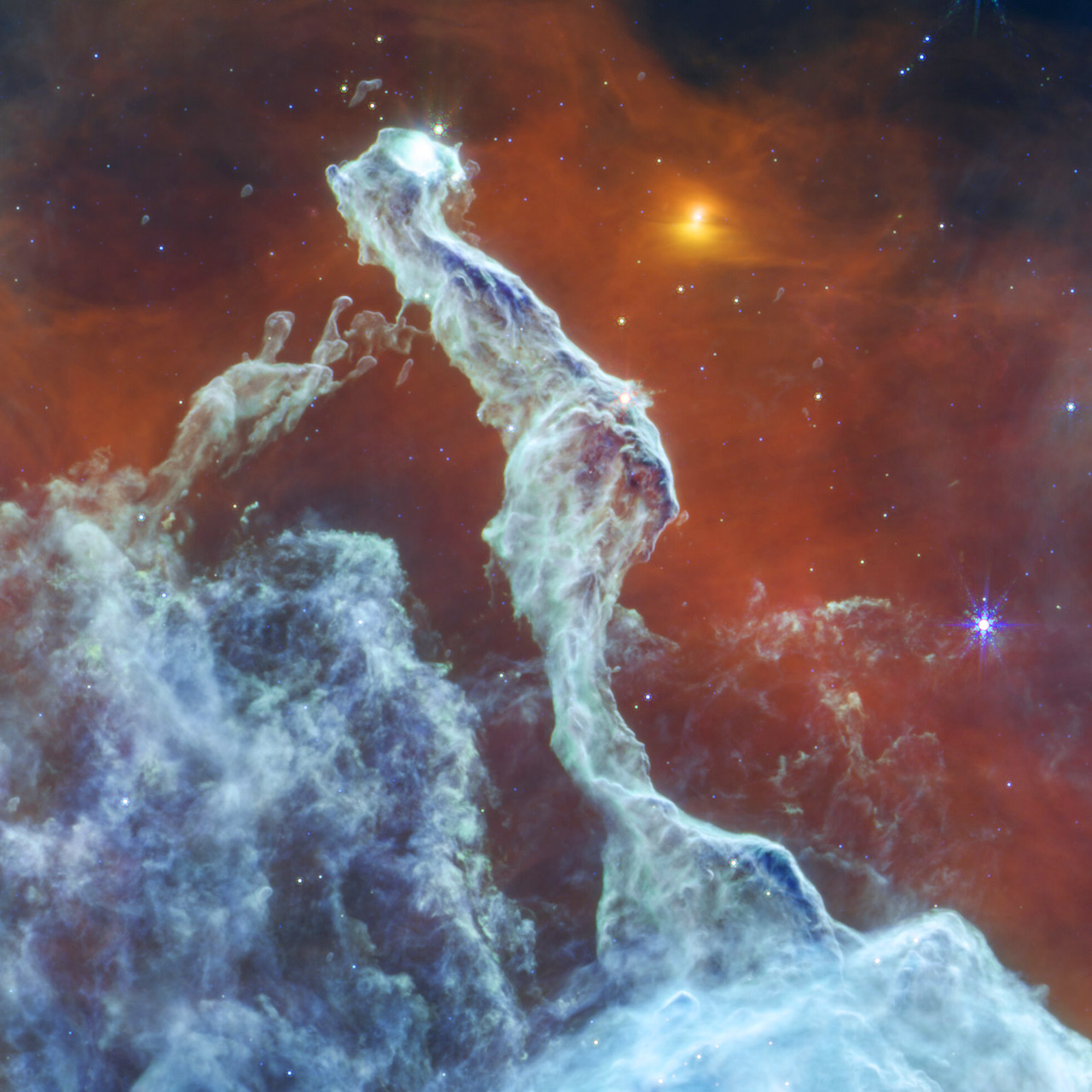
| Near-Infrared | JWST (NIRCam) | Near-Infrared | Orange-brown tendrils and wiggly shapes | Penetrating dust to reveal nascent stars and wispy strands |
| Mid-Infrared | JWST (MIRI) | Mid-Infrared | Soft bluish-grey colors and textures | Warm dust and carbon-based molecular emissions |
The Near-Infrared Perspective (NIRCam)
Using the Near-Infrared Camera (NIRCam), the JWST captured a view that reveals a prominent orange-brown tendril stretching through the frame. This view shows a “narrow wiggly shape” that forms the head of the cat, turning toward the right. A key feature in this wavelength is a bright yellow glow located near the head. Experts suggest this glow is the light from a newly forming star that is still deeply embedded within the dusty clutches of the nebula.
The Mid-Infrared Perspective (MIRI)
The Mid-Infrared Instrument (MIRI) provides a different chemical and thermal profile. In mid-infrared light, the orange-brown tendril seen by NIRCam shifts to a soft, bluish-grey color. This color shift is significant because it indicates the presence of warm dust and the emission of carbon-based molecules. The MIRI data is particularly effective at showing the “globules and threads” within the nebula, providing a granular look at the internal structure that visible light simply cannot reach.
What It Means for You
While the Cat’s Head Nebula is located 7,500 light-years away, the implications of these findings reach beyond the professional astronomical community.
Counterpoints and Open Questions
Despite the clarity provided by the JWST, several questions remain regarding the Cat’s Head Nebula.
One common misconception is the anthropomorphic nature of the nebula. While it is easy to see a “cat” or a “head,” these shapes are entirely coincidental results of random erosion patterns and do not imply any inherent structure. Astronomers caution against over-interpreting these shapes as meaningful physical entities beyond their role as markers for density.
Additionally, while the bright yellow glow is “suggested” to be a young star, further spectroscopic analysis will be required to confirm its exact age, mass, and temperature. There is also the question of the exact rate of erosion; while we know the nebula is temporary, the precise timeline for when the “cat” will disperse remains an estimate based on current models of stellar wind intensity.
What Happens Next
The study of the Cat’s Head Nebula is far from over. As the James Webb Space Telescope continues its mission, astronomers will likely return to the Carina Nebula to observe how these structures evolve over longer periods.
Future research will likely focus on:
Frequently Asked Questions
How far away is the Cat’s Head Nebula?n
The Cat’s Head Nebula is located approximately 7,500 light-years from Earth. It is a part of the much larger Carina Nebula complex, which is one of the most active and massive star-forming regions in our galaxy.
Why does the nebula look like a cat?
The “cat” shape is a result of a process called photoevaporation. Intense ultraviolet radiation and powerful winds from nearby massive stars erode the surrounding gas and dust. Denser regions of the nebula resist this erosion longer than lighter regions, leaving behind pillars and shapes that, by coincidence, resemble a feline silhouette.
What is the difference between the Hubble and JWST images?
The Hubble Space Telescope captures the nebula in visible light, which shows the opaque, dark brown exterior and the glowing edges caused by ionized gas. The James Webb Space Telescope uses infrared light, which can pass through the dust to reveal the internal structures, such as hidden stars and carbon-based molecules, that are invisible to Hubble.
Is the nebula a permanent structure?
No. The nebula is a temporary structure. As the stars within the Carina Nebula continue to evolve and the radiation from those stars continues to strip away the surrounding material, the pillar of gas and dust that forms the “cat” will eventually disperse and change shape entirely.
Conclusion
The recent observations of the Cat’s Head Nebula represent a significant milestone in multi-wavelength astronomy. By utilizing the distinct strengths of both the Hubble Space Telescope and the James Webb Space Telescope, scientists have been able to peel back the layers of cosmic dust to witness the violent and beautiful process of star formation. As we continue to look deeper into the Carina Nebula, we move closer to understanding the fundamental mechanisms that shape our universe.
References
Featured image: Image via gnyouth.net