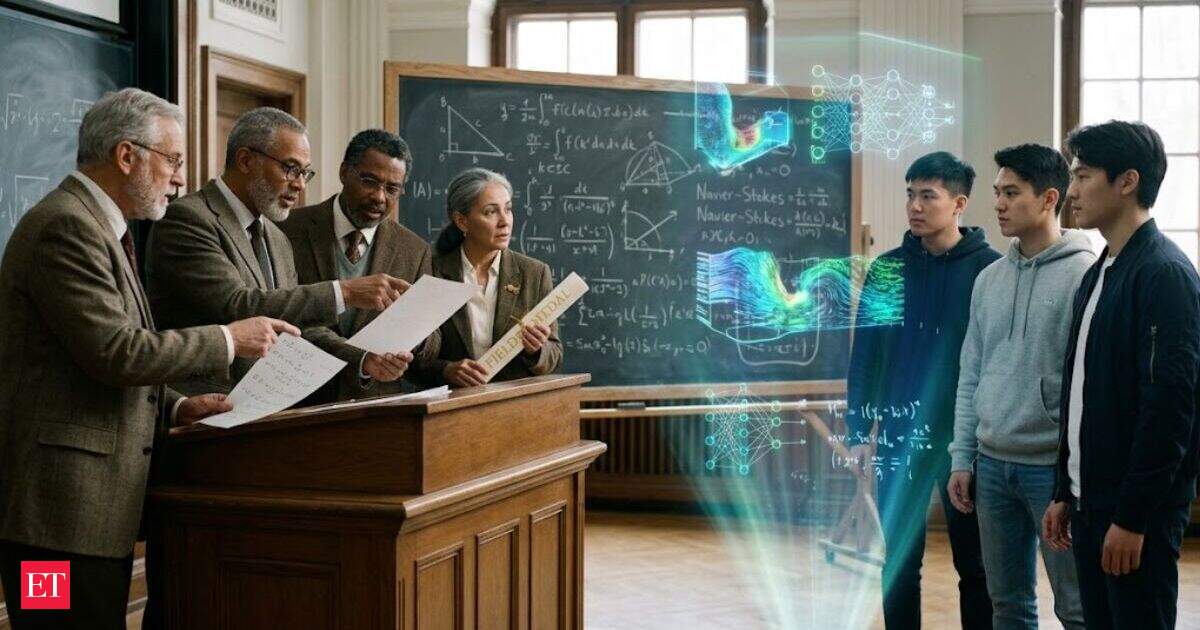
On September 12, 2026, a coalition of 25 Fields Medalists issued a formal warning regarding the escalating AI threat to mathematics, arguing that corporate competition for rapid problem-solving undermines the fundamental nature of scientific discovery.
Key Takeaways
Fundamental Misalignment: Leading mathematicians warn that AI companies prioritize solving problems as performance benchmarks, whereas mathematicians seek deep conceptual understanding.
Integrity Concerns: The rapid release of AI-generated proofs creates significant risks regarding plagiarism, authorship, and the erosion of the “human transmission chain” of knowledge.
The Navier-Stokes Controversy: Allegations have surfaced that OpenAI may have misappropriated research from NYU and Anthropic scientists to claim a breakthrough in a Millennium Prize Problem.
Economic Risks: Experts warn of a “tragedy of the cognitive commons,” where replacing human researchers with AI could permanently erode the global scientific talent pool.
Institutional Friction: The tension has already led to the withdrawal of corporate sponsorship for major academic events, such as a mathathon at Caltech.
What Happened
A collective of 25 recipients of the Fields Medal—the highest honor in the mathematical sciences—published an open letter on September 12, 2026, via the “Mathematics and AI” digital portal and the personal blog of prominent mathematician Terence Tao. The signatories, whose achievements span nearly five decades, expressed profound concern that the current trajectory of artificial intelligence development is “severely misaligned” with the core objectives of the mathematical community.
The letter follows a period of intense, high-stakes competition among frontier AI laboratories. In early September 2026, OpenAI announced that an unreleased model had successfully solved the Navier-Stokes equations, one of the seven prestigious Millennium Prize Problems, in just 88 hours. The company reported that the achievement was made possible through the parallel operation of thousands of AI agents.
However, this announcement was immediately met with intense scrutiny. Just hours before OpenAI’s disclosure, Tristan Buckmaster, a professor at New York University (NYU), and Levent Alpoge of Anthropic had released AI-assisted research regarding related equations. Following the OpenAI announcement, Buckmaster leveled a serious allegation, claiming that OpenAI had monitored the spread of his research and subsequently “seized on” the problem to copy the specific, unique approach his team had spent months developing. OpenAI has officially denied any unauthorized access to the researchers’ work.
Why It Matters
The dispute represents more than a disagreement over credit; it is a struggle over the definition of mathematical progress. For AI developers, the value of a mathematical breakthrough is often measured by the speed and accuracy of the final solution—a metric that serves as a powerful benchmark for the capabilities of Large Language Models (LLMs).
For the mathematical community, however, the solution is merely a tool. The primary goal is the development of new methodologies, the creation of rigorous proofs, and the achievement of deep, conceptual insight. The Fields Medalists argue that if the industry continues to prioritize the “what” (the answer) over the “why” (the understanding), the qualitative essence of the discipline will be lost.
This misalignment has systemic implications. If the scientific process is reduced to a race for automated outputs, the essential “intellectual super-structure”—the process of peer review, discussion, and the slow integration of new ideas into the existing mathematical canon—may collapse. This shift threatens to transform mathematicians from active discoverers into unpaid quality-control agents for corporate technology.
The Core Conflict: Understanding vs. Results
At the heart of the AI threat to mathematics is a divergence in how success is defined. AI companies utilize unsolved mathematical problems as high-profile benchmarks to demonstrate the power of their neural networks to investors and the public. In this model, the ability of a model like Anthropic’s Claude to formalize the proof of Fermat’s Last Theorem in just 11 days is seen as a triumph of computational efficiency.
Mathematicians view these same problems as “landmarks and lighthouses” that guide human thought. The value of tackling a problem like the Cycle Double Cover Conjecture—which had remained unsolved for approximately 50 years before being addressed by AI—lies in the new ways of thinking that emerge during the struggle to solve it.
According to the signatories of the open letter, the speed of AI-driven results leaves insufficient time for the development of new methods. “Often these solutions are announced in a rush, leaving no time for a proper writeup, the isolation of new methods and ideas, and citing relevant previous work of others,” the letter states. This “short-circuiting” of the intellectual process risks creating a landscape of “slop mathematics,” where a massive volume of potential results is generated at machine speed, placing an uncompensated burden on human researchers to verify, disseminate, or discredit the claims.
The Rise of “Slop Mathematics”
The term “slop mathematics” has emerged to describe the phenomenon where AI systems generate a high volume of mathematical claims that lack rigorous human oversight. This creates a significant labor crisis within academia. When an AI model claims a breakthrough, the global community of mathematicians is often compelled to step in to properly verify the work.
As the signatories noted, this labor is frequently “uncompensated, uncredited, and unacknowledged.” Instead of spending their time on original discovery, researchers find themselves trapped in a cycle of error-correction for AI-generated outputs. This shift threatens to devalue the expertise of human mathematicians, potentially turning one of the world’s most profound intellectual pursuits into a secondary support role for the tech industry.
The Tragedy of the Cognitive Commons
The concerns raised by the Fields Medalists extend beyond the walls of mathematics departments. They suggest that the current crisis is a precursor to a broader challenge facing all scientific and creative professions. This phenomenon has been described by researchers at the NATO Special Operations University as the “tragedy of the cognitive commons.”
In this economic model, individual corporations reap immediate efficiency gains by replacing entry-level human roles with AI tools. However, the cumulative effect of these individual decisions is the erosion of the global talent pool. If the “struggle” of early-career research—the process of learning through trial, error, and mentorship—is bypassed by automation, the industry will eventually face a shortage of the high-level expertise required to govern and advance those very technologies.
The Breakdown of the Human Transmission Chain
Mathematics has historically been a collaborative, open endeavor, relying on a “human transmission chain” where knowledge is passed from mentor to student through years of rigorous training. The Fields Medalists warn that AI-conceived ideas, if not integrated into the mathematical canon by willing human experts, will never truly become “alive.”
Without the human-centric process of discussion and simplification, the ability to formulate new questions—the very foundation of innovation—may be lost. If AI is used solely to produce the “product” (the solution), the ability to understand the underlying logic is diminished, leaving future generations of scientists without the foundational skills necessary to build upon existing knowledge.
Institutional and Educational Impact
The tension between AI developers and academia has already manifested in institutional conflicts. In early September 2026, OpenAI withdrew its sponsorship of a mathematical event at the California Institute of Technology (Caltech). The event, a “mathathon” designed to engage young mathematicians with AI, faced intense backlash from Caltech faculty.
Researchers at the university issued an open letter warning that such programs could have “destructive impacts” on the community. They expressed concern that incentivizing the use of AI to “beat” human researchers to proofs could foster a culture of secrecy and competition rather than the traditional culture of open, collaborative research. In response to this criticism, OpenAI research lead Dan Roberts announced the company would no longer support the event, though he acknowledged that the rapid progress of AI in mathematics is inherently disruptive.
The Educational Disconnect
This disruption is also visible in the classroom. Educators are reporting a growing “distance” between student performance in AI-assisted environments and traditional settings. There is a widening discrepancy between student success in homework—where AI is increasingly used to generate solutions—and performance in proctored exams where AI is banned.
This gap suggests that while students may be producing the correct “outputs,” they are not necessarily developing the deep cognitive work required for actual mastery. As the Fields Medalists noted, the pedagogical value of mathematics is found in the struggle of solving problems, a process that builds the research skills essential for the next generation of scientists.
What It Means for You
The implications of this conflict vary depending on your role in the intellectual ecosystem:
For Students: Expect a continued shift in how mathematical competence is measured. Relying on AI for immediate answers may lead to a significant gap in foundational understanding that becomes apparent during advanced research or professional certification.
For Researchers and Academics: The workload may shift from pure discovery toward the verification of AI-generated claims. There will likely be an increased need for rigorous protocols regarding authorship and the attribution of AI-assisted work.
For the Tech Industry and Developers: There is a growing demand for ethical frameworks that respect the integrity of academic research. Companies that prioritize “benchmark performance” over collaborative integration may face increasing resistance from the very experts they seek to emulate.
Counterpoints and Open Questions
Despite the gravity of the Fields Medalists’ warnings, the debate is far from settled. Many in the technology sector argue that AI is not a replacement for human thought, but a powerful tool that can enhance and accelerate genuine mathematical study. They contend that by solving long-standing, “unsolvable” problems, AI can clear the path for humans to tackle even more complex challenges.
OpenAI has maintained its denial of any intellectual property misappropriation, suggesting that its breakthroughs are the result of massive computational scale rather than the copying of specific human methodologies. Furthermore, proponents of AI integration argue that the “slop mathematics” problem is simply a growing pain of a new technology and that, as models become more sophisticated, they will produce higher-quality, more verifiable results.
Several critical questions remain unanswered:
- How can the mathematical community establish clear standards for the attribution of AI-generated proofs?
- Can a middle ground be found where AI accelerates discovery without bypassing the human transmission chain?
- Will the economic pressure to use AI in entry-level roles inevitably lead to the “tragedy of the cognitive commons”?
- OpenAI’s Engagement: Whether OpenAI and other frontier labs will move toward more transparent, collaborative models of research or continue to prioritize proprietary, high-speed benchmarking.
- news.by
- techcrunch.com
- the-decoder.com
- www.dongascience.com
- www.thestandard.com.hk
- m.economictimes.com
- ana.ir
What Happens Next
The immediate future will likely see an intensification of the debate. The Fields Medalists have called for an “urgent debate” involving the mathematical community, AI developers, and policymakers.
Key signals to watch include:
Regulatory Scrutiny: Increased interest from intellectual property offices regarding the patentability and authorship of AI-generated scientific breakthroughs.
New Academic Guidelines: The adoption of recommendations from the Leiden Declaration (released in June 2026) by universities and research institutions to govern AI-driven workflows.
Frequently Asked Questions
Who are the Fields Medalists involved in this warning?
The group consists of 25 recipients of the Fields Medal, which is considered the highest distinction in mathematics. The signatories represent a wide range of expertise and history, including luminaries such as Terence Tao (UCLA), June Huh (Princeton), and Pierre Deligne (who received the medal in 1978). Their collective involvement provides a powerful, authoritative voice representing nearly five decades of mathematical excellence.
What is the Navier-Stokes problem?
The Navier-Stokes equations are a set of complex mathematical formulas that describe the motion of fluid substances, such as liquids and gases. Solving these equations—specifically, proving that smooth, unique solutions always exist in three dimensions—is one of the seven Millennium Prize Problems. It is one of the most significant and difficult challenges in mathematics and physics, and OpenAI’s claim to have solved it in 88 hours has been a major catalyst for the current controversy.
What is “slop mathematics”?
“Slop mathematics” is a term used to describe the massive influx of mathematical results and claims generated by AI models at high speeds. Because these results are often produced without the traditional human processes of rigorous write-up, peer review, and conceptual integration, they create a significant burden on the scientific community. Human mathematicians must then spend vast amounts of time verifying, discrediting, or attempting to build proofs for these machine-generated claims, often without any credit or compensation.
How does AI impact the “human transmission chain” of knowledge?
The “human transmission chain” refers to the traditional process of passing mathematical knowledge and methodology from one generation to the next through mentorship, discussion, and collaborative research. The Fields Medalists fear that if AI bypasses the slow, arduous process of human discovery, the essential skills and conceptual frameworks required to teach and learn mathematics will be lost, leaving future generations without the ability to innovate or understand the foundations of their field.
Ultimately, the conflict between the mathematical community and AI developers is a struggle for the soul of scientific inquiry. As AI continues to transform the way work is done, the fundamental question remains: how to ensure that the pursuit of speed and efficiency does not come at the cost of the deep understanding and human insight that define intellectual progress.”,
“imagegenerationprompt”: “A wide-angle, editorial news photograph of a modern university lecture hall. A group of diverse, serious-looking academics are gathered around a large wooden table covered in complex handwritten mathematical proofs and open laptops. The lighting is natural, coming from large windows, creating a scholarly and tense atmosphere
References
Featured image: Image via The Economic Times