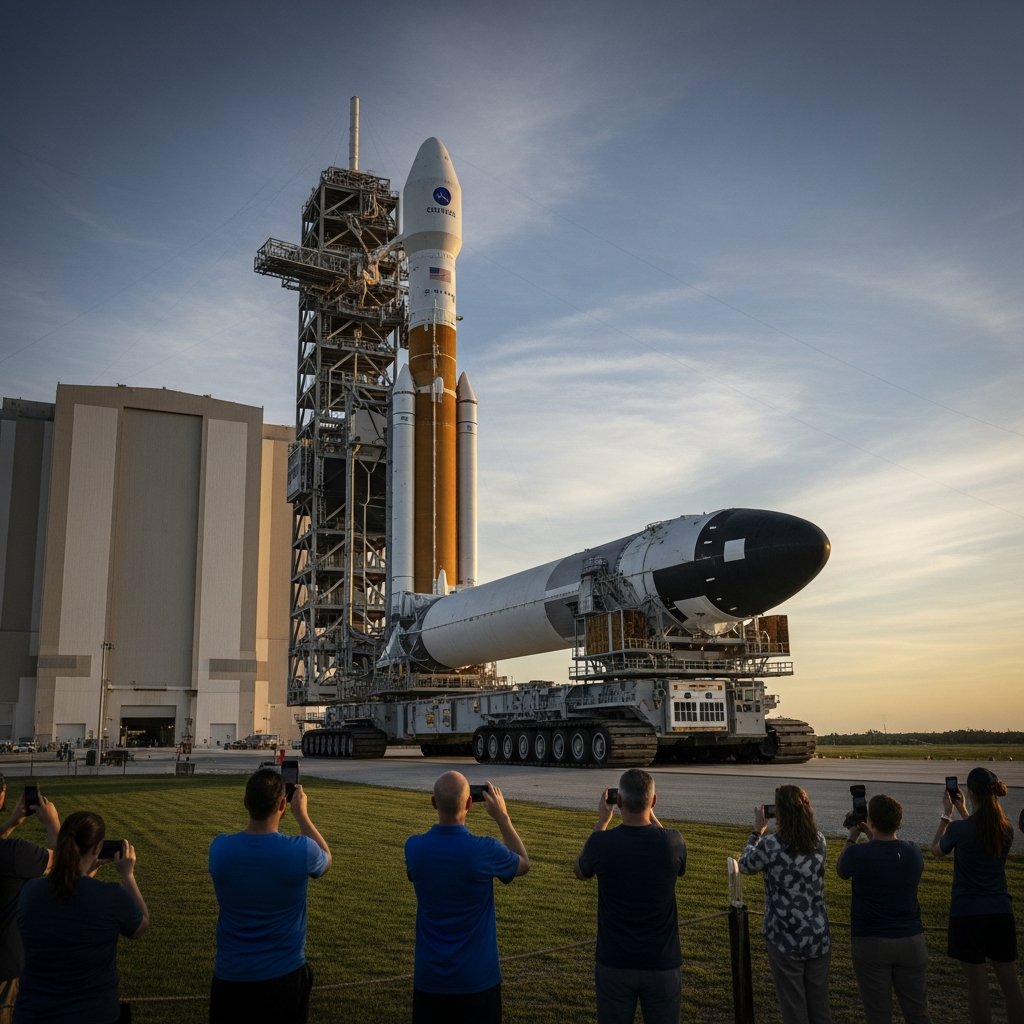
The colossal Space Launch System (SLS) rocket and Orion spacecraft for NASA’s Artemis II mission are making a momentous move, signaling a significant leap toward humanity’s return to the Moon. This crucial rollout from the iconic Vehicle Assembly Building (VAB) to Launch Pad 39B at Kennedy Space Center marks another vital step in preparing for the first crewed mission of the Artemis program. Scheduled to begin as early as 7 a.m. EST on Saturday, January 17, this multi-hour journey sets the stage for a new era of deep space exploration. Enthusiasts worldwide can follow comprehensive live coverage and essential mission briefings leading up to this historic event.
The Giant’s Journey Begins: Artemis II’s Roll to Launch Pad 39B
NASA’s integrated SLS rocket and Orion spacecraft, weighing a staggering 11 million pounds, are poised for their majestic trek. This crucial journey will see the towering stack transported approximately four miles from the Vehicle Assembly Building (VAB) to Launch Pad 39B at NASA’s Kennedy Space Center in Florida. The specialized crawler-transporter 2, an engineering marvel in itself, will meticulously carry the immense vehicle at a deliberate pace of about one mile per hour. The entire operation is projected to span up to 12 hours, transforming the landscape of humanity’s premier spaceport.
This isn’t the first time the SLS-Orion stack has made such a journey. Previous rollouts, like those for the uncrewed Artemis I mission, provided invaluable experience in preparing these massive vehicles for launch. Each movement, though slow, is fraught with precision and represents countless hours of engineering and preparation. The current rollout signifies the readiness of the Artemis II hardware for final launch preparations at the pad.
A Monumental Trek: Engineering the Move
The crawler-transporter 2 is a testament to monumental engineering. Designed to carry the heaviest payloads, this tracked vehicle ensures the safe passage of the SLS and Orion across the complex terrain of Kennedy Space Center. Its slow, steady movement protects the delicate instrumentation and immense structure of the rocket and spacecraft, guaranteeing a stable journey to the pad. This careful process underscores NASA’s meticulous approach to mission readiness, where every detail is scrutinized to ensure astronaut safety and mission success.
Witness History Live: How to Follow the Rollout
For those eager to witness this pivotal moment, NASA is providing extensive coverage across multiple platforms. The agency will stream a pre-rollout mission news conference, offer live feeds of the rollout, and host a media gaggle, all accessible via NASA’s YouTube channel. Individual streams for each event will be available directly from that page, ensuring broad public access to these critical milestones. Information on streaming NASA content through various online and social media platforms will also be provided.
It is important to note that the exact timing of the rollout is flexible. Technical preparations or prevailing weather conditions may necessitate adjustments. NASA’s teams prioritize safety and mission readiness, making real-time decisions to ensure optimal conditions for the move.
Key Briefings and Crew Engagement
The path to launch is paved with comprehensive briefings and direct engagement with the mission’s central figures. Here’s a breakdown of the planned events:
Friday, January 16:
12 p.m. EST: An Artemis II Rollout and Mission Overview News Conference will provide critical insights. This briefing will feature key NASA leaders, including:
John Honeycutt, Artemis II mission management team chair
Charlie Blackwell-Thompson, Artemis launch director, Exploration Ground Systems
Jeff Radigan, Artemis II lead flight director, Flight Operations Directorate
Lili Villarreal, landing and recovery director, Exploration Ground Systems
Jacob Bleacher, chief exploration scientist, Exploration Systems Development Mission Directorate
These experts will discuss the mission’s objectives and the intricate details of the upcoming rollout.
Saturday, January 17:
7 a.m. EST: Live views of the Artemis II rollout from Kennedy Space Center will commence, offering real-time footage of the rocket’s majestic journey.
9 a.m. EST: A dedicated Artemis II Crew Rollout Media Event will take place. NASA Administrator Bill Nelson and the historic Artemis II crew – NASA astronauts Reid Wiseman, Victor Glover, and Christina Koch, alongside CSA (Canadian Space Agency) astronaut Jeremy Hansen – will engage with media present at the countdown clock. They will answer questions about their rigorous preparations and the monumental mission ahead. This direct interaction highlights the human element at the heart of the Artemis program, bringing the astronauts’ experiences and perspectives to the forefront.
Artemis II: A Critical Step for Human Lunar Exploration
The Artemis II mission stands as a critical stepping stone in NASA’s ambitious plan to return humans to the Moon and, eventually, journey to Mars. This will be the first crewed test flight of the SLS rocket and Orion spacecraft, following the successful uncrewed Artemis I mission. Artemis I thoroughly tested the deep space systems, paving the way for astronauts to venture further than ever before into lunar orbit. Artemis II will demonstrate the Orion capsule’s life support systems and validate essential procedures with humans aboard, proving the capability for future lunar landings.
The broader Artemis program aims to land the first woman and the first person of color on the Moon. It seeks to establish a long-term human presence there, using lunar resources for scientific discovery and economic benefits. This sustained lunar presence will serve as a vital proving ground for technologies and operational strategies essential for the ultimate goal: sending astronauts on pioneering missions to Mars. Alongside these crewed missions, NASA’s Commercial Lunar Payload Services (CLPS) initiative, involving private companies like Intuitive Machines, is also delivering critical science and technology to the lunar surface. These commercial partnerships are demonstrating innovative approaches to lunar exploration and resource utilization, complementing the Artemis missions by laying foundational infrastructure.
Milestones on the Path to the Moon and Mars
The rollout to the launch pad is a key milestone, but it’s just one step in a series of intensive preparations for the Artemis II mission. In the weeks immediately following the rollout, NASA teams will conduct final checks and preparations of the rocket and spacecraft. This includes critical tests like the wet dress rehearsal, which simulates a full launch countdown, including propellant loading. This rehearsal is crucial for assessing the flight readiness of the spacecraft, launch infrastructure, and the entire crew and operations teams.
Following a thorough evaluation of flight readiness after the wet dress rehearsal, the mission management team will formally select a launch date. While the earliest projected launch window for Artemis II opens on Friday, February 6, flexibility is built into the schedule to accommodate any additional technical work or fine-tuning required. There is also a provision for the SLS and Orion to be rolled back to the Vehicle Assembly Building if more extensive work is deemed necessary, emphasizing NASA’s commitment to mission success and astronaut safety. Each of these steps, from rollout to wet dress rehearsal and final flight readiness review, brings humanity closer to establishing a sustainable presence on the Moon and preparing for the next giant leap to Mars.
Frequently Asked Questions
What is the significance of the Artemis II rollout?
The Artemis II rollout is a pivotal milestone, marking the physical movement of the SLS rocket and Orion spacecraft to Launch Pad 39B at Kennedy Space Center. This event signifies that the integrated vehicle is nearing final preparations for its mission. As the first crewed test flight of the Artemis program, Artemis II will send astronauts around the Moon, proving the capabilities of the deep space transportation system and validating life support systems for future lunar landings. It represents a concrete step towards establishing a long-term human presence on the Moon and ultimately, sending humans to Mars.
How can the public watch the Artemis II rocket rollout and associated events?
NASA provides extensive live coverage for the public. All events, including the pre-rollout news conference on Friday, January 16 (12 p.m. EST), the live rollout feed on Saturday, January 17 (starting 7 a.m. EST), and the crew media event (9 a.m. EST), will be streamed live on NASA’s YouTube channel. The agency will also offer information on streaming content across various online platforms, including social media, ensuring broad accessibility for space enthusiasts worldwide.
What are the next major milestones for the Artemis II mission after rollout?
After the Artemis II rocket and Orion spacecraft are positioned at Launch Pad 39B, NASA teams will proceed with final preparations. A critical step will be the wet dress rehearsal, simulating a full launch countdown, including propellant loading, to verify the readiness of all systems and personnel. Following this, the mission management team will conduct a thorough flight readiness assessment. Only after this comprehensive evaluation will a specific launch date be selected. The earliest projected launch window for Artemis II is Friday, February 6.