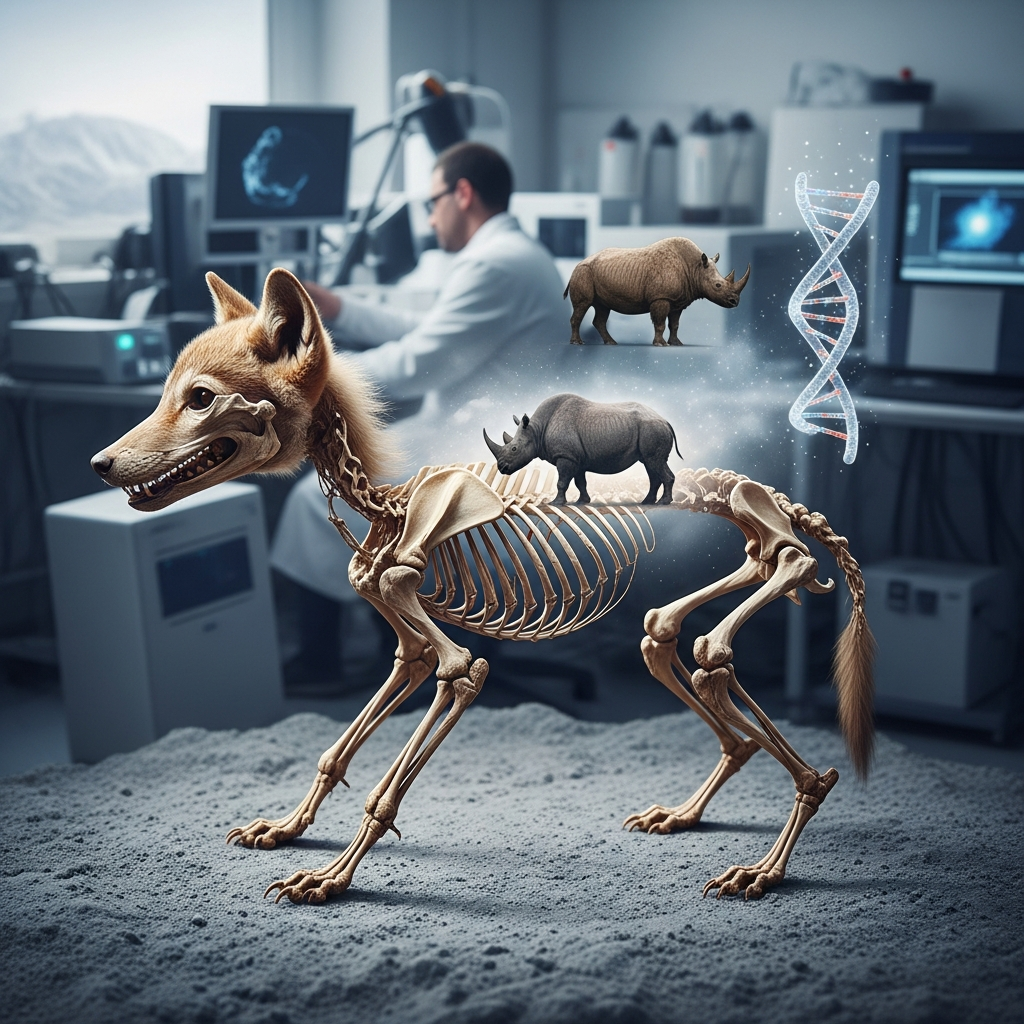
Deep within the frozen heart of Siberia, a remarkable discovery has surfaced: the mummified remains of a tiny Ice Age wolf cub, whose last meal holds the secret to one of Earth’s greatest prehistoric puzzles – the rapid disappearance of the woolly rhinoceros. This incredible find, dating back 14,400 years, has allowed scientists to sequence the genome of a woolly rhino from its partially digested remains, offering groundbreaking insights that challenge long-held theories about megafauna extinction. This isn’t just a tale of ancient predators and prey; it’s a critical investigation into how quickly entire species can vanish, with profound implications for understanding our planet’s past and protecting its future.
The Astonishing Siberian Discovery
The story begins in 2011 near the village of Tumat in northeastern Siberia. There, amidst the ancient permafrost, researchers unearthed the beautifully preserved body of a two-month-old female wolf cub. This young carnivore, thought to have perished when a landslide collapsed its den, was frozen in time. Its exquisite preservation allowed scientists an unprecedented glimpse into an ecosystem that vanished millennia ago.
A Mummified Clue from the Permafrost
The frigid conditions of the Siberian permafrost acted as a natural freezer, maintaining not only the wolf cub’s fur and form but also its internal organs, including its stomach contents. Scientists quickly realized the immense potential held within this prehistoric pup. What exactly had this Ice Age wolf eaten just before its sudden demise? The answer was a piece of woolly rhinoceros, a massive, shaggy herbivore that roamed northern Eurasia before its extinction around 14,000 years ago.
The Ultimate Ice Age Meal Ticket
This discovery wasn’t just interesting; it was a rare scientific jackpot. Well-preserved specimens from species nearing extinction are incredibly scarce, making the recovery of viable genetic material a daunting challenge. However, this particular chunk of partially digested meat offered a unique opportunity. If scientists could extract the rhino’s genetic blueprint, it might reveal the species’ health and population dynamics during its final centuries. As Dr. Camilo Chacón-Duque, a bioinformatician involved in the research, highlighted, obtaining genetic makeup from such a sample could unlock vital clues about what caused the species to die out. The woolly rhino tissue, carbon-dated to 14,400 years old, meant this cub had likely consumed one of the very last rhinos on Earth.
Unlocking Ancient DNA: A Scientific First
The scientific team, a collaboration between Stockholm University, Uppsala University, and the Swedish Museum of Natural History, faced a monumental task. Recovering DNA from partially digested, ancient tissue is extraordinarily difficult. Yet, they succeeded in a groundbreaking feat.
The Groundbreaking Genomic Analysis
In a historic achievement published in Genome Biology and Evolution, researchers successfully decoded the entire woolly rhino genome from the matted piece of meat found in the wolf cub’s stomach. This marks the first time an entire genome of an Ice Age animal has been recovered from inside another creature, showcasing predators’ meals as surprisingly rich sources of genetic material. According to Chacón-Duque, this also represents the youngest woolly rhinoceros genome obtained to date, providing a crucial “snapshot” of the species right before its extinction. Lead author Sólveig Guðjónsdóttir from Stockholm University described the process as both exciting and challenging, given the sample’s rarity.
Rewriting the Woolly Rhino Extinction Story
The prevailing scientific theories about species extinction often point to a slow decline, marked by decreasing genetic diversity, population bottlenecks, and inbreeding. Scientists initially expected to find signs of such “genomic erosion” in the woolly rhino. However, their findings presented a starkly different narrative.
Debunking Genetic Decline and Human Hunting
After meticulously comparing the wolf cub’s rhino DNA with genomes from two older specimens (dated to 18,000 and 49,000 years ago), the researchers were astonished. They found no evidence of genetic degradation. Instead, the analysis revealed a “surprisingly stable genetic pattern with no change in inbreeding levels through tens of thousands of years prior to the extinction.” This robust genetic health strongly indicates that the woolly rhino population remained relatively large and viable until very close to its rapid disappearance.
Professor Love Dalén, an evolutionary genomics expert, further solidified these conclusions. He noted that woolly rhinos had coexisted with humans in northeastern Siberia for a remarkable 15,000 years. This long period of coexistence makes human hunting an unlikely primary cause of their sudden disappearance, in stark contrast to the fate of some other megafauna. The evidence definitively ruled out a long, drawn-out population collapse caused by genetic factors or human hunting pressure for the woolly rhino extinction.
Climate Change: The Swift and Silent Killer
If not genetic decline or human hunting, what then caused such a swift and dramatic woolly rhino extinction? The study points to an abrupt period of intense climate warming. Known as the Bølling-Allerød Interstadial, this event occurred between 14,700 and 12,900 years ago, characterized by a rapid and dramatic warming of the Northern Hemisphere’s climate towards the end of the last Ice Age (Pleistocene epoch).
This rapid climatic shift would have profoundly transformed the landscape and devastated the favored cold-adapted vegetation that formed the primary food source for these massive herbivores. The research suggests that whatever killed the species was “relatively fast,” likely striking within a tight 300 to 400-year window before the woolly rhinos vanished around 14,000 years ago. Their inability to adapt to these rapidly changing environmental conditions, specifically global warming, became the ultimate cause of the woolly rhino extinction.
Lessons for Modern Conservation
The specific circumstances of how the wolf cub acquired its final meal remain somewhat speculative. Given the immense size of woolly rhinos (comparable to modern white rhinos), it’s highly improbable a two-month-old pup could have hunted one. It likely scavenged from a carcass, perhaps one killed by its pack, or received a regurgitated morsel from an adult. Curiously, a second wolf cub, thought to be its sister, was found at the same site, indicating both had started eating solids but were still suckling.
Beyond the Rhino: Future Possibilities
This groundbreaking research goes beyond merely solving an ancient mystery; it offers critical lessons for modern conservation efforts. The finding that a species can maintain genetic viability right up until a rapid extinction event driven by external factors like climate change underscores the vulnerability of even robust populations to sudden environmental shifts. It highlights the importance of recovering genomes from individuals that lived just before extinction, as this can provide vital clues to understanding species disappearance – a highly relevant endeavor for current endangered species. The technical achievement of sequencing DNA from such an “unlikely source” as a predator’s stomach opens exciting new avenues for future genomic analyses, potentially unlocking more secrets about prehistoric life and informing our strategies to prevent future extinctions.
Frequently Asked Questions
How did scientists manage to sequence ancient DNA from a wolf cub’s stomach?
Scientists achieved this by carefully extracting a matted piece of woolly rhino meat from the stomach of a 14,400-year-old mummified wolf cub found in the Siberian permafrost. The frigid conditions perfectly preserved the tissue. Specialized palaeogenetics techniques were then employed to reconstruct the complete woolly rhino genome from this partially digested material. This was a pioneering effort, marking the first time an entire Ice Age animal’s genome was sequenced from the stomach contents of another creature.
What does the woolly rhino’s stable genetic diversity imply about its extinction?
The discovery of stable genetic diversity in the woolly rhino, even in its final centuries, is highly significant. It contradicts the expectation of “genomic erosion,” where declining species show reduced genetic health due to inbreeding or population bottlenecks. This stability strongly suggests the woolly rhino population was genetically robust and viable until very close to its extinction. It implies that the species did not slowly “fade out” due to internal genetic weaknesses but was instead wiped out rapidly by an external, powerful factor.
How does understanding the woolly rhino’s rapid extinction inform modern conservation efforts?
The woolly rhino’s rapid extinction, primarily attributed to sudden climate warming (the Bølling-Allerød Interstadial), offers crucial insights for contemporary conservation. It demonstrates that even genetically healthy, widespread species can be incredibly vulnerable to abrupt environmental changes. This underscores the urgent need to address current climate change impacts, as rapid habitat shifts and food source disruptions can quickly decimate populations, even those not suffering from genetic decline. It highlights the importance of proactive conservation strategies that consider swift climatic shifts.
Conclusion
The discovery within a tiny Siberian wolf cub has fundamentally reshaped our understanding of the woolly rhino extinction. It paints a vivid picture not of a slow genetic fade, but of a thriving species abruptly overcome by the dramatic climate shifts of the last Ice Age. This pioneering work, extracting a complete genome from such an unusual source, not only illuminates a chapter of Earth’s ancient past but also provides invaluable lessons for today. As we face rapid environmental changes, the story of the woolly rhino stands as a stark reminder of the power of climate to swiftly alter life on our planet, emphasizing the critical importance of understanding and protecting our world’s precious biodiversity.