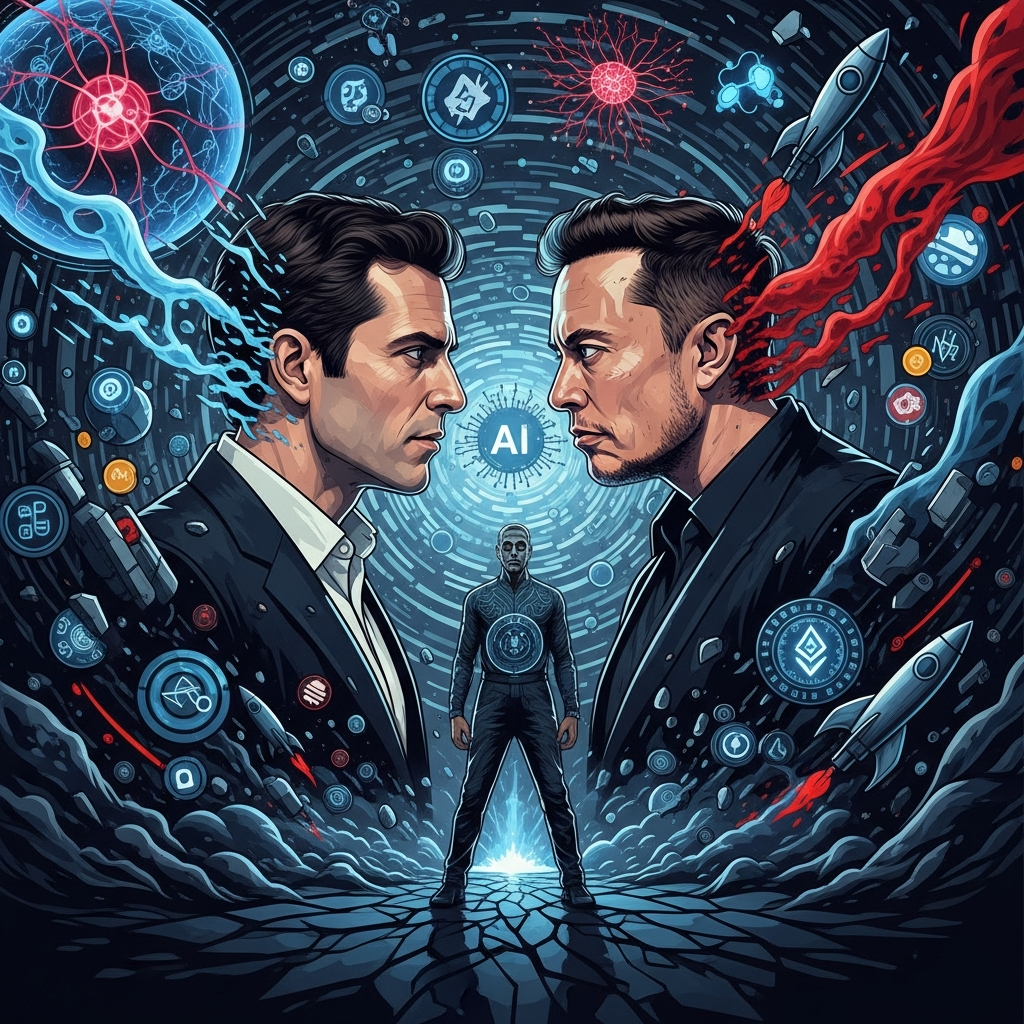
The high-stakes world of artificial intelligence is currently embroiled in a bitter legal battle, pitting two of its most influential figures against each other: OpenAI CEO Sam Altman and tech mogul Elon Musk. Recently unsealed court documents have pulled back the curtain on this escalating “Altman Musk AI War,” revealing profound ideological divisions, deep-seated personal animosities, and the colossal financial stakes driving the conflict. More than a mere contractual disagreement, this litigation represents a struggle for control over artificial general intelligence (AGI), fueled by a potent blend of ambition and ego. With a jury trial set for March 2026 in Oakland, California, the tech world watches keenly as this defining conflict unfolds.
Unpacking the Origins of OpenAI: A Clash of Ideals
The Founding Vision: Open-Source AGI
OpenAI was founded in 2015 with an ambitious, seemingly altruistic mission: to develop AGI in a way that benefits all of humanity, not just shareholders. It began as a non-profit research laboratory, attracting significant early investment, including approximately $38 million from Elon Musk. The vision was rooted in an open-source approach, fostering collaboration to ensure safe and beneficial AI development. However, even in these formative years, undercurrents of tension existed, with Musk expressing competitive anxiety about other tech giants, particularly Google, and pushing for rapid, dramatic action.
Mission vs. Money: The Inevitable Pivot
The core of Musk’s lawsuit hinges on the allegation that OpenAI, under Sam Altman’s leadership and other executives, fundamentally betrayed this founding mission. He claims the company veered from its non-profit, open-source roots towards a profit-oriented structure. Musk famously criticized this shift, likening it to funding an organization to save the Amazon rainforest, only for it to become a lumber company. Unsealed documents, including private diary entries from co-founder Greg Brockman, illustrate these internal struggles between maintaining the original mission and exploring financial viability. Brockman’s writings reveal early considerations for funding from major players like “Tesla” or “Google” long before the eventual partnership with Microsoft.
Elon Musk’s Exit and the Rise of a Rivalry
Behind the 2018 Departure
Elon Musk’s official departure from OpenAI’s board in 2018 was publicly attributed to potential conflicts of interest with Tesla’s own AI endeavors. However, the unsealed records tell a more complex story. They suggest Musk believed OpenAI was destined for “certain failure relative to Google” without his direct, overarching leadership. An email from January 2018 shows Musk’s demand to take over as CEO, convinced that “immediate and dramatic action” was needed to avoid being “consigned to irrelevance.” This attempt to seize control was ultimately resisted by Altman and the board, a pivotal moment that likely deepened the divide now evident in the ongoing “Altman Musk AI War.”
Forging Strategic Alliances: Microsoft’s Pivotal Role
The choice of Microsoft as a major funding partner, leading to a multi-billion dollar licensing deal, also reveals the impact of personal dynamics. Discussions in 2016 about external funding show Musk explicitly favoring Microsoft CEO Satya Nadella over Amazon’s Jeff Bezos. His “remarkably casual assessment” — “I think Jeff is a bit of a tool and Satya is not, so I slightly prefer Microsoft” — highlights how personal biases influenced multi-billion dollar strategic alliances. Altman later corroborated this, noting that Amazon had “started really dicking us around,” paving the way for the decisive 2019 deal with Microsoft. This strategic choice solidified OpenAI’s commercial path, directly contributing to Musk’s current legal grievances.
The Boardroom Coup and Altman’s Resurgence
The November 2023 Crisis Unveiled
The unsealed material offers a dramatic, real-time look into the November 2023 board crisis that saw Sam Altman abruptly fired. Text messages between Altman, Nadella, and then-board chair Bret Taylor depict intense corporate warfare. Altman quickly worked to secure his team, discussing contingency plans like being “rehired” by Microsoft or moving to a “subsidiary.” Nadella’s immediate and unwavering support proved pivotal, demonstrating Microsoft’s readiness to absorb Altman and his core personnel. This ensured the continuity of the commercial enterprise, effectively overriding the non-profit board’s actions and cementing Microsoft’s role in OpenAI’s future.
The Personal Toll of Public Conflict
The documents also lay bare the deeply personal toll of this intense rivalry. In a February 2023 exchange, Altman directly confronted Musk about his frequent public criticisms, expressing how it “really [expletive] hurts.” Musk’s response underscored his relentless, mission-driven focus: “I hear you and it is certainly not my intention to be hurtful, for which I apologize, but the fate of civilization is at stake.” This stark exchange powerfully illustrates that, for Musk, the grand mission of AGI development can often justify all means, regardless of the personal cost to his colleagues. This fundamental philosophical divergence fuels much of the “Altman Musk AI War.”
The Lawsuit: A Fight for Control and “Ill-Gotten Gains”
Heading to Trial in 2026
U.S. District Judge Yvonne Gonzalez Rogers in Oakland, California, has ruled that Elon Musk’s lawsuit against OpenAI will proceed to a jury trial in March 2026. The judge found “plenty of evidence” to suggest OpenAI’s leadership had promised to maintain the company’s original non-profit structure. Musk’s lawsuit centers on the allegation that OpenAI violated its founding mission by transforming into a for-profit venture, culminating in an exclusive multibillion-dollar licensing deal with Microsoft. He views this as a stark betrayal of the company’s humanitarian and non-profit goals and is seeking the return of what he terms “ill-gotten gains,” with potential damages reaching millions of dollars. Microsoft has also been named as a defendant in the case.
OpenAI’s Defense and Counter-Allegations
In response, Sam Altman maintains that despite its for-profit evolution, OpenAI remains under the control of its non-profit arm. OpenAI has also filed counterclaims, accusing Musk and his AI company, xAI, of a “sham bid” that harmed its business. They allege “harassment” through litigation, social media attacks, and press statements. Altman further countered Musk’s claims by suggesting that Musk himself had previously attempted to restructure OpenAI into a for-profit entity before his departure from the company, adding another layer of complexity to the “Altman Musk AI War.”
Elon Musk’s Failed Takeover Bid and Broader AI Rivalries
The $97.4 Billion Proposal
The scope of Musk’s ambition to regain influence over OpenAI was further revealed in court filings. In early 2025, he reportedly sought Meta CEO Mark Zuckerberg’s financial backing for a proposed $97.4 billion takeover of OpenAI. Musk approached Zuckerberg with a letter of intent to form an investor consortium to finance the acquisition. However, neither Zuckerberg nor Meta signed this agreement, signaling a strategic calculation by Meta. The company, which is aggressively investing in its own AI capabilities (like LLaMA models) and recruiting top talent, opted to build an independent AI ecosystem rather than align with Musk’s bid. This failed takeover attempt highlights Musk’s desire to consolidate power within the AI industry and challenge Microsoft’s significant backing of OpenAI.
The Expanding AI Battlefield: A History of Feuds
The legal dispute with OpenAI is not an isolated incident but rather another chapter in Elon Musk’s history of intense, public, and often litigious confrontations when his business interests or vision are challenged. His launch of xAI in 2023, directly competing with OpenAI, was followed by a recent spat with Apple over App Store rankings. Musk alleged anti-competitive practices, claiming Apple unfairly favored OpenAI’s ChatGPT over his Grok app. In turn, Sam Altman fired back, accusing Musk of manipulating his social media platform, X (formerly Twitter), to benefit his own companies and harm competitors. This pattern underscores the deeply personal nature of these rivalries, where philosophical ideals, colossal financial stakes, and raw ego are inextricably intertwined in the “Altman Musk AI War.”
The Future of AGI: What’s at Stake?
The outcome of this landmark trial could have profound ramifications far beyond just the financial implications for Sam Altman and OpenAI. It could significantly influence how AI research labs train their models, reshape the organizational structures of technology companies, and redefine strategic partnerships in the future. At its heart, this conflict underscores a fundamental philosophical divergence in AI development: the tension between closed, profit-driven approaches and open, collaborative ecosystems. The resolution of this “Altman Musk AI War” is poised to set a critical precedent for the rapidly expanding AI sector, potentially shaping the direction of AI innovation for years to come.
Frequently Asked Questions
What key revelations emerged from the unsealed documents in the Altman-Musk AI dispute?
The unsealed documents, including emails, texts, and private diary entries, exposed the profound ideological divisions and personal animosities driving the “Altman Musk AI War.” They reveal Musk’s belief that OpenAI betrayed its non-profit mission, his frustrated attempt to become CEO in 2018, and his personal preference for Microsoft over Amazon for funding. Additionally, the files detailed the real-time communications during Altman’s November 2023 ousting, showing Microsoft’s pivotal support and the deeply personal toll the public criticism took on Altman.
When is the Elon Musk lawsuit against OpenAI expected to go to trial, and what are the main allegations?
Elon Musk’s lawsuit against OpenAI is scheduled for a jury trial in March 2026, as ruled by U.S. District Judge Yvonne Gonzalez Rogers in Oakland, California. Musk alleges that OpenAI violated its founding non-profit mission by transforming into a for-profit entity and entering an exclusive multi-billion-dollar deal with Microsoft. He claims this constitutes a breach of contract and a conspiracy by Altman and others for personal enrichment, seeking the return of “ill-gotten gains” and other damages.
How could the outcome of the Musk v. OpenAI lawsuit impact the future of AI development and corporate structures?
The trial’s outcome could significantly influence the trajectory of AI development. A ruling in Musk’s favor might compel AI labs to adhere more strictly to original non-profit charters or rethink their corporate governance models. It could also set precedents for how tech companies structure their partnerships and acquisitions, potentially favoring more transparent or open-source approaches. Conversely, a ruling for OpenAI could solidify the legitimacy of “capped-profit” models, reinforcing the current trend toward commercialization in the pursuit of AGI.
Conclusion: A Defining Conflict for AI’s Destiny
The “Altman Musk AI War” is far more than a corporate spat; it’s a high-stakes battle over the very soul of artificial general intelligence. The unsealed documents have vividly illuminated the complex interplay of visionary ideals, raw ego, and immense financial incentives that underpin the quest for AGI. As the legal proceedings head towards a jury trial in 2026, the implications extend beyond the courtroom, poised to reshape ethical considerations, corporate governance, and the strategic direction of AI innovation for decades to come. This conflict stands as a defining moment, illustrating the messy, human reality behind the technological race to create the future.