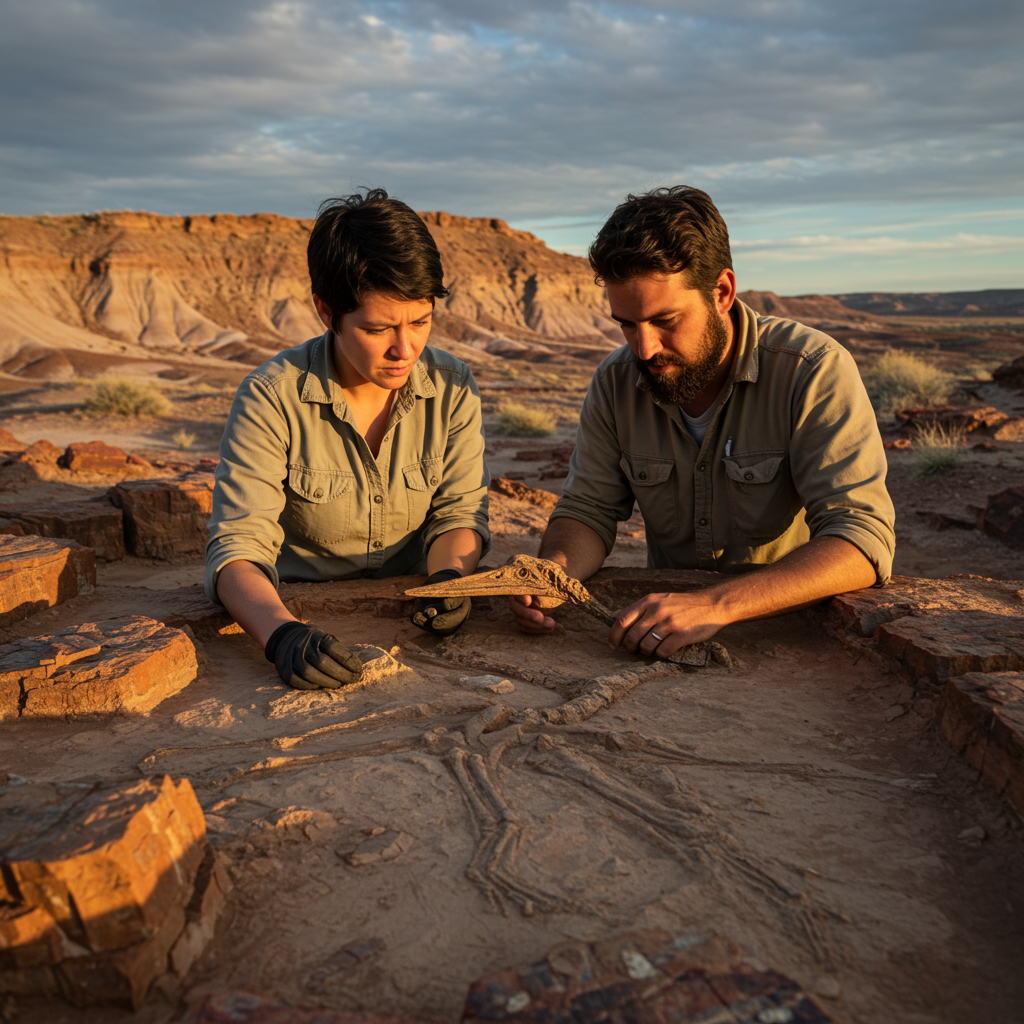
Paleontologists have made a groundbreaking discovery in Arizona, unearthing the oldest known pterosaur fossil found in North America. This ancient flying reptile, living around 209 million years ago just before a major global extinction event, offers an unprecedented glimpse into a prehistoric world previously shrouded in mystery. The remarkable find comes from a treasure trove of fossils discovered in Petrified Forest National Park, revealing a dynamic ecosystem where ancient creatures mingled with evolutionary newcomers.
The discovery challenges previous assumptions about which animal groups coexisted during the late Triassic period. It highlights a critical transitional phase in Earth’s history, setting the stage for the rise of dinosaurs and other modern vertebrate groups. The research, led by a Smithsonian paleontologist, not only identifies a new pterosaur species but also paints a vivid picture of a “lost ecosystem” preserved in exquisite detail.
Unearthing a Prehistoric Flyer
The key to this significant find was a small, fragile jawbone recovered from a remote bonebed within Petrified Forest National Park. Researchers, led by Dr. Ben Kligman of the Smithsonian’s National Museum of Natural History, meticulously studied this fossil alongside hundreds of others. The jawbone, with its distinctive teeth, confirmed the presence of a pterosaur, the first vertebrates to evolve powered flight. This particular specimen dates back an astonishing 209 million years.
Locating early pterosaur fossils, especially from the late Triassic, is exceptionally rare. Their bones were often delicate and hollow, making them less likely to fossilize than the robust skeletons of larger creatures. The unique geological conditions at this Arizona site provided the perfect environment for such fragile remains to be preserved.
Introducing Eotephradactylus mcintireae
The newly identified species has been formally named Eotephradactylus mcintireae. This name holds special meaning. “Eotephradactylus” translates roughly to “ash-winged dawn goddess,” a nod to the volcanic ash layers found at the site, which enabled precise dating, and the species’ position near the evolutionary base of pterosaurs. The species name, “mcintireae,” honors Suzanne McIntire, a dedicated volunteer at the Smithsonian’s FossiLab. McIntire was the first to recognize the significance of the small jawbone among thousands of other fossils.
This ancient flying reptile was considerably smaller than the colossal pterosaurs that soared the skies later in the Mesozoic Era. Based on the recovered jawbone and other fragments, scientists estimate Eotephradactylus was roughly the size of a modern seagull. It would have been light enough, perhaps, to comfortably perch on a person’s shoulder, a stark contrast to later species with wingspans reaching over 30 feet.
Analysis of the pterosaur’s teeth provided crucial clues about its diet. The tips of the teeth showed significant wear. This suggests Eotephradactylus likely fed on tough prey, probably the armored fish that swam in the ancient river systems of this region.
A Window into a Transitional World
The significance of this discovery extends far beyond just the pterosaur itself. The bonebed in the Owl Rock Member of Petrified Forest National Park is a paleontological goldmine. It preserves a remarkably diverse community of animals from a time slice (around 209 million years ago) that is poorly represented in the fossil record globally. This period falls just before the end-Triassic extinction event, which occurred roughly 201.5 million years ago and wiped out about 75% of Earth’s species, paving the way for the dominance of dinosaurs.
Dr. Kligman described the site as capturing a critical transition. It provides direct evidence that animal groups previously thought to exist largely after the extinction event were actually living alongside older, more archaic lineages before it happened.
Coexistence in the Late Triassic
The bonebed assemblage includes a fascinating mix of the old and the new. Living side-by-side with the small pterosaur were:
Ancient behemoths: Giant amphibians (some up to 6 feet long) and formidable armored crocodile relatives like aetosaurs.
Evolutionary pioneers: Early forms of frogs, relatives of modern tuataras, and significantly, one of the world’s oldest known turtle fossils.
The discovery of the turtle fossil, dating to around the same time as the oldest known turtle found in Germany, is particularly intriguing. It suggests that turtles rapidly dispersed across the supercontinent Pangaea, despite being small and slow-moving creatures. This site in Arizona reveals that these early turtles had spike-like armor in addition to their shells.
Other creatures found in the bonebed include freshwater sharks, coelacanths (a type of fish), and distinctive reptiles like Vancleavea. This diverse community highlights the complexity of equatorial ecosystems just before the end-Triassic mass extinction reshaped life on Earth.
The Ancient Arizona Landscape
Two hundred and nine million years ago, the region that is now northeastern Arizona was located near the equator in the heart of the supercontinent Pangaea. The environment was semi-arid, crisscrossed by numerous small river channels and likely subject to seasonal flooding. Volcanic activity nearby deposited layers of ash, which are now crucial for dating the fossils.
Scientists hypothesize that a major flood event likely buried the animals found in the bonebed. Sediment and ash carried by the flood waters would have quickly covered the remains, protecting the delicate structures, including the small pterosaur bones, from decay and destruction. This rapid burial in a river channel context appears to have been key to the exceptional preservation seen at the site, a rare occurrence for early pterosaurs.
The Long Road to Discovery
The fossil-rich bonebed was initially discovered in 2011 by a team braving the remote, rugged terrain of Petrified Forest National Park. The area, known for rattlesnakes and wild horses, presented significant excavation challenges. Due to the small size and sheer number of fossils embedded in the rock, excavating everything in the field was impractical.
Instead, large blocks of sediment containing fossils were carefully encased in plaster jackets and transported back to laboratories, including the Smithsonian’s FossiLab. Here, a dedicated team of volunteers, working under microscopes, painstakingly chiseled away the surrounding rock over thousands of hours. This meticulous process allowed researchers to uncover more than 1,200 individual fossils, representing at least 16 different vertebrate groups. The discovery of the critical pterosaur jawbone by volunteer Suzanne McIntire during this process underscores the vital role played by citizen scientists in paleontology.
Broader Implications
The discovery of Eotephradactylus mcintireae in North America fills a significant gap in the fossil record of early pterosaurs. Previously, most of the oldest pterosaur fossils were found in Europe. This find demonstrates that these pioneering flying reptiles had a much wider geographic distribution across Pangaea earlier than previously understood.
Furthermore, the unique assemblage of animals at the Petrified Forest site provides invaluable data for understanding ecological dynamics leading up to a major extinction event. It challenges the idea that certain “modern” groups only diversified after the Triassic-Jurassic extinction. Instead, it shows they were already present and coexisting with older lineages. This snapshot helps scientists piece together how ecosystems changed and adapted during one of Earth’s pivotal transitional periods.
The collaborative effort involving the Smithsonian, Petrified Forest National Park, and other institutions highlights the importance of multi-disciplinary research and volunteer contributions in pushing the boundaries of scientific knowledge. Future work at similar sites, particularly in ancient channel deposits like this one, may reveal even more secrets about the early history of pterosaurs and other fascinating creatures of the late Triassic.
Frequently Asked Questions
What is Eotephradactylus mcintireae and why is its discovery important?
Eotephradactylus mcintireae is the name given to a new species of pterosaur, an ancient flying reptile. Its discovery is highly important because the fossil, a jawbone found in Arizona, is the oldest known pterosaur fossil recovered in North America, dating back 209 million years. This fills a significant gap in the fossil record of early pterosaurs outside of Europe and shows they were present in North America earlier than previously confirmed.
Why was this ancient ecosystem preserved in Petrified Forest National Park?
The ecosystem was preserved due to a unique combination of factors in the late Triassic period. The area, located near the equator on Pangaea, was a semi-arid landscape with river channels. Scientists believe a flood event rapidly buried the animals in sediment and volcanic ash. This quick burial in a river channel environment protected the delicate fossils, including the tiny pterosaur bones, from decay and destruction, creating a rare preservation site.
What other important fossils were discovered alongside the pterosaur?
The bonebed in Petrified Forest National Park contained a rich assemblage of over 1,200 fossils. Alongside Eotephradactylus mcintireae, researchers found remains of giant amphibians (up to 6 feet), armored crocodile relatives, freshwater sharks, coelacanths, relatives of tuataras, early frogs, and one of the world’s oldest known turtle fossils. This diverse collection provides a snapshot of a transitional ecosystem just before the end-Triassic extinction.
The discovery in Petrified Forest National Park is a landmark achievement in paleontology. It not only adds a new, ancient species to the roster of North American prehistoric life but also provides crucial context for understanding the dramatic ecological shifts that occurred millions of years ago. The secrets held within this bonebed continue to unveil the complex story of life on Earth before the age of dinosaurs truly began.