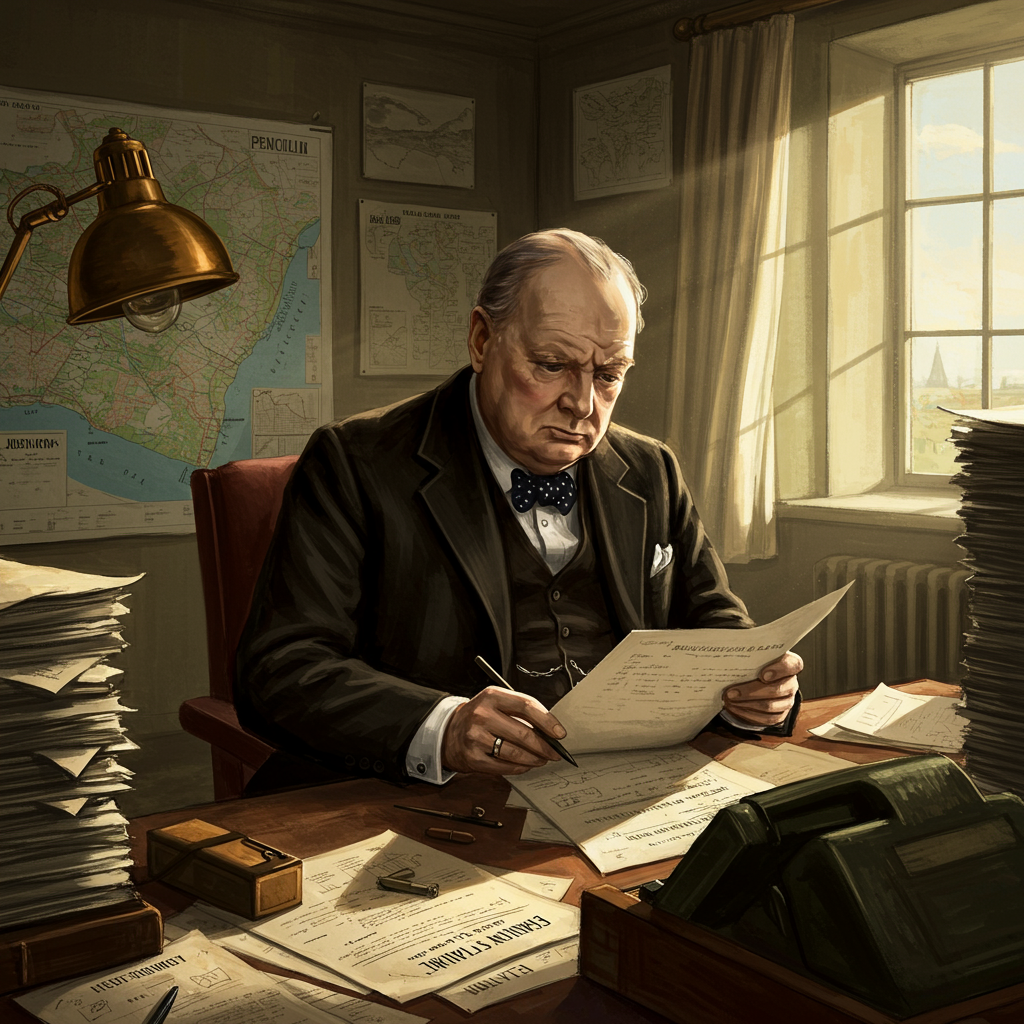
Newly unearthed documents from the National Archives shed remarkable light on a hidden wartime struggle: Winston Churchill’s urgent and often frustrated efforts to secure adequate supplies of the groundbreaking antibiotic, penicillin, in time for the massive D-Day landings.
Seen by BBC News ahead of the anniversary of the June 6, 1944, Normandy invasion, these official papers reveal the British Prime Minister’s personal concern and impatience with the slow progress in obtaining enough of what was then considered a revolutionary “wonder drug.”
A Lifesaving ‘Wonder Drug’ for D-Day
Penicillin was desperately needed to treat the vast number of casualties anticipated from the D-Day operation. Before its development, even relatively minor wounds could tragically lead to fatal blood poisoning with no effective treatment available. Securing sufficient quantities of this powerful new medicine was therefore deemed essential for saving countless lives among the Allied forces.
While Penicillin was a British discovery – identified by Professor Alexander Fleming in London in 1928 – developing it into a usable medicine and achieving large-scale production proved challenging, particularly with the onset of World War Two. An Oxford University team, led by Howard Florey, eventually conducted the first successful trials transforming the bacteria-killing mould into a viable treatment. However, facing difficulties in mass production within the UK, Florey and his team took their critical research to the United States, where pharmaceutical companies were able to significantly expand output.
Churchill’s Frustration Revealed in Handwritten Notes
The documents reveal Churchill’s deep disappointment that Britain lagged significantly behind the US in securing ample penicillin supplies, despite its origins as a “British discovery.” As early as the start of 1944, he was voicing complaints to his ministers about Britain’s inability to produce the drug at scale.
His frustration is palpable in handwritten notes scrawled on official reports. On a Ministry of Supply report highlighting greater American production, Churchill penned in red ink: “I am sorry we can’t produce more.” Later that year, reacting to explanations about the UK’s expected output, he stated, “Your report on penicillin showing that we are only to get about one-tenth of the expected output this year, is very disappointing.” He didn’t stop at complaints, issuing clear instructions: “Let me have proposals for a more abundant supply from Great Britain.”
Securing Supplies: A Race Against Time
The unearthed files offer a glimpse into the “extraordinary levels of preparation undertaken in advance of the D-Day landings,” according to Dr. Jessamy Carlson, a modern records specialist at The National Archives. She notes that penicillin only began reaching UK shores in quantities sufficient to significantly improve outcomes for wounded service personnel a mere six weeks prior to the invasion.
Ultimately, less than two weeks before D-Day, health officials were able to report that sufficient supplies had finally been obtained. However, these were primarily sourced from the US and were strictly allocated only for battle casualties.
The Stark Reality: Civilian Access Denied
The limited availability for civilians during this critical period is highlighted by a poignant telegram from 1944 found within the same files. A doctor in Cornwall, treating a 10-year-old child, desperately pleaded with authorities for the medicine, stating, “No hope without penicillin.” Tragically, the plea was rejected, confirming that supplies were reserved exclusively for military use at that time. Penicillin did not become fully available to the general public in the UK until 1946.
These newly revealed documents underscore the immense effort and urgency involved at the highest levels to secure this life-saving antibiotic for the first time on a large scale for a major military campaign, playing a critical role in the fight to liberate northern Europe.
References
- https://www.bbc.com/news/articles/cj09v52l8v4o
- https://ca.news.yahoo.com/handwritten-notes-reveal-churchills-penicillin-001759748.html
- https://www.bbc.co.uk/news/articles/ckgx6kl274zo
- https://www.bbc.co.uk/news/uk-politics-46899466