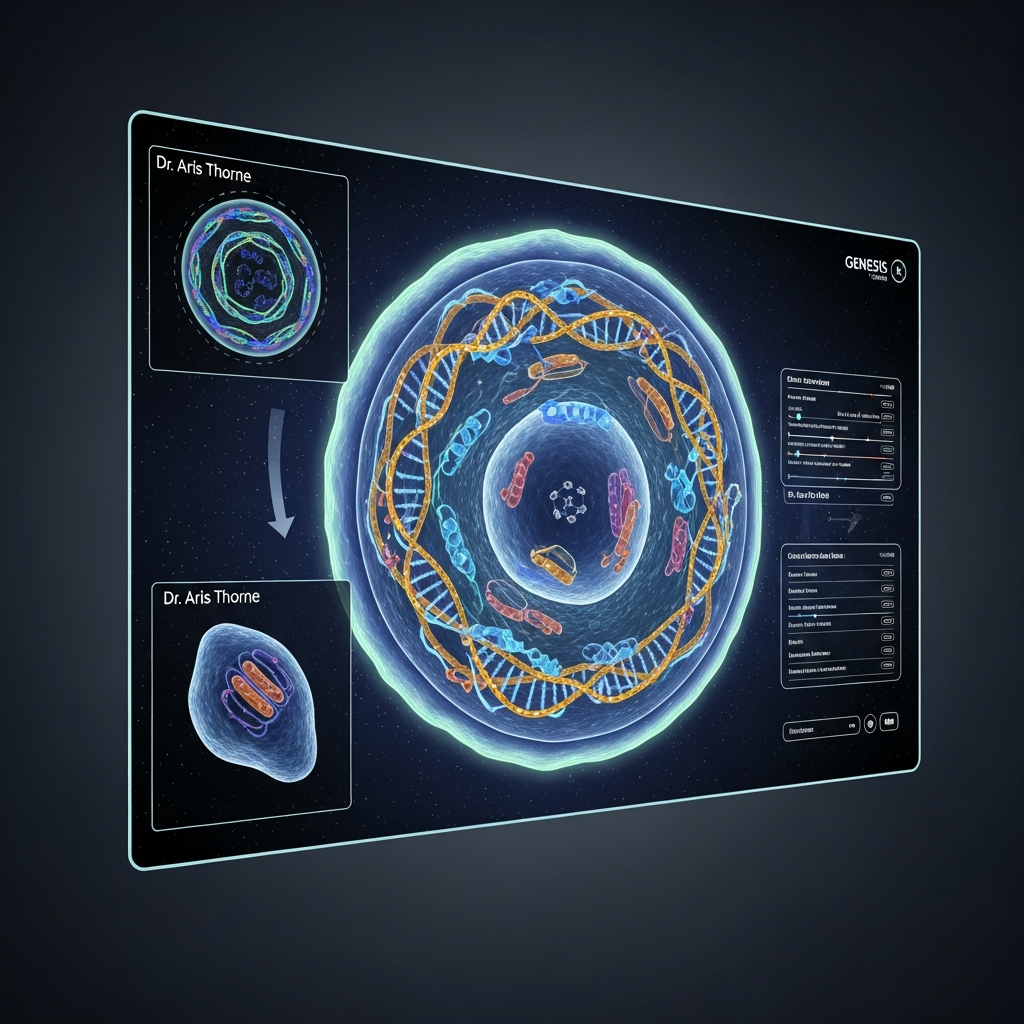
Scientists at the University of Illinois Urbana-Champaign have achieved a monumental feat, successfully simulating the entire life cycle of a living bacterial cell in unprecedented 4D detail. This groundbreaking computational model offers an immersive, nanoscale view of cellular processes, from DNA replication and protein synthesis to metabolism and cell division. Published in the prestigious journal Cell, this work marks a significant convergence of biology and computational science, promising to redefine our understanding of life’s fundamental mechanisms and accelerate breakthroughs in synthetic biology and medicine.
A Virtual Leap: Bringing the Minimal Cell to Life
At the heart of this achievement lies the “minimal cell” known as JCVI-syn3A. This streamlined bacterium was engineered by the J. Craig Venter Institute with fewer than 500 genes, each absolutely essential for its survival and replication. By focusing on such a pared-down organism, researchers dramatically reduced the complexity of the modeling challenge without sacrificing the critical processes that govern all cellular life. The team’s ambition was to simulate how this genetically minimal cell orchestrates its intricate molecular machinery throughout its entire 105-minute life cycle, revealing previously inaccessible insights into the physical interactions and precise temporal dynamics that underpin cellular function.
Creating such an extraordinarily detailed and dynamic model demanded the integration of massive experimental datasets with cutting-edge computational methods. The researchers had to represent the individual behavior and complex interactions of every molecule inside the cell. This included genes, proteins, RNA molecules, membranes, ribosomes, and metabolic intermediates, each governed by complex kinetics and biophysical constraints. Their innovative approach involved assembling mechanistic descriptions of gene expression, mRNA degradation, protein synthesis, sugar transport, membrane biogenesis, and the orchestration of DNA replication. These subcellular processes were then seamlessly linked into a continuous, time-resolved simulation.
Powering Discovery: Supercomputing the Secrets of Life
One of the project’s most remarkable technical achievements was handling the simultaneous, multiscale phenomena occurring within the tiny volume of the bacterial cytoplasm. This immense computational hurdle was overcome using a novel dual-GPU strategy. One dedicated GPU efficiently executed the detailed replication of the cell’s chromosome, while a second GPU managed concurrent activities such as metabolism and ribosome assembly. This parallel processing architecture dramatically accelerated the simulation, condensing what would typically be an overwhelming computational challenge into a feasible six-day run on advanced supercomputing infrastructure, specifically the Delta resource.
This innovative use of supercomputing power echoes advancements seen in other scientific domains. For instance, in cosmology, tools like Effort.jl are now accelerating complex simulations from days to hours, allowing researchers to explore vast cosmic scenarios more efficiently. Similarly, the semiconductor industry is leveraging NVIDIA’s AI physics frameworks to reduce Technology Computer-Aided Design (TCAD) simulation times from weeks to milliseconds. These parallels highlight a broader scientific trend: harnessing immense computational power and intelligent algorithms, often with GPU acceleration, is revolutionizing how we model and understand complex systems, whether it’s a living cell, the universe, or a microchip.
Unveiling Life’s Inner Workings: Discoveries and Visualizations
The simulation provided striking quantitative validation for existing experimental observations of DNA replication and cell division symmetry in Syn3A. Despite its reduced gene set, the minimal cell exhibits tightly regulated timing to ensure its chromosome is fully duplicated before splitting symmetrically into two daughter cells. This fidelity of replication and division was captured with remarkable accuracy, offering profound insights into the fundamental requirements for cellular life and division, even within a near-minimal genomic context.
Beyond confirming known phenomena, the model allowed the team to peer into the incredibly crowded molecular milieu inside the bacterial cell. By selectively rendering certain molecular components invisible—such as all cellular proteins—researchers could visualize how the cell’s lone chromosome threads through a densely packed cytoplasm. This provided unprecedented intuition into how the chromosome navigates spatial constraints imposed by ribosomes, transporters, and the cell membrane. Such visualizations offer a deeper understanding of intracellular crowding effects and molecular organization, phenomena that have been notoriously challenging to decipher experimentally.
A New Era for Systems and Synthetic Biology
This 4D minimal cell simulation is a landmark example of systems biology in action. It marries multiple layers of biological data into an integrated whole that can predict cellular behavior. Unlike isolated biochemical or genetic studies, such a holistic simulation enables simultaneous observation of numerous cellular subsystems. This offers unique insight into how, for example, nucleotide metabolism affects DNA replication timing, or how ribosome production is synchronized with cell growth and division.
This integrative insight is poised to accelerate research into minimal life forms and synthetic biology. Just as portfolio optimization frameworks are used to strategically identify optimal locations and combinations of technologies for offshore energy facilities, this cell model could guide the engineering of synthetic cells with novel functions. Imagine designing cells to produce specific compounds, detect diseases, or even repair tissues, with the ability to test their behavior virtually before experimental creation. The methodology behind this project also opens doors to simulating increasingly complex cellular behaviors in realistic environments, including responses to stress or mutations, mimicking efforts to model complex systems like the human mind itself, albeit with different methodologies.
The project’s success required years of interdisciplinary collaboration, drawing on expertise from computational biologists, chemists, physicists, and experimentalists. Pioneering work from Harvard Medical School helped delineate Syn3A’s essential metabolic and regulatory networks, while Illinois teams contributed sophisticated kinetic and spatial modeling expertise. The findings and data from this work are openly accessible, fostering a collaborative scientific journey to decipher the “code of life.”
The Future of Virtual Life Science
This pioneering work fundamentally reframes how we conceptualize living cells. They are not static collections of molecules, but rather orchestrated, highly dynamic entities whose nanoscale choreography can now be visualized and studied through computational virtuosity. The ability to run “virtual experiments” with this 4D cell model offers a glimpse into a future where lab bench and supercomputer operate in tandem, accelerating scientific discovery.
The model’s robustness is evident in repeated simulations, where even with slightly varied initial conditions, cell cycle durations converged within two minutes of experimentally measured values. This predictive power is invaluable. By capturing the essence of a minimal cell’s lifecycle in a virtual environment, the team from Urbana-Champaign and their collaborators have opened a vista into life’s fundamental architecture and temporal choreography. This provides powerful new tools and inspiration to unravel biology’s deepest mysteries, from understanding disease mechanisms to engineering entirely new forms of life.
Frequently Asked Questions
What makes the University of Illinois’ minimal cell simulation groundbreaking?
This minimal cell simulation is groundbreaking because it’s the first to model the entire life cycle of a living bacterial cell (JCVI-syn3A) at an unprecedented nanoscale, in four dimensions (3D space plus time). It integrates complex processes like DNA replication, protein synthesis, metabolism, and cell division, offering a holistic view of cellular dynamics previously impossible to observe. The use of a dual-GPU supercomputing strategy was key to overcoming the immense computational challenges, providing quantitative validation for experimental observations and new insights into intracellular organization.
How can researchers access or build upon this 4D cell model?
The researchers have made their findings and data from this work openly accessible. This commitment to transparency and collaboration means that other scientists worldwide can build upon this foundational 4D cell model, refine its parameters, and apply its techniques to other organisms or conditions. This open-source approach fosters collective scientific progress in fields like computational biology and synthetic biology, enabling faster advancements in understanding and engineering life.
What are the broader implications of simulating a living cell for synthetic biology and medicine?
The implications of this detailed cell growth simulation model are vast. In synthetic biology, it provides a powerful platform for designing and testing new cellular functions virtually, reducing experimental costs and accelerating development. For medicine, understanding cellular dynamics at this level could lead to new insights into disease mechanisms, more effective drug discovery by simulating drug interactions within cells, and advancements in regenerative medicine. It represents a paradigm shift towards predictive, systems-level biology.
Conclusion
The creation of a complete, 4D simulation of a living minimal bacterial cell represents a monumental achievement at the intersection of biology and computation. Researchers from the University of Illinois Urbana-Champaign have not only validated fundamental biological principles but also opened new avenues for discovery. This minimal cell simulation provides an unparalleled window into the dynamic choreography that sustains life. As computational power continues to grow and methodologies become more sophisticated, this breakthrough heralds a future where virtual biology will play an increasingly central role in unraveling the complexities of life and guiding the engineering of biological systems for human benefit.