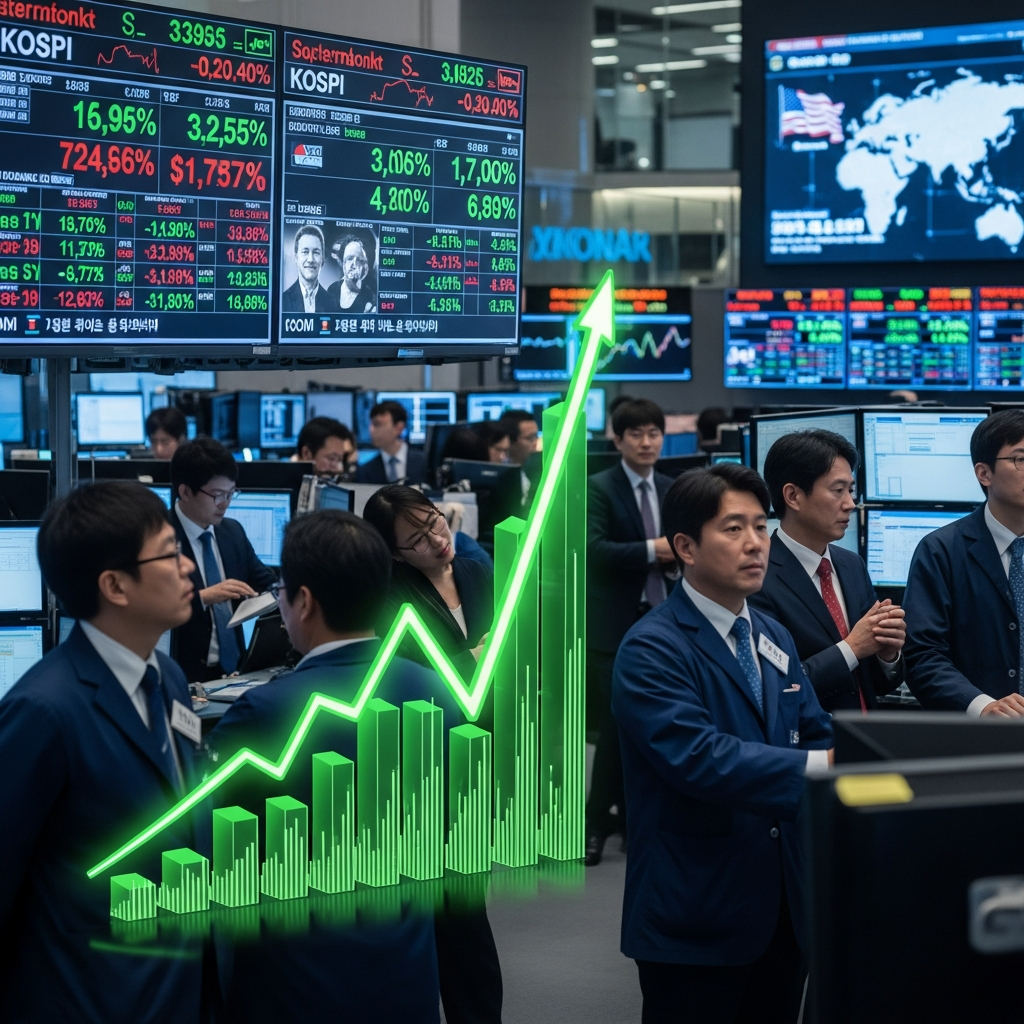
Asian financial markets witnessed a dramatic resurgence on Thursday, March 5, 2026, as Asia stocks rebound from a week of significant losses. South Korea’s benchmark KOSPI index led the charge, achieving an astonishing nearly 12% surge in intraday trading. This powerful recovery signaled a swift shift in investor sentiment, even as the ongoing U.S.-Iran conflict remained a focal point. Market experts pointed to a combination of bargain hunting, stabilizing oil prices, and robust U.S. economic data as key drivers behind this widespread Asian markets rally.
KOSPI Leads Asia’s Jaw-Dropping Market Reversal
South Korea’s KOSPI index delivered a truly historic performance, leaping as much as 12% on Thursday. This marked its best single-day rally since 2008, just a day after suffering its largest single-session loss since the 2008 financial crisis. This extreme volatility illustrates a modern market phenomenon where significant crashes can quickly reverse. The small-cap Kosdaq index also mirrored this strength, jumping over 11%, even triggering a circuit breaker.
Analysts attribute this rapid swing largely to the clearing of “margin calls.” The intense sell-off in previous sessions was fueled by forced selling from leveraged investors. Once these positions were liquidated, the selling pressure dissipated, creating an opportunity for new buyers to emerge. This “resetting of the market’s balance sheet overnight” paved the way for the aggressive KOSPI surge. Major South Korean heavyweights like Samsung Electronics Co Ltd, SK Hynix Inc, and Hyundai Motor all rallied between 11% and 13%, recovering substantial ground. The Financial Services Commission of South Korea affirmed a low likelihood of a ‘trend-based decline’ and committed to deploying a 100 trillion won market stabilization plan to address ‘excessive volatility.’
Broader Asian Markets Catch the Positive Wave
The positive momentum extended across the entire Asia-Pacific region, with several other major indexes showing strong gains. Japan’s Nikkei 225 index climbed approximately 4% after a roughly 3% drop the prior day, reflecting an improved global risk mood. Hong Kong’s Hang Seng Index rose by 1.2%, and the Hang Seng Tech Index saw a 1.3% increase.
Mainland Chinese stocks also moved higher following policy announcements. The Shanghai Shenzhen CSI 300 and Shanghai Composite indexes advanced by 1.3% and 0.8%, respectively. Other markets like Singapore’s Straits Times index (up 0.7%) and India’s Nifty 50 index (adding 0.4%) contributed to the widespread stock market rebound. Australia’s ASX 200 saw a more modest 0.3% gain, with major mining stocks trading ex-dividend holding back further advances.
Geopolitical Tensions and Oil Market Dynamics
The initial market turmoil earlier in the week stemmed primarily from escalating Middle East tensions involving Iran. Oil prices jumped over 4% amid supply fears, unsettling global investors. However, a moderation in global oil prices played a crucial role in calming nerves and supporting the Thursday rally. Brent crude, the international benchmark, stabilized around its previous day’s level after briefly exceeding $84.
Reports of Iran signaling a willingness to engage in negotiations, coupled with decisive actions from the U.S. administration, helped de-escalate immediate fears. U.S. Treasury Secretary Scott Bessent affirmed the crude oil market remained well-supplied amidst U.S. and Israeli military operations. President Trump also pledged U.S. support for tankers transiting the Strait of Hormuz, promising Navy escorts if needed to ensure “the free flow of energy to the world.” These assurances helped alleviate concerns about the conflict’s economic impact and the potential for prolonged expensive oil, which could fuel inflation.
U.S. Economic Strength and Wall Street’s Influence
A positive lead from Wall Street significantly buoyed Asian sentiment. U.S. stocks experienced a strong rebound on Wednesday, recouping most losses incurred since the onset of the Iran conflict. The Nasdaq composite advanced 1.3%, the S&P 500 climbed 0.8%, and the Dow Jones Industrial Average rose 0.5%. Gains in technology shares were particularly impactful.
Beyond the stabilization of oil, robust U.S. economic data provided a crucial boost. Reports indicated that the American services industry, covering sectors like real estate and finance, expanded at its fastest pace since mid-2022. Encouragingly, these reports also noted a slower rate of price increases for services prior to the Iran conflict, offering positive signs for inflation control. Non-government employers also increased hiring, hinting at underlying economic strength. While these strong reports were generally welcomed by the Federal Reserve, the surge in oil prices adds complexity to their task of managing inflation, potentially requiring interest rates to remain elevated longer.
China’s New Economic Trajectory and Policy Priorities
Chinese stocks reacted positively to Beijing’s announcements at the opening session of the National People’s Congress. Policymakers set a gross domestic product (GDP) target for 2026 between 4.5% and 5%. This target, the weakest annual growth target since 1991, signals a deliberate shift in China’s economic priorities.
Premier Li Qiang’s government work report emphasized pursuing “quality growth.” This strategic move includes a pronounced focus on fostering technological innovation and achieving greater economic independence. Beijing also pledged to increase government investment in new technologies and industrial sectors, alongside further supporting consumer spending to shore up domestic consumption. The nation also outlined plans to increase military spending by 7%. ING analysts noted that the economic target offered few surprises, especially as China works to address laggard domestic consumption, a major drag on economic growth in recent years.
Gold’s Rebound and Broader Market Sentiment
Gold prices also rebounded from a previous session’s hefty drop, finding support from a slightly weaker U.S. dollar. This often-sought safe-haven asset reflects ongoing investor caution despite the broader market rally. While gold and silver remained volatile, Bitcoin saw a significant jump, heading towards $74,000, underscoring the diverse movements within global financial assets.
Energy markets remain a critical “mood setter” for equities, and their stabilization contributed significantly to Thursday’s positive turn. However, underlying market worries persist concerning the potential duration of the Iran conflict, the long-term impact of oil prices on inflation, and subsequent corporate profits. While U.S. stock markets historically shake off Middle East military conflicts quickly, this hinges on oil prices not escalating excessively.
Frequently Asked Questions
What primarily drove the dramatic KOSPI rebound on March 5, 2026?
The exceptional KOSPI surge, climbing nearly 12%, was primarily driven by a swift clearing of “margin calls.” Earlier in the week, forced selling by leveraged investors, triggered by falling prices, created intense selling pressure. Once these positions were liquidated, the selling pressure dissipated, enabling new buyers to enter the market and propel a rapid rebound. Bargain hunting, especially in the chipmaking and auto sectors, further fueled this recovery.
Which regions in Asia showed the strongest stock market recovery alongside South Korea?
Alongside South Korea’s KOSPI, which led with an almost 12% jump, Japan’s Nikkei 225 index also demonstrated a strong recovery, climbing approximately 4%. Hong Kong’s Hang Seng Index rose by 1.2%, and mainland China’s CSI 300 and Shanghai Composite indexes saw gains of 1.3% and 0.8% respectively. These markets all benefited from positive cues from Wall Street and a general improvement in global investor sentiment.
How might ongoing geopolitical tensions continue to affect Asian stock markets in 2026?
Despite the recent Asia stocks rebound, ongoing geopolitical tensions, particularly the U.S.-Iran conflict, pose a persistent risk to market stability in 2026. While oil prices stabilized, sustained volatility in energy markets could still impact inflation and corporate profits, potentially leading to further market uncertainty. Investor sentiment will remain highly sensitive to any escalation or de-escalation in the Middle East, underscoring the need for careful monitoring of both geopolitical developments and their potential economic repercussions.
Conclusion
Thursday, March 5, 2026, marked a significant turning point for Asian markets, with a broad Asia stocks rebound led by South Korea’s KOSPI. This dramatic reversal highlights the swift, sometimes unpredictable, nature of modern financial markets, often described as markets that “reset their balance sheet overnight.” While easing fears over the Iran conflict and stabilizing oil prices provided crucial tailwinds, aided by robust U.S. economic data and China’s strategic policy announcements, underlying geopolitical risks persist. Investors should remain vigilant, understanding that market volatility can persist amidst a complex global economic and political landscape.