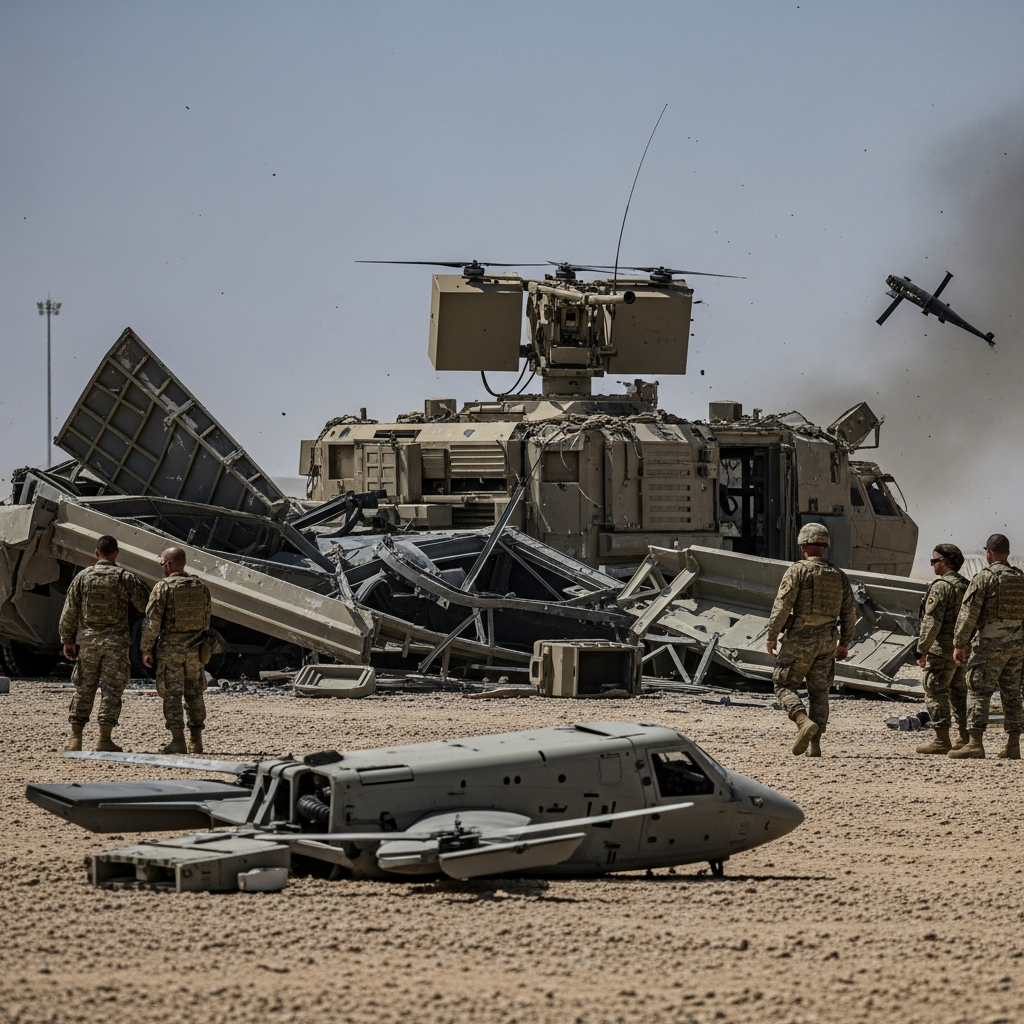
A devastating drone strike in Kuwait claimed the lives of six U.S. service members, thrusting the human cost of the escalating “Iran War” into stark relief. The Pentagon has officially released the names of four fallen Army Reserve soldiers, all assigned to the 103rd Sustainment Command in Des Moines, Iowa. This tragic incident unfolded on Sunday, March 2, 2026, when an Iranian drone struck a tactical operations center in Port Shuaiba, just one day after the United States and Israel launched a major military campaign against Iran.
The attack, which also left ten seriously wounded, underscores the volatile and rapidly evolving nature of the conflict across the Middle East. As military leaders mourned the profound loss, President Donald Trump grimly acknowledged that more casualties are likely, signaling a protracted and perilous engagement.
Remembering the Fallen: Heroes of the 103rd Sustainment Command
The six U.S. Army Reserve soldiers, who served in critical logistics roles, ensured troops received essential supplies like food, fuel, water, ammunition, and transportation. Their unit, the 103rd Sustainment Command, is the backbone of military operations, supporting forces across the region. The personal stories shared by their families paint a poignant picture of lives dedicated to service and dreams tragically cut short.
Capt. Cody A. Khork: A Patriot’s Journey
Capt. Cody A. Khork, 35, from Winter Haven, Florida, was remembered by his family as “truly the life of the party.” His infectious spirit and generous heart were matched only by his deep patriotism. Drawn to military service from a young age, Khork enlisted in the National Guard in 2009 and was commissioned in the Army Reserve in 2014. He had previously deployed to Saudi Arabia, Guantanamo Bay, and Poland. Holding a political science degree, he possessed a profound love for history and was cherished by friends like Abbas Jaffer, who described him as his “best friend, best man, and brother.”
Sgt. 1st Class Noah L. Tietjens: Dedication to Service and Family
Sgt. 1st Class Noah L. Tietjens, 42, of Bellevue, Nebraska, was a devoted husband and father. Having enlisted in the Army Reserve in 2006, he had already completed two prior deployments to Kuwait. Beyond his military service, Tietjens was an accomplished martial artist, holding black belts in Philippine Combatives and Taekwondo. The Philippine Martial Arts Alliance honored his commitment to values like honor, discipline, and service, which he exemplified as both an instructor and a soldier. Nebraska Gov. Pillen and Sen. Pete Ricketts extended heartfelt condolences, recognizing his immense sacrifice.
Sgt. 1st Class Nicole M. Amor: A Mother’s Sacrifice
Sgt. 1st Class Nicole M. Amor, 39, from White Bear Lake, Minnesota, was just days away from returning home to her husband, Joey Amor, and their two children—a high school senior son and a fourth-grade daughter. Her husband expressed profound shock, noting that Kuwait had not been considered a high-risk assignment. Nicole was an avid gardener, making salsa with her son and enjoying outdoor activities with her daughter. Tragically, a week before the drone strike, she was moved off-base to an undefended shipping container-style building due to fears of an attack on the main base. She last exchanged messages with Joey approximately two hours before her death, joking back and forth. Joey Amor reflected on her selfless nature, stating she “helped a lot of people through a lot of dark times, and brought a lot of light to this world.”
Sgt. Declan J. Coady: A Young Man’s Promising Future
Sgt. Declan J. Coady, 20, of West Des Moines, Iowa, was posthumously promoted from specialist to sergeant, a recognition he had just received. Despite his youth, Coady was an accomplished Eagle Scout since 2020, notably building 12 Adirondack chairs for an organization assisting homeless children. He enlisted in the Army Reserve in 2023 as an information technology specialist and was simultaneously studying cybersecurity online at Drake University, with aspirations of becoming an officer. His sister, Keira Coady, shared her disbelief and memories of their conversations about his future plans, highlighting his ability to interact with diverse individuals.
The Drone Strike in Kuwait: A Closer Look
The command center, described by Joey Amor as a shipping container-style building with no defenses, was located in Port Shuaiba, a civilian port more than ten miles from the main Army base. Satellite images reviewed by the Associated Press showed the main building in the complex destroyed, with a trail of black smoke rising from it. Chief Pentagon spokesperson Sean Parnell, however, stated that the “secure facility was fortified with 6-foot walls,” a detail that conflicts with family accounts and points to an ongoing investigation into the circumstances of the deadly attack.
The incident is particularly concerning given the logistical nature of the unit involved. The targeting of support personnel underlines the pervasive threat faced by all service members operating in the region. This brazen drone strike in Kuwait has undeniably heightened tensions and amplified calls for accountability and enhanced protection for U.S. forces abroad.
Escalating Tensions and Regional Fallout
The deadly drone strike in Kuwait occurred amidst a rapidly escalating conflict dubbed the “Ramadan War” by Iranian state television. The U.S. and Israel had launched a massive military operation against Iran, reportedly striking Supreme Leader Ayatollah Ali Khamenei’s compound in Tehran and resulting in his death, along with other Iranian officials. In retaliation, Iran’s military unleashed a barrage of missiles and drones toward Israel and several Gulf Arab states hosting U.S. forces.
The ripple effect of this conflict has been profound:
Widespread Attacks: Israeli airstrikes targeted Iran’s presidential office and facilities linked to the Supreme Leader, as well as a Hezbollah television station in Lebanon. Iran, in turn, launched missiles toward Israel. Attacks were reported across Iran, with Iranian state television showing ruins in central Tehran.
Regional Instability: Sirens sounded across Jordan, Bahrain, and Jerusalem. Saudi forces intercepted multiple drones and cruise missiles. An 11-year-old girl was killed by shrapnel in Kuwait City.
Civilian Casualties: Lebanon’s Health Ministry reported 50 deaths and 335 wounded in Israeli retaliatory strikes against Hezbollah, including seven children. U.N. humanitarian chief Tom Fletcher warned of the devastating impact on civilians across eleven countries in the region, citing strikes on homes, hospitals, and schools.
Economic Impact: Asian shares tumbled, with South Korea’s benchmark plunging as much as 11%. Oil prices surged, with U.S. benchmark crude climbing 1.2% to $75.46 per barrel and Brent crude gaining 1.5% to $82.61 per barrel, spooking investors concerned about global economic slowdown and inflation.
- International Response: The U.S. State Department authorized the evacuation of non-emergency personnel from Cyprus, Saudi Arabia, and Oman. Australia began repatriating 24,000 citizens from the UAE, while Czech and Slovak governments evacuated their nationals. French President Emmanuel Macron ordered the aircraft carrier Charles de Gaulle to the Mediterranean, deploying Rafale jets and air-defense systems to the Middle East.
- apnews.com
- www.pbs.org
- www.cbsnews.com
- www.newson6.com
- www.newsweek.com
Adm. Brad Cooper, head of U.S. Central Command, revealed that American forces had struck nearly 2,000 targets in Iran, severely degrading its air defenses and neutralizing hundreds of ballistic missiles, launchers, and drones. However, Iran retaliated with over 500 ballistic missiles and more than 2,000 drones, underscoring the fierce nature of the engagement.
Political Divisions and Future Outlook
The U.S. administration’s handling of the escalating conflict has sparked political debate. Senator Tim Kaine, D-Va., raised concerns about a “troubling pattern” of the Trump administration launching military operations without congressional authorization or advance notice. Senator Josh Hawley, R-MO, while acknowledging the “quite large” and “rapidly evolving” scope of the operation, maintained he would vote against a war powers resolution unless ground troops were introduced.
Secretary of State Marco Rubio defended President Trump’s decision, characterizing the initial strike as a “unique opportunity” to preempt Iranian retaliation and prevent the regime from acquiring nuclear weapons. Yet, the strike on the U.S. consulate in Dubai, a near-miss, demonstrated Iran’s continued capability to penetrate American defenses.
The United Arab Emirates stated its right to self-defense while insisting it was not part of the U.S.-Israel war against Iran and had not authorized the use of its territories for attacks. Turkish Foreign Minister Hakan Fidan criticized Iran’s attacks on Gulf neighbors as an “incredibly flawed strategy,” warning of a wider conflict if affected nations retaliate.
The deaths of these brave service members serve as a stark reminder of the sacrifices made in defending national interests and maintaining stability in an increasingly volatile world. As the conflict continues, the focus remains on protecting U.S. personnel, mitigating regional escalation, and honoring the ultimate sacrifice of those who serve.
Frequently Asked Questions
What led to the deadly drone strike that killed US troops in Kuwait?
The drone strike that tragically killed six US service members occurred on Sunday, March 2, 2026, when an Iranian unmanned aircraft system hit a tactical operations center in Port Shuaiba, Kuwait. This incident took place just one day after the United States and Israel initiated a major military campaign against Iran, which then launched retaliatory strikes across the Middle East. The facility was described by a family member as an undefended shipping container-style building, though the Pentagon stated it was a “secure facility fortified with 6-foot walls,” suggesting an ongoing investigation into the defensive posture of the site.
Who were the US Army Reserve soldiers identified in the Kuwait drone attack?
The Pentagon identified four of the six US Army Reserve soldiers killed in the Port Shuaiba drone strike. They were all assigned to the 103rd Sustainment Command in Des Moines, Iowa. The identified service members are Capt. Cody A. Khork, 35, of Winter Haven, Florida; Sgt. 1st Class Noah L. Tietjens, 42, of Bellevue, Nebraska; Sgt. 1st Class Nicole M. Amor, 39, of White Bear Lake, Minnesota; and Sgt. Declan J. Coady, 20, of West Des Moines, Iowa, who was posthumously promoted to sergeant. Their stories reflect lives dedicated to service, with roles in logistics, ensuring critical supplies reached troops.
How has the drone strike in Kuwait impacted the wider Iran war and regional stability?
The drone strike in Kuwait significantly escalated the ongoing Iran war, highlighting the direct threat to U.S. forces and their allies in the region. It demonstrated Iran’s retaliatory capabilities and led to heightened tensions, prompting U.S. State Department advisories for American personnel to consider evacuating from several Middle Eastern nations. The broader conflict has resulted in widespread civilian casualties in countries like Lebanon, disrupted global markets, caused oil prices to spike, and led to extensive military deployments and evacuations by international powers, underscoring the profound instability gripping the region.