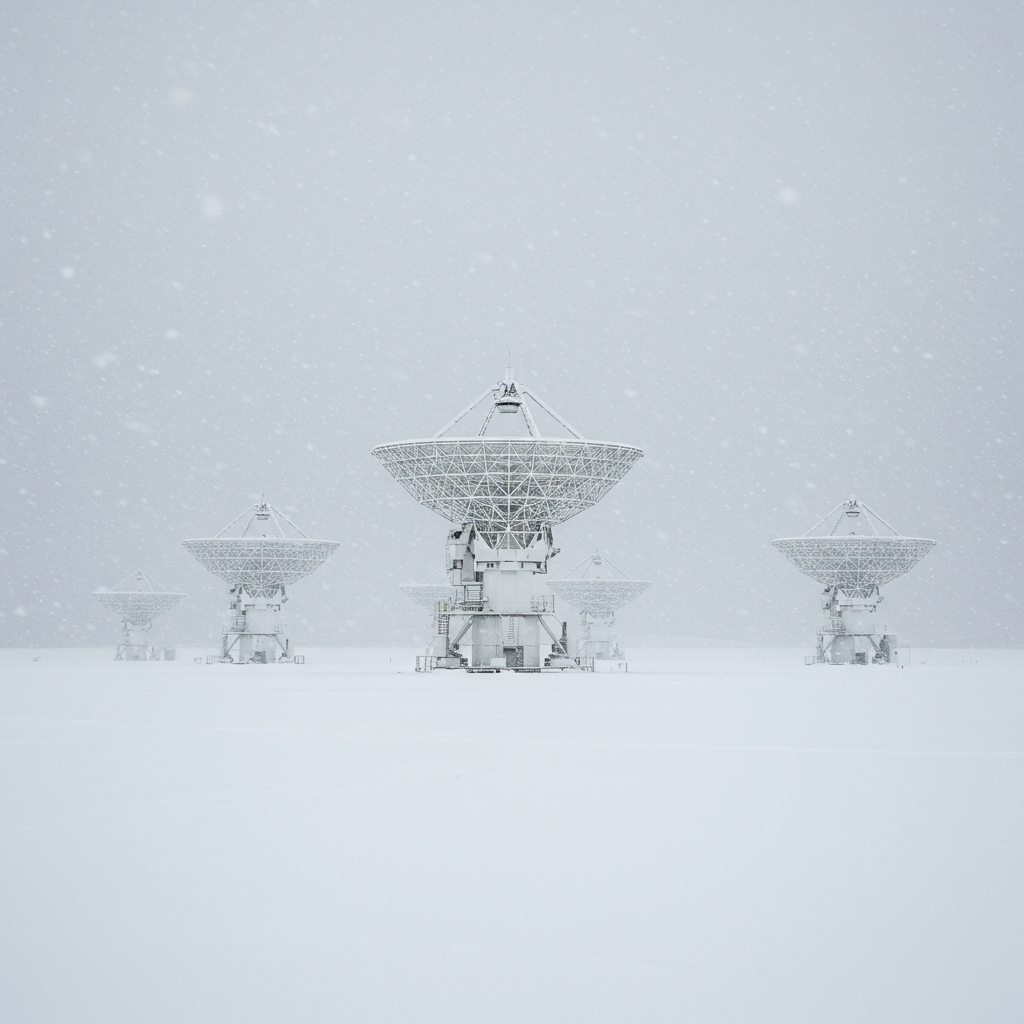
The atacama Large Millimeter/submillimeter Array (ALMA), often hailed as the world’s most powerful radio telescope, recently faced an unexpected challenge in one of Earth’s driest places: rare snowfall. This unusual weather event blanketed the observatory’s base camp, forcing a temporary halt to scientific operations and activating a critical safety protocol known as “survival mode.” The incident highlights the vulnerability of even robust astronomical facilities to extreme weather, prompting questions about how shifting climate patterns might affect operations in the future.
The Atacama Paradox: An Astronomer’s Haven
The Atacama Desert in northern Chile holds the title of the driest non-polar desert on Earth. This hyper-arid environment typically receives less than an inch of precipitation each year. In many areas, measurable rain or snow is absent for years on end. This extreme dryness, combined with high altitude and minimal light pollution, makes the Atacama a prime location for astronomical observation. The clear, stable atmosphere is particularly crucial for radio and submillimeter astronomy, which is ALMA’s domain.
However, this doesn’t mean the desert is entirely free of challenging weather. ALMA’s main array sits on the Chajnantor Plateau at a staggering 16,800 feet (5,104 meters) above sea level. At this elevation, snowstorms are somewhat more common, occurring typically three times a year. These high-altitude snowfalls, fueled by moisture from the Amazon or Pacific, can deposit between 8 and 31 inches (20 to 80 centimeters) annually.
ALMA: A Window to the Cosmic Past
ALMA is not a single telescope but a vast network of 66 high-precision antennas spread across the plateau. This international collaboration forms a single, powerful instrument capable of observing the universe at millimeter and submillimeter wavelengths. This unique capability allows astronomers to peer through cosmic dust clouds impenetrable to visible light telescopes. ALMA studies everything from the formation of distant galaxies in the early universe to the birth of stars and planets within our own Milky Way. Its design incorporates features to withstand the harsh high-altitude conditions, including strong winds and cold temperatures.
Snow Descends on the Unexpected
The recent disruption wasn’t caused by snow on the higher plateau, however. The snowfall affected ALMA’s Operations Support Facility (OSF). This base camp is located at a much lower altitude of 9,500 feet (2,900 meters). Snowfall at this elevation is exceedingly rare. ALMA representatives confirmed there hadn’t been a recorded snowfall at the base camp for over a decade. This made the event last week particularly noteworthy.
The unusual weather system began around Thursday, June 26. It was triggered by unusual atmospheric instability over northern Chile. A “cold core” passing through the region brought not only snow but also strong winds. Gusts reached speeds of 50-62 mph (80-100 km/h). Temperatures plummeted dramatically. At the high-altitude site, temperatures dropped to 10°F (minus 12°C). The wind chill made conditions feel as cold as minus 18°F (minus 28°C).
Activating ‘Survival Mode’
Faced with this combination of heavy snow, powerful winds, and extreme cold, ALMA suspended scientific operations. The observatory activated its “survival mode” safety protocol. This is a critical measure designed to protect the sensitive antenna structures.
A key step in this protocol involves reorienting the large antennas. They are pointed downwards and turned downwind. This minimizes the surface area exposed to wind gusts. It also prevents excessive snow buildup on the delicate dish surfaces. These precautions are essential to avoid structural damage from the severe conditions. Working outside becomes extremely difficult and hazardous under these circumstances.
Recovery and Future Concerns
As the storm subsided, recovery efforts began immediately. Specialized snow-clearing teams were activated. Their first task is to visually inspect each antenna. This ensures no damage occurred before operations resume. While challenging, the cold conditions often prove beneficial shortly after snowfall. Low temperatures reduce atmospheric humidity, which interferes with millimeter/submillimeter observations. This can lead to some of the best observing opportunities.
The rarity of snowfall at the base camp’s altitude raises significant questions. Could events like this become more frequent? The Atacama Desert is known for its steadfast dryness. However, climate change is altering weather patterns globally. While linking this specific lower-altitude snowfall directly to climate change requires more data, climatologists are considering the possibility. Raúl Cordero, a climatologist at the University of Santiago, noted that climate models predict a potential increase in precipitation in this hyper-arid region. He stated it’s currently too early to confirm if this increase is already underway.
Similar examples of unusual weather potentially linked to climate shifts are being observed elsewhere. Record snowfall recently impacted parts of Florida, a state not typically known for significant winter precipitation. Conversely, Hawaii’s high-altitude “pineapple powder” snow may become less frequent due to rising sea temperatures impacting weather patterns. Major observatories like the Arecibo facility in Puerto Rico have also faced severe disruptions from natural events like hurricanes and earthquakes. These global instances highlight the increasing challenges facilities face from extreme weather. While ALMA is built to handle harsh environments, the recent event underscores that even the most resilient observatories are not immune to the impacts of a changing climate. The need to monitor these patterns is increasingly important for the future of ground-based astronomy.
Frequently Asked Questions
What is ALMA and why is it located in the Atacama Desert?
ALMA stands for the Atacama Large Millimeter/submillimeter Array. It’s the world’s most powerful radio telescope, a collaboration using 66 antennas to study cold gas and dust in the universe, revealing details about star and planet formation and the early cosmos. The Atacama Desert in Chile is chosen for its extreme dryness and high altitude. These conditions minimize atmospheric water vapor, which absorbs the light ALMA observes, providing exceptionally clear viewing windows for specific wavelengths.
Why was the recent snowfall unusual for ALMA?
Snowfall regularly occurs on the high Chajnantor Plateau where ALMA’s antennas are located (16,800 feet). However, the recent snow fell heavily at ALMA’s Operations Support Facility (OSF) at a much lower altitude of 9,500 feet. According to ALMA representatives, it hadn’t snowed at the OSF base camp in over 10 years, making this event a rare occurrence for that specific site.
How did ALMA’s ‘survival mode’ protect the telescopes?
When extreme conditions like heavy snow, high winds, and severe cold hit, ALMA activates a “survival mode” protocol. This safety measure involves reorienting the antennas. They are pointed downward and turned towards the wind. This positioning reduces the risk of damage from wind stress or snow accumulation on the dishes. Operations are halted until the storm passes and antennas can be inspected and cleared.