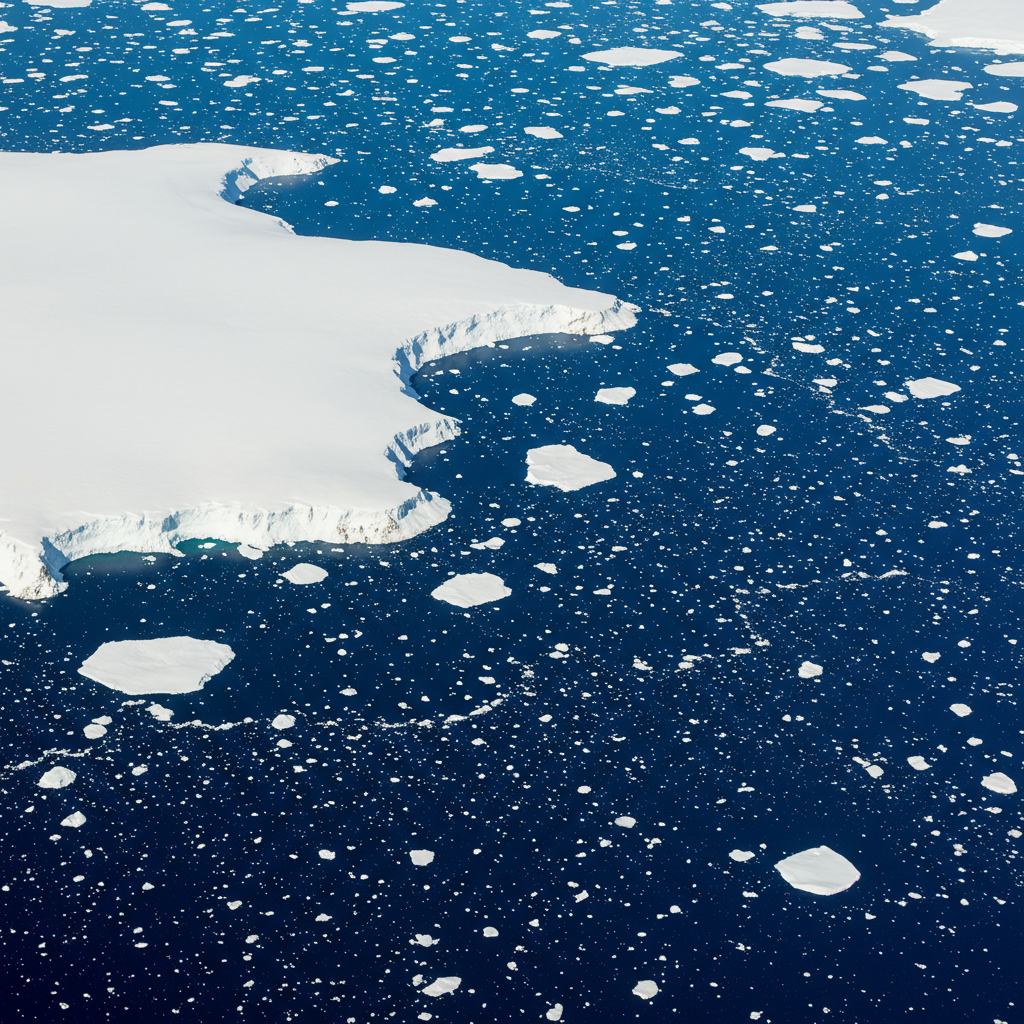
The pristine white expanse surrounding Antarctica is undergoing a dramatic and concerning transformation. For the past few years, especially during the warmer summer months, the protective layer of sea ice ringing the continent has shrunk to levels never before seen since satellite observations began. This isn’t just a distant environmental issue; it’s a critical change with cascading effects that threaten global climate stability, sensitive ecosystems, and even human activities in the region. Understanding these unprecedented shifts is vital, prompting scientists to intensify research efforts and warning that faster action on climate change is desperately needed.
Unprecedented <a href="https://news.quantosei.com/2025/07/06/fiona-the-pregnant-sea-reptiles-fossil-hints-at-the-birth-of-a-new-ocean/” title=”Stunning Pregnant Ichthyosaur Fossil Reveals Ocean Birth Secret”>antarctic Sea Ice Collapse
Antarctic sea ice behaves differently than Arctic sea ice. While Arctic ice has seen a steady decline over decades, Antarctic sea ice extent actually showed a slight increase before a sudden, dramatic drop began around 2015-2016. Since then, the summer sea ice has consistently remained well below the long-term average, hitting new record lows year after year over the past four summers. These rapid, intense changes have caught many scientists by surprise and highlight a worrying acceleration in the region’s response to global warming.
Scientists have been using a range of cutting-edge tools and techniques to grasp the scale and implications of this rapid decline. From orbiting satellites capturing wide-scale changes to autonomous robots sampling frigid ocean waters, researchers are piecing together a picture of how less sea ice is fundamentally altering the Antarctic system. Voyage reports from icebreakers, like the Australian RSV Nuyina reaching previously inaccessible areas near places such as Denman Glacier due to the lack of expected ice, also offer direct observations of the altered environment.
How We Uncovered the Impacts
To understand the widespread consequences of this significant sea ice loss, a large international team of scientists synthesized existing research and gathered extensive new evidence. Satellite data provided a crucial perspective on the ice itself, measuring not only how much ice was present (extent and thickness) but also how long areas remained ice-free each year. These orbital observations also revealed how much more of Antarctica’s coastline was left exposed to the open ocean’s waves.
Beyond studying the ice directly, researchers employed free-drifting ocean robots. These devices collected data on microscopic marine plants that form the base of the Antarctic food web, helping assess how sea ice loss affects ocean productivity. Computer models were also essential, running complex simulations to predict the broader oceanographic impacts of extreme low sea ice conditions. Finally, harnessing data from various sources, including logistical reports from vessels operating in the Southern Ocean, allowed for a comprehensive analysis of the interconnected consequences across the environment and human operations. This multi-faceted approach was necessary to tackle a system changing so rapidly.
Four Critical Consequences for the Planet
The extensive research findings paint a stark picture of the impacts resulting from the dramatic reduction in Antarctic summer sea ice. These consequences affect everything from ocean temperatures and ice sheets to wildlife survival and human operations.
1. Amplified Ocean Warming
One of the most immediate and significant impacts is on ocean temperatures. Sea ice is bright white and highly reflective; it bounces approximately 90% of incoming sunlight back into space. The ocean, being much darker, absorbs about 90% of that same sunlight. When there is less summer sea ice coverage, the ocean surface absorbs significantly more solar energy, leading to increased warming.
This warming effect became particularly pronounced and persistent following the extreme low sea ice year of 2016. Previously, the Southern Ocean system seemed to have a way of buffering against this. If a summer saw low sea ice and a bit more ocean warming, the extra heat would often dissipate into the atmosphere over the following winter. However, this natural ‘reset’ mechanism appears to be failing. Low summer sea ice events, as observed since 2016, now trigger ocean warming that persists for around three years, potentially accumulating year after year as low ice conditions recur. Measured sea surface temperatures confirm this trend, and computer models validate the relationship, showing a worrying compounding effect.
2. Increased Iceberg Calving
Sea ice provides a crucial buffer, protecting Antarctica’s vast ice sheets and coastlines from the relentless pounding of ocean waves. On average, about one-third of the continent’s extensive coastline is typically exposed to open water during summer. Disturbingly, recent years like 2022 and 2023 saw this exposure increase dramatically, with more than half of the Antarctic coast losing its protective sea ice barrier.
The research clearly links this increased exposure to a higher rate of icebergs breaking off (calving) from the ice sheets. In a typical summer, roughly 100 icebergs might calve. Summers characterized by low sea ice cover, however, produce roughly double that number. With the coast more vulnerable to wave action without the damping effect of the ice, the stability of ice sheets connected to the coast could be further compromised in the long term.
3. Devastating Impact on Antarctic Wildlife
Many of Antarctica’s iconic species rely heavily on the presence of stable sea ice for essential parts of their life cycle, including breeding, raising young, and moulting. Without this vital platform, these animals face severe challenges.
For emperor penguins, the loss of sea ice can be catastrophic. Entire colonies experienced complete breeding failures in 2022 because the sea ice they used for nesting broke up and melted before their chicks were mature enough to survive in the open water. Crabeater seals need large, secure sea ice platforms for a few weeks after giving birth to provide shelter and protection for their pups during weaning. Finding sufficiently large and stable ice becomes difficult with less summer sea ice. Similarly, species like Adelie penguins and various seals need sea ice as a safe refuge when they undergo their yearly moult, replacing old feathers or fur. During this vulnerable period, they cannot enter the icy water and risk hypothermia and death if they cannot stay dry on the ice.
4. Mounting Logistical Challenges
Operating in Antarctica requires careful planning, and logistical support for research bases and other operations often relies on the presence of stable summer sea ice. Traditionally, supply ships would unload essential cargo directly onto the fast ice (sea ice attached to the land) near bases.
Shrinking and less reliable summer sea ice significantly narrows the safe window for these critical resupply missions. Bases may face the need to receive supplies from alternative locations or rely on more challenging and potentially riskier methods, such as using smaller boats to ferry cargo ashore. The loss of stable ice platforms makes established logistical practices increasingly difficult and sometimes impossible, adding complexity and cost to human presence in the region.
Compounding Challenges: Data, Research, and Tourism
The rapid changes in Antarctic sea ice are unfolding at a time when understanding and responding to them face additional challenges.
The Urgency of Research Amid Decline
The Antarctic system is changing so quickly that the pace of change is currently outrunning the scientific community’s capacity to fully study and comprehend it in real-time. This makes consistent, long-term data collection absolutely essential, yet challenges persist. The potential loss of access to data from critical sources, such as US Department of Defense satellites (even with delays), highlights the fragility of long-term climate datasets needed to track these rapid shifts accurately. International cooperation and data sharing are paramount for observing the entire Earth system, and disruptions hinder this vital work.
Compounding this difficulty is a concerning trend in global investment in Antarctic research. Recent analysis indicates a decline in overall publication output on Antarctic and Southern Ocean topics from many nations, including traditional leaders like the US, UK, Australia, Germany, and Russia, since 2016. While China has significantly increased its research output, even surpassing the US in high-quality publications, the overall drop suggests a potential reduction in collective global effort and investment when it is arguably needed most. Reports from countries like Australia and the UK have voiced concerns about funding certainty and the need to expand research efforts. Furthermore, geopolitical dynamics within the Antarctic Treaty System, where scientific research underpins decision-making authority, contribute to complexities in addressing these environmental challenges effectively, particularly when consensus on protection measures faces obstacles.
Tourism’s Double-Edged Sword
Ironically, the very changes making Antarctica more vulnerable might also be increasing its accessibility for some. Reduced summer sea ice can potentially open up new areas and extend the operational season for vessels like tourist cruise ships. Data shows a dramatic increase in visitor numbers to Antarctica, rising steeply over recent decades. While the majority of tourism is concentrated in the Antarctic Peninsula, the overall trend is significant.
However, this increased human presence brings its own set of environmental risks. Landings by tourists can compact soil, trample fragile vegetation, introduce non-native species, and disturb sensitive wildlife breeding colonies. Even ships that don’t land can cause pollution and damage. Furthermore, the carbon emissions associated with travel to and from Antarctica contribute to the very global warming that is causing the ice to melt. This presents a complex paradox: a fragile environment is becoming more accessible due to climate change, while the act of visiting it can exacerbate the problem. Managing the growing tourism industry effectively to minimize its environmental footprint is another crucial challenge for the region’s governance bodies.
What This Means and What Comes Next
The dramatic and sustained record lows in Antarctic summer sea ice are not a minor anomaly; they represent a significant shift in a critical part of the Earth’s climate system. The changes observed, particularly the compounding ocean warming since 2016, the increased calving of icebergs, the severe impacts on unique Antarctic wildlife, and the disruption to essential logistical operations, underscore that the region is no longer as stable or predictable as it once was.
A Stark Warning for the Planet
The Antarctic sea ice system, previously thought to be relatively stable compared to the Arctic, is now exhibiting rapid and worrying changes. Its role in reflecting solar radiation, protecting ice sheets, and supporting marine ecosystems makes its decline a matter of global concern. The observations confirm that human-caused climate change is reaching into even the most remote corners of the planet, altering fundamental environmental processes.
The Path Forward: Accelerating Climate Action
The science is clear: the primary driver of these changes is the increase in greenhouse gases from burning fossil fuels. The rapid transition away from fossil fuels and the urgent pursuit of net zero emissions are the only viable ways to slow down or potentially halt these escalating impacts in Antarctica and globally. The concerning data emerging from the Southern Ocean serves as a powerful, urgent call to accelerate climate action on a global scale before even more drastic and irreversible changes are locked in.
Frequently Asked Questions
What are the primary consequences of the recent record low Antarctic summer sea ice?
Recent research highlights four major impacts. First, reduced sea ice leads to amplified ocean warming because darker water absorbs more sunlight than reflective ice, and this warming is now persisting and compounding year after year since 2016. Second, less sea ice exposes more coastline to waves, resulting in roughly double the number of icebergs breaking off from ice sheets compared to average years. Third, many seal and penguin species rely on stable sea ice for breeding, raising young, and moulting, and its loss is causing significant population impacts, including catastrophic breeding failures for emperor penguins. Finally, low sea ice disrupts logistical operations, making it harder and riskier to resupply Antarctic research bases.
Why is understanding Antarctic sea ice particularly challenging right now, especially for scientists?
Studying the rapid changes in Antarctic sea ice is difficult because the system is transforming faster than scientists can fully study it. This requires consistent, long-term datasets, but challenges like the potential loss of access to satellite data hinder this. Furthermore, analysis indicates a concerning decline in overall global research investment in Antarctic science from many traditional nations, even as China increases its output. This suggests a potential reduction in the collective capacity to monitor and understand changes at a critical time, compounded by geopolitical complexities within the governing Antarctic Treaty System that rely on scientific consensus for action.
How does the melting Antarctic sea ice connect to human activity beyond climate change, such as tourism?
While the primary driver is climate change from fossil fuel emissions, the melting ice also intersects with other human activities. Reduced summer sea ice can potentially increase accessibility for tourist vessels, leading to a dramatic rise in visitors to Antarctica. This poses environmental risks, including habitat damage from landings, disturbance to wildlife, pollution from ships, and carbon emissions associated with travel, which contribute back to the warming cycle. Managing this growing tourism industry in a way that protects the fragile environment, potentially through economic tools like taxes or permits, becomes another challenge linked to the changing ice conditions.
Conclusion
The record low Antarctic summer sea ice levels represent a dramatic signal of global climate change. The findings from recent research leave no doubt that this phenomenon has profound implications, from warming oceans and increased iceberg calving to devastating impacts on wildlife and logistical challenges for those working in the region. This crisis underscores the urgent need for a global shift away from fossil fuels and towards net zero emissions. The fate of Antarctica’s ice, and the crucial role it plays in the global climate, hinges on rapid and decisive action now.