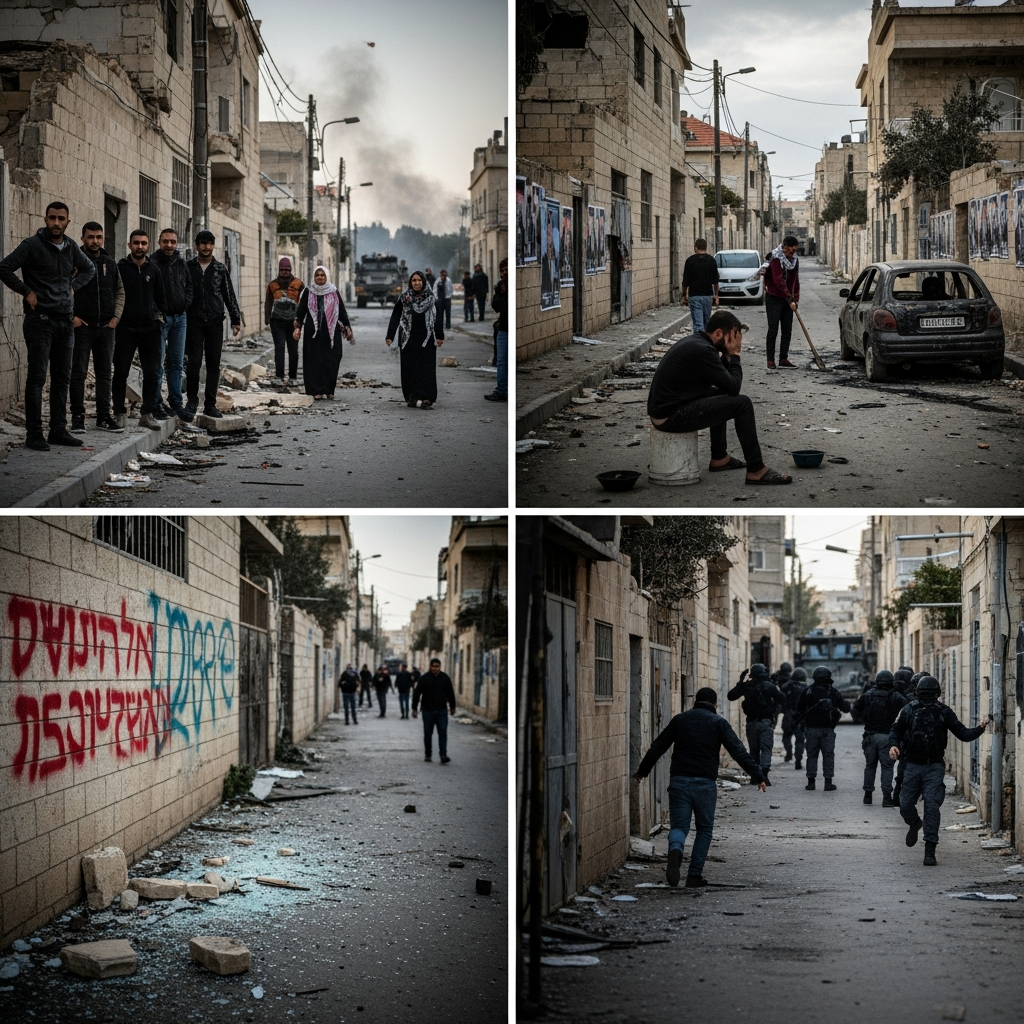
The occupied West Bank is currently experiencing a dramatic surge in violence, marking a critical escalation of the Israeli-Palestinian conflict. This period of heightened unrest has led to a tragic rise in Palestinian casualties, with one recent incident involving the death of 23-year-old Ali Majed Hamadneh in the village of Deir Jarir, northeast of Ramallah. His killing underscores a disturbing pattern of escalating fatalities and intensified regional tensions, particularly coinciding with broader geopolitical shifts.
Reports surrounding Hamadneh’s death on a recent Saturday reveal conflicting accounts. While the Palestinian Ministry of Health confirmed his fatality, Israel’s military stated a reservist shot him while responding to a violent riot. Conversely, Fathi Hamdan, head of the Deir Jarir Village Council, claimed a civilian settler was responsible for the shooting, with military forces arriving only afterward. This incident is not isolated; it reflects an alarming trend where accountability for violence against Palestinians often remains elusive, according to human rights organizations and Palestinian sources.
Escalating Fatalities Amidst Regional Tensions
The past few months have witnessed a severe increase in West Bank violence, with grim statistics painting a stark picture. Since the end of February, aligning with what some reports term the “US-Israeli war on Iran,” 22 individuals have been killed in the territory. This year alone, the total number of Palestinian deaths has reached 33, with two-thirds of these occurring since March. Disturbingly, Israeli settlers are implicated in at least eight of these fatalities.
A wider lens reveals an even more troubling trajectory. The United Nations Office for the Coordination of Humanitarian Affairs (UN OCHA) reported 240 Palestinians killed in the West Bank in 2025, primarily by the Israeli military, with nine fatalities attributed to Israeli settlers. This upward trend accelerated dramatically following the Hamas attacks on October 7, 2023. Since that date, over 1,000 Palestinians, including nearly a quarter who were children under 18, have been killed by Israeli settlers and soldiers in the occupied West Bank.
Personal Stories of Loss and Despair
Behind these statistics are profound human tragedies. The PBS News report highlighted the story of Nasrallah Abu Siyam, a 19-year-old American citizen from Mukhmas. He was killed while attempting to assist another Palestinian shot during a settler attack, during which armed settlers allegedly stole livestock, a vital livelihood, before opening fire. His family asserts that Israeli military checkpoint delays critically hampered his chances of survival. They point to a nearby illegal Israeli outpost as the origin of the attackers, noting its unchecked proliferation.
Another tragic event involved Mohammad al-Malhi, shot in the head by settlers near Bethlehem after they re-erected an outpost on his family’s land. He became the seventh Palestinian killed since the “US-Israeli war on Iran” began. In Tayasir, near Tubas, a 75-year-old man was left bruised and bloodied after settlers raided his village and opened fire on young men confronting them. These incidents underscore a pervasive sense of insecurity, with many Palestinians lamenting, “There’s no safety anymore.”
Unprecedented Settlement Expansion Fuels Conflict
The surge in violence is deeply intertwined with accelerated Israeli settlements West Bank expansion. Israel’s government recently approved the establishment of 34 new settlements. The settlement monitoring group Peace Now revealed these approvals were granted by the Security Cabinet on April 1 but were deliberately kept secret during the Iran tensions to avoid straining relations with the United States. These approvals include new neighborhoods for existing settlements gaining independent designation, alongside official recognition for previously unauthorized outposts and farms.
Further compounding the issue, the security cabinet has reportedly legalized 30 outposts across the West Bank retroactively. These structures, previously deemed illegal even under Israeli law, now hold official recognition. Since 2023, the Israeli government has established a staggering 102 new settlements, marking the most extensive expansion and planning approvals since the UN began monitoring the situation. Under international law, all Israeli settlements in the occupied territories are considered illegal.
Political Motivations and Condemnations
Peace Now strongly condemned this “frenzy” of approvals, characterizing it as an “election ploy” designed to bolster Prime Minister Benjamin Netanyahu’s support among right-wing voters. The organization asserts that settlement establishment “harms security, places an abnormal burden on the IDF, and undermines the possibility of resolving the conflict and achieving any future security and peace.”
Conversely, right-wing Israeli politicians lauded the settlement expansion. Finance Minister Bezalel Smotrich declared that “Israel’s political decisions in Judea and Samaria are completely killing off the idea of separate states and the founding of a terror state in the heart (of Israel).” This expansion, critics argue, strategically aims to separate and isolate Palestinian communities, paving the way for further Israeli outposts or settlements on land designated for a future Palestinian state.
A Crisis of Accountability: Systemic Impunity
Perhaps the most alarming aspect of the escalating violence is the profound breakdown in accountability. A Guardian analysis, supported by extensive legal data, reveals that Israel has not prosecuted its citizens for killing Palestinian civilians in the occupied West Bank since 2020. This systemic impunity has created a justice vacuum, effectively shielding perpetrators of violence.
Former Israeli Prime Minister Ehud Olmert has openly called for the International Criminal Court (ICC) to intervene, urging them to “take enforcement measures and issue arrest warrants.” He contends this is crucial to “save the Palestinians and us [Israelis]” from what he describes as state-backed settler violence, which he likens to “ethnic cleansing” and pogroms. His alarm is echoed by dozens of former Israeli security commanders, including former military and intelligence chiefs, who have warned that “organised Jewish terrorism” poses an existential threat to Israel’s “moral strength.”
Stark Statistics on Non-Accountability
The statistics are grim:
Since 2020, over 1,100 Palestinian civilians have been killed in the occupied West Bank by Israeli soldiers and settlers, yet no one has been charged for these deaths.
The last indictment for a deadly attack by Israeli security forces was in 2019; for an Israeli civilian, it was in 2018.
Between 2020 and 2025, data from the legal rights group Yesh Din shows over 96% of police investigations into settler violence concluded without an indictment. Out of 368 cases, a mere eight (2%) resulted in convictions.
From 2020 to 2024, Palestinians filed 1,746 complaints regarding harm by Israeli soldiers, including over 600 related to killings, but less than 1% led to indictments.
Experts now describe the Israeli legal system as having transformed from a mechanism for justice into a “shield for perpetrators,” prioritizing “immunity over the rule of law.” This “performance of accountability,” once a diplomatic defense, has largely ceased due to internal political pressure. Even former Likud justice ministers have accused the current government of enabling “active and horrific ethnic cleansing” of Palestinians.
Retaliatory Violence and Official Reactions
The cycle of violence intensified recently following the death of an 18-year-old settler, Yehuda Sherman, reportedly hit by a Palestinian-driven vehicle. WhatsApp groups used by settlers quickly circulated calls for a “revenge campaign,” leading to over 20 reported attacks overnight. Villages like Jalud, Qaryut, and al-Funduqmiya saw homes and vehicles set ablaze, with “Avenge Yehuda” spray-painted on buildings. The Palestinian Red Crescent Society reported at least three Palestinians hospitalized with head wounds after confronting attackers, and one Israeli officer was injured by settlers.
Reactions to these events have been varied. The Palestinian Ministry of Foreign Affairs condemned the assaults, highlighting the terrorization and killing of civilians during Eid al-Fitr. While Israeli police stated they arrested five individuals and pledged “zero tolerance,” Yesh Din criticized security forces for failing to adequately prepare despite prior knowledge of planned attacks.
Internationally, the EU and UK have demanded that Israel halt the escalating settler violence. Within Israel, opposition figures like Yair Golan accused the government of fostering “total anarchy” and allowing “Jewish terrorism” to spread. Even the IDF’s chief of staff, Lt Gen Eyal Zamir, previously stated that settler violence in the West Bank was “morally and ethically unacceptable.” These condemnations underscore the growing alarm over the deteriorating situation.
The Broader Human Impact and Future Prospects
The relentless escalation of violence, coupled with unchecked settlement expansion and systemic impunity, has devastating consequences for the 3.3 million Palestinians living in the West Bank alongside approximately 700,000 Israeli settlers. The constant encroachment on their land, the daily threats, and the perceived lack of justice create an atmosphere of fear and instability.
The strategic implications are profound. The increasing attacks and displacement are seen by many as a deliberate effort to fragment and isolate Palestinian communities, thereby undermining the viability of a future Palestinian state. This relentless pressure, as PBS described, leaves Palestinian families with a “hollowness that can never be filled,” posing a significant challenge to any prospects of peace or security in the region.
Frequently Asked Questions
What is driving the recent surge in violence in the West Bank?
The recent surge in West Bank violence is driven by several interconnected factors. These include ongoing tensions in the broader Middle East, particularly coinciding with what some sources refer to as the “US-Israeli war on Iran” (starting end of February 2026). This regional instability appears to exacerbate local conflicts. Additionally, intensified Israeli settlement expansion, including the approval of 34 new settlements and retroactive legalization of outposts, fuels Palestinian resentment and creates flashpoints. A perceived lack of accountability for violence against Palestinians, with few prosecutions for settler or soldier actions, further contributes to the escalating cycle.
How does Israeli settlement expansion impact the conflict in the West Bank?
Israeli settlement expansion significantly impacts the conflict by altering the demographic and geographic landscape of the West Bank. The establishment of new settlements and the legalization of previously unauthorized outposts fragment Palestinian communities, making a contiguous future Palestinian state increasingly difficult to achieve. This expansion is often viewed by Palestinians and international bodies as a violation of international law and a direct obstacle to peace. It also frequently leads to land confiscations, increased friction between settlers and Palestinians, and a heightened sense of insecurity for Palestinian residents.
What is the international community’s stance on the escalating violence and lack of accountability in the West Bank?
The international community has expressed significant concern over the escalating violence and systemic impunity in the West Bank. The EU and UK have explicitly demanded that Israel halt the increasing settler violence against Palestinians. Former Israeli Prime Minister Ehud Olmert and dozens of former Israeli security chiefs have called for international intervention, including from the International Criminal Court (ICC), citing what they describe as “ethnic cleansing” and “organised Jewish terrorism.” Human rights groups like Yesh Din highlight the exceptionally low rates of indictment for violence against Palestinians. These calls reflect a growing international demand for adherence to international law and accountability for actions in the occupied territories.
Conclusion
The situation in the West Bank represents a deepening crisis characterized by escalating West Bank violence, a tragic rise in Palestinian deaths, and a pervasive sense of injustice. The intertwined dynamics of unchecked settlement expansion, a troubling lack of accountability for violence, and broader regional instability create an explosive environment. As both local communities and international observers warn of the severe implications, understanding these complex factors is crucial for recognizing the urgent need for pathways towards de-escalation, justice, and lasting peace in the region.