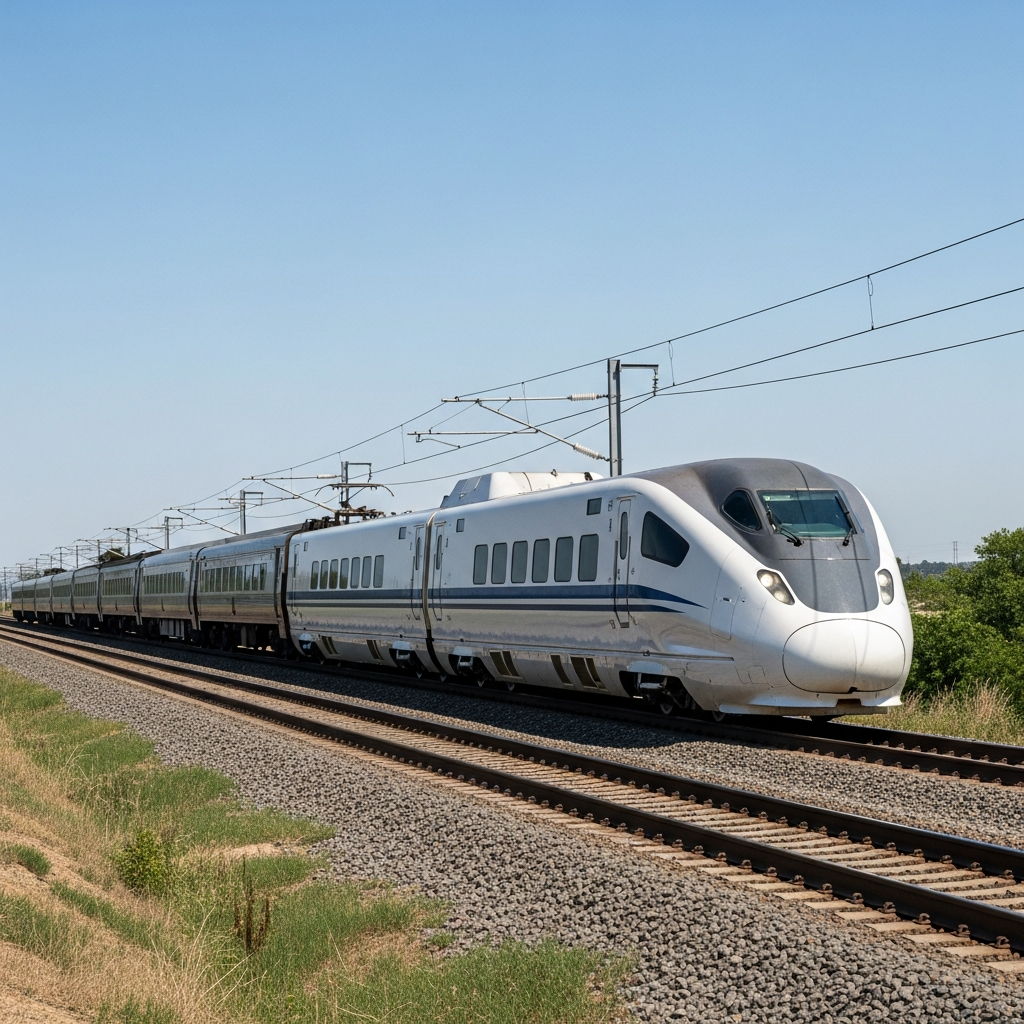
The United States, a nation celebrated for its pioneering spirit in infrastructure, paradoxically lags far behind the rest of the developed world in high-speed rail. While countries from Japan to Morocco zip along at 200 mph, American passenger trains often struggle to break 100 mph. What formidable obstacles have consistently derailed the dream of high-speed rail in the US, transforming ambitious visions into costly mirages? This deep dive explores the complex interplay of history, economics, politics, and culture preventing America from joining the global bullet train revolution.
The American Dream of Rail: A Fading Romance?
For generations, the train symbolized progress and romance in the American story. Yet, this historic connection hasn’t translated into modern, efficient high-speed rail in the US. Today, the fastest trains like Amtrak’s NextGen Acela top out at 160 mph, impressive for US standards but a far cry from international norms. Other nations view 186 mph (300 km/h) as the baseline for “high-speed.” The question isn’t just why the US hasn’t embraced these rapid transit networks, but can it still build big things in a fragmented, politically charged environment?
A Global Snapshot: The World’s High-Speed Leaders
While the US grapples with its rail future, much of the world has already redefined ground travel. Japan’s iconic Shinkansen, operational since 1964, epitomizes safety, punctuality, and frequency, with trains running every minute during peak times. France’s TGV, Germany’s ICE, and China’s Fuxing Hao trains routinely operate at 199-217 mph. Even newer entrants like Morocco’s Al Boraq, Africa’s first high-speed line, achieve 199 mph. These systems connect major cities, reduce travel times, cut pollution, and bolster national pride—benefits the US has yet to fully realize.
California’s High-Speed Rail Nightmare: A Case Study in Challenges
Perhaps the most glaring example of America’s struggle is the California High-Speed Rail (CAHSR) project. Conceived in 2008 with voter approval, the vision was bold: connect Los Angeles and San Francisco in less than three hours for an estimated $33 billion, by 2020. What followed has been described as a “quintessential example of government waste and mismanagement,” a stark illustration of the hurdles facing US rail infrastructure.
Unraveling the $125 Billion Funding Gap
Today, the CAHSR project is a shadow of its former self. Instead of connecting LA to San Francisco, the state is preparing to lay its first tracks for roughly the original $33 billion, but for only one-third of the distance: connecting the Central Valley cities of Bakersfield and Merced. The completion date has shifted to 2033, and the estimated cost for the full LA-SF route has skyrocketed to over $125 billion, leaving a daunting $90 billion funding shortfall. This fiscal reality demonstrates the difficulty of managing mega-projects in the American context, often starting with “theoretical” business plans and insufficient initial financing.
The Bureaucratic Bog: Land, Laws, and Labor Costs
Behind the ballooning costs lie significant logistical and regulatory challenges. Negotiating rights-of-way for over 3,000 land parcels in the Central Valley proved incredibly complex, with individual landowners capable of causing extensive delays. California’s stringent environmental regulations triggered countless reviews and lawsuits, adding years and billions to the project. Furthermore, high US labor and construction costs significantly outpace those in other nations, making large-scale infrastructure projects inherently more expensive here. As one former Amtrak co-founder noted, “When the budget no longer permits you to finish it the way you wanted to, you start cutting off your arms and legs.”
Political Whiplash: Shifting Support and Funding Fails
Political instability has been another major impediment. Initial bipartisan support for CAHSR eroded over time, with politicians like Congressman Vince Fong criticizing it as a “bait and switch.” Governor Gavin Newsom, who initially expressed skepticism, later championed the project, only for former President Trump to cancel $4 billion in federal grants, citing “wasted billions.” This pattern of inconsistent federal and state backing highlights the lack of sustained political will, making long-term planning and financing for a bullet train in America incredibly difficult.
Private Sector Promises: Can Brightline Deliver?
Against the backdrop of public sector struggles, a private company, Brightline West, is attempting to prove that private enterprise can succeed where government has faltered. Brightline aims to connect Los Angeles and Las Vegas with true high-speed rail, reaching 200 mph by 2029. Its existing Florida route between Miami and Orlando, operating at 125 mph, serves as a “beta test.” This venture could offer a blueprint for future US rail infrastructure development.
Innovation or Illusion? Brightline’s Business Model
Brightline West plans to circumvent right-of-way issues by running tracks on the median of the I-15 highway. This innovative approach promises to streamline construction. However, the private model isn’t without its own challenges. Analysts have downgraded Brightline’s debt to “junk,” raising questions about its financial viability. While passenger numbers are growing, they are lower than initially projected, demonstrating the difficulty of building a profitable high-speed rail in the US from scratch. Significantly, even this private venture relies heavily on public funding, having received federal grants and seeking a $6 billion loan from the Trump administration—a tacit acknowledgment that such massive infrastructure projects typically require government support worldwide.
Safety and Public Acceptance: A Critical Test
Brightline’s Florida operations have also faced serious safety concerns, with over 200 fatalities linked to its trains in nearly a decade, often involving pedestrian and vehicle collisions at street-level crossings. While Brightline asserts its desert route will be safer due to grade-separated crossings, public perception and trust remain crucial hurdles for any new US rail infrastructure project, especially one aiming for such high speeds.
Why the US Lags: A Multilayered Problem
Beyond individual project woes, systemic issues explain why the US continues to fall short in high-speed rail. The problem is not a lack of technological capability, but a complex web of historical priorities, regulatory burdens, and fragmented political will.
From Transcontinental Tracks to Car Culture Dominance
The US pioneered transcontinental rail in the 19th century, but a decisive shift in the mid-20th century rerouted national priorities. The Eisenhower administration’s massive investment in the interstate highway system cemented America’s car culture, sidelining rail development. This long-standing cultural preference for automobiles, combined with a vast domestic airline network, has created a deeply entrenched transportation landscape that is difficult to disrupt with a bullet train in America.
The Regulatory Maze: “A Million Obstacles”
Experts like Michael Kimmelman of the New York Times describe the US regulatory environment as creating “a million obstacles to progress and very few easy paths” for large infrastructure projects. From local zoning battles to complex environmental impact assessments and property rights disputes, the process for building new US rail infrastructure is often protracted, litigious, and incredibly expensive. Unlike countries where central governments can often override local objections for national projects, the US system gives significant power to local jurisdictions and individual stakeholders, leading to endless delays.
The Missing Ingredient: Sustained Political Will
Ultimately, the most significant barrier is a lack of sustained national political will and consensus. As Lou Thompson, an Amtrak co-founder, succinctly put it, other countries have high-speed rail because “they’ve decided they want to do it and pay for it, and we haven’t.” Without consistent federal commitment and investment, it’s virtually impossible for states to undertake such capital-intensive projects. The vision for a truly interconnected national high-speed rail network, like those in Asia or Europe, remains a distant dream without a unified federal strategy.
The Path Forward: Lessons from Global Successes
Despite the daunting challenges, the dream of a bullet train in America isn’t entirely dead. Learning from global leaders offers clear pathways for success, highlighting that HSR is more than just technology; it’s about strategy, integration, and a long-term commitment to public benefit.
Prioritizing Safety, Frequency, and Reliability
Japan’s Shinkansen success hinges on unwavering commitment to safety (zero passenger injuries since 1964 despite earthquakes), reliability (one-minute delay is a major event), and high frequency. For American rail, “frequency is actually more important for ridership than speed,” making HSR competitive with short-haul flights and dense road traffic. Future projects must be designed for seamless, predictable, and frequent service to truly change passenger behavior.
Political Consensus and Interoperability
France’s TGV benefited from bipartisan political will spanning decades, from Charles de Gaulle’s initial vision to François Mitterrand’s launch. This consensus is vital for long-term project stability. Furthermore, the TGV’s ability to integrate with existing conventional lines (“interoperability is a must”) allows for “one-seat rides” that extend the reach of high-speed travel. A future US rail infrastructure plan must prioritize interoperability, connecting new high-speed lines with existing transit networks, airports, and urban centers.
Integrated Mobility and Passenger Focus
Germany’s ICE system exemplifies “door-to-door mobility,” integrating HSR with other transport modes like Lufthansa flights, metro, and buses, all on a single ticket. As Deutsche Bahn’s Thorsten Krenz observed, “In Germany, the operators serve the passenger, in the U.S. the passenger has to adapt to the systems.” The focus should shift from standalone projects to comprehensive, passenger-centric networks that prioritize convenience, reducing travel stress, and “reclaiming time” for travelers. This means simple, functional stations and seamless connections, not opulent “Taj Mahal” terminals.
Frequently Asked Questions
Why has the California High-Speed Rail project faced such significant delays and cost overruns?
The California High-Speed Rail (CAHSR) project has been plagued by a confluence of issues. Initial cost estimates of $33 billion for an LA-SF route by 2020 proved theoretical, escalating to over $125 billion by 2026. Challenges include the arduous process of acquiring rights-of-way for thousands of land parcels, California’s strict environmental regulations leading to lawsuits and delays, high US labor and construction costs, and a lack of full funding at the project’s inception. Shifting political support and federal grant cancellations further complicated progress, resulting in a significantly scaled-back initial segment.
Which regions or private companies are currently leading high-speed rail development efforts in the United States?
While the California High-Speed Rail project continues to face challenges, the private company Brightline West is a prominent leader in US high-speed rail development. It aims to connect Los Angeles and Las Vegas with 200 mph service by 2029, building on the success of its 125 mph Florida route between Miami and Orlando. Other regions, such as the Chicago to St. Louis corridor, are also exploring 220 mph service with feasibility studies, and potential routes like Dallas to Houston are being considered. These efforts represent different models for advancing US rail infrastructure.
What are the primary reasons other countries have successful high-speed rail systems, and what can the US learn?
Successful high-speed rail systems in countries like Japan, France, and Germany are built on several key pillars. They benefit from sustained political will and long-term public funding commitments, often spanning decades. These systems prioritize exceptional safety, high frequency of service (often every few minutes during peak times), and robust reliability. Crucially, they emphasize interoperability, seamlessly integrating high-speed lines with conventional rail and other transport networks for door-to-door mobility. The US can learn to prioritize a national vision, streamline regulatory processes, invest in mature, integrated technology, and foster a passenger-centric approach to overcome its current challenges.
The Journey Ahead: Will America Get on Track?
The ambition for high-speed rail in the US remains compelling, offering solutions for congestion, climate change, and economic revitalization. Yet, the path forward is fraught with obstacles that require more than just technological prowess. It demands an unprecedented level of political consensus, sustained financial commitment, and a willingness to learn from international success stories. Until America can overcome its historical biases, regulatory hurdles, and fragmented political landscape, the dream of catching the bullet train may continue to be a ghost on the tracks, waiting for the collective will to finally bring it to life.