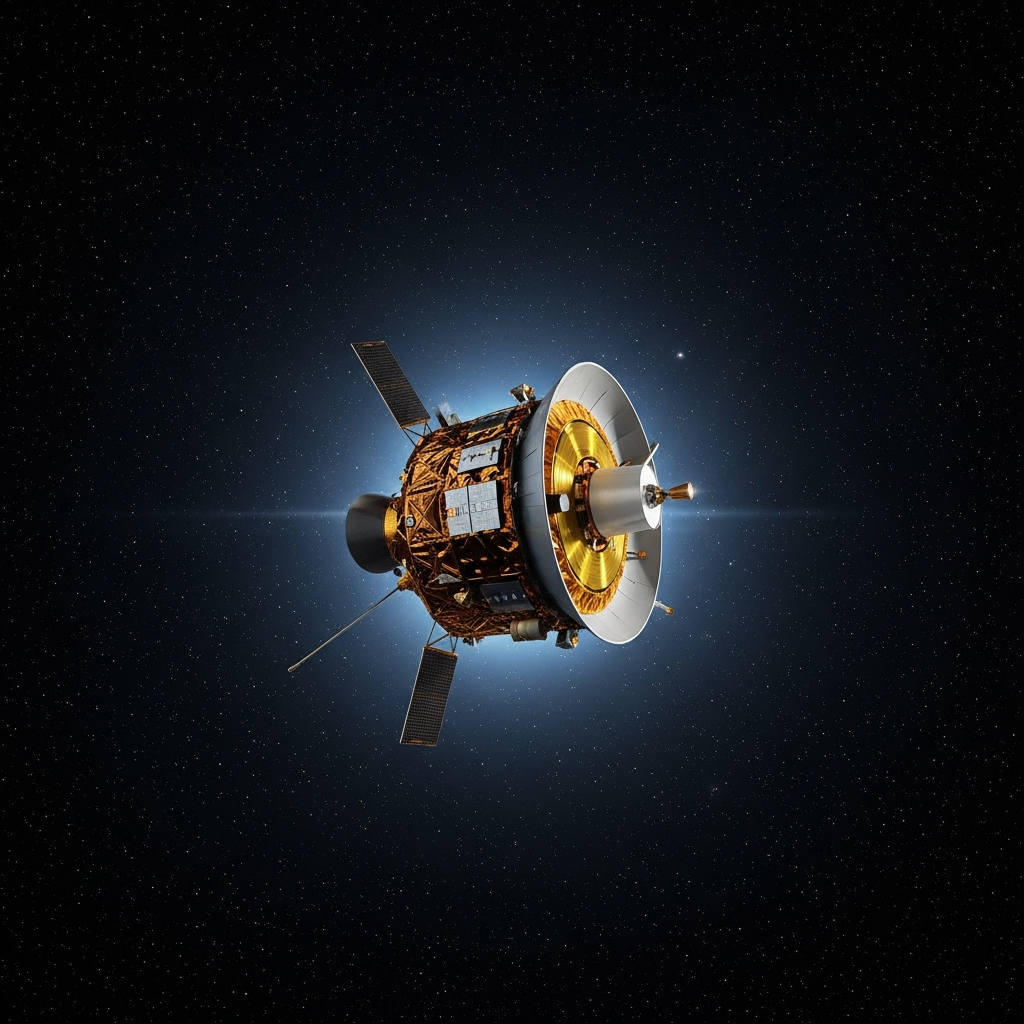
Humanity’s farthest emissaries, the iconic Voyager 1 and Voyager 2 probes, are embarking on their final celestial chapter. After nearly five decades of unparalleled deep space exploration, these robotic pioneers, now over 15 billion miles from Earth, are gracefully approaching the end of their operational lives. Their incredible journey has redefined our understanding of the cosmos, from the outer planets to the mysterious realm of interstellar space. As NASA engineers meticulously manage their dwindling power, the world reflects on the monumental legacy of these spacecraft—a testament to human ingenuity and our insatiable quest for knowledge beyond our solar system.
The Grand Tour: An Unprecedented Cosmic Saga Begins
The Voyager mission began with a bold vision. Launched in 1977—Voyager 2 on August 20, followed by Voyager 1 on September 5—these twin robotic probes embarked on a “Grand Tour” of the outer solar system. Carried by powerful Titan-Centaur rockets from the Florida coast, their primary objective was to exploit a rare planetary alignment. This alignment provided a gravitational slingshot effect, enabling the probes to visit Jupiter, Saturn, Uranus, and Neptune in quick succession. Engineers at NASA’s Jet Propulsion Laboratory (JPL) in Southern California initially designed them for a mere five-year lifespan. Few could have predicted the half-century odyssey that would unfold.
Voyager 1 quickly delivered humanity’s closest look at Jupiter and Saturn, providing breathtaking images and invaluable data about their atmospheres, rings, and numerous moons. Its twin, Voyager 2, extended this cosmic reconnaissance, offering the first and only close-up views of Uranus and Neptune. By 1990, both Voyagers had successfully completed their primary planetary missions, far exceeding all expectations. Yet, their journey was far from over.
Humanity’s Love Letter to the Stars: The Golden Records
Beyond their scientific instruments, each Voyager probe carried a profound message for any potential extraterrestrial intelligence: the Golden Record. This 12-inch golden-plated copper audio-visual disk was meticulously crafted as a cosmic time capsule. Led by renowned astronomer Carl Sagan, with science writer Ann Druyan as creative director, a dedicated team faced the monumental challenge of representing humanity to the universe.
The carefully curated contents of these Golden Records offered a diverse snapshot of Earth and its inhabitants. They included 115 images depicting Earth’s landscapes, scientific diagrams, and human cultures. Sounds from nature, such as thunder and whale songs, captured the planet’s natural environment. A 90-minute music compilation showcased human artistic expression, predominantly from the 20th century. Perhaps most poignantly, greetings in 55 languages offered a collective outreach, a hopeful “hello” from our species across the vastness of space. These records symbolize not just technological achievement but a deep human curiosity and a profound desire for cosmic connection.
The Long Goodbye: Voyagers Power Down
The remarkable longevity of the Voyager probes stems from their unique power source. Unlike modern spacecraft that often rely on solar panels, the Voyagers are equipped with radioisotope thermoelectric generators (RTGs). These RTGs convert heat from the decay of small amounts of Plutonium-238 into electricity. However, after nearly 50 years, this power source is significantly dwindling. To conserve precious energy, NASA engineers have progressively powered down many of the probes’ 11 scientific instruments over the years. Some were switched off after completing their specific tasks, such as observing planetary atmospheres which are now far in the probes’ rearview mirrors.
Most recently, Voyager 1 saw its low-energy particle telescope and low-energy magnetospheric particle analyzer switched off. These instruments were crucial for measuring the speed and origin of particles carried by solar winds. Voyager 2’s identical instruments were powered down even earlier. The first to go on Voyager 1 was its photopolarimeter subsystem, which included a small telescope designed to analyze scattered sunlight from Jupiter and Saturn’s atmospheres and rings. This strategic powering down allows the remaining critical instruments to continue sending data as long as possible.
Pioneers in Interstellar Space: Beyond Our Star’s Reach
Despite their diminishing power, the Voyager probes continue to achieve the unprecedented. They are the farthest human-made objects ever to venture into space, having crossed the heliopause—the boundary where the sun’s solar wind gives way to the interstellar medium. This makes the data they transmit profoundly valuable. Each signal, taking roughly 23 hours to reach Earth from Voyager 1, offers unique insights into the mysteries of interstellar space, a region no other spacecraft has yet explored.
There’s a significant effort to extend the mission’s life as long as possible. Johns Hopkins University space scientist Ralph McNutt noted in 2024 the “big push to try to keep the mission going until the 50th anniversary of their launches” in 2027. More optimistically, the team monitoring the probes told NPR they plan instrument testing this year that might even extend their lifespans into the 2030s. This isn’t mere sentimentality; the scientific return from continued observations in this unexplored territory is immense, promising unforeseen discoveries about our cosmic neighborhood.
A New Dawn in Space Exploration: Voyager’s Successors
While the Voyagers bravely limp along on life support, a new generation of sophisticated space telescopes and ground-based detectors has emerged, building upon their pioneering spirit. These instruments are already peering deeper into the cosmos with unparalleled clarity. The Vera C. Rubin Observatory in Chile, for instance, began releasing imagery last year, pinpointing 11,000 new asteroids and imaging distant nebulae and galaxies thousands of light-years away.
NASA’s James Webb Space Telescope, launched in 2021, works in conjunction with the venerable Hubble Space Telescope (launched 1990) to capture extraordinary images. Together, they recently delivered the most detailed views of Saturn ever seen. Looking ahead, NASA plans to launch the Nancy Grace Roman Space Telescope in September 2026. This powerful camera will observe in visible and near-infrared light, complementing Webb’s infrared and Hubble’s visible and ultraviolet observations. Its mission promises to unravel some of the universe’s greatest puzzles, including the enigmatic dark matter and dark energy that shape our cosmos. These new tools extend humanity’s vision, but they stand on the shoulders of giants like the Voyagers, who first showed us what lay beyond.
Frequently Asked Questions
Why are the Voyager probes powering down their scientific instruments?
The Voyager probes derive their power from radioisotope thermoelectric generators (RTGs) which use the heat from decaying Plutonium-238. After nearly 50 years, this power source is significantly dwindling. To prolong the missions, NASA engineers strategically power down instruments to conserve the remaining energy. Some instruments were also switched off because they had completed their primary tasks, such as observing the atmospheres of planets that are now far behind the probes. This meticulous management ensures the most critical instruments can continue operating in interstellar space as long as possible.
What message did the Voyager probes carry into space for potential extraterrestrial life?
Both Voyager probes carry an identical “Golden Record”—a 12-inch gold-plated copper audio-visual disk. This “cosmic time capsule” was curated by a team led by Carl Sagan and Ann Druyan. It contains a diverse array of information about Earth and humanity, including 115 images depicting human life, landscapes, and scientific diagrams; sounds from nature (e.g., thunder, whale songs); a 90-minute music compilation; and spoken greetings in 55 languages. The Golden Records represent humanity’s hopeful “love letter to interstellar space,” designed to be understood by a technologically advanced alien civilization.
What’s the future for the Voyager missions, and what comes next in space exploration?
While the Voyager probes are nearing the end of their operational lives, engineers are still working to extend their lifespan. There’s a strong push to keep them functioning until at least their 50th anniversary in 2027, with some instrument testing potentially extending their data collection into the 2030s. Their continued observations from interstellar space offer unique, scientifically invaluable data. Looking ahead, advanced observatories like the James Webb Space Telescope, the Vera C. Rubin Observatory, and the upcoming Nancy Grace Roman Space Telescope are continuing and expanding humanity’s quest to explore the cosmos, delving into everything from distant galaxies to dark matter and dark energy.
The Enduring Legacy of Cosmic Exploration
The Voyager probes are more than just remarkable pieces of engineering; they are enduring symbols of humanity’s boundless curiosity and capacity for discovery. Their nearly five-decade journey has stretched the limits of what’s possible, providing unparalleled insights into our solar system and the vast interstellar medium beyond. As they continue their silent, lonely drift into the cosmic abyss, these diminished but not defeated pioneers will forever represent our first bold steps beyond our sun’s embrace. Their legacy inspires future generations of explorers, reminding us that even as one chapter closes, the universe holds endless mysteries waiting to be unveiled.