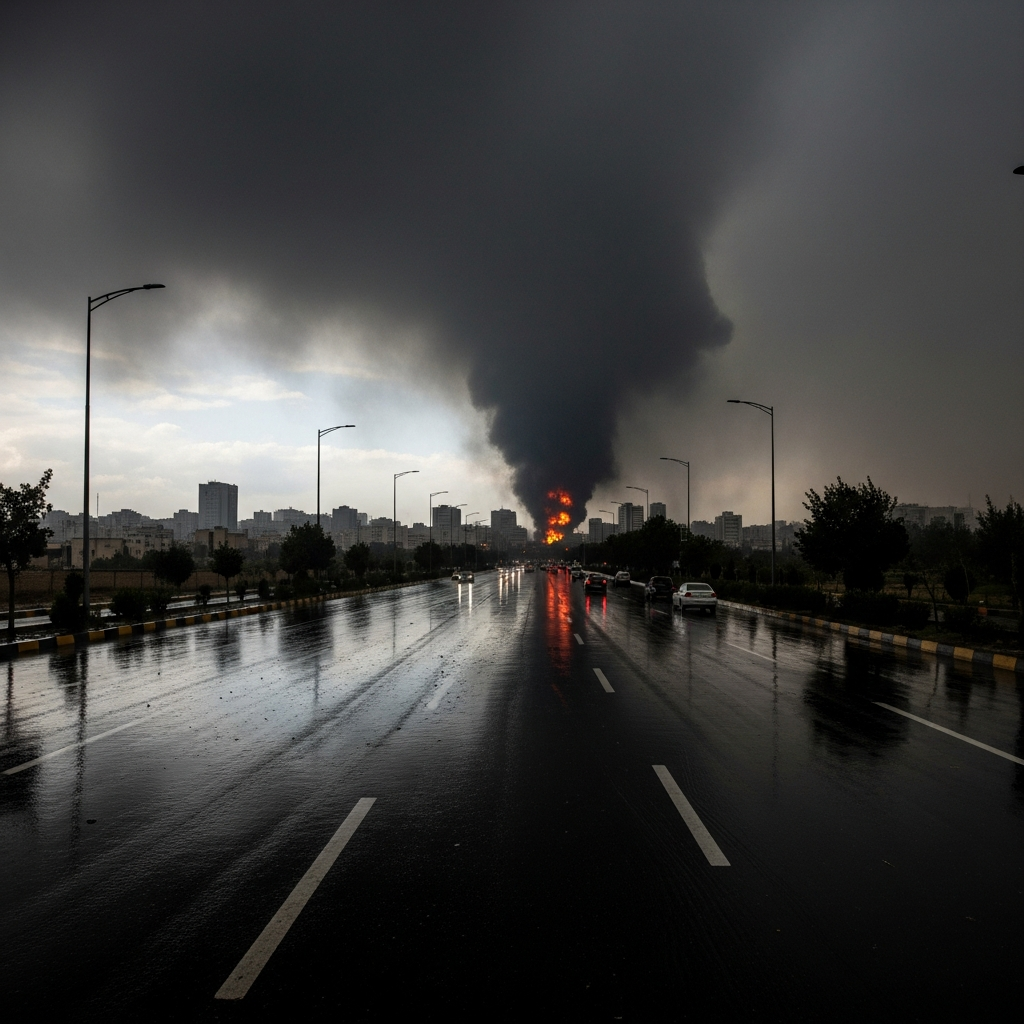
Tehran, Iran’s sprawling capital, found itself cloaked in a suffocating cloud of toxic smoke after overnight Israeli airstrikes targeted several fuel depots. This devastating event, which saw massive fires burn for hours, triggered black, oily rainfall that extended dozens of miles from the strike sites, painting the city in shades of environmental catastrophe and amplifying a pre-existing air pollution crisis. Residents reported immediate and severe health impacts, transforming the urban landscape into a scene of distress and highlighting the perilous escalation of regional conflicts.
A City Choked: The Immediate Aftermath of the Strikes
The dawn revealed a terrifying reality for Tehran’s nearly 10 million inhabitants. Thick, black smoke billowed across the skyline, a stark visual of the environmental disaster unfolding. Eyewitness accounts painted a grim picture: “The rain is black, I can’t believe it,” shared Kianoosh, a 44-year-old engineer from Tehran, recounting the surreal sight. This “black rain” reached far-flung districts like Tajrish, miles from the immediate vicinity of the oil tanks, demonstrating the widespread impact of the inferno.
Residents across the region faced immediate health and environmental consequences. Parviz, a 49-year-old university professor residing 70 miles north of Tehran, described his white car turned “almost black” by the oil-tainted downpour. More alarmingly, the air itself became a threat. Leila, a 27-year-old teacher, described the air as “unbreathable,” likening the sky over Tehran to being swallowed by a “black monster.” She recounted personal suffering after just 15 minutes of exposure: a headache, burning and raw skin on her face and lips, and irritated eyes. The Iran’s Red Crescent Society issued urgent warnings, cautioning that the rainfall could be “highly dangerous and acidic,” potentially leading to “chemical burns of the skin and serious damage to the lungs.” The severe air pollution forced some residents, like 63-year-old Ahmad, to flee the city entirely.
Targets Identified: The Israeli Campaign and Its Allegations
Iranian state media reported that the Israeli strikes hit several critical fuel installations. Among those targeted were the Aghdasieh oil warehouse in northeast Tehran, the Shahran oil depot north of the city, an oil refinery in the south, and an oil depot in Karaj, located west of Tehran. These attacks marked a significant escalation in the ongoing regional tensions.
The Israeli military promptly claimed responsibility, stating on X (formerly Twitter) that it had targeted “several fuel storage complexes belonging to the [Islamic Revolutionary Guard Corps (IRGC)] in Tehran.” Israel alleged these facilities were being used to “distribute fuel to multiple military entities in Iran.” This was not the first instance of such targeting; the Shahran oil depot had previously been hit during Israel’s 12-day air campaign against Iran in June of the previous year. The strikes also coincided with a stark warning from President Donald Trump, who posted on Truth Social that “today Iran will be hit very hard,” adding that areas and groups previously unconsidered were now under “serious consideration for complete destruction and certain death” due to Iran’s “bad behavior.” This broader U.S.-Israeli offensive, now over a week old, has reportedly claimed over 1,000 civilian lives and sparked a regional conflict, with Iran retaliating by firing hundreds of missiles at Israel and its Gulf allies.
Tehran’s Pre-Existing Environmental Battle: A City Under Siege by Smog
The recent toxic cloud landed on a city already battling a chronic and severe air pollution crisis. Tehran is famously prone to “smog holidays,” city-wide shutdowns declared when pollution levels become “unhealthy.” This existing vulnerability amplified the impact of the strikes, turning a severe incident into an environmental catastrophe.
For years, Tehran, with its over 12 million residents and more than 3 million cars, has struggled with near round-the-clock traffic jams that fuel its persistent smog. The city’s unique geography exacerbates the problem: the towering Alborz Mountains, while picturesque, act as a thermal catch basin, trapping smog and blocking winds. This creates a perpetual “soup of yellow” air, obscuring distant views and prompting residents to routinely wear surgical masks. The Health Ministry has long issued warnings for vulnerable populations—those with respiratory and heart ailments, the elderly, and children—to remain indoors. Each “smog holiday” inflicts an estimated $130 million in financial losses, straining an already struggling economy. Despite numerous proposed solutions, from expanding public transportation to ambitious, costly plans like generating rain or creating man-made wind corridors, many have failed to gain traction. The recent fuel depot strikes thus layered a fresh, potent cocktail of hazardous substances onto an already fragile and compromised urban atmosphere, pushing the city’s environmental resilience to its breaking point.
Escalating Conflict: Beyond Fuel Depots to Critical Infrastructure
These attacks represent the most significant strike on Iran’s civilian industrial infrastructure in the war so far. The conflict has spiraled into a wider regional confrontation, with devastating consequences beyond Iran’s borders. In Lebanon, a separate theater of the war has seen Israel launch a major offensive against the militant group Hezbollah, resulting in the deaths of 394 people, including 83 children.
Iran’s Foreign Ministry spokesperson, Esmaeil Baghaei, condemned the targeting of fuel depots as releasing “hazardous materials and toxic substances into the air, poisoning civilians, devastating the environment, and endangering lives on a massive scale.” The Red Crescent Society also reported extensive damage across Iran, with approximately 10,000 civilian structures, including homes, schools, and medical facilities, impacted nationwide. In retaliation for the U.S.-Israeli offensive, Iran has launched barrages of missiles and drones toward Israel and American military bases in Gulf countries, reportedly striking both military and civilian targets like hotels, airports, and apartment buildings.
The Looming “Water Wars”: Desalination Plants Under Threat
The conflict has even extended to critical water infrastructure, sparking fears of “water wars.” Iran’s Foreign Minister Abbas Araghchi accused the United States of attacking a desalination plant on Qeshm Island, alleging it impacted the water supply for 30 villages and warning of “grave consequences.” Both the U.S. and Israeli militaries denied involvement, with President Trump dismissing the accusation while criticizing Iran’s leadership.
However, the day after Iran’s warning, Bahrain accused Tehran of a drone attack that caused “material damage” to a desalination plant on its territory, denouncing it as “Iranian aggression indiscriminately attacked civilian targets.” The United Arab Emirates and Kuwait also reported being targeted by Iranian ballistic missiles, cruise missiles, and drones. Kuwait International Airport, for instance, sustained damage to fuel tanks from these attacks. The targeting of desalination plants is particularly alarming for arid regions like Iran, Bahrain, and the UAE, where these facilities are crucial for sustaining millions of people. This highlights a dangerous escalation where essential civilian lifelines become targets in broader geopolitical conflicts.
The Human Cost and Global Implications
The toxic smoke and black rain over Tehran serve as a stark reminder of the devastating human and environmental costs of escalating conflict. Residents face immediate health crises, while the long-term impacts of exposure to hazardous substances remain a grave concern. This incident also underscores the amplified vulnerability of urban centers with pre-existing environmental challenges. The targeting of essential civilian infrastructure—from fuel depots to water desalination plants—sets a perilous precedent in modern warfare, potentially leading to widespread suffering and environmental devastation that far outlasts any military objectives. This ongoing regional turmoil demands urgent attention to prevent further humanitarian and ecological catastrophes.
Frequently Asked Questions
What were the immediate environmental and health impacts of the Israeli strikes on Tehran’s fuel depots?
The Israeli strikes on fuel depots in and around Tehran caused massive fires that blanketed the city in a thick cloud of toxic smoke. This led to “black rain,” which was oil-tainted and acidic, reaching dozens of miles away. Residents reported difficulty breathing, headaches, burning skin, and irritated eyes. The Iran’s Red Crescent Society warned of “chemical burns of the skin and serious damage to the lungs” due to the hazardous rainfall. The severe air pollution also forced some residents to leave the city.
How has Tehran’s pre-existing air pollution crisis contributed to the severity of this incident?
Tehran already suffers from chronic and severe air pollution, characterized by frequent “smog holidays” and high levels of particulate matter trapped by the surrounding Alborz Mountains. The recent toxic smoke from the fuel depot strikes compounded this dire situation, layering new hazardous substances onto an already compromised atmosphere. This made the air even more dangerous and “unbreathable,” significantly amplifying the health risks and overall environmental impact for the city’s vulnerable population.
What are the broader geopolitical implications of targeting civilian infrastructure like fuel depots and desalination plants in the ongoing conflict?
Targeting civilian industrial infrastructure, such as fuel depots and desalination plants, marks a dangerous escalation in the conflict. It directly impacts civilian populations, leading to humanitarian crises, environmental devastation, and economic disruption. This strategy risks pushing regional conflicts into “water wars” and further destabilizing critical infrastructure in arid regions, potentially causing widespread suffering that could ignite broader international condemnation and calls for de-escalation, while also setting a concerning precedent for future conflicts.
Conclusion: A City Reels Amidst Regional Turmoil
The recent events in Tehran present a harrowing image of a city grappling with an immediate environmental disaster, compounded by its long-standing battle against air pollution. The toxic smoke and black rain, direct consequences of the Israeli strikes on fuel depots, have inflicted severe health and environmental damage, further destabilizing an already fragile urban ecosystem. As the broader regional conflict escalates, with vital civilian infrastructure like desalination plants increasingly becoming targets, the human and ecological toll continues to mount. This unfolding crisis underscores the urgent need for international attention and de-escalation efforts to prevent further suffering and widespread environmental catastrophe in an already volatile region.