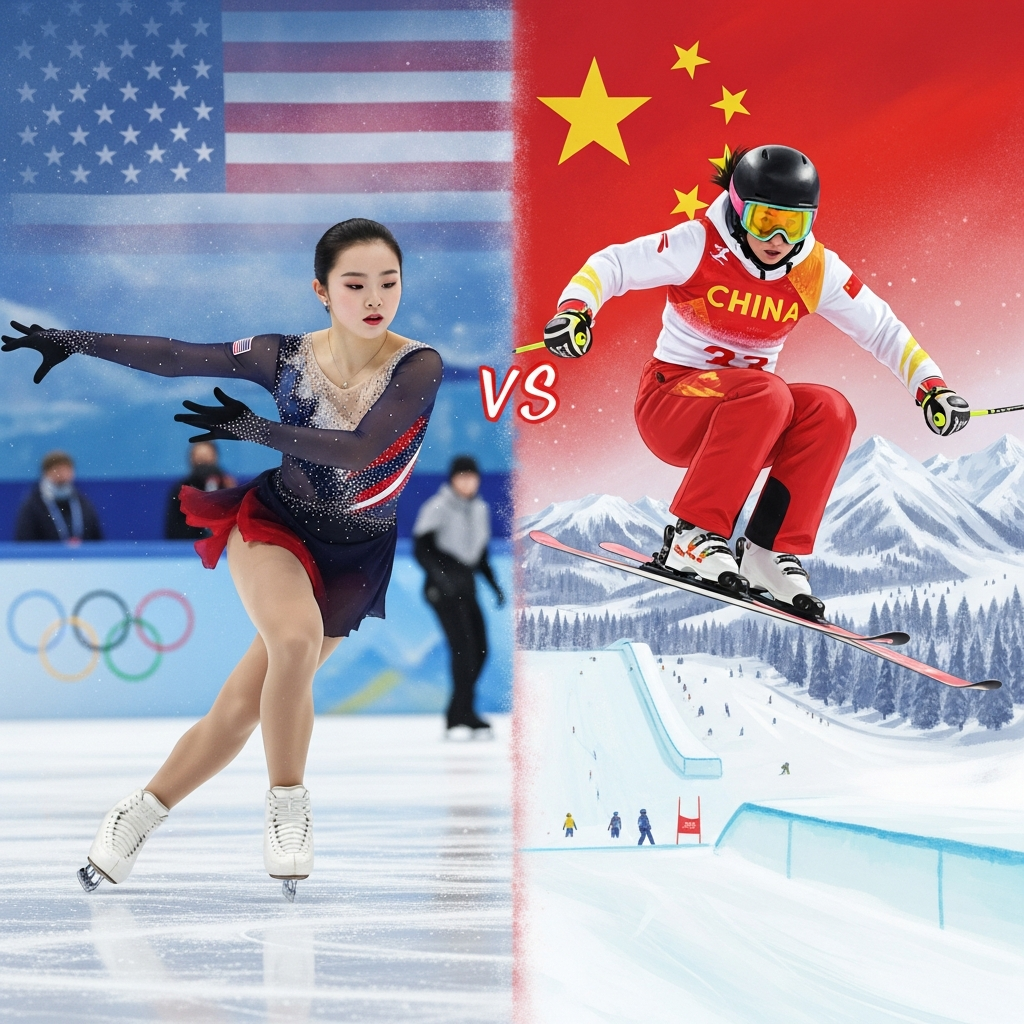
The Winter Olympics in Milan Cortina 2026, a stage for athletic excellence and national pride, has unexpectedly become a backdrop for a contentious debate. U.S. figure skating gold medalist Alysa Liu and China-backed freestyle skiing star Eileen Gu find themselves at the center of a politically charged comparison. This article delves into the uncomfortable juxtaposition of these two extraordinary athletes, exploring the roots of the “good Asian, bad Asian” narrative, the complex factors influencing their allegiances, and the broader implications for bicultural athletes on the global stage. Understanding this rivalry reveals more than just sports; it exposes deeper geopolitical and societal tensions.
Alysa Liu’s Historic Gold and a Resonant American Story
Oakland native Alysa Liu captivated the world at the Milan Cortina Games, securing America’s first Olympic women’s figure skating gold in 24 years. Her “stirring performance” in the free skate ended a significant drought for Team USA. Liu’s triumph felt like a dream after a remarkable comeback story. She had temporarily retired from the sport at 16, citing the sport’s restrictive nature and pandemic impacts. Her return in 2024, at 20 years old, led to a 2025 World Championship win, setting the stage for her Olympic glory.
Her path to gold was marked by both resilience and joy. Liu, a former prodigy who landed a triple axel at 13 and a quad jump at 14, now emphasizes her “completeness as a figure skater.” Her Milan Cortina short program scored 76.59, placing her third. She then delivered a “lively and clean” free skate to Donna Summer’s “MacArthur Park,” earning a season-best 150.20 for a total of 226.79 points. This commanding performance held off tough Japanese competition.
A Legacy Rooted in Freedom
Liu’s personal narrative adds profound depth to her Olympic achievement. She is the daughter of Arthur Liu, a Chinese dissident who fled China after the 1989 Tiananmen Square protests. This background has reportedly made Alysa and her father targets of Beijing harassment and spying. Her father’s experiences instill in Alysa a “strong moral conscience about the importance of freedom and the value of American democracy.” This choice to proudly represent the United States, described as a “land of the free,” resonates deeply with many. Back home in Oakland, her community celebrates. Fentons Creamery, a local institution, even promised her “ice cream for life,” highlighting the strong local pride.
Eileen Gu’s Global Stardom and Divisive Allegiance
In stark contrast, freestyle skier Eileen Gu, also born and raised in Northern California, chose to compete for the People’s Republic of China. A “divisive figure” in her sport for two Olympic cycles, Gu has achieved immense success, securing two golds and a silver at the previous Winter Games and adding two silvers in Milan Cortina. Her decision has garnered both widespread admiration in China and significant criticism in the United States.
Gu’s move has been linked to considerable financial incentives. Reports suggest she and Los Angeles native Beverly Zhu (who competes as Zhu Yi) have received $14 million over the last three years to represent China. This financial aspect fuels much of the criticism. Critics accuse Gu of “picking green over red, white and blue,” suggesting her allegiance is driven by profit.
Facing Scrutiny and Political Backlash
Gu’s choice has drawn ire from various U.S. political figures. Rep. Michael Baumgartner, R-Wash., and Rep. Andy Ogles, R-Tenn., have implicitly and explicitly criticized her. Ogles even posted a picture of Gu with a medal, asserting, “There must be consequences for those who betray the United States and support our adversaries.” Vice President JD Vance also weighed in, stating his support for “American athletes” who “identify themselves as Americans.” Gu has become “a bit of a punching bag for a certain strand of American politics.”
The “Good Asian, Bad Asian” Narrative Takes Hold
The side-by-side comparisons of Alysa Liu and Eileen Gu quickly devolved into a “good Asian, bad Asian” narrative. Cal State Fullerton sociology professor Christina Chin observed this racialized tendency. “We have two totally different sports,” Chin noted, “But yet there’s a tendency that if there’s two of them, then we must compare, we must make a racial comparison.” This oversimplification ignores the complex individual circumstances influencing an athlete’s decision.
Social media amplified this binary, with the phrase “Be an Alysa Liu” trending widely. Posts juxtaposing the two athletes, often with messages like “In a world full of choices … Be Alysa Liu,” garnered millions of views. This phenomenon highlights differing standards applied to Asian American athletes. Chin explains, “There are constant questions about how they’re seen, how they’re racialized in a way that’s very different than compared to white athletes.” These athletes face persistent scrutiny regarding their identity and allegiances.
Gu’s Defense: A Broader Perspective on Allegiance
Eileen Gu has publicly addressed the intense criticism she faces. She argues that her situation is unfairly singled out. “So many athletes compete for a different country,” Gu stated. She believes the problem stems from critics lumping “China into this monolithic entity,” driven by a broader animosity towards the nation itself. Gu asserts the issue is “not really about what they think it’s about,” suggesting a deeper, more prejudiced motivation.
Indeed, Gu is not the first American-born athlete to represent another country. However, her choice has drawn an “outsized amount of heat.” This intense backlash underscores the complex and often politicized nature of national identity in sports, particularly when a country’s geopolitical rivals are involved. The public often struggles with the nuanced decisions athletes make regarding their heritage, opportunities, and personal convictions.
The Enduring Impact of Politicized Athletic Identity
The uncomfortable comparisons between Alysa Liu and Eileen Gu serve as a stark reminder of the pressures athletes face, especially those with bicultural backgrounds. Their individual choices, shaped by family history, personal values, and athletic opportunities, become fodder for nationalistic debates. While Liu’s story is celebrated as quintessentially American, Gu’s is seen through a lens of suspicion and betrayal. This narrative creates a difficult environment for athletes who often simply want to pursue their passion.
The Milan Cortina 2026 Olympics, through these two powerful women, unwittingly illuminates the complexities of identity, patriotism, and the global political landscape. Their experiences prompt us to consider how we define national loyalty in a world where talent, heritage, and opportunity transcend borders. The spotlight on Alysa Liu and Eileen Gu reminds us that athletic competition can sometimes reflect much larger societal conversations about who belongs and where allegiance lies.
Frequently Asked Questions
What sparked the uncomfortable comparisons between Alysa Liu and Eileen Gu at the Olympics?
The comparisons between Alysa Liu and Eileen Gu intensified following Liu’s historic gold medal win at the Milan Cortina 2026 Olympics. Both athletes are American-born with Chinese heritage, but Liu chose to represent the U.S. while Gu competes for China. This stark difference in allegiance, coupled with Liu’s father’s dissident background, fueled a politically charged narrative, particularly within conservative circles and social media, positioning them against each other in a “geopolitical battle.”
Why did a “good Asian, bad Asian” narrative emerge around these two athletes?
The “good Asian, bad Asian” narrative developed from a tendency to racially compare Liu and Gu, despite their different sports. Sociology professor Christina Chin noted that this framing reduces complex individual decisions about national representation to a simplistic moral judgment based on race. Liu, representing the U.S. with a dissident father, was cast as the “good Asian,” while Gu, competing for China with significant financial backing, was labeled the “bad Asian.”
What are the broader implications of these comparisons for Asian American athletes?
The comparisons highlight the “different standards” applied to Asian American athletes compared to their white counterparts. They face constant questions about their identity and how they are “racialized,” often forced to publicly validate their loyalty. This places an undue burden on bicultural athletes, forcing them to navigate complex geopolitical tensions in addition to their athletic pursuits, rather than simply celebrating their achievements and choices.