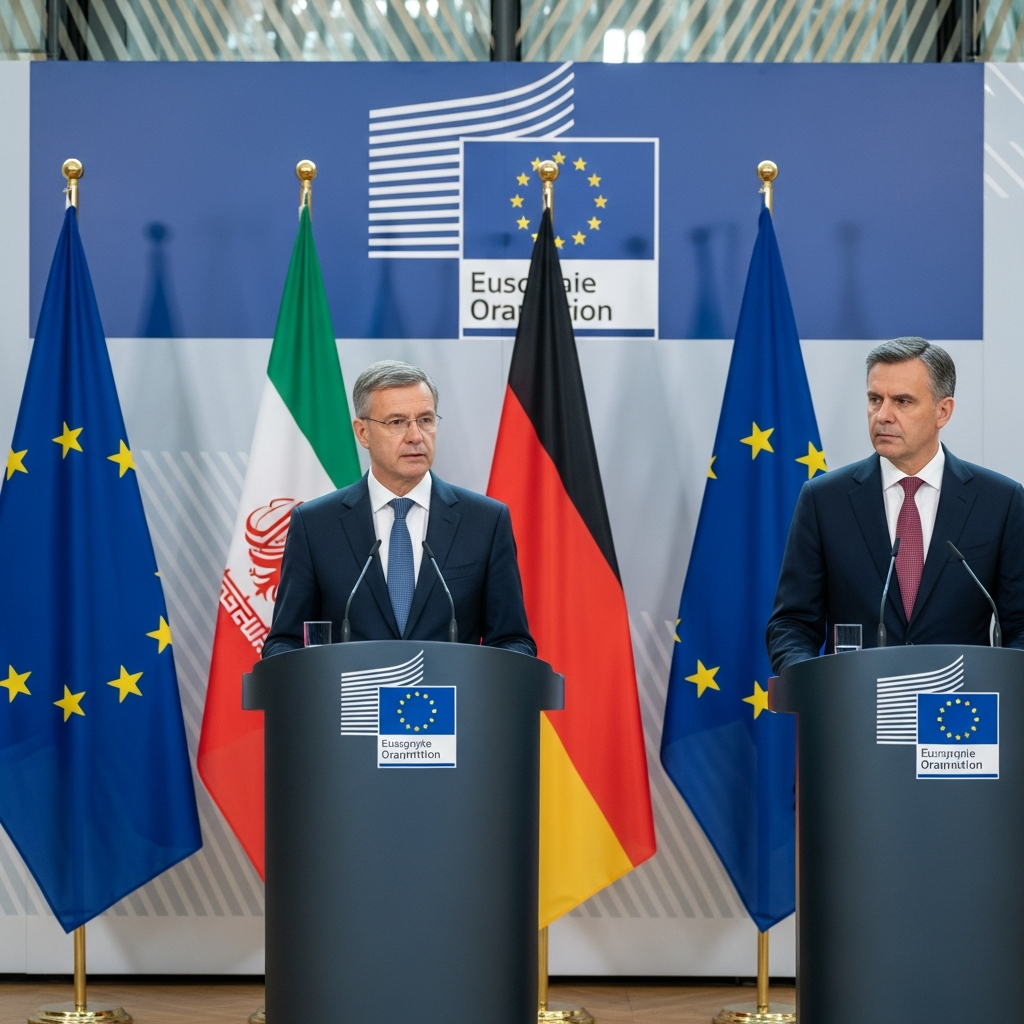
In a significant and decisive move, the European Union has officially designated Iran’s Islamic Revolutionary Guard Corps (IRGC) as a terrorist organization. This critical decision, swiftly endorsed by Germany and welcomed across Europe, marks a pivotal shift in the international community’s approach to the Iranian regime. It comes amidst widespread condemnation of Tehran’s brutal crackdown on internal protests and its concerning military support for Russia. The EU’s action places the IRGC on a blacklist alongside groups like al-Qaeda and the Islamic State, signaling a united front against repression.
EU Takes Decisive Stand Against Iran’s IRGC
The European Union moved definitively on Thursday to add Iran’s Islamic Revolutionary Guard Corps (IRGC) to its official terrorist list. European Commission President Ursula von der Leyen hailed the designation as “long overdue,” emphasizing that “terrorist is indeed how you call a regime that crushes its own people’s protests in blood.” This robust condemnation reflects growing international outrage over the violent suppression of dissent across Iran, which began in late December and escalated into widespread calls for regime change.
Germany’s Foreign Minister Johann Wadephul affirmed the EU’s commitment to rapid implementation, pledging to make the decision legally binding as swiftly as possible. He described the move as a powerful political signal, underscoring the severe scale of repression within Iran. The EU’s top diplomat, Kaja Kallas, further asserted that “repression cannot go unanswered,” making it clear that those who operate through terror must be treated as terrorists.
New Sanctions Target Iranian Officials and Entities
Alongside the IRGC designation, the EU introduced a fresh round of sanctions. These measures specifically target Iranian officials and entities deemed responsible for the violent crackdown on protests, mass killings, and severe human rights violations. Among those now facing sanctions are Iran’s Interior Minister Eskandar Momeni, Prosecutor General Mohammad Movahedi Azad, senior IRGC commanders, and presiding judge Iman Afshari.
Additional sanctions were imposed on six entities, including Iran’s media regulator and state-linked online influence groups, for their roles in censorship, spreading disinformation, and disrupting internet access. These comprehensive restrictive measures include asset freezes, travel bans, and prohibitions on providing funds or economic resources to those listed. The EU also incorporated Tehran’s military assistance to Russia into these broader measures, highlighting the interconnected nature of Iran’s problematic international activities.
The IRGC: Iran’s Powerful and Controversial Force
The Islamic Revolutionary Guard Corps stands as Iran’s most powerful and influential armed force. Established after the 1979 revolution, its primary mission is to protect the country’s Islamic system and its clerical leadership, operating distinctly from the regular army. The IRGC commands an estimated 190,000 active personnel with sophisticated capabilities across land, air, and sea, overseeing Iran’s strategic weapons programs.
Beyond its direct military functions, the IRGC wields immense economic and political power. It has extensive business interests within Iran and exerts significant overseas influence by providing financial, military, and technological support to allied governments and various armed groups across the Middle East. Internally, the IRGC controls the paramilitary Basij Resistance Force, which boasts hundreds of thousands of members and is frequently deployed to suppress domestic dissent with extreme violence. German Foreign Minister Wadephul specifically accused the IRGC and its auxiliary forces of meeting protesters with brutality, carrying out executions, and playing a destabilizing role throughout the region.
International Alignment and Continued Pressure
The EU’s designation aligns it with several other nations that have already blacklisted the IRGC as a terrorist entity. The United States designated the IRGC a Foreign Terrorist Organization in April 2019, followed by Canada in June 2024, and Australia in 2025. Bahrain and Saudi Arabia have also designated the group. Advocacy groups like United Against Nuclear Iran (UANI) lauded the EU’s decision and urged swift implementation, additionally calling on the United Kingdom to follow suit. While the UK has extensive sanctions on the IRGC, it has not yet made a full proscription.
The decision by the EU, particularly France’s reversal of its initial hesitation, underscores a unified resolve. French Foreign Minister Jean-Noel Barrot noted that the repression was “the most violent in Iran’s modern history,” emphasizing that there could be “no impunity for the crimes committed.” France, along with other EU members, now believes maintaining diplomatic ties cannot come at the cost of addressing such severe human rights abuses.
The Tragic Human Toll of Repression
The EU’s actions are a direct response to the horrific human cost of the Iranian government’s crackdown. Human rights organizations report a grim picture of widespread violence and fatalities. The US-based Human Rights Activists News Agency (HRANA) confirmed at least 6,373 fatalities, including thousands of protesters, with many more deaths under review. The Norway-based Iran Human Rights suggested the toll could tragically exceed 25,000. In stark contrast, Iranian authorities reported significantly lower figures, claiming the majority of deaths were security personnel or bystanders attacked by “rioters.”
Assessing the full extent of the government’s violence has been severely hampered by an internet blackout imposed by Iranian authorities, along with communication restrictions and limited internet restoration. Despite these challenges, verified videos have emerged, showing security forces, including the IRGC, firing live ammunition directly into crowds of peaceful protesters. Concerns have also been raised by the World Health Organization regarding the detention of doctors and assaults on healthcare workers who treated injured protesters, indicating a “revenge” campaign by the regime.
Iran’s Retaliation and Geopolitical Tensions
Reacting sharply to the EU’s designation, Iran’s parliament speaker, Mohammad Bagher Ghalibaf, criticized the move. He defended the IRGC as “one of the strongest and most effective anti-terrorism forces in the world,” claiming that only those allied with terrorists would deny the IRGC’s role against ISIS. Iran’s Foreign Minister, Abbas Araghchi, dismissed the EU’s decision as a “stunt” and a “major strategic mistake,” warning that Iran’s armed forces stand ready “with their fingers on the trigger” to respond to any aggression. He further accused Europe of “fanning the flames” rather than preventing “all-out war” in the region.
These heightened tensions are compounded by broader geopolitical dynamics. Past statements from then-US President Donald Trump concerning Iran’s nuclear program, including warnings of a “massive Armada” and “time running out” for a nuclear deal, reflect persistent international concerns. Meanwhile, Iran announced an upcoming “naval shooting” drill in the strategically crucial Strait of Hormuz, raising fears of disruptions to global maritime traffic, a move that would likely provoke a robust international response.
Frequently Asked Questions
What exactly prompted the EU to designate the IRGC as a terrorist group?
The European Union’s decision to designate Iran’s Islamic Revolutionary Guard Corps (IRGC) as a terrorist organization was primarily driven by Tehran’s severe and violent crackdown on widespread anti-government protests. EU officials cited mass killings, human rights violations, and the brutal suppression of dissent. European Commission President Ursula von der Leyen explicitly stated that the regime’s actions, which included crushing its own people’s protests in blood, justified the “terrorist” label, making the designation “long overdue.”
How does the EU’s designation of Iran’s Revolutionary Guard compare to actions by other nations?
The EU’s decision places it in alignment with several other key international actors. The United States designated the IRGC as a Foreign Terrorist Organization in April 2019. Canada followed suit in June 2024, and Australia in 2025. Additionally, Bahrain and Saudi Arabia have also listed the IRGC as a terrorist group. While the United Kingdom has imposed extensive sanctions on the IRGC, it has not yet made a full proscription under its terror laws, although it remains under pressure to do so.
What are the potential long-term impacts of the EU’s terror designation on Iran and international relations?
The EU’s terror designation carries significant political weight, though some of its practical implications overlap with existing sanctions. It aims to dismantle the IRGC’s support networks through asset freezes and travel bans, making any financial or material support a criminal offense. This move could lead to the seizure of IRGC assets in Europe. Strategically, it signals a shift in EU foreign policy towards Iran, moving from a strategy of dialogue to one of isolation and containment. It adds substantial pressure on the Iranian regime, intensifying international scrutiny of its human rights record and its destabilizing role in the Middle East and its support for Russia. Iran, however, has dismissed the move as a “stunt” and threatened retaliation, suggesting potential for further escalation in regional tensions.
A New Era of Scrutiny for the Iranian Regime
The European Union’s designation of Iran’s Islamic Revolutionary Guard Corps as a terrorist organization represents a watershed moment in international relations with Tehran. It underscores a unified condemnation of the regime’s flagrant human rights abuses and its broader destabilizing actions. While Iran has swiftly condemned the move and warned of repercussions, the EU, alongside global allies, has sent an unambiguous message: violent repression and support for international aggression will not go unanswered. This decisive action promises to intensify international pressure on the Iranian regime, demanding accountability and potentially shaping the trajectory of the Middle East’s geopolitical landscape for years to come.