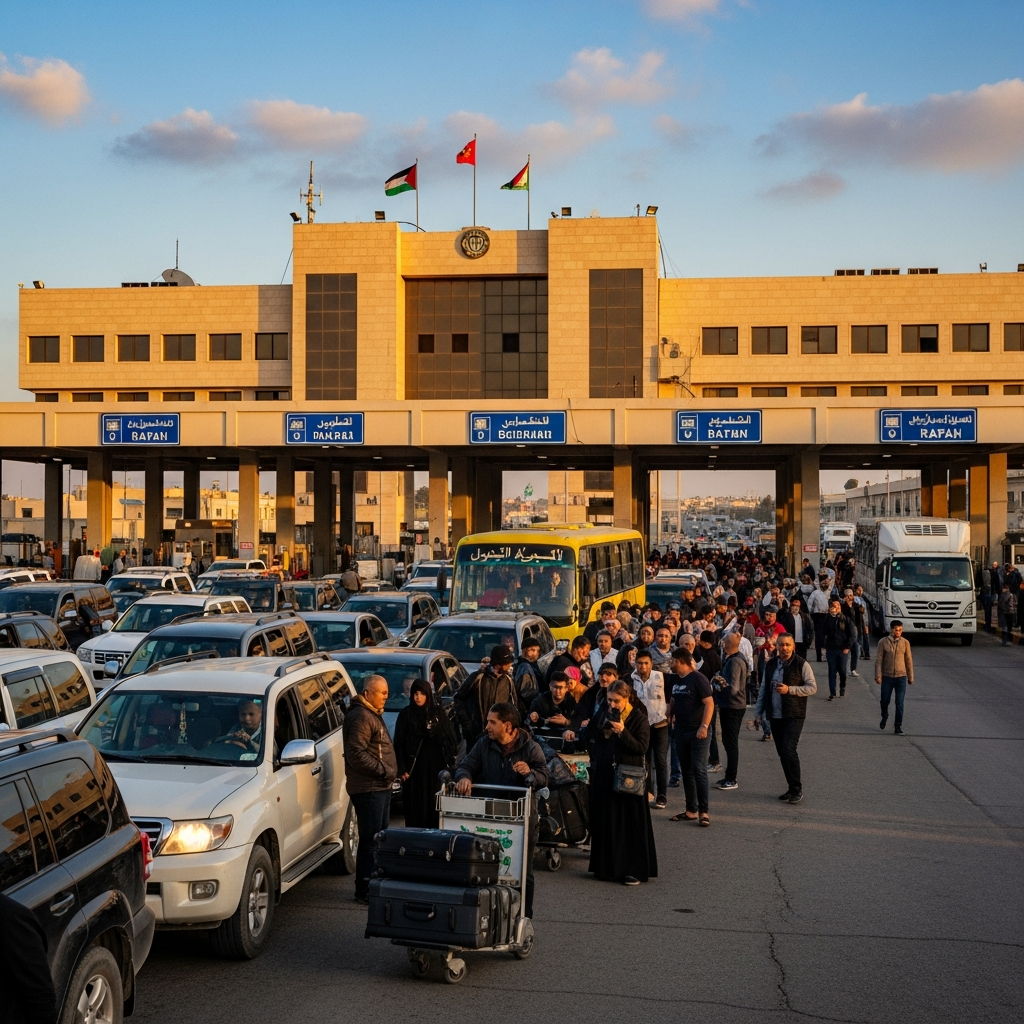
The Rafah border crossing, Gaza’s vital artery to the outside world, is buzzing with renewed activity as February 1, 2026, marks a pivotal moment in the region’s complex landscape. After years of near-complete isolation, Israel has initiated a limited reopening, signaling a cautious yet significant step in the U.S.-brokered Israel-Hamas ceasefire agreement. This development reignites hope for thousands in the war-devastated Gaza Strip, desperate for medical care or a return home, while simultaneously highlighting the immense challenges that lie ahead in establishing lasting peace and stability.
A Glimmer of Movement: Rafah’s Test Reopening
On Sunday, February 1, 2026, the Rafah border crossing, which connects Gaza with Egypt, saw its first significant movements. Israeli authorities confirmed a “test” opening, with COGAT, the Israeli military agency overseeing aid to Gaza, announcing active preparations for a fuller operation. Palestinian security officers were observed moving towards the Palestinian gate to join a European Union mission, which will play a crucial supervisory role in managing entries and exits. Ambulances, a poignant symbol of urgent need, also crossed through the Egyptian gate. Reports indicate that two-way travel is set to commence on Monday, ushering in a new, albeit restricted, era for cross-border movement.
The Long Shadow of Closure: Gaza’s Isolation
For Palestinians, the Rafah crossing is far more than just a border point; it represents their primary gateway to the world beyond the confines of the Gaza Strip. Its prolonged closure since Israeli forces seized control in May 2024 has exacerbated the territory’s deep-seated isolation. Israel had previously cited efforts to combat Hamas arms smuggling as the reason for its stringent control and closure. While the crossing briefly opened for medical evacuations during an early 2025 ceasefire, a sustained reopening was consistently resisted. A critical turning point, paving the way for the current limited operations, was the recent recovery of the remains of the last hostage held in Gaza. This event reportedly cleared significant diplomatic hurdles.
A Lifeline for the Vulnerable: Addressing Humanitarian Needs
The reopening of the Rafah border crossing is a desperate necessity for Gaza’s civilian population, particularly those requiring urgent medical attention. An estimated 20,000 Palestinian children and adults are in dire need of medical care unavailable within war-torn Gaza. Additionally, thousands of Palestinians who left during the conflict are eager to return home.
Prime Minister Benjamin Netanyahu has outlined specific, albeit limited, parameters for passage. Israel will permit 50 patients per day to leave Gaza for medical treatment, each accompanied by up to two relatives. Concurrently, approximately 50 individuals who departed Gaza during the conflict will be allowed to return daily. Both Israeli and Egyptian authorities will jointly vet all individuals seeking to cross, with European Union border patrol agents providing crucial oversight. While these numbers are a fraction of the total need, they represent a significant step, with expectations for a gradual increase in traveler numbers if the system proves successful. The initial phase, however, will not permit the transport of goods.
Unpacking the Ceasefire: Phase Two’s Complexities
The current resumption of activity at the Rafah crossing is integral to the second, more intricate phase of the U.S.-brokered ceasefire agreement. This truce, which took effect on October 10, 2023, brought an end to over two years of devastating conflict between Israel and Hamas, ignited by a Hamas-led attack on southern Israel.
The initial phase of the ceasefire focused on critical immediate steps:
The exchange of all hostages held in Gaza for hundreds of Palestinians imprisoned by Israel.
A much-needed increase in humanitarian aid flowing into Gaza.
A partial withdrawal of Israeli troops from the territory.
The current second phase is considerably more ambitious and fraught with challenges. Its objectives include:
Establishing a new Palestinian administrative committee to govern Gaza.
Deploying an international security force to maintain order.
Disarming Hamas, a deeply contentious and complex undertaking.
- Initiating extensive rebuilding efforts for the devastated territory.
- www.npr.org
- www.wfmz.com
- www.devdiscourse.com
- www.etvbharat.com
- beritaja.com
The reopening of Rafah is a foundational element for the success of these broader goals, allowing for the movement of people essential to governance and reconstruction.
Geopolitical Stance and Control Dynamics
The operational control and oversight of the Rafah border crossing are subjects of intense geopolitical sensitivity. Historically, Rafah served as Gaza’s primary non-Israeli controlled access point for people, differentiating it from the four other border crossings Gaza shares exclusively with Israel. Under the current ceasefire terms, the Israeli military retains control over the area situated between the Rafah crossing and the zones predominantly inhabited by Palestinians, a critical security consideration for Israel.
Egypt, sharing a direct border with Gaza via Rafah, has consistently voiced strong concerns that Israel might utilize the crossing to forcibly displace Palestinians out of the enclave. Consequently, Cairo has repeatedly emphasized the necessity for the crossing to be open for both entry into and exit from Gaza, ensuring a two-way flow of movement. Historically, both Israeli and Egyptian authorities have been involved in vetting Palestinians seeking to cross, a practice that continues under the new arrangements.
A Shadow Over Aid: The MSF Controversy and Recent Tensions
The fragile progress at Rafah is overshadowed by ongoing humanitarian challenges and recent escalations. In a concerning development, Israel’s Diaspora Ministry announced its intention to “terminate” the operations of Doctors Without Borders (MSF) in Gaza, effective February 28, 2026. This move follows Israel’s December suspension of MSF and other aid groups for refusing to comply with new Israeli registration requirements, specifically the demand to submit lists of local employees. MSF has steadfastly maintained that such regulations could endanger their Palestinian staff and has refused to share the lists. Israel argues these rules are vital to prevent militant infiltration of aid organizations, while aid groups counter that the arbitrary nature of these bans will severely harm a civilian population already reeling from two years of Israeli bombardment and supply restrictions. MSF plays an indispensable role in Gaza, funding and staffing six hospitals, operating two field hospitals, eight primary health centers, and two of the five stabilization centers for severely malnourished children.
Furthermore, the backdrop to Rafah’s reopening includes recent violence. The day prior to the announcement, Israeli strikes reportedly resulted in the deaths of at least 30 Palestinians, including children, marking one of the highest death tolls since the October 2025 ceasefire. Israel, in turn, had accused Hamas of fresh truce violations just days before. These incidents underscore the immense fragility of the ceasefire and the peace process, with international calls for restraint and adherence to the agreement.
Frequently Asked Questions
What is the significance of the Rafah border crossing reopening?
The reopening of the Rafah border crossing is highly significant as it represents a crucial step toward easing the severe isolation of the Gaza Strip, a condition that has persisted for years. It allows for limited humanitarian movement, particularly for medical evacuations and the return of displaced Palestinians, marking progress in the U.S.-brokered Israel-Hamas ceasefire agreement. Palestinians view Rafah as their primary non-Israeli controlled gateway to the outside world, making its operation essential for any semblance of normalcy and future reconstruction.
Who is permitted to travel through the Rafah crossing currently, and under what conditions?
Initially, travel through the Rafah crossing is highly restricted. Only a limited number of people are permitted, with no goods allowed. Israeli Prime Minister Benjamin Netanyahu stated that 50 patients per day can leave Gaza for medical care, each accompanied by up to two relatives. Approximately 50 individuals who left Gaza during the war will also be allowed to return daily. All travelers will be jointly vetted by Israeli and Egyptian authorities, with supervision from European Union border patrol agents.
What are the major challenges facing the second phase of the Israel-Hamas ceasefire related to Gaza’s future?
The second phase of the ceasefire faces significant challenges, as outlined in the agreement. These include establishing a new Palestinian administrative committee to govern Gaza, deploying an international security force, disarming Hamas, and initiating extensive rebuilding efforts for the devastated territory. The process is complicated by deep-seated geopolitical tensions, the ongoing humanitarian crisis, and the recent controversy surrounding the termination of Doctors Without Borders operations, all of which pose substantial hurdles to achieving lasting stability and peace.
Towards a Fragile Future
The renewed activity at the Rafah border crossing represents a delicate balance between emerging hope and enduring challenges. While the limited movement offers a vital lifeline to thousands of Palestinians, the broader objectives of the ceasefire’s second phase—governance, disarmament, and reconstruction—remain monumental tasks. The controversies surrounding humanitarian aid and recent escalations underscore the fragility of the peace process. The world watches, hoping that this crucial opening can pave the way for genuine, lasting stability and a more humane future for the people of Gaza.