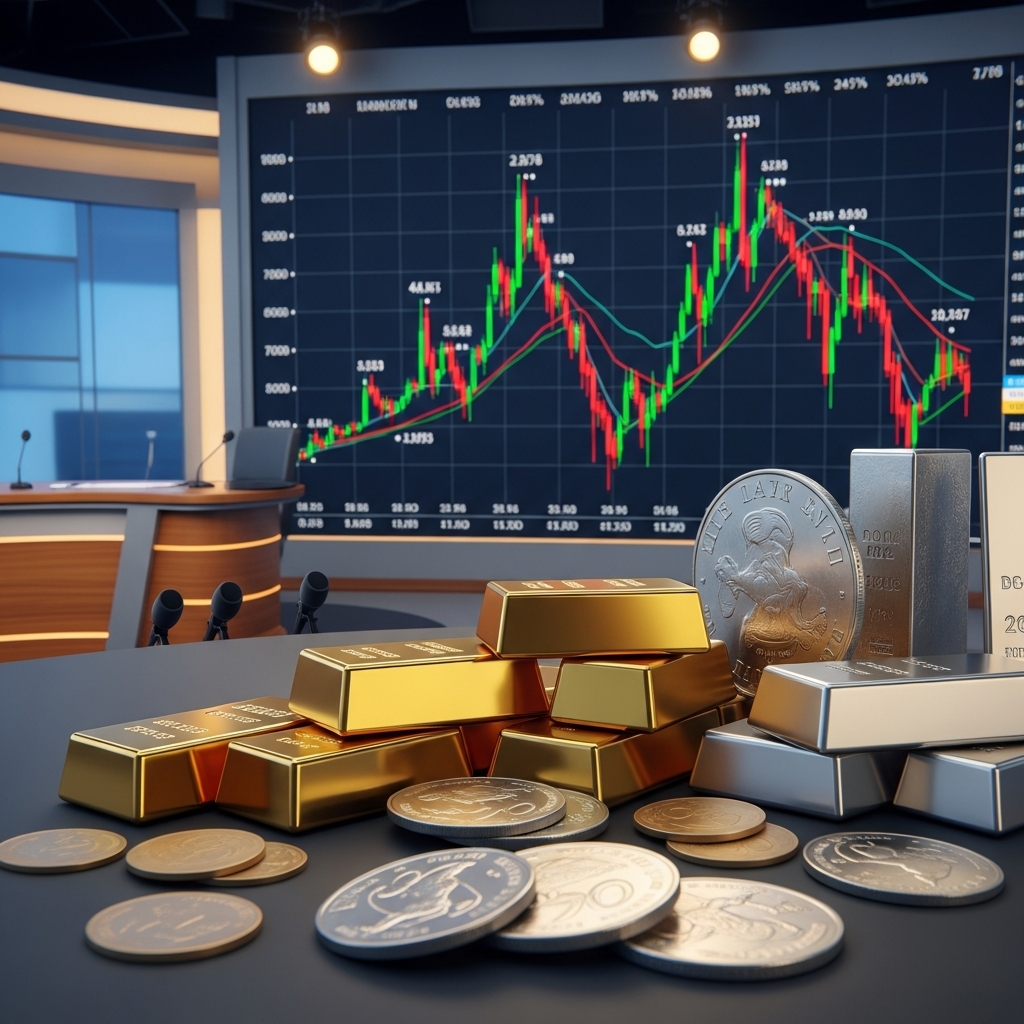
The gold and silver market has seen an exhilarating and at times bewildering ride recently, showcasing both record-setting surges and sharp, sudden corrections. From geopolitical tensions fueling safe-haven demand to shifting Federal Reserve policies impacting investor sentiment, understanding the forces at play is crucial for anyone interested in precious metals trends. This comprehensive analysis dives into the recent volatility, explores the underlying drivers, and offers a forward-looking perspective on what investors might expect from these vital commodities.
Recent Volatility: The FOMC’s Hawkish Hold and Metals’ Flash Red
The start of 2026 brought intense dynamics to the precious metals sector. After a period of record-setting runs, the market experienced a significant reversal. On January 29, 2026, gold, silver, and even copper witnessed brutal stalling in their rallies. This sudden shift followed a critical Federal Open Market Committee (FOMC) decision. The Federal Reserve indicated a stance of “higher rates for longer.” This was largely due to a robust US labor market and a resilient economy, making significant interest rate cuts difficult to justify.
The impact was swift and severe:
Gold (XAU/USD): After climbing 6% above its pre-FOMC levels, gold experienced a dramatic 10% flash crash. This erased those hard-won gains almost instantly.
Silver (XAG/USD), Palladium, and Platinum: These metals saw drops ranging between 9% and 11%.
Copper (XCU/USD): Despite spiking to a new record high of $6.52 per pound, copper lacked fundamental backing for sustained elevated prices. It subsequently declined by 9% to 11%.
This abrupt profit-taking compelled traders to reassess the market’s health and the sustainability of the overarching bullish trend. Despite the initial shock, prices showed some rebound, highlighting the market’s underlying resilience.
Unpacking Gold’s All-Time Highs and Correction
Just prior to the FOMC meeting on January 28, 2026, gold had reached a fresh all-time high near $5,312.00. This peak was part of a “parabolic rally” that saw gold appreciate over 15% in merely seven trading sessions. This robust rally largely stemmed from a “crisis of confidence” in the US dollar. The dollar had plummeted to a four-year low. Signals from the White House, favoring a weaker dollar to boost exports, further influenced this sentiment.
Silver also mirrored gold’s historic surge. It traded above $112.28 per ounce and hit an earlier weekly peak of $117.69. For silver, this rally was fueled by a “perfect storm.” This included global supply shortages, exacerbated by China’s recent export ban. Surging industrial demand from sectors like artificial intelligence (AI) and solar energy also played a major role.
The Bullish Undercurrent: Why Precious Metals Soared
Even with recent corrections, a strong bullish undercurrent has largely defined the gold and silver market. Several key factors have contributed to their ascent, positioning them as essential portfolio hedges.
Geopolitical Tensions and Safe-Haven Demand
Heightened geopolitical uncertainty consistently drives demand for precious metals. Threats from leaders like former US President Donald Trump regarding alleged drug shipments have historically boosted “safe haven” demand. The prevailing global political instability reinforces gold’s traditional role as a store of value during turbulent times. Continued central bank purchases worldwide further underscore this strategic importance. They often acquire gold to diversify reserves and hedge against currency fluctuations.
Expectations of Global Monetary Easing
Anticipation of accommodative monetary policies from central banks has been another powerful catalyst. Even as the Fed signaled “higher rates for longer,” broader expectations for eventual global monetary easing provide underlying support. Such policies typically lower the opportunity cost of holding non-yielding assets like gold. This makes them more attractive to investors.
Industrial Demand: Silver’s Unique Edge
While gold primarily serves as an investment and safe haven, silver boasts significant industrial utility. Its demand is expanding dramatically across modern industries. This includes solar panels, electric vehicles (EVs), AI infrastructure, and broader electrification themes. This robust industrial demand adds a distinct layer of support for silver prices, differentiating it from gold’s purely investment-driven surges. The China export ban on silver, as noted in January 2026, further tightened global supply. This amplified price increases due to existing demand.
The Curious Case of Silver: East vs. West Price Divergence
A striking feature of the gold and silver market in January 2026 was the significant divergence in silver prices between the United States and China. Silver was priced around $94 per ounce in the US. In contrast, it commanded roughly $104 per ounce in Shanghai (after currency conversion). This represented a nearly $10 per ounce premium in China. This isn’t just about exchange rates. It reflects fundamental differences in market structure and local supply and demand.
Understanding Market Dynamics
Western Markets (US and Europe): Prices are predominantly determined by futures contracts and financial instruments. These are traded on exchanges like COMEX and in London. The vast majority of these contracts are financially settled. Physical delivery is not common. Prices here reflect liquidity, speculative positioning, US dollar movements, and interest rate expectations.
Chinese Markets (Shanghai Gold Exchange and Shanghai Futures Exchange): Physical delivery plays a much more crucial role. Prices are closely tied to the actual demand for physical metal. This metal can be withdrawn directly from the exchange system. This leads to rapid price adjustments in response to immediate physical demand.
Why the Premium in China?
Robust physical demand within China is a key driver. Chinese industries heavily utilize silver for solar panels, electronics, and advanced manufacturing. Additionally, Chinese investors show a greater preference for holding physical bullion over paper exposure. When this combined industrial and investment demand intensifies, local supply constraints can emerge. This causes Shanghai prices for immediately available metal to rise significantly above Western futures-based benchmarks.
Differences in local inventories and complex logistics further contribute to this divergence. Moving physical silver between regions is costly and complex. This limits the effectiveness of arbitrage. The US-China price spread suggests that physical silver is scarcer and more highly valued in China. It also indicates that Western “paper” prices might not fully reflect the tightness in the physical market, signaling early supply-and-demand stress globally.
Temporary Dip or Trend Reversal? Analyzing Recent Pullbacks
Despite the broader bullish sentiment, the gold and silver market has also experienced notable dips. For example, a previous dip saw spot gold fall 2.7 percent from a preceding week. It dropped below the $4,000 mark to $3,984.43 per ounce. In India, 24-carat gold reached Rs 1,21,113 per 10 grams. Similarly, silver prices corrected sharply, with one kilogram priced at Rs 1,49,660 after hitting festive-season highs of around Rs 2 lakh.
These corrections were attributed to several factors:
Declining Safe-Haven Demand: A cooling of trade tensions between major global powers, like the United States and China, can reduce the immediate need for safe-haven assets.
Strengthening Dollar: A stronger dollar index makes dollar-denominated assets less attractive.
Rising US Bond Yields: Bond yields climbing above 4 percent can diminish investor appetite for non-yielding assets.
Fed Comments: Remarks from Fed Chair Jerome Powell, suggesting no guaranteed interest rate cuts, can dampen sentiment.
Local Factors: In India, a weak rupee can sometimes support local prices. However, in other regions, policy changes like Beijing discontinuing a tax rebate for retailers can suppress demand.
However, many experts view such dips as temporary phases within a longer-term uptrend. Gold, for instance, showed strong year-to-date performance. It remained over 50 percent higher despite the pullbacks. Underlying support continues from consistent central bank purchases and lingering global economic uncertainties.
Key Technical Levels and Future Outlook
Understanding technical levels is vital for navigating the volatile gold and silver market.
Gold (XAU/USD) – International Market
Gold’s impressive yearly run is being tested. Key levels to watch:
Resistance: $5,500-$5,600, with an all-time high ($5,600) for further upside towards $5,800-$5,900. Previous peak was near $5,312.00.
Support: $5,100, a break below which could challenge all of 2026’s gains. Critical support levels include $5,066.16, $4,951.70, and $4,889.52.
The Relative Strength Index (RSI) at 77.01 in late January suggested an “overheated” market, vulnerable to profit-taking.
Silver (XAG/USD) – International Market
Silver is within a steep upward channel, currently testing its upper bound amid high volatility consolidation.
Resistance: $118-$120 (current ATH resistance), with the record at $121.67. Weekly peak was $117.69.
Support: $100-$104, with a pivotal support at $89-$92. A break lower could test the channel’s lower bound around $92.
Copper (XCU/USD) – International Market
Copper’s recent volatility might not signal a trend reversal.
Resistance: Current ATH resistance is $6.40-$6.50, and the record at $6.52. New highs could be between $6.90-$7.00.
Support: Holding above the January 14 record range ($6.00-$6.10 Major Pivot) suggests the trend remains intact. A close below this pivot implies a test of the $5.70-$5.90 pivotal support.
Indian Market Levels
For Indian traders, specific levels are:
Gold: Support at Rs 1,37,150-1,36,310 and resistance at Rs 1,39,350-1,40,670. During a dip, support was Rs 1,20,870-1,20,480, resistance Rs 1,21,890-1,22,300.
Silver: Support in the Rs 2,42,810-2,40,170 zone with resistance at Rs 2,49,810-2,51,470. During a dip, support was Rs 1,47,450-1,46,750, resistance Rs 1,49,340-1,50,280.
Looking Ahead
Investors are keenly awaiting crucial U.S. employment data, which will provide clues regarding the Federal Reserve’s future policy direction. The potential for a “hawkish hold” from the Fed, or conversely, dovish signals, remains a significant market mover. Furthermore, the perceived independence of the Fed, with ongoing investigations and rumors of a new Chair nominee, could also influence market sentiment and further fuel gold’s safe-haven appeal. Historically, January has been a strong month for precious metals, making the continuation of rallies into “colder February” a key indicator.
Frequently Asked Questions
What factors are driving current gold and silver price volatility?
Current gold and silver price volatility is driven by a complex interplay of factors. Geopolitical tensions, such as global conflicts and political uncertainty, significantly boost safe-haven demand. Simultaneously, expectations of global monetary easing policies from central banks can make non-yielding assets more attractive. The weakening or strengthening of the US dollar also plays a crucial role, as a weaker dollar typically supports bullion prices. For silver, robust industrial demand from sectors like solar energy, electric vehicles, and AI infrastructure provides additional structural support, making its price movements sensitive to economic growth indicators.
How do market structures in the US and China affect silver prices differently?
Silver prices diverge significantly between the US and China due to fundamental differences in market structure. In Western markets (US and Europe), prices are primarily determined by financially settled futures contracts on exchanges like COMEX. These reflect speculative positioning, liquidity, and interest rate expectations rather than immediate physical demand. In contrast, Chinese markets (Shanghai Gold Exchange) are physically driven. Prices are closely tied to the actual demand for physical metal that can be withdrawn from the exchange system. This leads to a premium for physical silver in China, driven by robust industrial and investor demand for tangible bullion, coupled with lower local stocks and logistical challenges for arbitrage.
Should investors expect a sustained rally in precious metals despite recent dips?
While the gold and silver market has experienced notable dips and corrections, many experts view these as temporary within a broader bullish trend. Underlying support for precious metals comes from consistent central bank purchases and lingering global economic uncertainties. Geopolitical tensions and the structural demand for silver in new technologies continue to provide strong fundamental backing. However, investors should remain cautious. Factors like a hawkish stance from the Federal Reserve, a strengthening US dollar, and rising bond yields can trigger pullbacks. Monitoring upcoming US employment data and Fed guidance will be critical for assessing the short-to-medium-term trajectory, but the long-term outlook appears supported by these persistent drivers.
In conclusion, the gold and silver market remains a dynamic and crucial segment for investors. Its recent trajectory, marked by both soaring highs and sharp corrections, underscores its sensitivity to global economic shifts, monetary policy, and geopolitical events. While volatility is a constant companion, the enduring roles of gold as a hedge against uncertainty and silver as an industrial powerhouse suggest continued relevance. Careful monitoring of market indicators and technical levels will be key for navigating these fascinating and often unpredictable commodities.