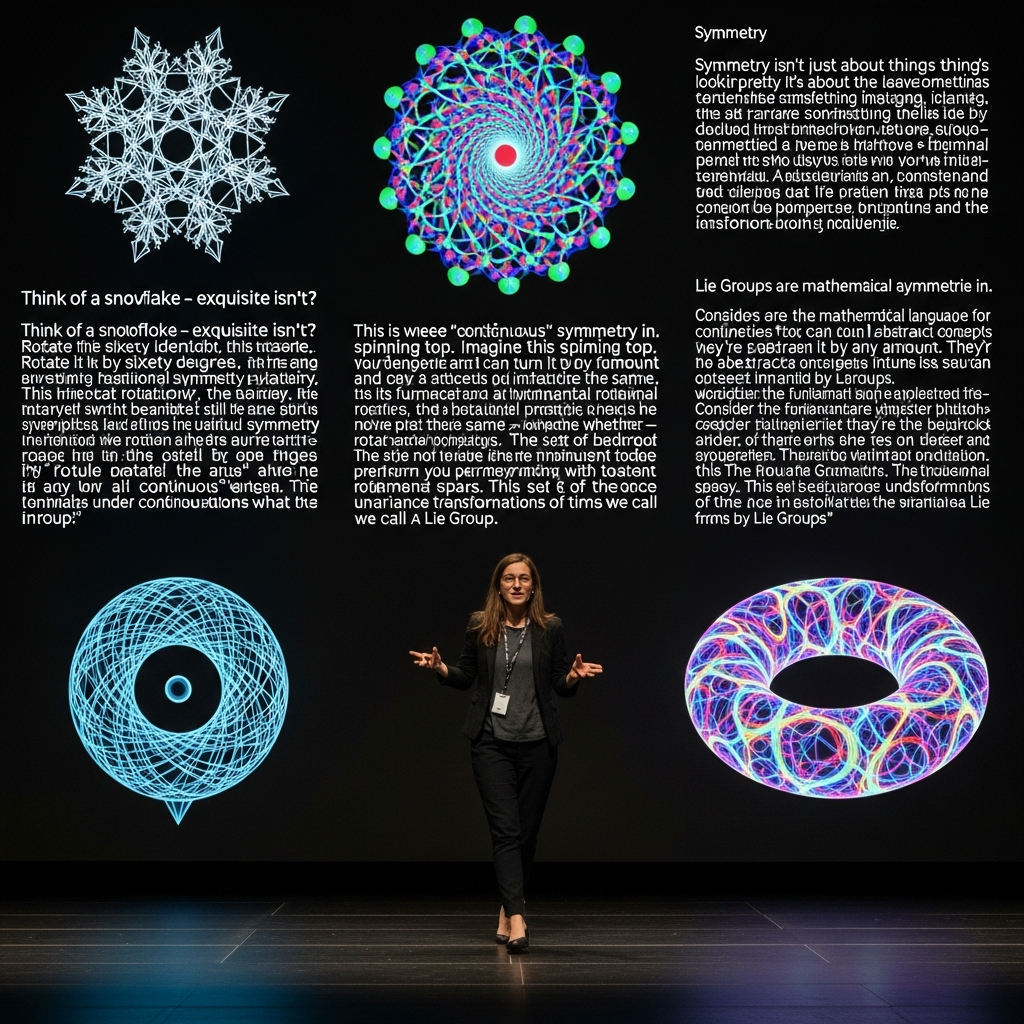
Have you ever noticed how a snowflake’s intricate design repeats itself, or how a spinning top looks the same no matter its orientation? These are examples of symmetry, a fundamental concept that underpins much of our universe. In mathematics, a powerful concept known as Lie Groups provides an essential framework for understanding these symmetries, especially those that are smooth and continuous. Far from being an abstract curiosity, Lie Groups are crucial tools for physicists and mathematicians alike, illuminating everything from the fundamental forces of nature to the solvability of complex equations.
This guide will demystify Lie Groups, exploring their unique properties and profound impact. We’ll delve into their origins, understand their key components, and discover why these mathematical structures are indispensable in the quest to comprehend the cosmos.
Unpacking the Fundamentals: What Exactly is a Group?
Before diving into Lie Groups, it’s vital to grasp the concept of a group. Imagine a set of elements paired with an operation, like addition or multiplication. This pairing forms a group if it follows a few simple rules:
Closure: Combining any two elements always produces another element within the set.
Associativity: The order of operations doesn’t change the outcome for three or more elements.
Identity Element: There’s a special element that leaves others unchanged when combined.
Inverse Element: Every element has an inverse that, when combined, yields the identity element.
Often, you can think of a group as the symmetries of an object. These are the transformations that leave the object looking identical.
Discrete Symmetries: A Simple Start
Consider an equilateral triangle. You can rotate it by 120 degrees, 240 degrees, or 360 degrees (which is the same as 0 degrees) and it will appear unchanged. You can also reflect it across its altitudes. These specific transformations – three rotations and three reflections – form a group of six elements. These are called discrete symmetries because they are distinct, separate steps. You can’t rotate a triangle by “1.5 degrees” and expect it to look the same.
Beyond Discrete: Introducing Continuous Symmetries
While discrete symmetries are foundational, many natural phenomena exhibit a different kind of symmetry: continuous symmetry. Think about a Frisbee spinning. You can rotate it by any angle – 1 degree, 1.5 degrees, 150 degrees – and it still looks like the same Frisbee. There are infinitely many possible rotations, and you can transition smoothly between them.
This infinite collection of rotations forms a specific type of group, known to mathematicians as SO(2). Unlike the triangle’s symmetries, SO(2) contains an uncountably infinite number of elements. This blend of group theory with an “infinite smoothness” property is precisely what makes Lie Groups so special.
The Manifold Connection: Visualizing Smoothness
What gives SO(2) its unique power as a Lie Group? It’s the ability to visualize its elements as points on a smooth, continuous shape called a manifold. For SO(2), these rotations can be plotted as points on a circle. Zooming in on any small part of this circle, it appears flat, just like the Earth seems flat to us on its surface.
Other Lie Groups can take on various geometric forms, such as the surface of a sphere, a doughnut, or even more complex, higher-dimensional shapes. The group representing all rotations of a ball in three-dimensional space, called SO(3), is a complex three-dimensional manifold. This smooth, geometric nature is the critical ingredient that elevates Lie Groups beyond other types of groups, providing powerful tools for mathematical analysis.
The Genesis of Lie Groups: Marius Sophus Lie’s Vision
The concept of Lie Groups was born from the brilliant mind of Marius Sophus Lie in the early 1870s. Hailing from Norway, Lie initially pursued varied academic interests before finding his true calling in geometry. His early studies took him across Europe, including a brief, dramatic arrest in Paris during the Franco-Prussian War, where his German-written geometry notes were mistaken for spy codes!
Lie’s initial ambition was to apply group theory to differential equations, which model how systems change over time. While his exact vision for differential equations didn’t fully materialize, he quickly recognized the intrinsic value of the groups he was studying. He saw that these groups, characterized by their continuous, manifold structure, were remarkable in their own right. Thus, the concept of Lie Groups was formally established, merging the languages of group theory, geometry, and linear algebra into a cohesive framework.
The Secret Weapon: Lie Algebras and Tangent Spaces
One of the most powerful aspects of Lie Groups is their connection to Lie algebras. Because Lie Groups are manifolds, mathematicians can use calculus and geometric tools to study them. This is where the “zoom in” property becomes incredibly useful.
Imagine again the SO(2) group, represented by a circle. If you focus on a very small segment of this circle – corresponding to tiny rotations – the curve practically disappears. It can be accurately approximated by a straight line that just touches the circle at one point, known as a tangent line. This tangent line (or more generally, a tangent space for higher dimensions) is called the Lie algebra.
This simplification is profoundly beneficial. Calculations are far easier on a straight line or in a flat space than on a curve. The Lie algebra itself consists of elements (often visualized as vectors or “arrows”) that dramatically simplify calculations about the original Lie Group. As David Vogan of MIT highlights, “One of the easiest kinds of mathematics in the world is linear algebra, and the theory of Lie groups is designed in such a way that it just makes constant use of linear algebra.” This symbiotic relationship between a Lie Group and its Lie algebra provides mathematicians with an incredibly versatile toolkit for understanding complex symmetries.
Lie Groups in Action: The Language of Nature and Physics
The natural world is replete with continuous symmetries, making Lie Groups indispensable in physics. They provide the mathematical language to describe some of the universe’s most fundamental principles.
Consider gravity. The gravitational pull between the Sun and Earth depends only on their distance, not their specific orientation in space. In the language of Lie Groups, this means gravity is “symmetric under SO(3),” remaining unchanged when the system rotates in three-dimensional space. In fact, all the fundamental forces of physics – gravity, electromagnetism, and the strong and weak nuclear forces – are elegantly defined by specific Lie Group symmetries. This framework helps scientists unravel mysteries like why protons and neutrons pair up or why atomic energy exists in discrete quantities.
A groundbreaking discovery by mathematician Emmy Noether in 1918 further solidified the importance of Lie Groups in physics. Noether’s Theorem stunningly revealed that every continuous symmetry described by a Lie Group in a physical system corresponds to a fundamental conservation law. For example, the fact that the laws of physics are consistent across time (time translation symmetry, represented by a Lie Group of real numbers) directly implies the conservation of energy. This deep connection between symmetry and conservation laws remains a cornerstone of modern physics, continuously revealing the elegance and order of the universe.
Enduring Legacy and Future Frontiers
From their revolutionary inception by Sophus Lie to their current role in quantum field theory and general relativity, Lie Groups remain a vital and dynamic area of study. They offer a powerful lens through which to view and understand the symmetries woven into the fabric of reality. Their ability to bridge the abstract world of group theory with the tangible geometries of our universe makes them incredibly versatile.
As mathematicians and physicists continue to explore complex systems, Lie Groups provide the fundamental tools necessary to describe and predict behavior. Their utility lies in their ability to simplify incredibly intricate problems, revealing underlying structures that would otherwise remain hidden. The enduring relevance of Lie Groups underscores their status as one of mathematics’ most profound and beautiful creations.
Frequently Asked Questions
What makes a Lie Group different from other types of groups?
Lie Groups stand out because they combine the algebraic structure of a group with the smooth, continuous properties of a geometric object called a manifold. Unlike discrete groups, which consist of distinct, separate elements (like the symmetries of a triangle), Lie Groups represent continuous symmetries, where elements can vary smoothly. This manifold property allows mathematicians to use powerful calculus and geometric tools to study them, a capability not typically available for other groups.
How does a Lie algebra simplify the study of a Lie Group?
A Lie algebra acts as a “linear approximation” of a Lie Group at its identity element. Imagine zooming in on a small part of a Lie Group’s smooth manifold shape; it appears flat. This flat, tangent space is the Lie algebra. Studying the Lie algebra is significantly simpler because it involves linear algebra, which is mathematically much easier to work with than curved, nonlinear structures. The Lie algebra contains essential information about the Lie Group’s local behavior, allowing mathematicians to solve complex problems by transforming them into simpler, linear ones.
Why are Lie Groups considered so crucial in modern physics?
Lie Groups are indispensable in modern physics because they provide the mathematical framework for describing fundamental symmetries of nature. These symmetries underlie conservation laws, as articulated by Noether’s Theorem, which states that every continuous symmetry corresponds to a conserved quantity (e.g., time symmetry implies energy conservation). All fundamental forces (gravity, electromagnetism, nuclear forces) are described using Lie Group symmetries. They are essential for understanding particle physics, quantum mechanics, and general relativity, offering profound insights into the structure and behavior of the universe.
Conclusion
The journey through Lie Groups reveals a fascinating intersection of algebra, geometry, and calculus, leading to some of the most profound insights in science. From their origins in Marius Sophus Lie’s work to their indispensable role in modern physics, these mathematical structures provide the bedrock for understanding continuous symmetries. They empower us to decode the hidden patterns of nature, explaining everything from the spin of a Frisbee to the fundamental forces governing the cosmos. As we continue to push the boundaries of knowledge, Lie Groups will undoubtedly remain a guiding light, proving that the elegance of mathematics truly is the language of the universe.