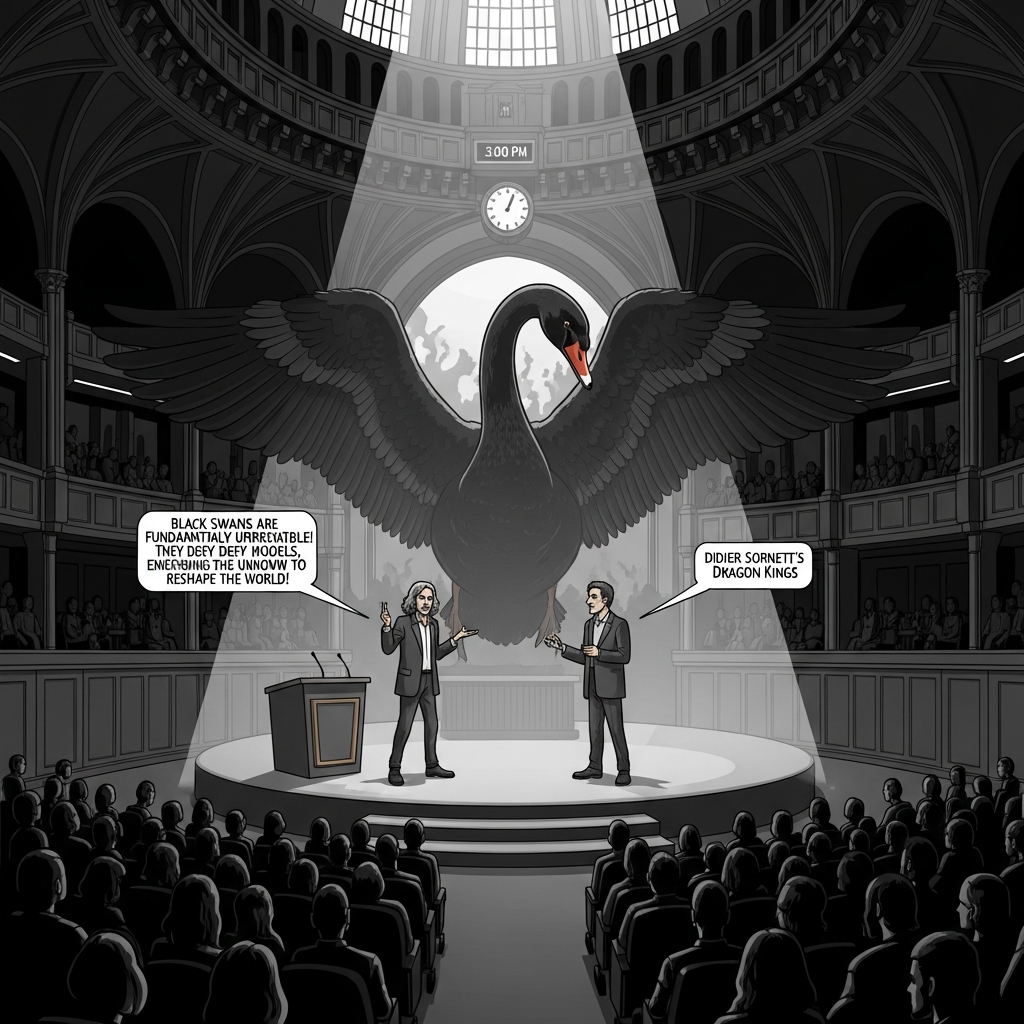
In the high-stakes world of finance and risk management, understanding extreme events is paramount. Nassim Nicholas Taleb and Didier Sornette stand as intellectual titans, each offering a distinct framework for comprehending these market-shaping phenomena. While Taleb popularized the concept of “Black Swans”—unpredictable, high-impact outliers—Sornette introduced “Dragon Kings,” extreme events he argues possess detectable precursors. This article delves into their contrasting philosophies, explores their impact on investing, and synthesizes their profound contributions to deciphering an inherently uncertain financial landscape.
Deconstructing Extreme Risk: Black Swans vs. Dragon Kings
The financial world often grapples with events that defy conventional models. Traditional finance, rooted in the idea of normal distributions, frequently underestimates the probability and impact of rare occurrences. This analytical gap is precisely where the work of Nassim Taleb and Didier Sornette converges, albeit with different conclusions on predictability. Their insights are crucial for investors, policymakers, and anyone seeking to navigate complex systems.
Nassim Taleb’s Unpredictable Black Swans
Nassim Taleb, a former options trader, essayist, and scholar, fundamentally challenged conventional risk assessment with his Black Swan theory. Introduced in his seminal 2007 book, The Black Swan: The Impact of the Highly Improbable, this concept describes events with three key attributes:
- Rarity: They are statistical outliers, outside the realm of regular expectations.
- Extreme Impact: They carry an enormous, game-changing effect.
- Retrospective Predictability: Despite their unpredictability before they occur, humans tend to concoct explanations for them after the fact, making them seem explainable and predictable in hindsight.
Taleb argues that most of the consequential events in history, from technological breakthroughs to financial crashes like the 2008 Global Financial Crisis, are Black Swans. He contends that our reliance on flawed statistical models, which assume bell-curve distributions for random variables, blinds us to the true nature of risk in “Extremistan”—environments dominated by large, rare events.
Challenging Conventional Wisdom: Taleb’s Critique of Modern Portfolio Theory
Taleb is a vocal critic of Modern Portfolio Theory (MPT) and similar frameworks that assume risks can be accurately measured and diversified away. He highlights MPT’s failure to account for systemic, interconnected risks that manifest during Black Swan events, rendering traditional diversification ineffective precisely when it’s needed most. Instead, Taleb advocates for an “antifragile” approach, wherein systems not only withstand shocks but actually benefit and grow from them. This philosophy underpins the strategies of “Chaos Kings”—investors who thrive amidst market turbulence.
Universa Investments: Profiting from the Improbable
Taleb’s insights found practical application through Universa Investments, a hedge fund co-founded with his partner, Mark Spitznagel. Universa specializes in what Spitznagel calls “explosive downside protection.” Their strategy involves purchasing cheap, out-of-the-money put options that typically expire worthless, acting as an insurance premium against market downturns. While these small, incremental losses accumulate during bull markets, the payoff during a severe market crash can be astronomical.
For example, during the initial phases of the COVID-19 pandemic in 2020, Universa reportedly generated a staggering $3 billion profit from a relatively small options bet, demonstrating the power of their Black Swan hedging strategy. This approach allows other investors to remain fully invested in growth assets, knowing a portion of their portfolio is shielded against catastrophic declines, thus potentially improving long-term compound returns.
Didier Sornette’s Foreseeable Dragon Kings
In contrast to Taleb’s emphasis on unpredictability, Didier Sornette, a Professor of Entrepreneurial Risks at ETH Zurich, proposes the concept of Dragon Kings. Introduced in 2009, Dragon Kings are extreme events that, unlike Black Swans, do not follow typical statistical power-law distributions. Instead, they occur more frequently than such models would predict, suggesting they arise from specific, identifiable mechanisms that may allow for their early detection and even suppression.
Sornette argues that these events, whether they be ruptures in materials, certain epileptic seizures, or financial market crashes, often exhibit distinct precursory signs. He identifies financial bubbles as prime examples of systems prone to Dragon Kings.
The Dynamics of a Bubble: Super-Exponential Growth
Sornette’s research posits that speculative bubbles form through a two-stage process. Initially, new information or perceived opportunities drive demand. This is then amplified by positive feedback loops or “herding behavior,” where rising asset prices themselves attract more investors, creating a “super-exponential” acceleration in prices. This means that the rate of growth itself starts to grow, pushing the system towards an unstable tipping point.
His models, often based on power law distributions rather than the normal distributions favored by conventional finance, actively look for these “out-of-control” growth patterns. Sornette’s Financial Crisis Observatory tracks various markets, issuing forecasts based on his predictive methodology. To counter concerns about self-fulfilling prophecies, his team often releases encrypted predictions, decodable only after the forecast period concludes.
Experimental Validation and Suppression
A significant breakthrough for Sornette’s theory came from a controlled laboratory experiment. Researchers demonstrated that in a simple system of oscillating circuits, extreme desynchronization events—which were identified as Dragon Kings—were consistently preceded by reliable warning signs. Crucially, by applying a small electrical “nudge” upon detecting these signs, the researchers were able to prevent the catastrophic desynchronization. Sornette eloquently described this as “killing the dragon-king in the egg.”
While the leap from simple lab systems to complex financial markets remains a challenge, this experiment provided the first physical demonstration that Dragon Kings could be both forecasted and suppressed, opening a new frontier in proactive risk management.
Beyond the “Vs.”: Complementary Perspectives on Extreme Events
Despite their differing conclusions on predictability, the relationship between Taleb and Sornette is more nuanced than a simple “vs.” Taleb himself includes Sornette’s book, Why Stock Markets Crash: Critical Events in Complex Financial Systems, on his list of recommended readings for investors. This suggests that even Taleb, a proponent of fundamental unpredictability for Black Swans, sees value in Sornette’s deep exploration of complex financial systems.
Perhaps the most valuable insight is that these two frameworks are not mutually exclusive but rather describe different types of extreme events. Some events may indeed be pure Black Swans—fundamentally unpredictable and requiring robust, antifragile preparation. Others, the Dragon Kings, might possess detectable early warning signals, offering a slim window for intervention or mitigation.
The challenge for investors and policymakers lies in discerning which type of event they are facing. Both Taleb and Sornette, as prominent “Chaos Kings,” push us to move beyond simplistic models and acknowledge the inherent complexities and non-linearities of financial markets. Their work together forms a powerful intellectual toolkit for understanding the full spectrum of extreme risk.
Practical Implications for Investors and Policymakers
The combined wisdom of Taleb and Sornette offers crucial takeaways:
Embrace Uncertainty: Taleb reminds us that true unpredictability is a constant. Building antifragility into portfolios and systems, rather than attempting to predict every outcome, is key. This means structuring investments to absorb and even benefit from shocks, often through robust hedging strategies.
Monitor for Precursors: Sornette’s work suggests that for a subset of extreme events, signals do exist. Developing sophisticated monitoring tools, like those at the Financial Crisis Observatory, could potentially offer early warnings for specific types of market bubbles or systemic risks.
Rethink Risk Management: Traditional diversification may fall short during extreme events. Investors should explore strategies like those employed by Universa, which provide explicit downside protection for Black Swan events, allowing for greater risk-taking in other areas. Policymakers, too, could explore interventions based on Dragon King models to “steer our planet better” in the face of burgeoning crises.
Interdisciplinary Approach: Both thinkers draw heavily from mathematics, physics, and behavioral economics, underscoring that understanding financial markets requires a broad, scientific perspective beyond conventional economic theories.
The contributions of Nassim Taleb and Didier Sornette highlight that successful financial navigation in the 21st century demands a sophisticated, multi-faceted approach to risk. By understanding both the “unknowable unknowns” and the “knowable unknowns,” we can better prepare for—and perhaps even prevent—the next major crisis.
Frequently Asked Questions
What is the core difference between Nassim Taleb’s Black Swans and Didier Sornette’s Dragon Kings?
The primary distinction lies in their predictability. Nassim Taleb’s Black Swans are fundamentally unpredictable, rare, high-impact events that are only rationalized in hindsight. They defy conventional statistical modeling. In contrast, Didier Sornette’s Dragon Kings are also extreme events, but they are theorized to possess identifiable precursors or “warning signs.” Sornette argues that these events deviate from typical power-law distributions, occurring more frequently than expected, and arise from specific underlying mechanisms that make them potentially predictable and even suppressible, as demonstrated in some experimental settings.
How do these theories influence practical investment strategies or risk management?
Taleb’s Black Swan theory inspires strategies focused on antifragility and robust hedging. Investment vehicles like Universa, co-founded by Taleb’s partner Mark Spitznagel, use out-of-the-money options to provide “explosive downside protection” against market crashes, allowing investors to take more systemic risk in their core portfolios. Sornette’s Dragon King theory, on the other hand, suggests the possibility of proactive intervention. His models, often used by the Financial Crisis Observatory, aim to forecast financial bubbles and their subsequent crashes, which could inform regulatory decisions or trading strategies to mitigate or profit from specific, identifiable risks.
Can Dragon Kings truly be predicted and prevented in complex financial markets?
While Sornette’s research, including successful lab experiments, demonstrates the predictability and suppressibility of Dragon Kings in simple systems, their direct applicability to complex, high-dimensional financial markets remains a subject of debate. Sornette has made notable forecasts, such as for the Shanghai Stock Exchange and specific market crashes, and his methodology for identifying “super-exponential growth” in asset prices offers a unique diagnostic tool. However, the sheer complexity, interconnectedness, and human behavioral aspects of global financial systems make definitive prediction and prevention a formidable challenge. The research offers a promising framework, but its real-world implementation faces significant hurdles and skepticism from some experts.
Conclusion
Nassim Taleb and Didier Sornette, each a formidable intellect, offer indispensable perspectives on the nature of extreme events in financial markets and beyond. Taleb forces us to confront the limitations of our predictive models and embrace the inherent unpredictability of certain catastrophic events, advocating for robust, antifragile strategies. Sornette, conversely, provides a compelling argument for the existence of foreseeable extreme events, “Dragon Kings,” which might be identifiable and even manageable. Together, their work forms a crucial dialogue in the study of risk, urging investors and policymakers to look beyond traditional frameworks and adopt a more sophisticated, interdisciplinary approach to navigate an increasingly volatile world. Understanding both Black Swans and Dragon Kings is not merely an academic exercise; it’s an essential toolkit for anyone seeking to thrive amidst chaos.