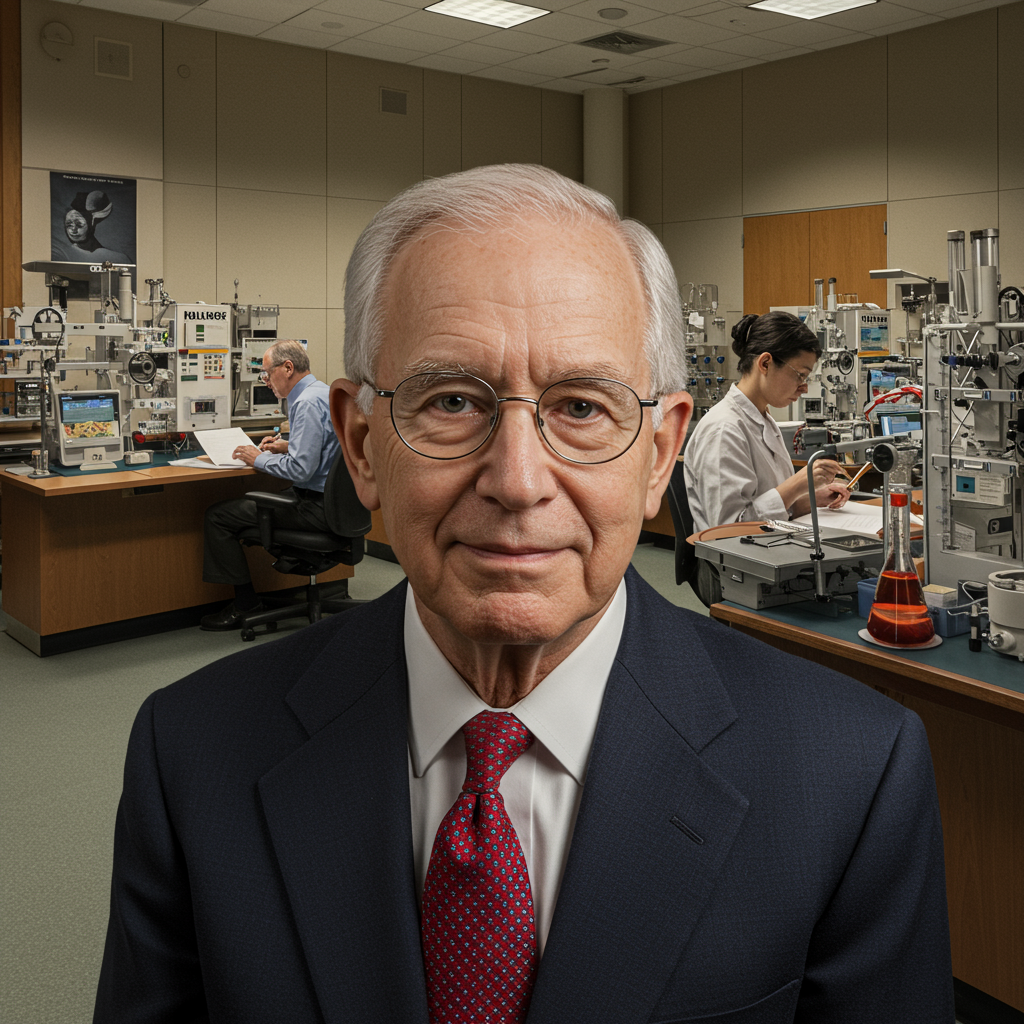
The scientific community deeply mourns the passing of Dr. David Baltimore, a Nobel Laureate and Caltech President Emeritus, who departed on September 6, 2025, at the age of 87. An unparalleled visionary, Dr. Baltimore’s life was a testament to groundbreaking research, transformative leadership, and unwavering advocacy for science in public policy. His monumental work fundamentally reshaped our understanding of biology and medicine, leaving an indelible mark on generations of scientists and the institutions he served with distinction. This article explores his extraordinary journey, celebrating the immense impact of a mind dedicated to unraveling life’s most complex mysteries and improving the human condition.
A Revolutionary Discovery: Unlocking Genetic Secrets
Dr. David Baltimore earned global recognition as a co-recipient of the 1975 Nobel Prize in Physiology or Medicine. This prestigious award celebrated his pivotal discovery of reverse transcriptase, an enzyme that defied prevailing scientific dogma. Prior to his work, the flow of genetic information was largely understood to move in one direction: from DNA to RNA to protein. Baltimore, however, revealed that certain RNA viruses, known as retroviruses, could synthesize DNA from their RNA genomes.
His elegantly simple experiment in 1970 revolutionized molecular biology. It proved the existence of reverse transcriptase, an enzyme that literally “reversed” the established direction of genetic information flow. Caltech colleague Carlos Lois lauded this breakthrough as an “exemplar of elegance and simplicity,” noting Baltimore achieved it even in his first foray into retrovirology. This discovery was not merely academic; it quickly became a cornerstone of modern biotechnology. When the AIDS pandemic emerged in the early 1980s, the understanding of reverse transcriptase enabled scientists to swiftly identify HIV as a retrovirus, drastically accelerating research into the disease. Furthermore, the ability to create DNA from RNA, facilitated by reverse transcriptase, became a critical tool for cloning and manipulating genes, directly fueling the biotechnology revolution.
Beyond Reverse Transcriptase: Diverse Scientific Contributions
Baltimore’s intellectual agility allowed him to explore a vast landscape of biological inquiry. Following his Nobel-winning work, he delved into immunology, a field where his laboratory continued to make significant strides. His team identified NFkappaB, a crucial regulator of inflammatory processes. The dysregulation of NFkappaB is now recognized as a factor in numerous autoimmune diseases and various forms of cancer, underscoring the foundational importance of his findings.
His students, under his guidance, also elucidated the genes responsible for antibody diversity. This work provided a molecular-level understanding of how the mammalian immune system can generate billions of unique antibodies, forming the basis of our adaptive immunity. Even after stepping down from his presidency at Caltech in 2006, Baltimore remained an active researcher. He pioneered new methodologies for fighting cancer, developed an effective gene therapy aimed at preventing HIV infection, and refined techniques for producing transgenic mice. His unwavering commitment to global health challenges was evident in his pursuit of an HIV vaccine, securing a substantial $13.9 million grant from the Bill & Melinda Gates Foundation in 2005 to “engineer immunity” against HIV and other chronic pathogens.
A Stewardship of Excellence: Leading Academic Institutions
Beyond the laboratory, David Baltimore demonstrated exceptional leadership within higher education. His distinguished career included pivotal roles at some of the world’s foremost scientific institutions. He was a founding director of the Whitehead Institute at MIT from 1982 to 1990, served as president of Rockefeller University from 1990 to 1991, and most notably, led Caltech as its seventh president from 1997 to 2006.
During his tenure at Caltech, Baltimore’s ambitious vision propelled the institute to new heights. He successfully oversaw two high-impact fundraising campaigns, including a significant initiative for the biological sciences and a $1.4 billion capital campaign. These efforts culminated in the construction and dedication of the Broad Center for the Biological Sciences, a testament to his dedication to advancing research infrastructure. His presidency also coincided with remarkably successful space and planetary missions managed by the Jet Propulsion Laboratory (JPL) for NASA, including the iconic Mars Exploration Rovers. Caltech Board of Trustees chair David W. Thompson lauded Baltimore’s ability to elevate the Institute’s global stature, noting his knack for engaging diverse audiences and his profound influence on campus development.
Fostering Inclusivity and Undergraduate Life
Dr. Baltimore was also a fervent advocate for diversity and an enhanced undergraduate experience. As Caltech president, he actively worked to increase representation, particularly by bringing more women into administrative roles. With a keen interest in improving student quality of life, he appointed Caltech’s first full-time vice president for student affairs and established a $3 million fund dedicated to supporting student activities and services. Reflecting on his leadership, he once wrote, “Its dedication to excellence has been undiminished, requiring that it continually be in flux, reaching for the altering frontiers of knowledge.” These words encapsulate his philosophy of continuous evolution and pursuit of intellectual frontiers.
Championing Ethical Science and Public Policy
David Baltimore’s influence extended far beyond the confines of research institutions, making him a prominent figure in science policy and ethical debates. In the 1970s, he played an instrumental role in shaping national science policy regarding recombinant DNA research. He notably co-organized the seminal Asilomar Conference on Recombinant DNA in 1975, which laid down foundational ethical guidelines for this emerging technology.
He was an early and passionate advocate for federal AIDS research, co-chairing a National Academy of Sciences committee on a National Strategy for AIDS in 1986. His expertise led to his appointment in 1996 to head the NIH AIDS Vaccine Research Committee, affectionately known as “the Baltimore Committee.” He also collaborated with the NIH in developing guidelines for the ambitious Human Genome Project. Following the contentious 2000 presidential election, Baltimore co-founded the Caltech/MIT Voting Technology Project, a multidisciplinary group whose recommendations significantly influenced the Help America Vote Act of 2002. More recently, he was a leading voice in global discussions surrounding genome-editing techniques. In 2015 and again in 2018, he called for and chaired international summits on a worldwide moratorium on altering inheritable human DNA, emphasizing the profound ethical considerations. Baltimore expressed profound hope that modern biology would one day ameliorate major human diseases, envisioning a world “a better place” because of scientific progress.
A Multifaceted Life: Reflections from Colleagues and Family
Colleagues and friends consistently recalled David Baltimore’s insatiable curiosity, intellectual rigor, and deep personal commitment. Elliot Meyerowitz, a Caltech professor, described him as “generous,” freely sharing his profound knowledge and vast experience across science and institutional leadership. Thomas Palfrey, a close friend and Caltech colleague, highlighted his diverse interests beyond science, including classical and jazz music, art, wine, and exceptional food, characterizing him as a person who “put his foot on the accelerator and never let up his whole life.” This multifaceted personal dimension enriched his professional endeavors and endeared him to many.
Paul Sternberg, a Bren Professor of Biology at Caltech, remembered Baltimore’s “continual willingness to share his wisdom and exquisite intellectual taste,” noting hundreds of scientists benefited from his guidance. Barbara Wold, another Caltech professor, observed his instinct to identify and nurture brilliance, often seeing in people possibilities they hadn’t recognized in themselves. Lois, who was a postdoctoral fellow in Baltimore’s lab, vividly recalled the “electrifying” atmosphere, describing lab meetings as opportunities to learn something new from leaders in diverse fields, fostering an environment of immense motivation and intellectual ambition. These reflections paint a picture of a leader who was not only brilliant but also profoundly human and inspiring.
Early Life, Education, and Esteemed Recognition
Born on March 7, 1938, in New York City, David Baltimore embarked on his academic journey at Swarthmore College, earning his BA in chemistry in 1960. He completed his PhD in biology from The Rockefeller University in 1964. His distinguished career included tenures at MIT, The Salk Institute, and The Rockefeller University before assuming the presidency at Caltech.
His extraordinary contributions garnered numerous accolades throughout his lifetime, including the National Medal of Science (1999), the National Academy of Sciences Award in Molecular Biology (1974), and the prestigious Lasker~Koshland Special Achievement Award in Medical Science (2021). He was a member of both the National Academy of Sciences and the National Academy of Medicine, a fellow of the American Academy of Arts and Sciences, and a foreign member of the Royal Society of London. From 2007 to 2008, he served as president and chair of the American Association for the Advancement of Science. His legacy is also honored through the establishment of the Gertrude Baltimore Chair in Experimental Psychology (2006) and the David Baltimore Professorship in Biology and Biological Engineering at Caltech (2017). Dr. Baltimore is survived by his wife of 56 years, Alice Huang, a senior faculty associate in biology at Caltech, and their daughter, TK Baltimore.
Frequently Asked Questions
What was David Baltimore’s most significant scientific discovery?
Dr. David Baltimore’s most renowned scientific achievement was the discovery of reverse transcriptase in 1970, for which he co-received the Nobel Prize in Physiology or Medicine in 1975. This enzyme allows certain RNA viruses, specifically retroviruses, to synthesize DNA from their RNA genetic material. This finding contradicted the then-accepted “central dogma” of molecular biology and proved fundamental to understanding viruses like HIV, rapidly advancing AIDS research and catalyzing the biotechnology revolution by providing a tool for gene manipulation.
How did David Baltimore influence science policy and ethical debates?
David Baltimore was a leading advocate for responsible scientific advancement and public policy throughout his career. He co-organized the landmark Asilomar Conference on Recombinant DNA in 1975, establishing crucial ethical guidelines for genetic engineering. He was a vocal proponent of federal AIDS research, chaired the NIH AIDS Vaccine Research Committee, and contributed to guidelines for the Human Genome Project. More recently, he led international discussions on the ethical implications of genome-editing techniques, advocating for a global moratorium on altering inheritable human DNA, emphasizing his deep commitment to the societal impact of scientific progress.
Beyond science, what was David Baltimore’s broader impact as a leader and mentor?
Dr. Baltimore’s influence extended significantly into academia and mentorship. As president of Caltech (1997-2006), Rockefeller University, and a founding director of the Whitehead Institute, he shaped institutions, advanced research infrastructure, and championed diversity. Colleagues consistently highlighted his exceptional ability to mentor and inspire, fostering brilliance in others, and sharing his profound scientific knowledge and vast experience. His diverse interests in arts, music, and public service also showcased a multifaceted intellect and a deep commitment to improving the human condition, making him a respected figure well beyond the laboratory.
A Legacy of Transformative Impact
David Baltimore’s passing marks the end of an era for science, yet his profound legacy will undoubtedly resonate for generations. His groundbreaking discovery of reverse transcriptase fundamentally altered our understanding of life’s mechanisms and ignited the biotechnology industry. As a visionary leader, he steered prestigious academic institutions towards new frontiers of research and education. And as a passionate advocate for science in society, he shaped ethical guidelines and public policy that continue to safeguard and guide scientific progress. David Baltimore’s life serves as an inspiring testament to the power of relentless curiosity, intellectual courage, and a deep-seated commitment to making the world a better place through the advancement of knowledge.