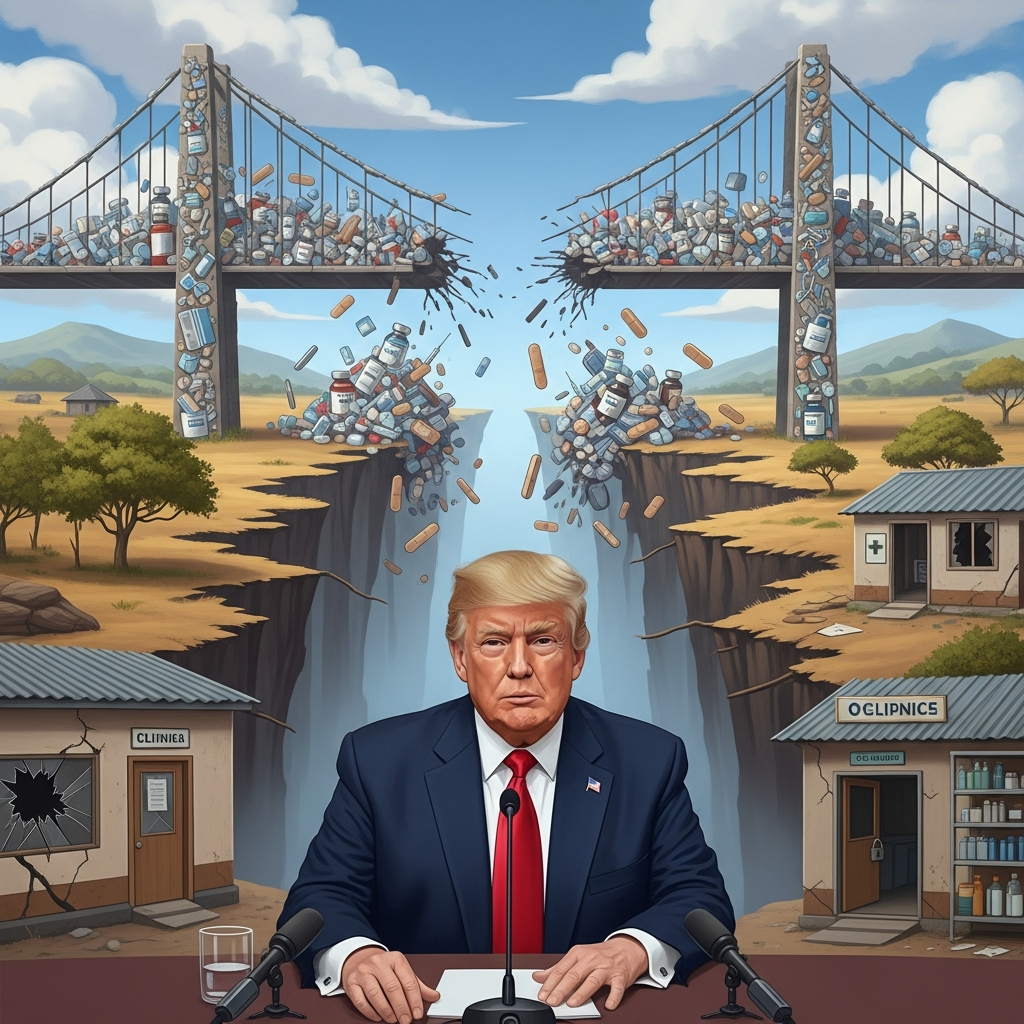
The United States’ pioneering global fight against HIV/AIDS, a bipartisan triumph credited with saving millions of lives, faces unprecedented peril. Despite robust congressional appropriations, the Trump administration is reportedly withholding crucial funds for the President’s Emergency Plan for AIDS Relief (PEPFAR), a decision with devastating consequences for frontline services across Africa and beyond. This unexpected funding freeze is forcing the closure of vital programs, jeopardizing decades of progress and sparking a significant humanitarian crisis in vulnerable communities worldwide.
For months, global health experts and aid workers have grappled with severe financial uncertainty. Funds for critical HIV/AIDS initiatives have arrived in unpredictable installments, or not at all, undermining the stability of one of the most successful international health programs in history. This erratic disbursement has created widespread distress, compelling organizations to scale back or shut down essential services and even prepare for staff layoffs, highlighting a profound disconnect between legislative intent and administrative action.
Global HIV/AIDS Funding: A Bipartisan Legacy Under Threat
Since its inception in 2003 under President George W. Bush, PEPFAR has channeled over $100 billion into building the world’s largest global health delivery system. This initiative has been instrumental in turning the tide against HIV/AIDS in many nations, particularly across Africa. Dr. Caspian Chouraya, who manages HIV/AIDS programs in twelve African nations for the Elizabeth Glaser Pediatric AIDS Foundation, witnessed the dire situation firsthand. He recalls the early 2000s in Eswatini (then Swaziland), where over a quarter of adults were infected, prompting fears of national decimation. US aid, he affirms, brought significant improvement to these dire circumstances.
Congressional support for global HIV funding has traditionally been strong and bipartisan. In 2025, lawmakers resisted President Trump’s proposed cuts to foreign aid. The following year, Congress allocated nearly $6 billion for global HIV/AIDS work, effectively maintaining PEPFAR’s funding at previous fiscal year levels and exceeding the administration’s request. Despite this clear directive and the funds being available, internal government sources and external observers indicate the State Department is deliberately retaining a portion of these allocated funds.
The Immediate Impact: Programs on the Brink
The repercussions of these funding delays are immediate and severe. Dr. Chouraya describes a chaotic environment where he must consult legal advisors about potential layoffs. Support groups for teenagers living with HIV have ceased operations, and vital communication channels like cell phone plans for clinics to contact patients have disappeared. In Cote d’Ivoire, funding intended for 53 health facilities, due in December, only arrived in March, long after teams had been forced to curtail training and other activities to preserve basic services like drug delivery. The pervasive uncertainty has even led Dr. Chouraya to prepare notices for staff contract terminations, fearing legal action if funds remain delayed.
This instability creates an environment of “extraordinary waste and abuse,” according to Emily Bass, author of To End a Plague. She argues that unstable, short-term funding is less effective than stable, predictable programs. Such a strategy not only yields lower returns on investment but also stresses the healthcare workforce, prompting skilled professionals to seek more reliable employment elsewhere. This undermines the very foundations of long-term health initiatives.
“America First” and the Shift in Global Health Strategy
These funding disruptions are linked to the Trump administration’s “America First Global Health Strategy,” an initiative designed to overhaul the decades-old system of global health aid. Following the dismantling of USAID—which once oversaw tens of billions in foreign aid—and the cancellation of numerous programs, the administration outlined a new approach in September. This strategy aims to gradually reduce US investment in global health, shifting greater financial responsibility to recipient countries.
While a transition towards national self-reliance was always a long-term goal for PEPFAR, Jennifer Kates of KFF warns that the accelerated and chaotic implementation of this new strategy carries significant risks. Under the State Department’s new directives, the US directly negotiates contracts with foreign governments, bypassing traditional aid organizations. The State Department initially set an “unrealistic” six-month deadline, until March 31, to establish these new implementation plans. During this period, “bridge funding” was promised to ensure the continuity of life-saving activities. However, the second installment of this bridge funding, due in December, was frequently late. After March 31, many organizations received notices of a three-month extension for bridge funding, but without clear dates for actual fund disbursement.
A “Controlled Demolition” of Critical Expertise
A more concerning aspect of this funding crisis is the growing belief among experts that the State Department is deliberately curtailing funding to the US Centers for Disease Control and Prevention (CDC). Historically, global HIV/AIDS funds flowed from Congress, through the State Department, and then primarily to the CDC and USAID. With USAID dismantled, the CDC has become the primary custodian of significant technical expertise, often providing the last on-the-ground experts in many countries. However, CDC-backed projects are now disproportionately affected by the funding uncertainty.
Dr. K.J. Seung, an associate physician at Brigham and Women’s Hospital, notes that much of the congressionally allocated money appears “stuck” at the State Department. An anonymous CDC official described this as an “active policy choice,” asserting that the “money exists. The State Department is simply not transferring enough of it to CDC to keep these programs running.” This official characterized the situation as a “controlled demolition” of the last intact pillar of the HIV/AIDS program, warning of potential funding depletion by June. Such an outcome would directly impact the over 12 million people living with HIV who rely on these programs for treatment. Dr. Chouraya corroborates that CDC-supported programs have experienced the most significant delays, with some, like those in Mozambique, now completely out of funds.
Geopolitical Shifts and the Aid Vacuum
The implications extend beyond public health. The US withdrawal and aid reductions create a vacuum that other global powers, notably China, are eager to fill. While China’s historical aid strategy focused on large-scale, often self-serving infrastructure projects, it is now strategically shifting towards “small and beautiful projects” aimed at winning hearts and minds, similar to the US’s past approach. This includes initiatives like building bridges, refurbishing maternal wards, and providing medical supplies. This contrasts sharply with the US’s current move towards a more bilateral, less broadly impactful aid model.
While China’s new strategy hasn’t yet achieved the aspirational influence once commanded by US aid, its biggest advantage is simply the US’s disengagement. Where the US retracts, China expands its presence, subtly enhancing its reputation and influence globally. The ripple effects of US aid cuts are already palpable, even impacting privately funded poverty alleviation programs in Uganda, as the overall slowdown in local economies due to reduced US aid limits market spending and business investment.
Legislators are now voicing serious concerns. Senator Patty Murray (D-Wash.) emphasized the administration’s “legal responsibility” to ensure uninterrupted life-saving services, urging immediate action. However, experts like Kates and Chouraya fear that reversing these entrenched policy changes will be challenging. Dr. Chouraya sadly notes a disheartening sentiment among clinicians that there is “no future in the field,” directly linking this shift to the uncertainty caused by the US’s new global health strategy.
Frequently Asked Questions
What is PEPFAR and why is its funding currently at risk?
PEPFAR (President’s Emergency Plan for AIDS Relief) is a highly successful US global health initiative launched in 2003, credited with saving over 26 million lives by providing HIV/AIDS treatment and prevention services worldwide. Its funding is currently at risk because, despite Congress appropriating nearly $6 billion for global HIV/AIDS work in 2026, the Trump administration’s State Department is reportedly withholding or significantly delaying the disbursement of these funds. This erratic funding disrupts operations and threatens the closure of vital programs, challenging Congress’s intent.
How is the Trump administration’s new global health strategy changing aid delivery?
The Trump administration’s “America First Global Health Strategy” aims to dismantle the traditional global health aid system. It seeks to reduce overall US investment, shifting financial responsibility to recipient countries. This new approach involves the State Department directly negotiating contracts with foreign governments, bypassing established aid organizations and leading to the dismantling of USAID. While intended to increase accountability, its accelerated implementation and a “controlled demolition” of funding to entities like the CDC have led to widespread instability and program shutdowns.
What are the broader geopolitical and humanitarian consequences of these US funding cuts?
The US funding cuts create a significant humanitarian crisis, jeopardizing the health and lives of millions reliant on HIV/AIDS programs. Geopolitically, the US withdrawal leaves a vacuum in global leadership and influence. Other powers, particularly China, are strategically stepping in with their own aid programs, shifting from large infrastructure projects to “hearts and minds” initiatives, gaining influence where the US recedes. This shift not only impacts global health outcomes but also has pervasive ripple effects on local economies and international relations.
Conclusion
The ongoing controversy surrounding global HIV funding reveals a critical juncture in US foreign policy and public health strategy. The deliberate withholding of congressionally appropriated funds for PEPFAR threatens to undo decades of life-saving work, destabilize frontline healthcare systems, and undermine America’s leadership in global health. As organizations struggle with an uncertain future and clinicians consider abandoning the field, the full human cost and geopolitical implications of this strategic shift are only beginning to emerge. The world watches as a beacon of international cooperation faces potential collapse, raising urgent questions about accountability and the future of global humanitarian aid.