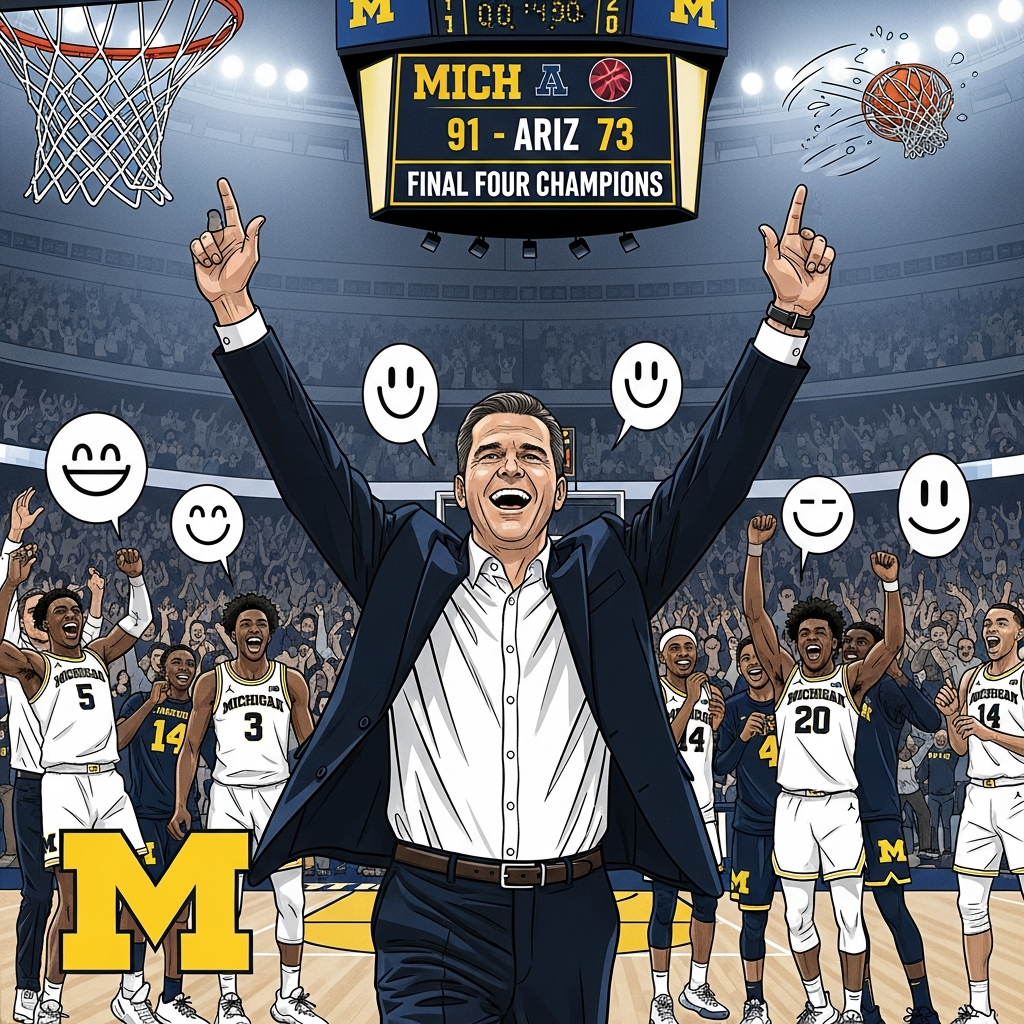
Michigan’s basketball program, under the guidance of Coach Dusty May, delivered a sensational performance in the 2026 Final Four, thoroughly dominating No. 1-seed Arizona with a resounding 91-73 victory. This decisive win, which saw the Wolverines advance to the National Championship, was a testament to May’s strategic prowess and the team’s unwavering cohesion. From unselfish play to gritty individual efforts, Michigan showcased the depth and resilience built throughout a challenging season. This article delves into the post-game insights from Coach May and key players, highlighting the tactical brilliance and personal sacrifices behind their championship pursuit.
Michigan Dominates Final Four: A Rout in Indianapolis
The Lucas Oil Stadium in Indianapolis bore witness to a Michigan Wolverines masterclass as they dismantled the Arizona Wildcats in a high-stakes Final Four showdown. What many anticipated as a tight, “de facto national championship” game quickly turned into a one-sided affair. Michigan’s offensive efficiency was staggering, sinking 12 of 27 three-point attempts (44.4%) and hitting the 90-point mark for an unprecedented fifth consecutive NCAA Tournament game. Their blistering start saw them seize a 26-10 lead, marking Arizona’s largest deficit of the season and setting the tone for a commanding 48-32 halftime advantage, fueled by 12 points off nine forced turnovers.
May’s Masterclass: Unpacking the Wolverines’ Philosophy
Following the monumental win, Coach Dusty May articulated the core tenets that propelled his team to victory. He characterized the performance as a perfect reflection of their season-long philosophy: “unselfish basketball.” May lauded his squad as a “connected group who defends, gets out in transition and then shares the basketball.” He specifically highlighted their exceptional assist-to-turnover ratio and dominant rebounding, particularly in the game’s early stages. A crucial differentiator, according to May, was Michigan’s superior hustle on 50/50 balls, consistently out-quickening Arizona. This success, he asserted, wasn’t a fluke but a product of their “incredibly aggressive schedule”—the second toughest nationally—which thoroughly “battle-tested” the Wolverines for high-pressure moments.
Heroic Performances & Unwavering Grit
The Final Four triumph wasn’t just about tactical brilliance; it was also defined by the heroic efforts of individual players who pushed through adversity.
Yaxel Lendeborg’s Gutsy Return from Injury
All-American forward Yaxel Lendeborg, the reigning Big Ten Player of the Year, epitomized Michigan’s fighting spirit. Despite suffering an MCL sprain in his left knee during the first half and battling early foul trouble, which limited him to just 14 minutes, Lendeborg made a courageous return to the court in the second half. Teammates Elliot Cadeau and Trey McKenney praised his “gutsy performance” and profound selflessness, emphasizing his determination to “give it his all” for Michigan. Coach May echoed these sentiments, noting that Yaxel is fundamentally “about winning” and that his willingness to be “one of the guys” helps everyone else embrace their roles. May even defended bringing Lendeborg back into a seemingly decided game, referencing the unpredictable nature of March and April basketball and recalling past comebacks.
Aday Mara’s Sensational Impact and Development
Center Aday Mara delivered a “sensational” and career-defining performance, tallying 26 points and nine rebounds. Coach May singled out Mara’s effectiveness at the rim, his ability to catch lobs, and his commanding presence as a “force down low.” May also highlighted Mara’s intelligence and critical rim protection, especially his stellar defense against Arizona’s Oumar Ballo. Mara, a 7-foot-3 transfer from UCLA, expressed profound gratitude for the opportunity, reflecting on two previous years where he felt unable to showcase his true abilities. May revealed that Mara’s current dominant role was envisioned during recruitment, based on his impressive play with the Spanish national team and Zaragoza, attributing his success to significant physical and mental growth.
Elliot Cadeau’s Composed Leadership & Distribution
Point guard Elliot Cadeau was the calm orchestrator amidst the Final Four storm. Despite facing an allergic reaction pre-game and admitting to missed shots and turnovers in the first half, Cadeau remained unflappable. He credited his composure to the coaching staff’s unwavering confidence, noting, “If I turn the ball over and I look over at Coach, they’re calm. So that just helps me stay calm as well.” Cadeau adapted quickly to the arena’s unique shooting environment, discussing strategies with McKenney at halftime to improve their second-half efficiency. Coach May lauded Cadeau’s consistent leadership, fearlessness, high basketball IQ, and competitiveness, describing him as an “excellent distributor” and a “pest defensively” who effectively disrupts opposing offenses.
Trey McKenney & Roddy Gayle Jr.: Supporting Cast Excellence
Freshman Trey McKenney provided crucial offensive bursts, particularly from beyond the arc in the second half. He emphasized the team’s commitment to individual workouts, which instilled the confidence needed to perform under pressure. McKenney acknowledged past “mental lapses” in big games but stated the team fully understood the “high stakes” of the Final Four, motivating them to leave “everything on the floor.” Roddy Gayle Jr., a vital returning player, was praised by Cadeau for establishing Michigan’s culture for the incoming transfers. Gayle was described as a steadying influence and a reliable teammate who consistently performed “what he does” on both ends of the floor, regardless of his scoring output.
Forging a Championship Contender: May’s Vision & Team Cohesion
Michigan’s ascent to the National Championship game is a narrative of exceptional team building and strategic execution under Dusty May.
Blending Talent: The Transfer Portal Success Story
Both Elliot Cadeau and Aday Mara spoke to the remarkable cohesion achieved within a squad largely comprised of transfers. Cadeau highlighted Coach May’s deliberate recruitment of “five people on the court at all times that are really good at passing the ball,” creating strong connectivity. Mara added that May prioritized “unselfish” players, a crucial factor in the fast-paced transfer portal era where rapid adaptation is key to playing effectively as a unit. May’s ability to seamlessly integrate diverse talents has been a cornerstone of Michigan’s success.
Physicality and Strategic Matchups Against Arizona
Michigan’s physical dominance from the outset was a deliberate strategy. Trey McKenney confirmed the team’s goal was to set an aggressive tone early. Coach May underscored that playing with “great physicality” has been a season-long hallmark, honed through rigorous strength training and the demanding Big Ten schedule. He believed Michigan’s size and strength offered a distinct advantage against Arizona, a team that “relies on scoring 15 feet and in.” May asserted that with Michigan’s array of bigs (Aday Mara, Morez Johnson, Yaxel Lendeborg) and active guards (Nimari Burnett, Roddy Gayle), it would be “tough to score enough points” inside if Michigan’s offense found its rhythm. This strategic matchup proved decisive, disrupting Arizona’s typical offensive flow.
Handling Pressure: Learning from Blowouts and High Stakes
Michigan’s experience with previous blowout victories proved invaluable. Elliot Cadeau revealed that the team had learned critical lessons from past games where opponents nearly mounted comebacks. The message in the huddle was clear: “keep our foot on the gas because it’s March, it’s April. Anything can happen.” This mindset prevented complacency, even with a substantial lead. Coach May’s decision to keep starters in late during blowouts also factored into this, reflecting a pragmatic understanding of tournament unpredictability and ensuring game management.
Arizona’s Perspective: Praising Michigan’s Dominance
The depth of Michigan’s victory was perhaps best articulated by their opponents. Arizona head coach Tommy Lloyd was exceptionally gracious in defeat, calling Michigan “outstanding” and admitting they put Arizona “on our heels” in a way “no one’s been able to do to us all year.” Lloyd acknowledged Michigan’s “impressive performance” and their “impactful” strong start, which caused his team to become “panicky.” He described Michigan as a “really well-built team” with a “great coach” that played “surgically,” making it incredibly difficult for Arizona to recover.
Arizona players echoed their coach’s sentiments. Jaden Bradley conceded Michigan was simply the “better team tonight.” Brayden Burries highlighted Michigan’s “great defensive plan” and their imposing physical size, suggesting many of Arizona’s missed shots were simply “in and out,” indicating it “just wasn’t your day.” Koa Peat specifically commended Aday Mara as a “good player” who had a “really good game.” Lloyd further elaborated on Michigan’s defensive strengths, particularly their effective “in the gaps” defense and strategic mixing of ball screens, which Arizona struggled to counter. He noted Michigan’s “scrappy and handsy” play and their crucial ability to secure second-chance points, preventing Arizona from ever finding their rhythm.
Beyond the Final Four: What’s Next for Michigan?
With the Arizona rout firmly in the rearview mirror, Michigan now looks ahead to the ultimate test: the National Championship game against UConn. This journey represents a remarkable turnaround for the Wolverines under Coach Dusty May, who inherited a program that went 8-24 just two years prior. May’s leadership has not only brought Michigan to their ninth Final Four appearance but has also positioned them for a shot at their second national title in program history, a testament to his transformative impact.
May’s coaching philosophy, developed through extensive experience, including as a team manager under Coach Knight at Indiana, prioritizes player development and a “doing life together” culture. His pragmatic approach to the NIL era, acknowledging Michigan’s brand advantage while emphasizing diligent spending, has been key to roster construction. The Wolverines are battle-tested and brimming with confidence, ready to face their final opponent on college basketball’s biggest stage.
Frequently Asked Questions
What specific aspects of Michigan’s game plan did Dusty May credit for their Final Four victory?
Coach Dusty May highlighted several key elements of Michigan’s game plan that led to their dominant Final Four win over Arizona. He emphasized the team’s “unselfish basketball,” strong connectivity, and commitment to defense. May also pointed to their exceptional ability to get out in transition, share the basketball effectively, and maintain a superior assist-to-turnover ratio. Critically, he noted Michigan’s success in winning “50/50 basketballs” and being quicker to the ball than Arizona, attributing these factors to their battle-tested nature from playing the nation’s second-toughest schedule.
How did key players like Yaxel Lendeborg and Aday Mara contribute despite challenges in the Final Four?
Yaxel Lendeborg and Aday Mara both delivered impactful performances despite facing significant hurdles. Lendeborg, the Big Ten Player of the Year, suffered an MCL sprain and early foul trouble, limiting his first-half minutes. However, he showcased immense grit by returning in the second half, exemplifying his “about winning” mentality. Aday Mara, the 7-foot-3 center, had a sensational game with 26 points and 9 rebounds. Coach May praised Mara’s “force down low,” rim protection, and intelligence, noting Mara himself felt he hadn’t fully showcased his abilities in previous years, making his Final Four performance a culmination of his development.
What makes Michigan’s transfer portal strategy under Dusty May particularly effective for championship contention?
Michigan’s transfer portal strategy under Dusty May is effective due to his intentional recruitment of unselfish and well-rounded players. May focused on bringing in players who were not only skilled scorers but also excellent passers and playmakers, fostering strong “connectivity” on the court. In the dynamic transfer portal era, this approach has enabled the team to quickly adapt and build a cohesive identity. By prioritizing intelligent, competitive individuals who are willing to embrace their roles and play for each other, May has successfully transformed Michigan into a championship contender in a short time.