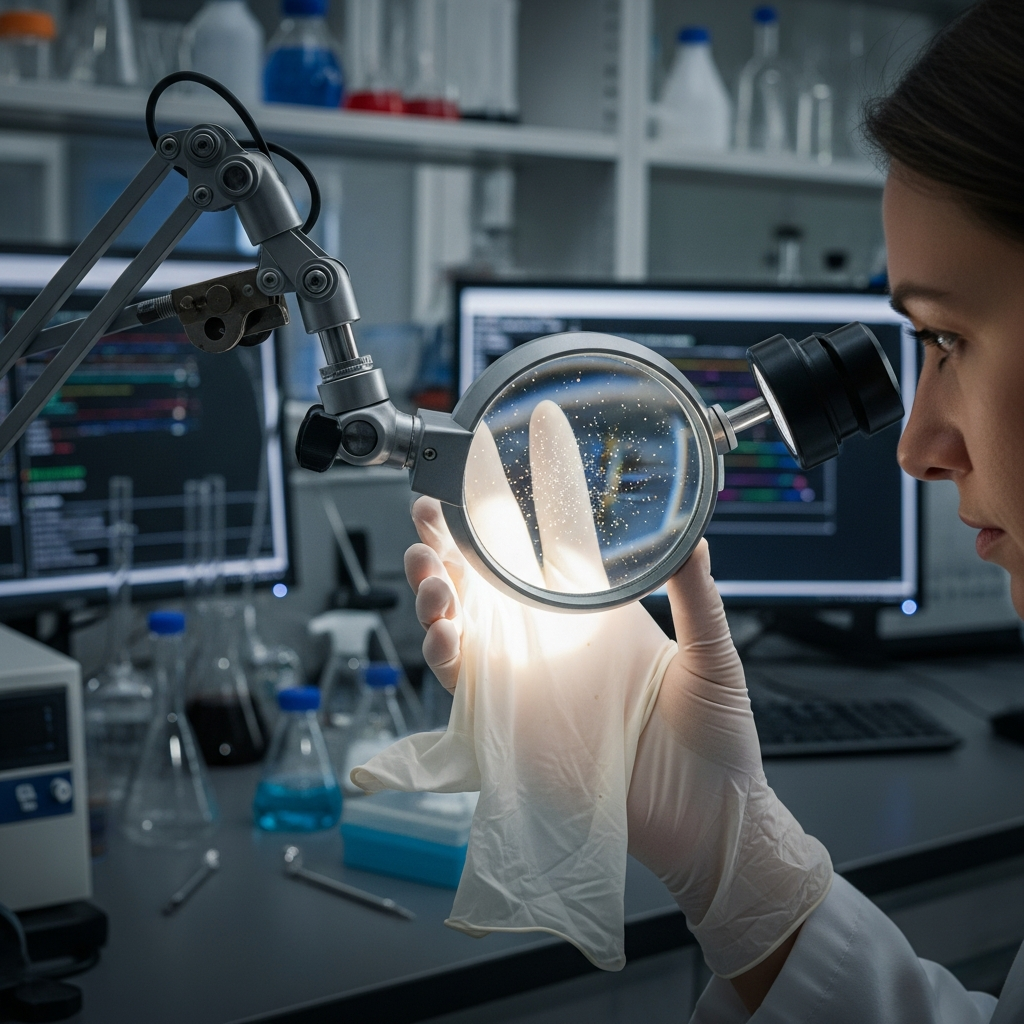
Microplastics are an invisible global threat, pervasive in our environments, food, and even within our bodies. They circulate in our rivers, contaminate our lungs, and have been detected in our bloodstreams. Yet, a startling discovery by scientists at the University of Michigan reveals a significant, overlooked source of microplastic pollution in the very labs tasked with tracking it: researchers’ own protective gloves. This hidden lab contamination suggests that years of accumulated data on environmental microplastics may be significantly inflated, demanding a critical re-evaluation of previous findings.
The Unseen Culprit: A Scientific Blind Spot
The unexpected revelation emerged from the University of Michigan, led by doctoral graduate in chemistry, Madeline Clough, and senior author Professor Anne McNeil. Clough embarked on a critical mission: to measure the atmospheric plastics that Michiganders inhale daily. She meticulously followed every strict protocol, using nonplastic clothing, avoiding plastic lab tools, and preparing samples in a specialized, filtered chamber. Despite these stringent measures, her instruments registered atmospheric plastic counts that were an astounding 1,000 times higher than any previous reports.
“It led to a wild goose chase of trying to figure out where this contamination could possibly have come from,” Clough recounted, knowing the numbers were impossibly high. Her team scrutinized every variable in their detailed process. The exhaustive search eventually pointed to the protective laboratory gloves – a ubiquitous item universally recommended as best practice in scientific communities worldwide.
Understanding Stearate Salts: The Impostor Particles
The root of this pervasive lab contamination lies with stearate salts. Manufacturers use these soap-like substances as “release agents” during the production of disposable latex and nitrile gloves. These salts prevent the gloves from sticking to their molds. Even a light, dry touch from a gloved hand can shed thousands of these minute particles onto lab equipment, filters, and samples.
Critically, these stearate particles are not plastic. However, they possess chemical and visual properties that make them incredibly difficult to distinguish from actual microplastics during standard analytical procedures. This striking structural resemblance, particularly to polyethylene—the most common plastic found in the wild—causes automated identification systems to mistakenly count them as environmental microplastics.
Mimicry and Misidentification: How False Positives Arise
Scientists typically employ vibrational spectroscopy to analyze microscopic fragments. This technique involves bouncing light off a particle and measuring its unique interaction, creating a chemical “fingerprint.” Because stearates and polyethylene share nearly identical structures, their light signatures overlap. This spectral mimicry consistently confuses automated detection systems, leading to countless false positives in environmental research.
The extent of this problem is significant. The University of Michigan team mimicked typical lab handling across seven different glove types. Their findings revealed an average of roughly 2,000 false positives per square millimeter, with some glove varieties shedding over 7,000 particles. This level of contamination is widespread across various microplastics research methods, confirming a pervasive potential for overestimation.
Adding to the complexity, most of these rogue stearate particles measure less than five micrometers. This specific size bracket is of intense focus for environmental scientists because such tiny particles can easily breach cellular barriers, posing greater risks to human and ecosystem health. This underscores why the accuracy of microplastic pollution measurements is so vital.
Beyond the Lab: The Broader Impact of Microplastic Pollution
While the discovery of lab contamination highlights data accuracy issues, it does not diminish the severity of the global microplastic pollution crisis. These tiny plastic fragments, defined as being up to 5 millimeters long, are truly inescapable. An estimated 10 to 40 million metric tons are released annually, a figure projected to double by 2040. Plastic never truly disappears; it simply breaks down into smaller and smaller pieces, eventually becoming nanoplastics (less than 1 micrometer) that are even more difficult to detect and study.
Microplastics in the Human Body: A Pervasive Threat
Public concern over microplastics’ health effects is escalating. Scientists estimate that adults may ingest the equivalent of one credit card’s worth of microplastics weekly. Dr. Desiree LaBeaud, a pediatric infectious diseases physician at Stanford Medicine, highlights that humans are now “born pre-polluted,” with microplastics detected in a newborn’s first stool, breastmilk, and placenta. These particles have been found in virtually every human organ and tissue tested, including the brain, heart, testicles, and lymph nodes.
Early research, primarily from animal and cellular studies, suggests alarming potential links to serious health issues. These include cancer, heart attacks, reproductive problems, inflammation, impaired immune systems, tissue deterioration, altered metabolic function, and abnormal organ development. A landmark study published in The New England Journal of Medicine (March 2024) directly examined human risk, finding that patients with microplastics in arterial plaque faced a significantly higher risk of heart attack, stroke, and death over two years. Children, with their developing organs, may be particularly vulnerable. Dr. Kara Meister, a pediatric otolaryngologist, found microplastics, including Teflon, deeply embedded in tonsil tissue removed from healthy children.
Challenges in Microplastic Research
The ubiquitous presence of plastics makes studying their direct health impacts incredibly challenging. Researchers face a lack of standardized methods for identifying and quantifying microplastics, especially nanoplastics. Furthermore, studies often struggle to account for the immense variety of real-world plastic particles and the more than 10,000 chemicals used in plastic production, two-thirds of which remain unassessed for safety. As the University of Michigan study painfully illustrates, lab contamination itself is a significant hurdle to obtaining accurate scientific accuracy.
Safeguarding Future Research: Solutions and Adaptations
The startling discovery by the University of Michigan team necessitates immediate adaptation across the scientific community. To mitigate future lab contamination, Madeline Clough and Anne McNeil now advise researchers to avoid standard stearate-coated gloves during sample handling whenever possible. When gloves are essential, particularly for handling harsh chemicals or biological materials, they strongly recommend switching to specialized cleanroom gloves. These alternatives are manufactured without stearate coatings and dramatically reduce contamination, leaving behind roughly only 100 false positives per square millimeter—a vast improvement.
Fortunately, researchers do not need to discard all their previous work. Collaborating with statistics experts, Clough and McNeil have engineered innovative analytical methods. These advanced techniques can differentiate the nuanced chemical fingerprints of true microplastics from glove residue. This offers a crucial lifeline for scientists, providing hope to recover and re-analyze impacted datasets to achieve a more accurate quantity of microplastics. While the University of Michigan team ultimately discarded their initial atmospheric data, this setback represents a vital step forward for environmental chemistry, ensuring future pollution metrics are as reliable and untainted as possible.
What Does This Mean for You? Practical Steps
This discovery underscores that achieving scientific accuracy in environmental research is a complex endeavor, but it also reinforces the undeniable reality of microplastic pollution. Even if some previous estimates were inflated, the problem remains severe. So, what can individuals do? While complete avoidance of microplastics is currently impossible, reducing exposure can significantly lower health risks.
Consider these actionable steps:
Avoid Nonstick and Plastic Cookware: Opt for alternatives like cast iron, stainless steel, or glass.
Choose Natural Fiber Clothing: Synthetic fabrics like polyester and nylon shed microfibers during washing.
Use Plastic-Free Toiletries: Many personal care products contain microbeads.
Select Foods in Glass Jars: Minimize exposure to plastics from food packaging.
Reduce Single-Use Plastics: Carry reusable bags, water bottles, and coffee cups.
Avoid Heating Plastic: Do not microwave food in plastic containers or wash plastic items in hot dishwashers, as heat can increase chemical leaching.
Beyond individual choices, broader systemic change is crucial. Experts like Dr. LaBeaud advocate for stronger policy action, including caps on plastic production, elimination of unnecessary single-use plastics, and a global treaty to end plastic pollution.
Frequently Asked Questions
What caused the microplastic lab contamination discovered by scientists?
The contamination was caused by stearate salts, a soap-like residue used by manufacturers to release disposable latex and nitrile gloves from their molds. These salts shed thousands of particles when touched, and critically, they produce a vibrational signature nearly identical to common plastics like polyethylene under lab lasers. This similarity misleads automated identification systems, causing researchers to mistakenly count these non-plastic particles as environmental microplastics.
How can scientists prevent future microplastic research contamination?
Scientists are advised to avoid standard stearate-coated gloves during sample handling whenever possible. When gloves are essential, specialized cleanroom gloves, which lack stearate coatings, are recommended. Additionally, the University of Michigan team has developed new analytical methods that can differentiate the chemical fingerprints of true microplastics from glove residue, offering a way to prevent future misidentification and potentially re-analyze existing datasets for greater scientific accuracy.
Should consumers be concerned about microplastics, and what can they do?
Yes, consumers should be concerned about microplastics. Despite the lab contamination discovery, microplastic pollution remains a severe global issue, with particles found throughout our environment and within the human body, linked to potential health risks like inflammation, heart issues, and cancer. Individuals can reduce their exposure by avoiding plastic cookware, choosing natural fiber clothing, opting for plastic-free toiletries and food packaging, and minimizing single-use plastics. Advocating for broader policy changes, such as caps on plastic production and a global pollution treaty, is also crucial.
The revelation of widespread lab contamination by gloves is a sobering reminder of the meticulous detail required for robust environmental research. While this discovery forces a critical re-evaluation of past microplastic pollution data, it ultimately strengthens the foundation of future science. By adopting new protocols and advanced analytical methods, scientists can move forward with greater scientific accuracy, ensuring that efforts to understand and combat plastic pollution are as precise and impactful as possible. This ongoing commitment to data integrity is essential for accurately addressing one of the most pressing environmental challenges of our time.